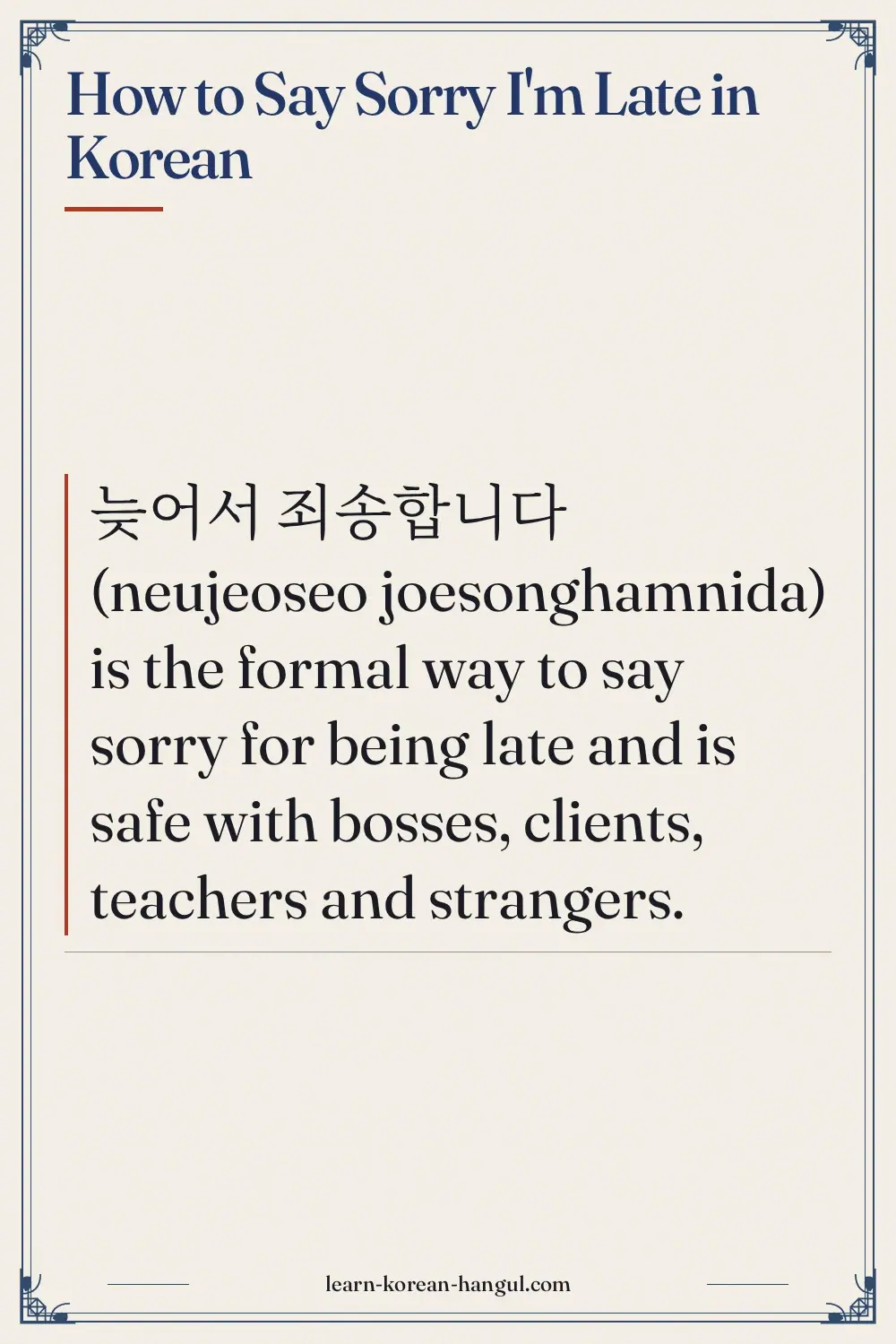
늦어서 죄송합니다
늦어서 죄송합니다
What you'll learn
- Say 늦어서 죄송합니다 aloud as [느저서 죄송함니다], with the sound changes in 늦어서 and 합니다.
- Choose between 늦어서 죄송합니다, 늦어서 미안해요 and 늦어서 미안해 for a senior, a colleague and a friend.
- Add a short reason such as 길이 막혀서 (because the road was jammed) so the apology sounds complete.
- Avoid the most common mistake: saying only 늦었어요, which states a fact and does not apologize.
Before you start: you need to read Hangul; romanization is shown as an aid and can be hidden. Time: about 9 minutes. Audio plays only when you press a button.
How Do You Say Sorry I'm Late in Korean?
The safest way to say sorry I'm late in Korean is 늦어서 죄송합니다. It names the problem (늦어서, "because I'm late") and apologizes in one formal phrase. Korean offers four common options, and the right one depends on who is waiting for you.
| Form | Romanization | Register | Say it to |
|---|---|---|---|
| 늦어서 죄송합니다 | neujeoseo joesonghamnida | Formal (합쇼체) | Bosses, clients, teachers, strangers |
| 늦어서 미안해요 | neujeoseo mianhaeyo | Polite (해요체) | Colleagues, acquaintances, people of similar age |
| 늦어서 미안해 | neujeoseo mianhae | Casual (반말) | Close friends, siblings, partners, younger people |
| 많이 기다렸죠? | mani gidaryeotjyo | Polite (해요체) question | Someone who has been waiting; often paired with an apology |
The table shows the choices. The next section puts each one in a sentence you can borrow.
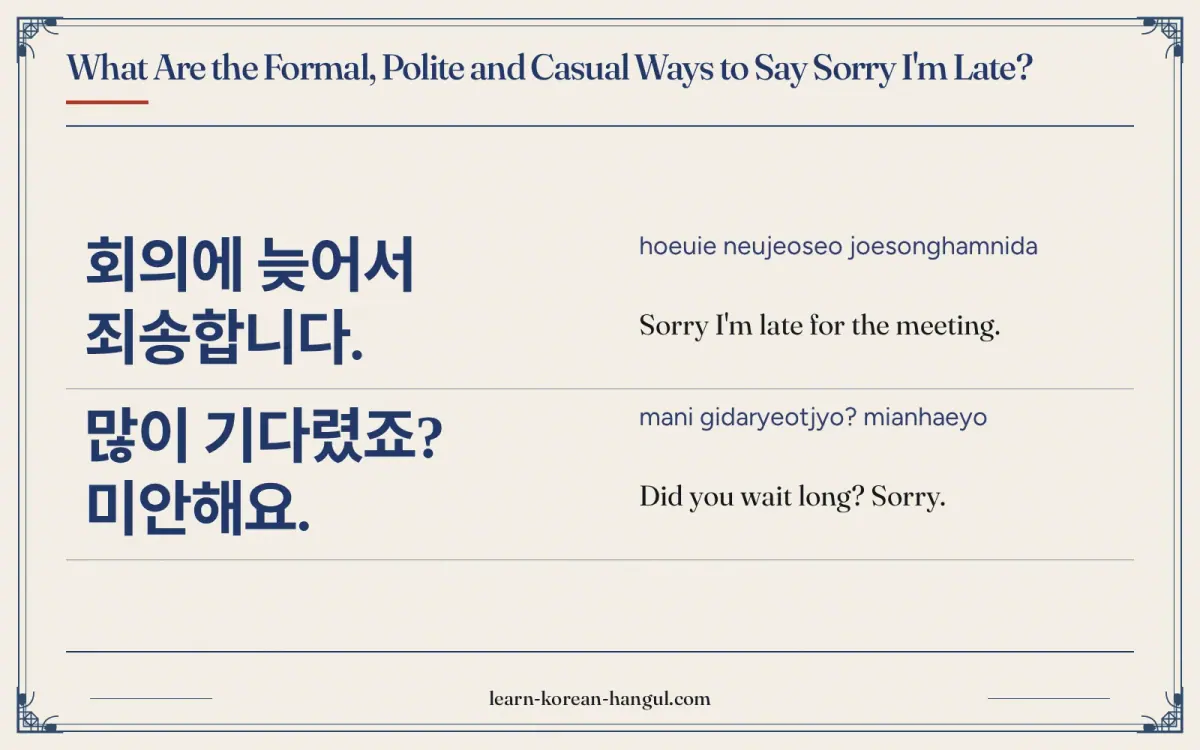
What Are the Formal, Polite and Casual Ways to Say Sorry I'm Late?
Korean changes the sentence ending to match the listener's age, status and closeness. These endings are called speech levels, and the guide to Korean speech levels explains them in full. The apology stays the same while the ending changes.
Formal: 늦어서 죄송합니다 (neujeoseo joesonghamnida)
Formal · 합쇼체늦어서 죄송합니다 uses the formal ending -ㅂ니다 and the humble word 죄송하다 (to be sorry). 죄송 is a Sino-Korean word that carries more humility than 미안, so it is the right choice when someone senior is waiting. Say it at the door of a meeting, at the start of a phone call or when you arrive at an interview.
회의에 늦어서 죄송합니다.
hoeuie neujeoseo joesonghamnida
Sorry I'm late for the meeting.
Polite: 늦어서 미안해요 (neujeoseo mianhaeyo)
Polite · 해요체늦어서 미안해요 puts 미안하다 (to be sorry) into the soft polite style (해요체). It suits colleagues you like, neighbours or a classmate's older sibling. It is friendly but less humble than 죄송합니다, so avoid it with someone clearly above you.
길이 막혀서 늦었어요. 미안해요.
giri makyeoseo neujeosseoyo. mianhaeyo
The road was jammed, so I'm late. Sorry.
Casual: 늦어서 미안해 (neujeoseo mianhae)
Casual · 반말늦어서 미안해 drops the polite -요. This is 반말 (casual speech), used with close friends, siblings, partners and younger people. Friends often add 진짜 (really) to show they mean it.
진짜 미안해. 지하철이 늦게 왔어.
jinjja mianhae. jihacheori neutge wasseo
I'm really sorry. The subway came late.
Polite Question: 많이 기다렸죠? (mani gidaryeotjyo)
Polite · 해요체많이 기다렸죠? means "Did you wait a long time?" It is not an apology by itself, but Koreans often say it right after arriving and follow it with 미안해요 or 죄송해요. The ending -죠 (a short form of -지요) invites the other person to agree. To a senior, use the honorific 기다리셨죠? (gidarisyeotjyo).
많이 기다렸죠? 미안해요.
mani gidaryeotjyo? mianhaeyo
Did you wait long? Sorry.
Each form carries the same apology at a different distance from the listener. Saying the main one cleanly is the next skill.
How Do You Pronounce 늦어서 죄송합니다?
늦어서 죄송합니다 is pronounced [느저서 죄송함니다], neujeoseo joesonghamnida, in eight syllables. Two spelling-to-sound changes matter: the ㅈ in 늦어서 moves to the next syllable, and the ㅂ in 합 sounds like ㅁ.
- 늦 (neu): said with the final ㅈ carried forward, so you hear [느] then [저].
- 어 (eo): joins the ㅈ, giving 저 (jeo).
- 서 (seo): a plain "suh" sound, soft and short.
- 죄 (joe): often heard as "jweh"; keep the lips rounded at first.
- 송 (song): ends with the nasal "ng".
- 합 (ham): written 합, said "hahm" with the lips closed.
- 니다 (ni-da): "nee-dah", with a soft d.
Sound Changes to Listen For
Two rules from the National Institute of Korean Language Standard Pronunciation (표준 발음법) shape the main phrase.
- Liaison in 늦어서. A final consonant before a vowel moves to the next syllable, so 늦어서 is [느저서], not [늗어서]. The pattern is explained in liaison (resyllabification).
- Nasalization in -ㅂ니다. ㅂ becomes ㅁ before ㄴ, so 죄송합니다 is [죄송함니다]. See ㅂ-to-ㅁ nasalization.
- Romanization matches the sound here. Revised Romanization writes neujeoseo and joesonghamnida, which already show both changes, so the romanized form is a reliable guide for this phrase.
With the sound set, the next question is who should hear it.
When Should You Use 늦어서 죄송합니다, and When Should You Not?
Use 늦어서 죄송합니다 whenever the person waiting deserves respect or you are not close. Choose 미안해요 or 미안해 only when the relationship is friendly enough.
Situations Where It Fits
- Arriving at a meeting or interview. Say it at the door, before you sit down.
- Calling ahead. 죄송합니다, 조금 늦을 것 같아요 means "I'm sorry, I think I'll be a little late."
- Meeting a teacher or an older relative. Add a short reason: 길이 막혀서 늦었습니다. 죄송합니다.
- A shop reservation or a taxi pickup. The formal form is expected with service staff.
Situations to Avoid
- A close friend waiting at a cafe. 늦어서 죄송합니다 sounds stiff or like a joke; use 늦어서 미안해.
- A boss with 미안해요. The word 미안 is less humble, so it can sound too casual.
- Only stating the fact. 늦었어요 (I'm late) without an apology can sound like an excuse.
These choices are easier to feel in real exchanges, so here are three.
What Does Sorry I'm Late Sound Like in a Real Conversation?
A Korean lateness exchange is short. The apology comes first, the reason second, and the other person usually waves it away.
Arriving Late to a Meeting
Jiho
회의에 늦어서 죄송합니다.
hoeuie neujeoseo joesonghamnida
Sorry I'm late for the meeting.
Manager
괜찮아요. 앉으세요.
gwaenchanayo. anjeuseyo
It's fine. Please sit.
What to notice: the manager answers 괜찮아요 (it's fine) and moves on. A short apology is enough.
Friends Meeting at a Cafe
Yuna
많이 기다렸지? 늦어서 미안해.
mani gidaryeotji? neujeoseo mianhae
Did you wait long? Sorry I'm late.
Min
아니야, 나도 방금 왔어.
aniya, nado banggeum wasseo
No, I just got here too.
What to notice: friends use -지? and 미안해, the casual forms. Min says 나도 방금 왔어 to make the apology easy.
Meeting an Acquaintance
Sora
늦어서 미안해요. 길이 막혀서요.
neujeoseo mianhaeyo. giri makyeoseoyo
Sorry I'm late. The road was jammed.
Daeho
괜찮아요. 저도 방금 왔어요.
gwaenchanayo. jeodo banggeum wasseoyo
It's fine. I just arrived too.
What to notice: Sora gives a reason with -서요. Giving a reason is a normal part of the apology, and it leads to the culture behind it.
What Should You Know about the Culture behind Sorry I'm Late?
Koreans usually expect a clear apology and a brief reason when you are late, especially for work and school. The words matter, but the timing and attitude count as well.
- Warn early. A message such as 조금 늦을 것 같아요 (I think I'll be a bit late) sent before the meeting is valued, and the apology still follows on arrival.
- Apologize first, explain second. Say 늦어서 죄송합니다, then give the reason: 지하철이 늦게 와서요 (the subway was late).
- Keep the reason short. A long story can sound like an excuse.
- Lateness at work. Being late to work or class is often called 지각 (jigak); a short, respectful apology is the norm.
An expert tip: learners often say 늦어요 or 느려요 interchangeably. They are different words. 늦다 means to be late in time, while 느리다 means to be slow in speed, so 느려서 죄송합니다 would mean "sorry for being slow". This page covers only everyday lateness. Formal business emails and written apologies use longer patterns that are not covered here.
What Mistakes Do Learners Make with Sorry I'm Late in Korean?
Most mistakes with this phrase come from the verb, the level or leaving out the apology.
| Mistake | Why it is a problem | Fix |
|---|---|---|
| Saying only 늦었어요 | States the fact without apologizing | Add 죄송합니다 or 미안해요 |
| Using 느려서 for "late" | 느리다 means slow, not late | Use 늦어서 |
| Saying 늦어서 미안해 to a boss | Casual ending, no respect | Use 늦어서 죄송합니다 |
| Pronouncing 늦어서 as [늗어서] | The ㅈ moves to the next syllable | Say [느저서] |
| Saying 죄송합니다 with no reason when very late | Feels thin for a long delay | Add 길이 막혀서 or 일이 늦게 끝나서 |
Learners often think the polite -요 form is always safe. For a boss or a client, 늦어서 죄송합니다 is safer than 늦어서 미안해요, because 죄송 signals humility and 미안 does not.
Is Sorry I'm Late the Same as Sorry for Being Late?
Mostly yes. The short answers below cover the other ways people search for this phrase.
- Sorry for being late in Korean: the same phrase, 늦어서 죄송합니다.
- Sorry for the delay in Korean: use 늦어져서 죄송합니다 (neujeojyeoseo joesonghamnida) for a delayed task or a late reply, such as 답장이 늦어서 죄송합니다 (sorry for the late reply).
- I'm late in Korean: 늦었어요 (neujeosseoyo) states the fact; add an apology if you owe one.
- Sorry for the wait in Korean: 기다리게 해서 죄송합니다 (gidarige haeseo joesonghamnida) means "sorry for making you wait", and it fits when someone waited at a counter or a phone line.
Reading the forms is one thing; producing them on cue is another, so practise now.
Practice: Say It Aloud
Play the slow clip of 늦어서 죄송합니다, repeat it three times, then try 늦어서 미안해요. Then choose a form for each situation. Answers follow.
- You arrive ten minutes late for a job interview.
- Your best friend has waited at the station.
- You are late meeting a coworker of your own age.
- Why is 늦어서 pronounced [느저서]?
Answers
- 늦어서 죄송합니다.
- 늦어서 미안해.
- 늦어서 미안해요.
- Because the final ㅈ of 늦 moves onto the vowel 어 (liaison).
The phrase flashcards drill all four forms with audio.
Related Phrases to Learn Next
Sorry I'm late sits in a family of apology phrases that learners need early.
- Sorry in Korean: 죄송합니다 and 미안해요 for general apologies.
- I'm very sorry in Korean: a stronger apology for bigger mistakes.
- Excuse me in Korean: 실례합니다 and 저기요 for getting attention or passing by.
This guide belongs to the polite Korean phrases collection. What this page does not cover: written apology letters and the full honorific system. Pick 늦어서 죄송합니다 when in doubt, and you can say sorry I'm late in Korean to anyone.
Frequently Asked Questions
What is the difference between 늦어서 죄송합니다 and 늦어서 미안해요?
Both mean sorry for being late. 늦어서 죄송합니다 is formal and humble, so use it with bosses, clients and strangers. 늦어서 미안해요 is polite and friendlier, and it fits colleagues and acquaintances. The word 죄송 shows more humility than 미안, so choose it whenever the listener outranks you.
Is 늦어서 죄송합니다 formal or casual?
It is formal. The ending -ㅂ니다 belongs to the formal speech level (합쇼체), the style used in business, service and speeches. For a casual version with friends, drop to 늦어서 미안해. If you are unsure, the formal form is almost never wrong.
Can I use 늦어서 죄송합니다 with friends, elders and strangers?
Yes for elders and strangers, where it is the best choice. With friends it sounds stiff, although people sometimes use it as a joke. Between friends say 늦어서 미안해. With elders, add a short reason such as 길이 막혀서 to sound sincere.
How do you write sorry I'm late in Hangul?
Write 늦어서 죄송합니다 in Hangul: 늦, 어, 서, then a space, then 죄, 송, 합, 니, 다. The first word is the verb 늦다 with the reason ending -어서. The second is 죄송하다 in its formal form. Both words are written with a space between them.
What is the most common mistake with sorry I'm late in Korean?
The most common mistake is saying only 늦었어요, which tells people you are late but does not apologize. Add 죄송합니다 or 미안해요. The second mistake is using 느려서 for late; 느리다 means slow, while 늦다 means late. A short reason such as 길이 막혀서 makes the apology complete.