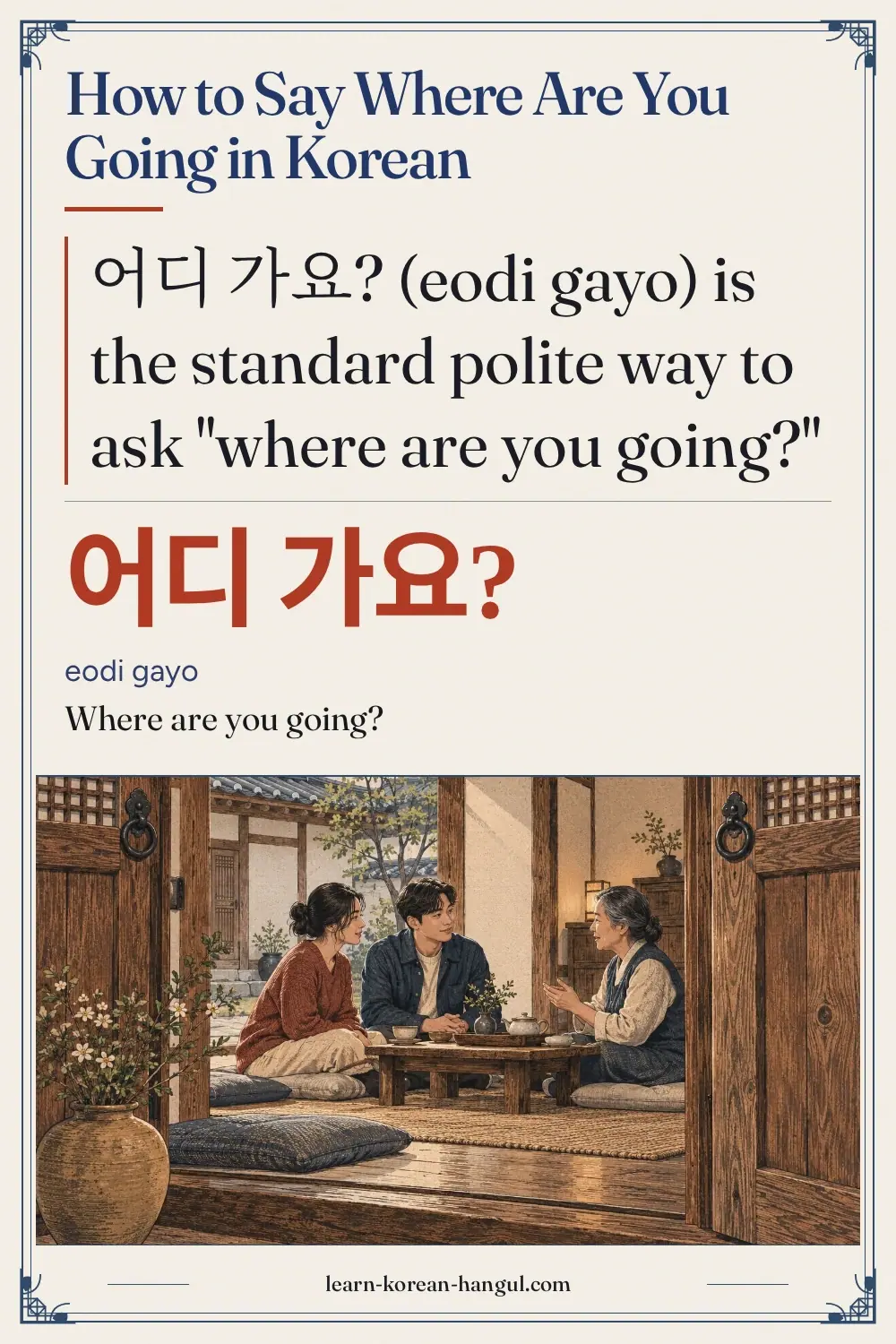
어디 가요?
어디 가요?
What you'll learn
- Say 어디 가요? aloud with the stress on 어디, and hear how a sharp final rise changes it to "going somewhere?"
- Choose between 어디 가요?, 어디 가세요? and 어디 가? for a coworker, an elder and a friend.
- Give short answers such as 회사 가요 and 잠깐 나가요.
- Tell 어디 가요? (where are you going) from 어디예요? (where is it).
Before you start: you need to read Hangul; romanization is shown as an aid and can be hidden. Time: about 10 minutes. Audio plays only when you press a button.
How Do You Say Where Are You Going in Korean?
The most natural way to ask "where are you going?" is 어디 가요? (eodi gayo). It joins 어디 (where) with 가요, the polite form of 가다 (to go). Four forms cover the question, from friends to formal service.
| Form | Romanization | Meaning | Register | Say it to |
|---|---|---|---|---|
| 어디 가요? | eodi gayo | where are you going? | Polite (해요체) | Peers, coworkers, acquaintances |
| 어디 가세요? | eodi gaseyo | where are you going? | Polite, honorific | Elders, neighbours, customers |
| 어디 가? | eodi ga | where are you going? | Casual (반말) | Close friends, younger people |
| 어디 가십니까? | eodi gasimnikka | where are you going? | Formal (합쇼체) | Formal service, scripts |
The table lists the forms. The next section shows each one in a sentence.
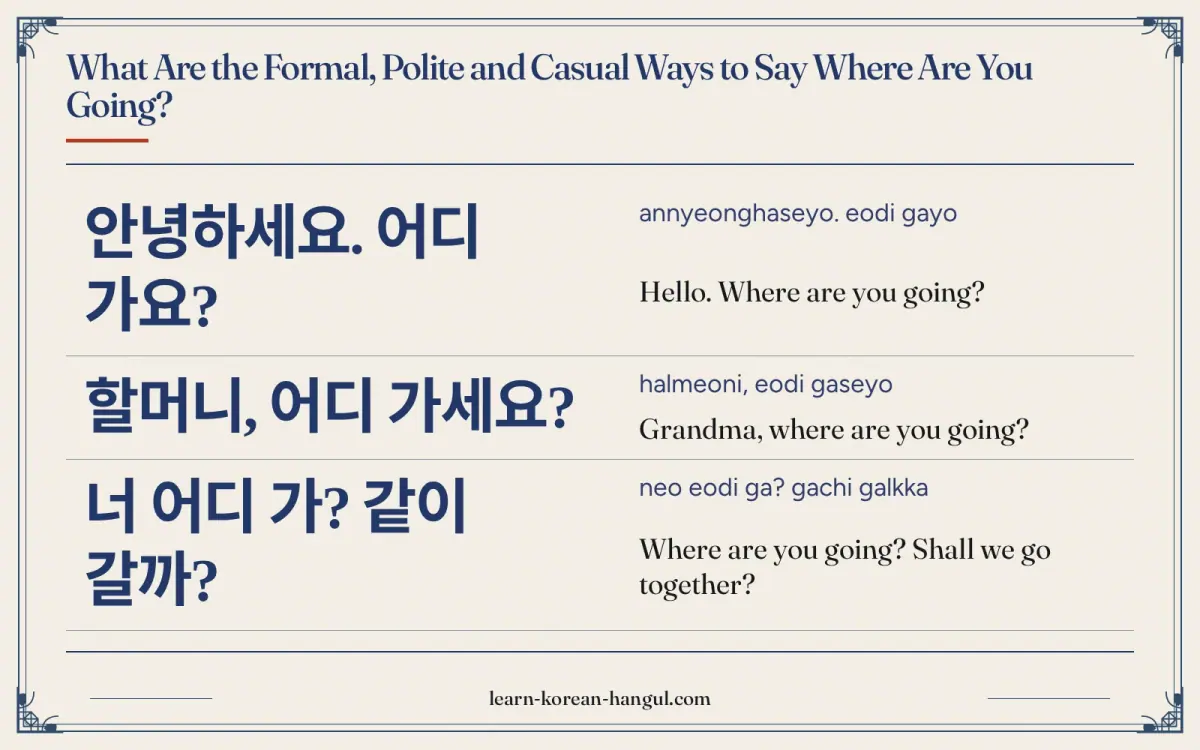
What Are the Formal, Polite and Casual Ways to Say Where Are You Going?
Korean changes the ending of a sentence to match the listener's age, status and closeness. These endings are called speech levels, and the guide to Korean speech levels explains them in full. This question also adds the honorific -시- when you ask about an elder's movement.
Polite: 어디 가요? (eodi gayo)
Polite · 해요체어디 가요? is the everyday polite question. It drops the particle 에 or 로, which Koreans do constantly in speech. Coworkers, classmates and people you have just met all hear it without offence, and it opens a short friendly exchange.
안녕하세요. 어디 가요?
annyeonghaseyo. eodi gayo
Hello. Where are you going?
Polite: 어디 가세요? (eodi gaseyo)
Polite · 해요체어디 가세요? adds the honorific -세요, which shows respect to the person doing the action, here the listener. It fits a grandparent, a neighbour, a teacher or any person clearly older than you. The verb 가다 becomes 가세요. The honorific shows respect, so it is the safer choice when you are unsure.
할머니, 어디 가세요?
halmeoni, eodi gaseyo
Grandma, where are you going?
Casual: 어디 가? (eodi ga)
Casual · 반말어디 가? drops the polite ending 요. It is 반말 (casual speech) for close friends, siblings and younger people. Friends often follow it with an offer: 같이 갈까? (shall we go together?).
너 어디 가? 같이 갈까?
neo eodi ga? gachi galkka
Where are you going? Shall we go together?
Formal: 어디 가십니까? (eodi gasimnikka)
Formal · 합쇼체어디 가십니까? uses the formal honorific ending -십니까, the 합쇼체 style of service and announcements. You will meet it in formal service talk, scripts and textbooks; taxi drivers more often say 어디로 가세요? or 어디로 모실까요?. It is never used between friends.
손님, 어디 가십니까?
sonnim, eodi gasimnikka
Sir, where are you headed?
Four forms and four sentences are enough to ask. How they sound comes next.
How Do You Pronounce 어디 가요?
어디 가요? is pronounced [어디 가요], in four syllables across two words. Say it as one smooth phrase, put the stress on 어디, and let the end fall, or rise and then fall.
- 어 (eo): an open "uh," with the mouth relaxed.
- 디 (di): "dee."
- 가 (ga): "gah," with a soft g.
- 요 (yo): "yoh." A sharp rise here turns 어디 into "somewhere": 어디 가요? ↗ means "Are you going somewhere?", a yes/no question that neighbours also use as a greeting.
Sound Changes to Listen For
The polite and honorific forms have no required sound change. Three points matter.
- Nasalization in 가십니까. Before ㄴ, the ㅂ of 십 becomes [ㅁ], so 어디 가십니까 is [어디 가심니까]. See nasalization.
- Fast casual speech. 어디 가? is often said as one phrase, almost [어디가].
- Tensification in answers. The answer 학교 가요 is pronounced [학꾜 가요], because the ㄱ at the end of 학 makes the ㄱ of 교 tense. See Korean tensification.
With the sounds set, the next question is who you can ask.
When Should You Use 어디 가요?, and When Should You Not?
Ask 어디 가요? of people you know, 어디 가세요? of people older than you, and 어디 가? of friends. Ask only when you already have some contact with the person.
Situations Where It Fits
- A neighbour in the elevator. 어디 가세요? is a polite greeting.
- A colleague leaving at lunchtime. 어디 가요? opens a lunch plan.
- A friend putting on shoes. 어디 가? is quick and natural.
- Formal service. 어디 가십니까? is the formal version you may hear from staff.
Situations to Avoid
- 어디 가? to an elder or teacher. The casual ending is too familiar.
- 어디 가요? to a stranger on the street. It sounds nosy, because it assumes closeness.
- Asking where a place is. For locations, use 어디예요?, as in 화장실이 어디예요? (where is the restroom?).
These rules are easier to feel in real exchanges, so here are three.
What Does Where Are You Going Sound Like in a Real Conversation?
A "where are you going" exchange is short. The asker uses the polite or casual form, and the answer names a place or an errand in a few words.
Neighbours in the Elevator
Neighbour
어디 가세요?
eodi gaseyo
Where are you going?
Resident
회사 가요.
hoesa gayo
I'm going to work.
Neighbour
조심히 다녀오세요.
josimhi danyeooseyo
Take care, and have a safe trip.
What to notice: the answer is two words. 다녀오세요 (danyeooseyo) means "go and come back," a standard farewell to someone leaving the building.
Colleagues at Noon
Hana
어디 가요?
eodi gayo
Where are you going?
Taeho
점심 먹으러 가요. 같이 가요?
jeomsim meogeureo gayo. gachi gayo
Going to have lunch. Want to come along?
What to notice: -으러 가요 means "go in order to," and the answer ends with an invitation. 같이 is pronounced [가치].
Friends
Yuna
어디 가?
eodi ga
Where are you going?
Min
편의점. 뭐 필요해?
pyeonuijeom. mwo piryohae
The convenience store. Need anything?
What to notice: Min answers with one word, which is normal in casual speech. The next section explains why this question is so common.
What Should You Know about the Culture behind Where Are You Going?
In Korean daily life, 어디 가요? or 어디 가세요? is often a greeting. Neighbours, shopkeepers and acquaintances ask it when they meet you on the way, in the same spirit as "how are you?" in English. A short answer is enough, and details are optional.
- A short answer is polite. 회사 가요 (to work), 잠깐 나가요 (stepping out for a moment), 집에 가요 (heading home), 점심 먹으러 가요 (going to lunch).
- Details are optional. Saying 잠깐 나가요 closes the topic politely.
- A close reply returns the question. Friends answer and ask back.
- The question may be an offer. 어디 가요? sometimes means "can I join you?"
An expert tip: Korean chooses between 가다 (go) and 오다 (come) from the speaker's point of view, where English often takes the listener's. When you are heading to the listener's place, you say 지금 갈게요 (jigeum galgeyo), "I'll go now," where English says "I'm coming." The verb 오다 (come) is for movement toward the speaker. This page covers the spoken question. The grammar of -(으)러 가다 and motion verbs is covered in grammar lessons.
What Mistakes Do Learners Make with Where Are You Going in Korean?
Most mistakes with this question come from honorifics, scope and verb choice.
| Mistake | Why it is a problem | Fix |
|---|---|---|
| Saying 어디 가? to an elder | The casual ending is too familiar | Say 어디 가세요? |
| Answering with a long story | The question is a greeting | Say 회사 가요 |
| Asking 어디 가요? for a location | It asks about movement, not place | Ask 어디예요? |
| Saying 와요 for "I'm coming" | Korean uses 가다 toward the listener | Say 지금 갈게요 |
| Ending with a sharp rise | 어디 가요? ↗ means "Are you going somewhere?" | Stress 어디 and let the end fall |
Learners often think 어디 가요? means "where do you go" as a general habit. It can, but the context usually shows it is about now. For a habit, add 보통 (usually): 보통 어디 가요? asks where you usually go.
How Do You Say Where Are U Going or Where to in Korean?
The text spellings have the same answer, 어디 가요? or 어디 가?, and "where to?" adds 로: 어디로 가요?. The short answers below cover each search.
- Where are u going in Korean: this text spelling means the same as "where are you going." Use 어디 가요? or 어디 가?
- Where to in Korean: ask 어디로 가요? (eodiro gayo), which stresses the direction. Taxi drivers often ask 어디로 모실까요? (eodiro mosilkkayo), "where shall I take you?"
- Where going in Korean: this short form is 어디 가요? or 어디 가?
- How far are you going in Korean: 어디까지 가세요? (eodikkaji gaseyo) asks the end point of a bus or taxi trip.
Knowing the forms is one thing; saying them on cue is another, so practise now.
Practice: Say It Aloud
Play the slow clip of 어디 가요?, repeat it three times, then answer it with 회사 가요. Then choose a form for each situation. Answers follow.
- You meet an elderly neighbour at the door.
- A close friend is putting on his coat.
- A colleague leaves at noon.
- How do you say "I'll go now" to someone waiting for you?
Answers
- 어디 가세요?
- 어디 가?
- 어디 가요?
- 지금 갈게요.
The phrase flashcards drill all four lines with audio.
Related Phrases to Learn Next
Asking where someone is going sits with the other small talk phrases.
- Korean small talk: the collection that lists every phrase in this cluster.
- What are you doing in Korean: the natural next question.
- Let's go in Korean: the phrase you will often hear in the same conversation.
- Have a safe trip in Korean: the farewell that often answers 어디 가요?.
What this page does not cover: directions to places, taxi destinations and full motion-verb grammar. Pick 어디 가세요? when in doubt, and you can ask where are you going in Korean to almost anyone you know.
Frequently Asked Questions
How do you say where are you going in Korean?
Say 어디 가요? (eodi gayo) in the polite style. 어디 means "where" and 가요 means "go." To an elder, say 어디 가세요? (eodi gaseyo). To a close friend, say 어디 가? (eodi ga). Formal service speech uses 어디 가십니까?. All four ask about the listener's destination.
How do you pronounce 어디 가요?
Say [어디 가요]: "eo-di ga-yo," as one smooth phrase. 어 is an open "uh," 디 is "dee," 가 is "ga," and 요 is "yo." Stress 어디; a sharp final rise changes the meaning to "going somewhere?" In fast casual speech, 어디 가 is said as one phrase, almost [어디가].
What is the difference between 어디 가요? and 어디 가세요?
Both ask "where are you going?" 어디 가요? is plain polite and fits peers and coworkers. 어디 가세요? adds the honorific -세요 and fits elders, neighbours and customers. The second shows more respect, so choose it when the listener is clearly older or when you are unsure.
Is 어디 가요? formal or casual?
It is polite but not formal. It uses the 해요체 ending, the everyday polite style. The casual form is 어디 가?, and the formal form is 어디 가십니까?. Most daily conversations with colleagues, shop staff and new friends use the polite 어디 가요?, which is the safe default.
Can I use 어디 가요? with friends, elders and strangers?
Use 어디 가요? with peers and coworkers, and 어디 가세요? with elders and neighbours. With close friends, 어디 가? is natural. The question is a friendly greeting between people who know each other, so skip it with strangers unless a situation, such as a taxi, makes it practical.
What is the most common mistake with where are you going in Korean?
The most common mistake is giving a long, exact answer, because the question works as a greeting. A short reply like 회사 가요 is enough. The second mistake is using 어디 가요 to ask where something is. For locations, ask 어디예요? or 어디에 있어요?