How Do You Say I'm Sorry to Hear That in Korean?
The standard polite way to say I'm sorry to hear that in Korean is 안타깝네요 (antakkamneyo). The phrase has two parts: 안타깝다 (antakkapda, "to feel pity or regret") and the ending 네요 (-neyo), which shows that you have just noticed or learned something. Together they mean "what a pity."
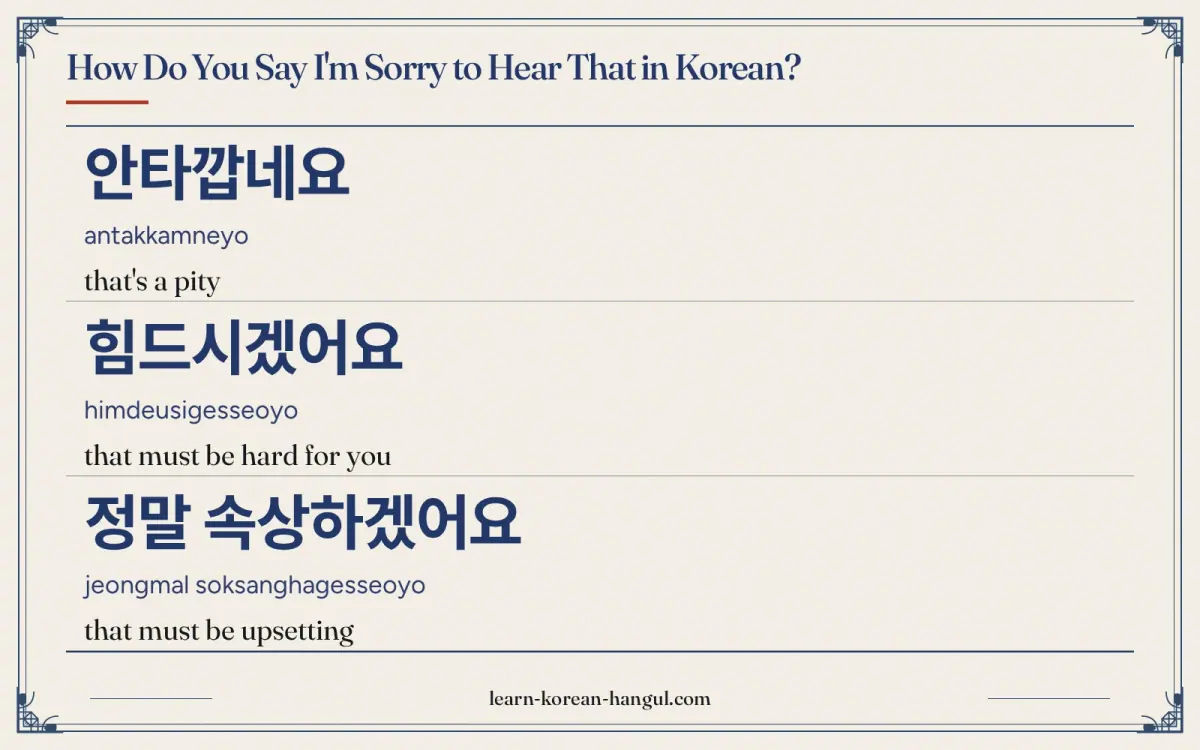
Six forms cover most situations.
| Korean | Revised Romanization | Meaning | Register |
|---|---|---|---|
| 안타깝네요 | antakkamneyo | that's a pity | polite (해요체) |
| 힘드시겠어요 | himdeusigesseoyo | that must be hard for you | polite, respectful |
| 정말 속상하겠어요 | jeongmal soksanghagesseoyo | that must be upsetting | polite (해요체) |
| 힘내세요 | himnaeseyo | stay strong | polite (해요체) |
| 안타깝습니다 | antakkapseumnida | that is regrettable | formal (합쇼체) |
| 힘들겠다 | himdeulgetda | that must be hard | casual (반말) |
Revised Romanization (the South Korean government standard of 2000) is a reading aid only. The Hangul is the real spelling. The next section sorts the forms by listener.
What Are the Polite, Formal and Casual Ways to Show Sympathy?
Four forms are polite, one is formal and one is casual. Korean speech levels explain the endings: 요 is polite, ㅂ니다 is formal, and a bare ending is casual. Each form also expresses a slightly different feeling, so choose by feeling as well as by listener.
Polite: 안타깝네요 (antakkamneyo)
안타깝네요 means "that's a pity" and expresses regret about someone else's bad news. It is the general-purpose reply to a colleague, a neighbour or an acquaintance, and it never sounds like an apology.
Example: 아, 그 얘기를 들으니 안타깝네요. (a, geu yaegireul deureuni antakkamneyo.) "Oh, hearing that makes me sad for you."
Polite and Respectful: 힘드시겠어요 (himdeusigesseoyo)
힘드시겠어요 means "that must be hard for you." The ending -겠- guesses what the other person feels, and the honorific marker -(으)시- raises the listener. Use it with an elder, a boss, a teacher or a customer.
Example: 야근이 많으시군요. 힘드시겠어요. (yageuni maneusigunyo. himdeusigesseoyo.) "You have a lot of overtime. That must be hard for you."
Polite: 정말 속상하겠어요 (jeongmal soksanghagesseoyo)
정말 속상하겠어요 means "that must be really upsetting." The adjective 속상하다 (soksanghada) describes a heart that is hurt by a loss or a disappointment. Use it with a friend, a coworker your age or a classmate, because it has no honorific.
Example: 휴대폰을 잃어버렸어요? 정말 속상하겠어요. (hyudaeponeul ireobeoryeosseoyo? jeongmal soksanghagesseoyo.) "You lost your phone? That must be really upsetting."
Polite: 힘내세요 (himnaeseyo)
힘내세요 means "stay strong" or "cheer up." The phrase literally says "put out strength." Say it after you have shown sympathy, as the second step. Use it with anyone who is struggling, and add it to an expression of regret, not instead of one.
Example: 힘내세요. 다 잘될 거예요. (himnaeseyo. da jaldoel geoyeyo.) "Stay strong. Everything will work out."
Formal: 안타깝습니다 (antakkapseumnida)
안타깝습니다 means "that is regrettable" in the formal style. Use it in a speech, a business letter or a news report. A related formal word is 유감입니다 (yugamimnida, "I regret it"), which sounds official and distant.
Example: 소식을 듣고 안타깝습니다. (sosigeul deutgo antakkapseumnida.) "I am sorry to hear the news."
Casual: 힘들겠다 (himdeulgetda)
힘들겠다 means "that must be hard" and drops the polite ending, so it fits a close friend or a sibling. The reaction word 어떡해 (eotteokae, "oh no, what will you do?") often comes first.
Example: 어떡해! 힘들겠다. (eotteokae! himdeulgetda.) "Oh no! That must be hard."
Choosing a Form by Listener
The table gives one clear choice per listener.
| Listener | Best choice | Why |
|---|---|---|
| Colleague, neighbour, acquaintance | 안타깝네요 | polite regret |
| Elder, boss, teacher | 힘드시겠어요 | honorific empathy |
| Friend or classmate your age | 정말 속상하겠어요 | warm and direct |
| After sympathy, to encourage | 힘내세요 | encouragement |
| Speech, letter, news | 안타깝습니다 | formal |
| Close friend, sibling | 힘들겠다 | casual |
Once the form is chosen, the next step is how it sounds.
How Do You Pronounce 안타깝네요?
안타깝네요 is pronounced [안타깜네요], roughly "an-ta-kkam-ne-yo," with five syllables. Play the slow clip, then the normal clip, and repeat each one aloud.
| Word | Spelled | Spoken | Revised Romanization |
|---|---|---|---|
| 안타깝네요 | 안-타-깝-네-요 | [안타깜네요] | antakkamneyo |
| 속상하겠어요 | 속-상-하-겠-어-요 | [속쌍하게써요] | soksanghagesseoyo |
| 힘드시겠어요 | 힘-드-시-겠-어-요 | [힘드시게써요] | himdeusigesseoyo |
What Sound Changes Happen in 안타깝네요?
Three sound details matter. They follow the Standard Pronunciation Rules (표준 발음법) of the National Institute of Korean Language (국립국어원).
- 안타깝네요 becomes [안타깜네요]. The final ㅂ of 깝 sounds like ㅁ before the ㄴ of 네, so Revised Romanization writes antakkamneyo.
- 속상하겠어요 becomes [속쌍하게써요]. After the final ㄱ of 속, the ㅅ of 상 turns tense. The page on Korean tensification explains this change.
- 겠어요 becomes [게써요]. The double ㅆ moves to the next syllable with the vowel.
The doubled ㄲ in 깝 is a tense consonant already, so say it with tension and no puff of air. With the sounds clear, the next question is when to use the phrase.
When Should You Use 안타깝네요, and When Should You Not?
Use 안타깝네요 when a colleague or acquaintance shares bad news, because it expresses regret without taking blame. Use 힘드시겠어요 with an elder or a superior, and add 힘내세요 afterward to encourage them. The order matters: first show you understand, then encourage.
Situations Where 안타깝네요 Fits
- A colleague misses a flight or fails a test. Say 안타깝네요, then ask 괜찮으세요? (gwaenchaneuseyo, "are you all right?").
- A neighbour mentions an illness. Say 안타깝네요 and 힘드시겠어요.
- A friend loses something. Say 정말 속상하겠어요.
Situations to Avoid with 안타깝네요
- Using 죄송해요 or 미안해요. These sound like you caused the problem. Fix: use 안타깝네요.
- Using 힘드시겠어요 with a close friend. The honorific sounds too stiff. Fix: use 힘들겠다.
- Using it for a death. Fixed condolence phrases exist, covered in the guide to sorry for your loss in Korean.
The dialogues below show the forms in context.
What Does I'm Sorry to Hear That Sound Like in a Real Conversation?
Read each dialogue, play the clip, and say one role aloud.
Dialogue 1: A colleague misses a flight
- A: 어제 비행기를 놓쳤어요. (eoje bihaenggireul nochyeosseoyo.) "I missed my flight yesterday."
- B: 아, 정말 안타깝네요. 괜찮으세요? (a, jeongmal antakkamneyo. gwaenchaneuseyo?) "Oh, I'm so sorry to hear that. Are you all right?"
- A: 네, 다음 비행기로 갔어요. (ne, daeum bihaenggiro gasseoyo.) "Yes, I took the next flight."
어제 비행기를 놓쳤어요. 아, 정말 안타깝네요. 괜찮으세요? 네, 다음 비행기로 갔어요.
Dialogue 2: A neighbour with back pain
- A: 요즘 허리가 아파서 잘 못 걸어요. (yojeum heoriga apaseo jal mot georeoyo.) "My back hurts these days, so I can't walk well."
- B: 아이고, 안타깝네요. 많이 힘드시겠어요. (aigo, antakkamneyo. mani himdeusigesseoyo.) "Oh dear, I'm sorry to hear that. That must be very hard for you."
- A: 걱정해 줘서 고마워요. (geokjeonghae jwoseo gomawoyo.) "Thank you for worrying about me."
요즘 허리가 아파서 잘 못 걸어요. 아이고, 안타깝네요. 많이 힘드시겠어요. 걱정해 줘서 고마워요.
Dialogue 3: Two friends
- A: 나 시험에 떨어졌어. (na siheome tteoreojyeosseo.) "I failed the exam."
- B: 어떡해! 정말 속상하겠다. 힘내. (eotteokae! jeongmal soksanghagetda. himnae.) "Oh no! That must be so upsetting. Cheer up."
- A: 고마워. (gomawo.) "Thanks."
나 시험에 떨어졌어. 어떡해! 정말 속상하겠다. 힘내. 고마워.
In Dialogue 2, the speaker names the other person's difficulty instead of apologizing, which is the key idea of the next section.
What Should You Know about the Culture behind I'm Sorry to Hear That?
Koreans express sympathy by acknowledging the other person's difficulty, not by apologizing. The phrases above all say "that is a pity" or "that must be hard for you." They place the feeling on the listener's situation. 죄송합니다 (joesonghamnida) is an apology for your own fault, so using it for sympathy sounds like you caused the problem.
For a death, Korean uses fixed condolence wording such as 삼가 고인의 명복을 빕니다 (samga goinui myeongbogeul bimnida, "I respectfully pray for the repose of the deceased"), which belongs to a separate page. Everyday sympathy stays lighter and shorter. With the custom clear, the common mistakes are easy to spot.
What Mistakes Do Learners Make with I'm Sorry to Hear That in Korean?
The most common mistake is saying 죄송해요 or 미안해요 for sympathy. Five mistakes appear again and again:
- Using 죄송해요 for sympathy. It means "I apologize." Fix: say 안타깝네요.
- Using 힘드시겠어요 with a friend. It is too stiff. Fix: say 힘들겠다.
- Giving only 힘내세요. Cheering up without regret can sound dismissive. Fix: add 안타깝네요 first.
- Missing the nasal sound. Saying "an-ta-kkap-ne-yo" sounds foreign. Fix: say [안타깜네요].
- Dropping 요 with elders. 힘들겠다 is casual. Fix: add 요 or switch to 힘드시겠어요.
These slips come from carrying English habits into Korean, where "sorry" covers both apology and sympathy. A few related searches ask the same thing in other words, so they are answered next.
Is It the Same as Sorry to Hear, That's Too Bad or My Sympathies?
Not exactly, because Korean uses separate phrases for each feeling. Three searches lead to this page, so each gets a short answer.
- Sorry to hear in Korean: 안타깝네요 is the closest match.
- That's too bad in Korean: 안됐네요 (andwaenneyo, "poor thing") or 안타깝네요.
- My sympathies in Korean: 유감이에요 (yugamieyo, "I regret it") or the fixed condolence wording for a death.
After the answers, the next pages continue the conversation.
Related Phrases to Learn Next
Three phrases help you comfort someone:
- Sorry for your loss in Korean: the fixed condolence wording for a death.
- Cheer up in Korean: more ways to encourage a person who is struggling.
- Don't worry in Korean: the reassurance that often follows sympathy.
The complete list sits in the polite Korean phrases collection.
Practice: Say It Aloud
Spend five minutes on this routine.
- Play the slow clip of 안타깝네요 and repeat it three times.
- Say it again with the nasal sound: [안타깜네요], not "an-ta-kkap-ne-yo."
- Say 안타깝네요 first and 힘내세요 second, as one two-step reply.
- Hide the Romanization with the toggle and read the six forms from Hangul only.
- Drill the cluster with the phrase flashcards.
When the two-step reply comes out smoothly, you can say I'm sorry to hear that in Korean without sounding like an apology.
Frequently Asked Questions
The answers below add details about how to say I'm sorry to hear that in Korean beyond the sections above.
How do you say I'm sorry to hear that in Korean?
The standard polite reply is 안타깝네요 (antakkamneyo), meaning "that's a pity." To show you feel the person's difficulty, say 힘드시겠어요 (himdeusigesseoyo) to an elder or 정말 속상하겠어요 to a peer. Add 힘내세요 afterward to encourage them. Do not use 죄송해요, which is an apology.
How do you pronounce 안타깝네요?
Say it as [안타깜네요], roughly an-ta-kkam-ne-yo. The final ㅂ of 깝 sounds like ㅁ before the ㄴ of 네, and the ㄲ is a tense consonant, so say it with tension and no puff of air. The Revised Romanization is antakkamneyo. Play the slow clip first, then repeat at normal speed.
What is the difference between 안타깝네요 and 힘드시겠어요?
안타깝네요 expresses regret about the situation: "what a pity." 힘드시겠어요 guesses at the other person's feeling: "that must be hard for you," with the honorific -(으)시-. Use the first for general news and the second for an elder, a boss or a customer who is going through something.
Can I use 안타깝네요 with friends, elders and strangers?
Yes. 안타깝네요 is polite and works with colleagues, neighbours, elders and strangers. With a close friend, 정말 속상하겠다 or 어떡해 sounds more natural. With an elder, pair it with 힘드시겠어요. For a death, use the fixed condolence wording, not this phrase alone.
What is the most common mistake with I'm sorry to hear that in Korean?
Learners say 죄송해요 or 미안해요, which means "I apologize" and sounds as if the speaker caused the problem. Say 안타깝네요 instead. A second frequent slip is using 힘드시겠어요 with a close friend, where it sounds too stiff, and 힘들겠다 is better.
Is 힘내세요 the same as I'm sorry to hear that?
No. 힘내세요 means "stay strong" and encourages the person, but it does not express regret by itself. Say 안타깝네요 first to show sympathy, then 힘내세요 to encourage. The order matters, because cheering up without acknowledging the problem can sound dismissive.