오랜만이에요
오랜만이에요
What you'll learn
- Choose the formal, polite, casual and respectful forms of long time no see.
- Pronounce 오랜만이에요 as [오랜마니에요].
- Spell 오랜만 correctly and explain how 오랜만에 differs.
- Follow the greeting with 잘 지냈어요? so it sounds complete.
Before you start: knowing hello in Korean helps, because 오랜만이에요 usually follows 안녕하세요. Time: about 10 minutes. Audio plays only when you press a button.
How Do You Say Long Time No See in Korean?
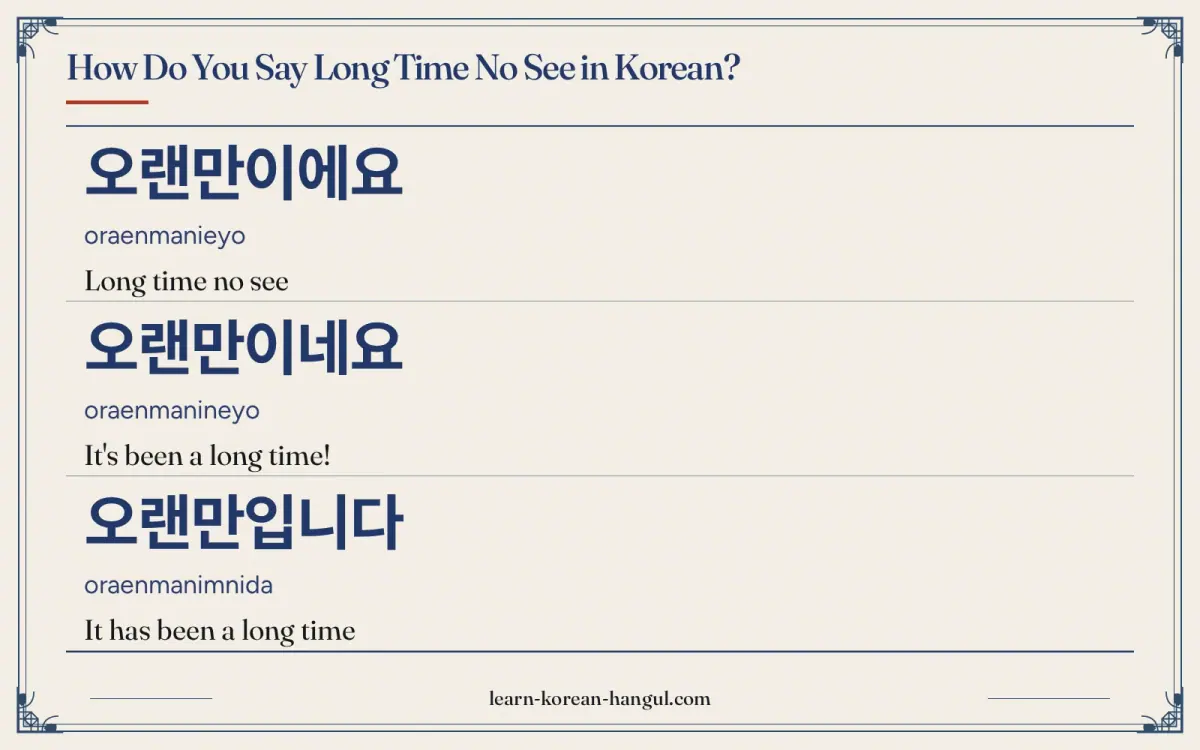
The standard way to say long time no see in Korean is 오랜만이에요, which literally means "it has been a long time". It is polite, friendly and suitable for coworkers, acquaintances, neighbours and friends you speak to politely.
| Form | Korean | Romanization | Meaning | Best for |
|---|---|---|---|---|
| Polite | 오랜만이에요 | oraenmanieyo | Long time no see | Most people |
| Polite, warm | 오랜만이네요 | oraenmanineyo | It's been a long time! | A pleasant surprise |
| Formal | 오랜만입니다 | oraenmanimnida | It has been a long time | Seniors, work |
| Respectful | 오랜만에 뵙겠습니다 | oraenmane boepgetseumnida | It's been a while, nice to see you | Teachers, clients |
| Casual | 오랜만이야 | oraenmaniya | Long time no see | Friends |
The word 오랜만 comes from the older, longer 오래간만, and both are correct. The sections below show each form in a sentence.
What Are the Formal, Polite and Casual Ways to Say Long Time No See?
Korean changes the sentence ending to match the listener, a system called speech levels. The guide to Korean speech levels explains them in depth, and this page uses three: formal (합쇼체), polite (해요체) and casual (해체).
Formal: 오랜만입니다 (oraenmanimnida)
Formal · 합쇼체오랜만입니다 is the formal form for teachers, bosses and older relatives. It sounds a little stiff, but it is exactly right when you meet a respected person after years.
선생님, 오랜만입니다.
seonsaengnim, oraenmanimnida
Teacher, it has been a long time.
Respectful: 오랜만에 뵙겠습니다 (oraenmane boepgetseumnida)
Formal · 합쇼체오랜만에 뵙겠습니다 means "I am seeing you after a long time" and uses the humble verb 뵙다 for seeing a senior. It is common at the start of a formal meeting, a visit or a message to a professor or client.
교수님, 오랜만에 뵙겠습니다.
gyosunim, oraenmane boepgetseumnida
Professor, it's been a while, nice to see you.
Polite: 오랜만이에요 (oraenmanieyo)
Polite · 해요체오랜만이에요 is the everyday polite form. After it, ask the follow-up 잘 지냈어요? to ask how the person has been since you last met.
오랜만이에요. 잘 지냈어요?
oraenmanieyo. jal jinaesseoyo?
Long time no see. Have you been well?
Polite, Warm: 오랜만이네요 (oraenmanineyo)
Polite · 해요체The ending -네요 shows that you have just noticed or realised something. 정말 오랜만이네요 sounds pleasantly surprised: "it's really been a long time!" Use it at a chance meeting.
정말 오랜만이네요.
jeongmal oraenmanineyo
It's really been a long time.
Casual: 오랜만이야 (oraenmaniya)
Casual · 반말With friends, switch 이에요 to 이야: 오랜만이야 means "long time no see". Add 잘 지냈어? to ask how the friend has been. Never use it with a teacher, a boss or an older stranger.
오랜만이야. 잘 지냈어?
oraenmaniya. jal jinaesseo?
Long time no see. Have you been well?
The polite 오랜만이에요 is the safe choice in most situations. Now the sounds.
How Do You Pronounce 오랜만이에요?
오랜만이에요 is pronounced [오랜마니에요], in five syllables, with the ㄴ of 만 linking to the next syllable. Say it slowly in five beats.
- 오 (o): a short "oh".
- 랜 (raen): the Korean ㄹ between vowels is a quick tap, like the "tt" in "butter", then "ehn".
- 마 (ma): "mah".
- 니 (ni): "nee".
- 에요 (eyo): "eh-yo".
Sound Changes to Listen For
Two linking points explain the sound.
- Liaison (연음). The final ㄴ of 만 moves onto the empty ㅇ of 이, so 만이에요 is said ma-ni-e-yo. See Korean liaison.
- Linking in 지냈어요. In the follow-up 잘 지냈어요, the final ㅆ, which is already a tense consonant, moves onto the next syllable: [잘 지내써요]. These follow the National Institute of Korean Language Standard Pronunciation rules (표준 발음법).
The formal 오랜만입니다 is said [오랜마님니다], with the same linking and with ㅂ turning into ㅁ before ㄴ.
With the sound clear, the next question is when each form is right.
When Should You Use 오랜만이에요, and When Should You Not?
Use 오랜만이에요 when you meet someone after months or years. Add 잘 지냈어요? to turn it into a full greeting, and match the ending to the listener. Do not use it for someone you saw recently.
Situations Where It Fits
- Meeting a former classmate or colleague. 오랜만이에요. 잘 지냈어요?
- Visiting a former teacher. 선생님, 오랜만입니다.
- A friend you have not seen for a year. 오랜만이야!
- Calling a relative after a long gap. 할머니, 오랜만이에요.
Situations to Avoid
- Someone you met last week. It would sound odd.
- A boss or professor with 오랜만이야. Too casual.
- A first meeting. Use 처음 뵙겠습니다 or 만나서 반갑습니다, as in nice to meet you in Korean.
Real exchanges show how the greeting sounds.
What Does Long Time No See Sound Like in a Real Conversation?
The greeting usually comes first, and the follow-up question comes second.
Meeting a Former Teacher
Teacher
민수 씨, 오랜만이에요. 잘 지냈어요?
minsu ssi, oraenmanieyo. jal jinaesseoyo?
Minsu, long time no see. Have you been well?
Minsu
네, 선생님. 오랜만입니다. 잘 지내셨어요?
ne, seonsaengnim. oraenmanimnida. jal jinaesyeosseoyo?
Yes, teacher. It has been a long time. Have you been well?
What to notice: the teacher uses the polite form and the student uses the formal 오랜만입니다. 지내셨어요 adds the honorific -시- to ask about the teacher's wellbeing.
Friends after Years
Minsu
야, 오랜만이야! 잘 지냈어?
ya, oraenmaniya! jal jinaesseo?
Hey, long time no see! Have you been well?
Jia
응, 보고 싶었어.
eung, bogo sipeosseo
Yeah, I missed you.
What to notice: 보고 싶었어 (I missed you) is the warm reply between friends. A close relative of this phrase is i miss you in Korean.
A Chance Meeting at a Wedding
Minsu
어, 지아 씨! 정말 오랜만이네요.
eo, jia ssi! jeongmal oraenmanineyo
Oh, Jia! It's really been a long time.
Jia
안녕하세요! 정말 오랜만이에요. 그동안 어떻게 지냈어요?
annyeonghaseyo! jeongmal oraenmanieyo. geudongan eotteoke jinaesseoyo?
Hello! It's really been a long time. How have you been all this time?
What to notice: 그동안 어떻게 지냈어요? (how have you been during this time?) is the natural way to open a catch-up. The next common question is covered in how are you in Korean. These habits reflect Korean greeting manners.
What Should You Know about the Culture behind Long Time No See?
In Korean, the first words in a reunion are usually the greeting, not a question. Saying 오랜만이에요 shows that you remember the person and the relationship.
- Greeting first. Say 오랜만이에요 or 오랜만입니다 before you ask anything. Skipping it with a former teacher or colleague can feel cold.
- Then the catch-up. 잘 지냈어요? and 그동안 어떻게 지냈어요? invite a short update.
- Small bow or handshake. For a teacher or elder, a slight bow often goes with the words.
- Warmth for friends. Friends often add 보고 싶었어 (I missed you) or 얼굴 보니까 좋다 (it's good to see your face).
An expert insight: learners often answer 오랜만이에요 with a long story. In Korean, a short reply and a return question are the norm, such as 네, 잘 지냈어요. 선생님은요? (Yes, I've been well. And you, teacher?). The table below shows other common mistakes.
What Mistakes Do Learners Make with Long Time No See in Korean?
Most mistakes come from the spelling and from the choice of ending.
| Mistake | Why it is a problem | Fix |
|---|---|---|
| 오랫만이에요 | A spelling error | Write 오랜만이에요 |
| 오랜만이야 to a teacher | Casual speech is rude | Say 오랜만입니다 |
| 오랜만이에요 after a short gap | It means a long gap | Say 안녕하세요 |
| Reading it as "o-raen-man-i-e-yo" | The linking is missing | Say [오랜마니에요] |
| Only 오랜만이에요 with no follow-up | Feels abrupt | Add 잘 지냈어요? |
Learners often assume 오랜만 and 오랜만에 are the same. Actually, 오랜만 is a noun used in 오랜만이에요, and 오랜만에 is an adverb meaning "after a long time", as in 오랜만에 친구를 만났어요.
Is It the Same as Long Time No See Formal or Casual?
Mostly yes. Each English search points to one form on this page. The short answers below cover the other searches folded into this page.
- Long time no see formal in Korean: 오랜만입니다 or 오랜만에 뵙겠습니다.
- Long time no see casual in Korean: 오랜만이야.
- It's been a while in Korean: 오랜만이에요, or 만난 지 오래됐네요 (it's been long since we met).
- Long time no see, warm: 정말 오랜만이네요.
The pattern holds across all of them: formal 입니다, polite 이에요, casual 이야. Now practise.
Practice: Say It Aloud
Play the slow clip of 오랜만이에요 three times, then say it as [오랜마니에요]. Choose a phrase for each situation. Answers follow.
- You meet your old professor in the street.
- A friend your age shows up at a reunion.
- You meet a former coworker by chance and feel surprised.
- You want to ask the former coworker how they have been.
Answers
- 교수님, 오랜만에 뵙겠습니다. (or 오랜만입니다)
- 오랜만이야!
- 정말 오랜만이네요.
- 그동안 어떻게 지냈어요?
The phrase flashcards drill these with audio.
Related Phrases to Learn Next
Long time no see leads straight into questions about the other person, so these are the natural next phrases.
- How are you in Korean: 잘 지내세요? and its replies.
- Nice to meet you in Korean: the first-meeting counterpart.
- Hello in Korean: 안녕하세요 and its casual partner.
This guide belongs to the Korean greetings collection. What this page does not cover: the full honorific system and written reunion messages, which have their own lessons. Match the ending to the listener, add 잘 지냈어요? and you can say long time no see in Korean to anyone you have missed.
Frequently Asked Questions
What does 오랜만 mean on its own?
오랜만 means after a long time, or a long time since the last time. It is a noun. 오랜만이에요 literally says it is a long time. Add 에 to make the adverb 오랜만에, as in 오랜만에 친구를 만났어요 (I met my friend after a long time). Both come from the older full form 오래간만.
Is it 오랜만 or 오랫만?
The correct spelling is 오랜만. The form 오랫만 is a common spelling mistake, probably influenced by 오랫동안 ("for a long time"), which does contain ㅅ. 오랜만 is a contraction of 오래간만, so its ㄴ comes from 간. In writing, always use 오랜만. The longer 오래간만 is also correct and sounds slightly more careful.
What do I say when I have not seen someone for years?
Say 정말 오랜만이에요 (it's really been a long time) or 정말 오랜만이네요, then ask 그동안 어떻게 지냈어요? (how have you been all this time?). The ending -네요 adds a friendly surprise at the meeting. If you missed the person, add 보고 싶었어요 (I missed you).
Can I reply to 오랜만이에요 with the same phrase?
Yes. A natural reply is 네, 정말 오랜만이에요 (yes, it's really been a while), followed by 잘 지내셨어요? (have you been well?) or 잘 지냈어요? to someone your age. Many people also reply 반가워요 (nice to see you). The reply should match the level of the first speaker.
How do I say it has been a while since we met?
Say 만난 지 오래됐네요 (it's been a long time since we met). 지 after the -(으)ㄴ form of a verb means since, and 오래됐네요 means it has been long. This sentence is a little more explicit than 오랜만이에요 and suits a message. For a spoken greeting, 오랜만이에요 is shorter and more common.