
막내
막내
What you'll learn
- Write and say 막내, 막내야 and 막내 라인.
- Explain why 막내 is read [망내] and why fans spell it "maknae".
- Use 막내예요 (polite) and 막내입니다 (formal) to talk about yourself.
- Avoid using 막내 as a nickname for people outside the group.
Before you start: knowing the basics of Korean speech levels helps, because the endings change with the listener. Time: about 10 minutes. Audio plays only when you press a button.
How Do You Say Maknae in Korean?
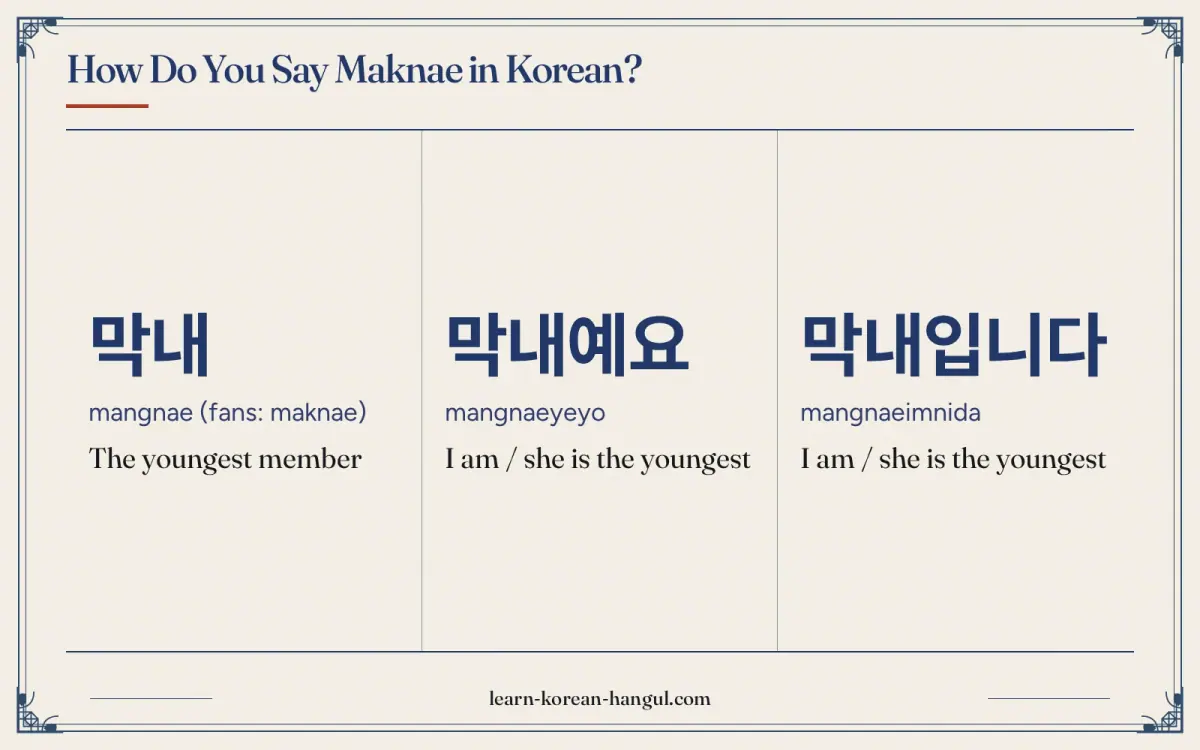
Write it 막내. The spelling has two syllables: 막 (mak) and 내 (nae). The English spelling "maknae" follows the Hangul letter by letter, which is why fans use it. The government's Revised Romanization system (2000) follows the sound instead, so it writes mangnae. Both point to the same Korean word, so when you search for maknae meaning, you are looking for 막내.
| Korean | Romanization | Meaning | Style |
|---|---|---|---|
| 막내 | mangnae (fans: maknae) | The youngest member | Neutral noun |
| 막내예요 | mangnaeyeyo | I am / she is the youngest | Polite |
| 막내입니다 | mangnaeimnida | I am / she is the youngest | Formal |
| 막내야 | mangnaeya | Hey, youngest | Casual |
| 막내 라인 | mangnae rain | The youngest members line | Casual, fan talk |
Learn the Hangul first and treat the romanization as a reading aid. The next section looks at each form and who can use it.
What Are the Casual Ways to Say Maknae?
Because 막내 is a noun, the word itself does not change with politeness. What changes is the ending that you attach to it. These three uses cover most real conversations.
Everyday: 막내 (mangnae)
Polite · 해요체On its own, 막내 names the role. In a polite sentence, add 예요: 막내예요 means "I am the youngest" or "she is the youngest". At a formal event, 막내입니다 is the version to use. The same word works in families, schools, offices and fan groups.
우리 팀 막내예요.
uri tim mangnaeyeyo
She is the youngest on our team.
Casual: 막내야 (mangnaeya)
Casual · 반말The ending -야 after a vowel is a calling particle. It turns a name or a role into a direct address, like "Hey, youngest!" An older sibling, a friend or a senior in a group can call the youngest 막내야. The younger person does not call a senior 막내야, and the form is never used for someone older.
막내야, 이리 와.
mangnaeya, iri wa
Youngest, come here.
Casual: 막내 라인 (mangnae rain)
Casual · 반말Fans use 라인 (rain, from the English word "line") for a group of members. 막내 라인 means the youngest members as a set. In a fan chat it is a friendly way to talk about them together. Outside fandom, most people will understand it, but it is slangy.
우리 집 막내가 제일 귀여워요.
uri jip mangnaega jeil gwiyeowoyo
The youngest in our family is the cutest.
The forms are simple, but the pronunciation hides a change that surprises learners. That is next.
How Do You Pronounce 막내?
막내 is pronounced [망내]: mang-nae. The spelling shows ㄱ at the end of the first syllable, but the sound is the nasal ng, like the end of "sing". Two syllables, two beats.
- 막 → [망]: start with "ma" and finish with the back-of-the-tongue "ng", as in "song".
- 내 → nae: a plain ㄴ and the vowel ㅐ, which most Seoul speakers pronounce like ㅔ, close to "neh".
Sound Changes to Listen For
Korean has a rule called nasalization (비음화). A final stop sound (ㄱ, ㄷ or ㅂ) turns into its nose-sound partner (ㅇ, ㄴ or ㅁ) when a nasal consonant (ㄴ or ㅁ) follows. Here ㄱ meets ㄴ, so ㄱ becomes ㅇ. The full rule is on the page about Korean nasalization.
| Spelling | Sound | Why |
|---|---|---|
| 막내 | [망내] | ㄱ + ㄴ → ㅇ + ㄴ |
| 막내야 | [망내야] | the same change, plus 야 |
| 막내 라인 | [망내 라인] | the change is inside 막내, and 라인 is a separate word |
This is also why "maknae" and "mangnae" both exist. The first copies the spelling, and the second copies the sound. Say [망내], and Korean listeners will hear the right word. With the sound settled, the next question is who can use the word and when.
When Should You Use 막내, and When Should You Not?
Use 막내 for the youngest person in a defined group. Do not use it as a nickname for someone who is simply younger than you.
Situations Where It Fits
- Talking about a K-pop group. "Who is the maknae?" means "who is the youngest member?" Fans use the word when they discuss member roles.
- Talking about your family. 막내 is the youngest child. You can say 우리 집 막내 (the youngest of our family).
- Describing your own place at work. On a team, the newest and youngest person is often called the 막내, and may be asked to run small errands.
- Calling a younger group member. 막내야 is friendly from a sibling, a senior or a friend in the same group.
Situations to Avoid
- A stranger who looks young. The role needs a group, and without one the word sounds rude.
- Anyone older or senior than you. Calling a senior 막내야 is a serious breach of manners.
- Formal writing. Use "the youngest member" (가장 어린 구성원) or the person's name.
- Making fun of someone. In an office, calling a colleague 막내 in front of others can sound belittling if the person is not comfortable with it.
Two short dialogues show the word in its natural setting.
What Does Maknae Sound Like in a Real Conversation?
The first dialogue is a fan asking about a group. The second is a friend starting a new job.
Which One Is the Maknae?
Fan
저 그룹 막내가 누구예요?
jeo geurup mangnaega nuguyeyo
Who is the youngest in that group?
Friend
맨 왼쪽 친구가 막내예요.
maen oenjjok chinguga mangnaeyeyo
The one on the far left is the youngest.
What to notice: the question 누구예요 ("who is it?") is a wh-question, so it does not need a rising tone. The answer uses 막내예요, the polite form from earlier.
A New Office Job
Min-Seo
나 이번에 회사 막내가 됐어.
na ibeone hoesa mangnaega dwaesseo
I became the youngest at the company this time.
Jun-Ho
축하해, 이제 심부름 많이 하겠다.
chukahae, ije simbureum mani hagetda
Congratulations, you'll be running a lot of errands now.
What to notice: 됐어 is the casual past of 되다 ("to become"). In an office, the youngest often takes on small tasks, which is why Jun-ho jokes about it. The role carries expectations, and that is part of the culture behind the word.
What Should You Know about the Culture behind Maknae?
Age order matters in Korean groups, and 막내 is one of the clearest age-order words.
- Roles in a group. In a K-pop group, fans talk about members by role, and the maknae is the youngest one. Fans often discuss the maknae as the one older members look after.
- Terms for the others. Older members are addressed with words such as hyung in Korean, oppa in Korean and unnie in Korean, and the maknae uses them upward.
- Family and office use. 막내 is part of ordinary family talk too, as you can see on the page of Korean family members. In companies, the youngest or newest staff member may be called 막내 informally.
- A role, not an insult. Within a close group, the word is affectionate. The same word shouted at a stranger is not.
An expert insight: because many Korean relationships begin with "how old are you?", a word like 막내 gives a compact way to place someone in the order of a group. This is why it appears so often in fan talk. The next section lists the mistakes that follow from it.
What Mistakes Do Learners Make with Maknae in Korean?
Most mistakes come from the spelling or from treating the role as a nickname.
| Mistake | Why it is a problem | Fix |
|---|---|---|
| Saying [막내] with a hard k | The spoken form is [망내] | Use the ng sound before ㄴ |
| Writing "mangnae" when fans write "maknae" | Both are used, for different audiences | Use "maknae" in K-pop talk, "mangnae" in standard romanization |
| Calling a younger stranger 막내 | The word needs a group | Use the name or 저기요 |
| Saying 막내야 to a senior | The calling form is only for equals or juniors | Use the title or 님 |
| Using 막내 as "baby" in general | It means the youngest in a group, not any baby | Use 아기 for a baby |
Learners often assume that 막내 means "child". It does not: it means the youngest of several. A family with one child has no 막내. Ordinary questions about the word follow.
Is It the Same as Maknae Meaning?
Yes. Searches such as "maknae meaning", "what does maknae mean in Korean" and "youngest in Korean" all lead to 막내. Short answers:
- Maknae meaning: the youngest member of a group.
- What does maknae mean in Korean: 막내 (mangnae), the youngest member, whether in a band, a family or a team.
- Youngest in Korean: 막내 for the youngest member, and 가장 어린 (gajang eorin) when you only describe age.
- Oldest in Korean: for the opposite role, see the family page above, which lists the sibling words.
Now practise the word and its forms.
Practice: Say It Aloud
Play the slow clip and repeat 막내 three times, making sure the ending of the first syllable is ng. Then choose the best word for each situation. Answers follow.
- You say "I am the youngest" politely.
- You call your younger sibling in a casual way.
- You say the sound of 막내 aloud.
- You talk about the youngest members of a group as a set.
Answers
- 막내예요.
- 막내야.
- [망내].
- 막내 라인.
The phrase flashcards drill fan phrases and group words with audio.
Related Phrases to Learn Next
Maknae connects to the other words for people in a group.
- Oppa in Korean: how a woman addresses an older brother or an older male friend.
- Unnie in Korean: how a woman addresses an older sister or an older female friend.
- Hyung in Korean: how a man addresses an older brother or an older male friend.
This guide belongs to the kpop Korean phrases collection. What this page does not cover: the names of real group members and their positions, or the full list of fandom slang. Say [망내] for 막내 and use it for the youngest of a group, and you can say maknae in Korean the way fans and families do.
Frequently Asked Questions
How do you say maknae in Korean?
Write it 막내, which fans romanize as maknae and the Revised Romanization system writes as mangnae. It means the youngest member of a group, such as a K-pop group, a family or a work team. To say "I am the youngest" politely, use 막내예요.
How do you pronounce 막내?
Say it as [망내], mang-nae. The ㄱ at the end of 막 turns into the nasal ng sound because ㄴ follows it, a rule called nasalization. The second syllable is nae, with a plain ㄴ and a vowel close to "neh". Play the slow clip and repeat after it.
What is the difference between 막내 and 막내야?
막내 is the noun for the youngest member. 막내야 is the same word used as a direct address, like "hey, youngest". It is casual, so it fits an older sibling, a friend or a senior speaking to the youngest member. It does not suit a stranger or a senior.
Can I use 막내 with friends, elders and strangers?
With friends in a group, 막내 and 막내야 are natural. To describe yourself to others, use 막내예요 or 막내입니다. Do not use it for elders, or for strangers who simply look young. The word names a role in a group, and without a group it can sound rude.
What is the most common mistake with maknae in Korean?
The most common mistake is reading the word as [막내] with a hard k sound, when the standard sound is [망내]. The second is using 막내 as a general nickname for a younger person. Remember that it means the youngest of a defined group.