제 짐이 없어졌어요
제 짐이 없어졌어요
What you'll learn
- Say 제 짐이 없어졌어요, 짐을 찾을 수 없어요 and 짐이 아직 안 나왔어요, and know which fits when.
- Report a missing bag politely to airline staff and ask for help.
- Pronounce 없어졌어요 as [업써저써요] without stumbling over the final cluster.
- Avoid the common error of saying 짐이 없어요, which means something different.
Before you start: the phrases below use the polite style, so a quick look at Korean speech levels helps. Time: about 10 minutes. Audio plays only when you press a button.
How Do You Say My Luggage Is Lost in Korean?
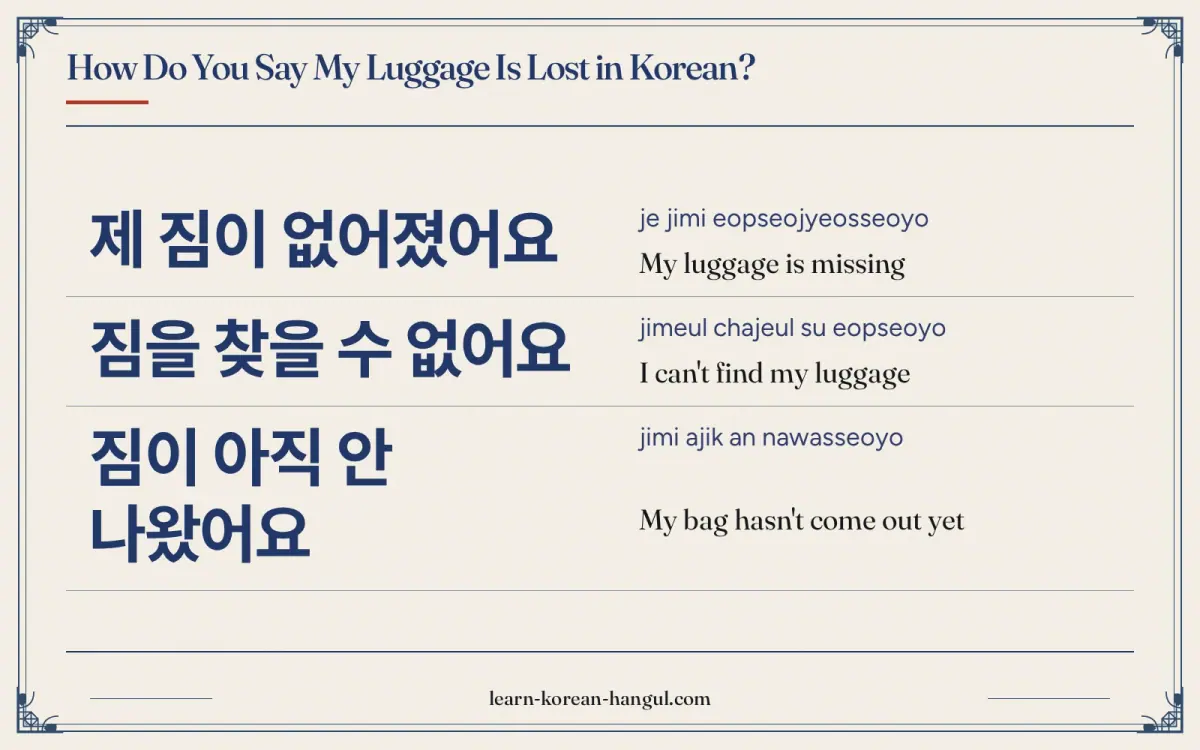
The best all-purpose sentence is 제 짐이 없어졌어요. It has four parts: 제 (je, "my"), 짐 (jim, "luggage, load") with the subject marker 이, and 없어졌어요 (eopseojyeosseoyo, "has gone missing"). The verb 없어지다 means "to become absent", so it describes something that has vanished, without saying whose fault it is.
| Korean | Romanization | Meaning | Style |
|---|---|---|---|
| 제 짐이 없어졌어요 | je jimi eopseojyeosseoyo | My luggage is missing | Polite |
| 짐을 찾을 수 없어요 | jimeul chajeul su eopseoyo | I can't find my luggage | Polite |
| 짐이 아직 안 나왔어요 | jimi ajik an nawasseoyo | My bag hasn't come out yet | Polite |
| 제 짐이 없어졌습니다 | je jimi eopseojyeotseumnida | My luggage is missing | Formal |
Revised Romanization (the South Korean government standard of 2000) is only a reading aid. Learn the Hangul first. The next section sorts the phrases by situation.
What Are the Polite Ways to Say My Luggage Is Lost?
At an airport, the polite style with -요 is right for almost everyone. The three phrases below differ by what you know about your bag.
Polite: 제 짐이 없어졌어요 (je jimi eopseojyeosseoyo)
Polite · 해요체Use this when you have waited, checked the belt and still cannot find the bag. It tells staff the bag is gone. Begin with 저기요 ("excuse me") to get attention, and then say the sentence.
저기요, 제 짐이 없어졌어요.
jeogiyo, je jimi eopseojyeosseoyo
Excuse me, my luggage is missing.
For a written claim form or an official statement, the formal version is 제 짐이 없어졌습니다.
Formal · 합쇼체Polite: 짐을 찾을 수 없어요 (jimeul chajeul su eopseoyo)
Polite · 해요체This one means "I cannot find my luggage". The pattern -(으)ㄹ 수 없다 expresses "cannot". It stresses your search and is a good opening for a request: add 도와주세요 ("please help me").
짐을 찾을 수 없어요. 도와주세요.
jimeul chajeul su eopseoyo. dowajuseyo
I cannot find my luggage. Please help me.
Polite: 짐이 아직 안 나왔어요 (jimi ajik an nawasseoyo)
Polite · 해요체아직 means "yet" and 안 나왔어요 means "has not come out". This is the right sentence while you are still at the belt and the bag may only be late. It does not claim the bag is lost, so it is the more accurate choice in the first minutes.
짐이 아직 안 나왔어요. 확인해 주세요.
jimi ajik an nawasseoyo. hwaginhae juseyo
My bag has not come out yet. Please check.
All three phrases are easy to understand, but the first one has a tricky ending. Let us look at the sound.
How Do You Pronounce 제 짐이 없어졌어요?
제 짐이 없어졌어요 is pronounced [제 지미 업써저써요]. It has eight syllables: 제, 짐, 이, 없, 어, 졌, 어 and 요. Say it in two chunks, "je jimi" and "eopseojyeosseoyo".
- 제 짐이 → [제 지미]: the ㅁ of 짐 moves to the next syllable, because 이 starts with a vowel.
- 없어 → [업써]: the final cluster ㅄ splits. The ㅂ stays, and the ㅅ moves forward as a tense ㅆ.
- 졌어요 → [저써요]: the ㅈ + ㅕ is pronounced like 저 in standard speech, and the ㅆ links to 어 as a tense s.
Sound Changes to Listen For
- Linking (liaison). A final consonant moves to an empty ㅇ, so 짐이 sounds like 지미, and 짐을 sounds like 지믈.
- Cluster ㅄ in 없. When a vowel follows, ㅂ stays in 없 and ㅅ becomes ㅆ in the next syllable: [업써]. Revised Romanization writes eopseo.
- Tense ㅆ. The ㅆ in 졌어요 is tense and links to the vowel. See Korean tensification for the wider rule.
- 찾을 수. After the ending -(으)ㄹ, the next sound is tense, so 찾을 수 is [차즐쑤]. The whole phrase sounds like [지믈 차즐쑤 업써요]. RR does not show this tensing.
| Spelling | Sound |
|---|---|
| 제 짐이 | [제 지미] |
| 없어졌어요 | [업써저써요] |
| 짐을 찾을 수 없어요 | [지믈 차즐쑤 업써요] |
| 안 나왔어요 | [안 나와써요] |
In fast speech, 아직 안 may run together as [아지간]. You do not need to copy this, but you may hear it. Knowing the sounds helps in a noisy airport. The next section covers how to use them well.
When Should You Use 제 짐이 없어졌어요, and When Should You Not?
Use it when your bag is really missing after you have checked the belt. Use the "has not come out yet" sentence first if you are still waiting.
Situations Where It Fits
- At the arrival belt. First wait, then say 짐이 아직 안 나왔어요 to a staff member.
- At the airline's baggage service counter. Say 제 짐이 없어졌어요 and show your boarding pass and baggage claim tag. The counter is usually in the arrivals area, near the belts.
- On the phone with the airline. The polite sentence works in a call, and the formal form works in a written report.
- In a taxi or hotel after arrival. If your bag was sent to the wrong place, the same sentence explains the problem.
Situations to Avoid
- Before checking the belt. Staff may answer that the bags are still coming. Say 아직 안 나왔어요 first.
- Casual endings with staff. Do not use casual endings like 제 짐 없어졌어 with airport staff.
- When you left a bag somewhere. If you forgot it, 잃어버렸어요 or 두고 왔어요 is more accurate.
- A stolen bag. Say 도둑맞았어요 (dodungmajasseoyo) and ask for the police, as in help in Korean.
Two short dialogues show the phrases in action.
What Does My Luggage Is Lost Sound Like in a Real Conversation?
The first dialogue is at the belt, and the second is at the service counter.
At the Baggage Belt
Traveler
저기요, 제 짐이 아직 안 나왔어요.
jeogiyo, je jimi ajik an nawasseoyo
Excuse me, my bag has not come out yet.
Staff
어느 항공편이세요?
eoneu hanggongpyeonieseyo
Which flight were you on?
Traveler
오늘 아침에 도착한 비행기예요.
oneul achime dochakan bihaenggiyeyo
The plane that arrived this morning.
What to notice: 어느 항공편이세요? is a wh-question, so it does not need a sharp rise at the end. The staff member uses the honorific -세요 to be polite to you. 도착한 is [도차칸] with an aspirated ㅋ sound, and RR writes dochakan.
At the Service Counter
Traveler
제 짐이 없어졌어요. 어떻게 해야 해요?
je jimi eopseojyeosseoyo. eotteoke haeya haeyo
My luggage is missing. What should I do?
Staff
여기에서 분실 신고를 해 주세요.
yeogieseo bunsil singoreul hae juseyo
Please file a loss report here.
What to notice: 분실 신고 (bunsil singo) is a "loss report". The staff member answers with a request, 해 주세요 ("please do"), and you can follow that instruction. Next is a point that surprises many visitors: Koreans call luggage different names.
What Should You Know about the Culture behind My Luggage Is Lost?
Airport Korean has its own vocabulary, and the words differ from daily speech.
- 수하물 versus 짐. Airlines officially call luggage 수하물 (suhamul), and staff may say 수하물 분실 for lost baggage. In daily speech people say 짐. Both work at the counter.
- 캐리어. A wheeled suitcase is usually called 캐리어 (kaerieo), from English "carrier". 가방 means a bag in general.
- Baggage claim. The area where you collect bags is 수하물 찾는 곳 (suhamul channeun got, "place to collect baggage"). Signs often show the English words too.
- Polite, calm requests. Staff respond best to a calm, polite sentence with 저기요 at the start and 도와주세요 at the end. Raising your voice does not help.
- Report before leaving. Airlines generally want a report made before you leave the arrivals area, so go to the counter first. Check your airline's rules for the exact deadline.
An expert insight: Korean prefers describing the situation ("the bag is missing") to naming a cause ("you lost it"), and 없어졌어요 does exactly that. This makes it a diplomatic choice at the counter. The mistakes below show how the nearby phrases go wrong.
What Mistakes Do Learners Make with My Luggage Is Lost in Korean?
The biggest error is a verb that looks right and is not.
| Mistake | Why it is a problem | Fix |
|---|---|---|
| Saying 짐이 없어요 | It means "I have no luggage" | Say 짐이 없어졌어요 |
| Using 잃어버렸어요 for the airline's mistake | It means "I lost it" and puts the blame on you | Use 없어졌어요 or 안 나왔어요 |
| Using casual endings with staff | 제 짐 없어졌어 is too familiar | Keep the -요 or -습니다 ending |
| Pronouncing 없어졌어요 as [없어졌어요] | The cluster splits into [업써저써요] | Link ㅂ and tense ㅆ |
| Skipping 저기요 | The sentence can sound abrupt | Open with 저기요 |
Learners often translate "lost" as 잃어버렸어요 because the dictionary gives it first. That verb is right when you misplaced something yourself. At an airport, the bag went missing in the system, so 없어졌어요 is more accurate. English also has other terms, as shown next.
Is It the Same as Lost Luggage?
Yes, with small differences in the Korean.
- Lost luggage in Korean: 분실된 짐 (bunsildoen jim) or 짐을 분실했어요 (jimeul bunsilhaesseoyo) in an official report; 제 짐이 없어졌어요 in speech.
- Lost bag in Korean: 가방이 없어졌어요 (gabangi eopseojyeosseoyo) for any bag.
- Baggage claim in Korean: 수하물 찾는 곳 for the area, and 짐을 찾고 싶어요 ("I'd like to collect my bag") to ask.
- Lost passport: see I lost my passport in Korean.
Now practise the sentences.
Practice: Say It Aloud
Play the slow clip and repeat 제 짐이 없어졌어요 three times, linking each final consonant to the next syllable. Then choose the best sentence for each situation. Answers follow.
- You are still waiting at the belt and your bag is not out yet.
- You are at the counter and the bag has not arrived at all.
- You need to say "I cannot find my luggage" and ask for help.
- You are writing a formal statement.
Answers
- 짐이 아직 안 나왔어요.
- 제 짐이 없어졌어요.
- 짐을 찾을 수 없어요. 도와주세요.
- 제 짐이 없어졌습니다.
The phrase flashcards drill airport sentences with audio.
Related Phrases to Learn Next
My luggage is lost belongs to the airport group of phrases.
- Help in Korean: how to ask for help in an emergency or at a counter.
- I lost my passport in Korean: the next most serious problem.
- Check in in Korean: the phrases for the start of a trip.
This guide belongs to the Korean airport phrases collection. What this page does not cover: airline compensation rules, customs, or how to file a claim online. Say it calmly and politely, and you can say my luggage is lost in Korean in a way staff understand at once.
Frequently Asked Questions
How do you say my luggage is lost in Korean?
Say 제 짐이 없어졌어요 (je jimi eopseojyeosseoyo). It means "my luggage is missing" and is polite. If the bag has not come out yet, say 짐이 아직 안 나왔어요. To ask for help, add 도와주세요 at the end.
How do you pronounce 제 짐이 없어졌어요?
Say it as [제 지미 업써저써요]. The ㅁ of 짐 links to 이, the cluster in 없 splits into ㅂ and a tense ㅆ, and 졌어요 sounds like 저써요. Say it in two chunks: "je jimi" and "eopseojyeosseoyo". Play the slow clip and repeat.
What is the difference between 제 짐이 없어졌어요 and 짐을 찾을 수 없어요?
제 짐이 없어졌어요 says the bag has gone missing. 짐을 찾을 수 없어요 says you cannot find it, which stresses your search. Both are polite, and staff will understand either. The second is a good start for a request such as 도와주세요.
Can I use 제 짐이 없어졌어요 with friends, elders and strangers?
Yes. The polite -요 form works with airline staff, police, hotel workers and strangers. With a friend, you can drop the ending and say 내 짐 없어졌어. For a written report, use the formal 제 짐이 없어졌습니다.
What is the most common mistake with my luggage is lost in Korean?
The most common mistake is saying 짐이 없어요, which means "I have no luggage". You need 없어졌어요 for "has gone missing". The second is using 잃어버렸어요, which suggests that you lost the bag yourself.