바보
바보
What you'll learn
- Say 바보, 바보야 and 바보 같아 and know what each one means.
- Pronounce the soft ㅂ and the [가타] sound in 바보 같아.
- Decide when the word is a tease and when it is an insult.
- Spot the common spelling and spacing mistakes.
Before you start: you should read Hangul and know that 야 is a casual way to call someone. Knowing sorry in Korean helps, because teasing is often followed by an apology. Time: about 11 minutes. Audio plays only when you press a button.
Key facts
- 바보 (babo) means "fool" or "silly person".
- 바보야 (baboya) is a casual call or tease, and 바보 같아 (babo gata) means "you are being silly".
- The spelling "pabo" comes from the sound of the first ㅂ; the standard romanization is babo.
- The word is mild between close people and rude to strangers, colleagues and elders.
- 파보 with ㅍ is a different word.
How Do You Say Pabo in Korean?
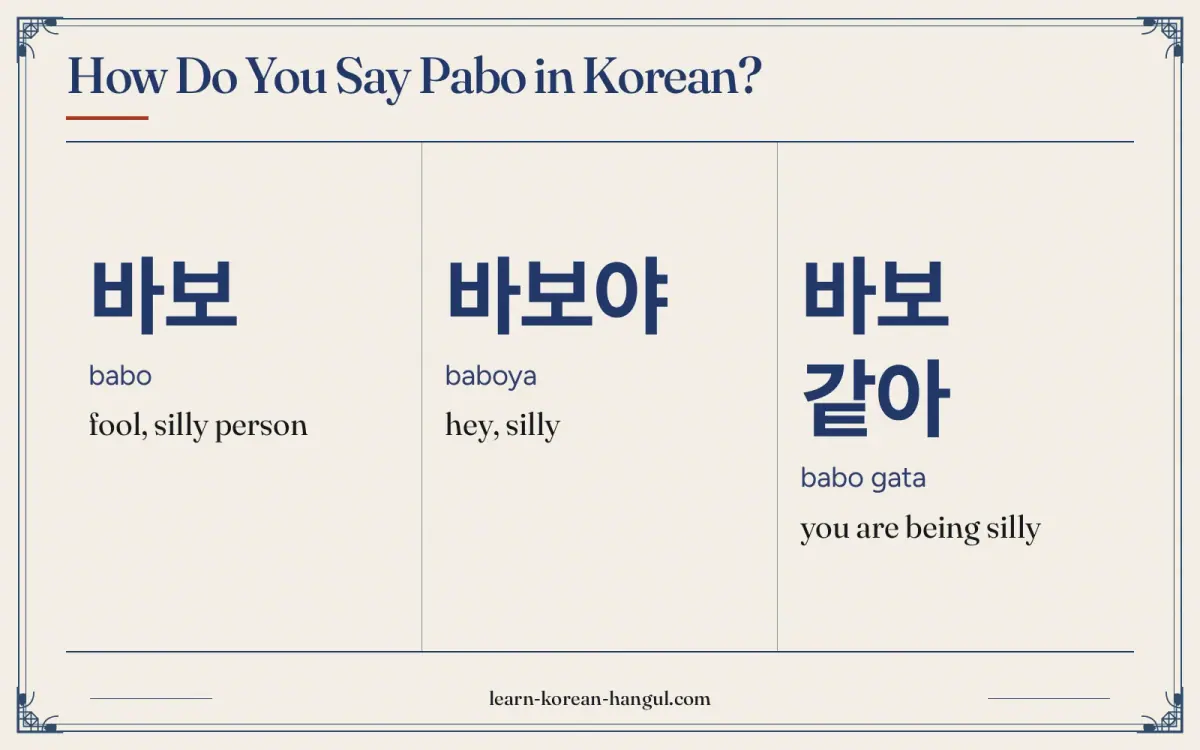
The word is 바보. It is a noun, so you can use it alone as an exclamation ("you silly!"), after a name, or inside a longer phrase. K-drama fans often write "pabo" because the first ㅂ sounds close to a p to English ears. The standard Revised Romanization spelling is babo, and this page uses it.
| Korean | Romanization | Meaning | Style |
|---|---|---|---|
| 바보 | babo | fool, silly person | casual |
| 바보야 | baboya | hey, silly | casual |
| 바보 같아 | babo gata | you are being silly | casual |
| 바보 같아요 | babo gatayo | that seems silly | polite ending, still blunt |
| 귀여운 바보 | gwiyeoun babo | a cute fool | affectionate |
| 멍청이 | meongcheongi | dummy, stupid person | stronger, rude |
The pattern 바보 같아 is made from 같다 (gatda, "to be like"). It literally says "you are like a fool". The same pattern works for other nouns: 아기 같아 (agi gata, "you are like a baby"). In the table, the polite 바보 같아요 shows that a polite ending does not make an insult polite.
What Are the Casual Ways to Say Pabo?
Every form on this page is casual, because 바보 belongs to close relationships. The guide to Korean speech levels explains the levels. The choice below is really about the relationship and the tone of voice, not about the ending.
Casual: 바보 (babo)
Casual · 반말Alone, 바보 is a short tease. It works when a friend forgets a coat, spills a drink or falls for a joke. The speaker's smile tells the listener it is play.
Casual: 바보야 (baboya)
Casual · 반말The ending 야 calls the person, like "hey" in English. It makes the word more personal, so it is common between partners, siblings and parents with children.
바보야, 우산 같이 쓰자.
baboya, usan gachi sseuja
Silly, let's share the umbrella.
Casual: 바보 같아 (babo gata)
Casual · 반말This is a description: "you are being silly" or, about yourself, "I feel like a fool". With the pronoun 나 it becomes self-mockery.
나 진짜 바보 같아.
na jinjja babo gata
I feel like such a fool.
Polite Ending, Still Blunt: 바보 같아요 (babo gatayo)
Polite · 해요체Adding 요 gives 바보 같아요, which you might say about a decision or about yourself in front of a colleague. About another person it is still an insult.
Now the sounds, which are simple but often misspelled.
How Do You Pronounce 바보?
바보 has two syllables: ba-bo. Both vowels are open and steady. The ㅏ is like the "a" in "father", and the ㅗ is like "oh" without gliding into "w".
The first ㅂ is unaspirated, which means you do not push out a puff of air. English ears may hear it as a soft p or a soft b, and that is why you see "pabo". The second ㅂ sits between two vowels and sounds like a clear b. Both are the same letter, written ㅂ and romanized b.
Sound Changes to Listen For
- 바보 같아 is [바보 가타]. The final ㅌ of 같 moves to the next syllable and, because 아 has no sound of its own, you hear ㅌ at the start of it. Revised Romanization writes gata, and the spoken form is [가타]. The same shift in 같아요 gives [가타요].
- 바보야 has no change. The ㅇ in 야 is silent, so the word is just ba-bo-ya, three syllables.
If you type "pabo" in a Korean keyboard, you might get 파보, which is a different spelling. The letter ㅍ is aspirated, with a strong puff of air, and 파보 is not a word to use for fool. Use ㅂ in both syllables.
For tone, listen to the voice: a playful 바보! is bright and short, and a warm 바보야 is softer and slower. Next comes the question of when it is safe.
When Should You Use 바보, and When Should You Not?
Use 바보 only where the relationship is close. In Korean, how you say a word matters as much as the word, so a smile and a gentle voice can turn the same word from a tease into an insult.
Situations Where It Fits
- Between a couple or close friends. A small mistake gets a fond 바보.
- A parent to a young child. 바보야 can be affectionate, with a laugh.
- About yourself. 나 바보 같아 is a safe way to joke about your own error.
- In K-drama dialogue. A lead character often says 바보야 to a loved one, which explains why fans know the word.
Situations to Avoid
- Strangers. Calling a driver or a shop clerk 바보 is a clear insult.
- Elders and teachers. Even a joking 바보 is disrespectful.
- Colleagues and clients. Choose a polite phrase such as 실수하셨네요 (silsuhasyeonneyo, "you made a mistake") or just stay quiet.
- Serious mistakes. If the other person is hurt, 바보 sounds like blame.
What Does Pabo Sound Like in a Real Conversation?
In real talk, 바보 is short and often part of a laugh. Listen to the soft, falling tone in the first dialogue and the rising teasing tone in the second.
A Shared Umbrella
Doyun
우산 안 가져왔어?
usan an gajyeowasseo
Didn't you bring an umbrella?
Yuna
응, 잊어버렸어.
eung, ijeobeoryeosseo
No, I forgot.
Doyun
바보야, 같이 쓰자.
baboya, gachi sseuja
Silly, let's share mine.
What to notice: 안 가져왔어 is a yes/no question and rises at the end. 잊어버렸어 is pronounced [이저버려써], and 같이 is [가치]. The word 바보야 is warm because the next sentence offers help.
Teasing a Friend
Sujin
나 시험지에 이름 안 썼어.
na siheomjie ireum an sseosseo
I didn't write my name on the test.
Haneul
진짜? 바보 같아, 하하.
jinjja? babo gata, haha
Really? That's silly, haha.
Sujin
놀리지 마.
nolliji ma
Don't tease me.
What to notice: 놀리지 마 means "don't tease", a natural reply to a playful 바보. The laugh shows that the word is a joke.
A Gentle Question
Minho
바보야, 왜 울어?
baboya, wae ureo
Silly, why are you crying?
Eunji
몰라, 그냥.
molla, geunyang
I don't know, just because.
What to notice: 왜 울어 is a question with a question word, so the pitch does not climb sharply at the end. It falls or stays low, which keeps the mood tender. The sentence is pronounced [왜 우러].
What Should You Know about the Culture behind Pabo?
Korean has many ways to tease, and 바보 sits near the gentle end. Because it is mild and common, it appears in drama titles, songs and everyday family talk.
- Mild does not mean harmless. The word relies on closeness. Without it, 바보 is rude.
- It can show love. A partner who says 바보야 while helping you is showing care. Pairing the word with 귀여운 (gwiyeoun, "cute") makes it even softer.
- Stronger words exist. 멍청이 (meongcheongi) means "dummy" and is a real insult. Avoid it unless you are quoting a drama.
- It appears in folk tales. The legend of 바보 온달 (babo Ondal, "Ondal the fool") tells of a man who is mocked as a fool and later becomes a general. The story is a famous example of a "fool" proving his worth.
- Tone is part of the meaning. A smile, a laugh and a soft voice mark play. A flat voice marks anger.
Using 바보 about yourself is the safest way to practise it: 나 바보 같아 makes fun of no one but you.
What Mistakes Do Learners Make with Pabo in Korean?
Most mistakes are about relationship, spelling or spacing.
| Mistake | Why it is a problem | Fix |
|---|---|---|
| 바보 to a stranger or an elder | It is an insult without closeness | Choose a polite phrase or stay silent |
| Typing 파보 | ㅍ is aspirated and not the word | Type 바보 with two ㅂ |
| 바보 야 with a space | The calling particle attaches to the noun | Write 바보야 |
| 바보 같아요 as a polite remark | The ending is polite but the message is not | Avoid it about other people |
| Saying gat-a with a hard t | The final ㅌ moves to the next syllable | Say [가타] |
The first mistake matters most. English speakers often think "silly" is a light word and assume the Korean one is the same. In Korean, the weight comes from who says it and to whom.
Is It the Same as Pabo Meaning?
People search for several related words, and Korean uses one family of words for them.
- Pabo meaning: "fool" or "silly person", used playfully or as an insult.
- Babo in Korean: the standard romanization of the same word.
- Stupid in Korean: 멍청하다 (meongcheonghada) describes a person, and 어리석다 (eoriseokda) is a formal word for "foolish". Both are stronger than a playful 바보.
- Idiot in Korean: 바보 is the mild choice, and 멍청이 is the harsher one.
- Fool in Korean: 바보 is the usual word, and the combination 바보 같은 짓 (babo gateun jit, "a foolish act") describes an action.
Related Phrases to Learn Next
Teasing, sorrow and surprise often follow each other in dramas, so learn the set:
- Michin in Korean: 미친, a stronger casual word for "crazy".
- Sorry in Korean: the apology that often follows a tease.
- Aigoo in Korean: 아이고, a sigh of sympathy or dismay.
- Jinjja in Korean: 진짜, "really", for reacting to news.
This guide belongs to the K-drama phrases collection. What this page does not cover: strong swear words, which are not taught here, and the full grammar of the calling particle 야, which has its own lesson. Say 바보 only with a smile among friends, and you can say pabo in Korean with the right feeling.
Practice: Say It Aloud
Play the slow clip of 바보 and repeat it three times, then 바보야 and 바보 같아. Then choose the right reaction. Answers follow.
- Your partner forgot their keys, and you smile.
- You made a silly mistake and joke about yourself.
- A stranger bumps your bag, and you feel annoyed.
- A friend teases you and you want them to stop.
Answers
- 바보야.
- 나 바보 같아.
- Say nothing, or use a polite phrase such as 조심하세요 (josimhaseyo, "be careful"). Do not use 바보.
- 놀리지 마.
The phrase flashcards drill these reactions with audio.
Frequently Asked Questions
How do you say pabo in Korean?
The word is spelled 바보 and romanized babo. The "p" spelling comes from how the first ㅂ sounds to English ears, because it is neither a clear b nor a clear p. Use 바보 for "fool", 바보야 to call someone, and 바보 같아 for "you are being silly".
How do you pronounce 바보?
Say ba-bo, two syllables with the open vowels ㅏ and ㅗ. The first ㅂ is soft and unaspirated, so it sits between b and p. The second ㅂ falls between two vowels and sounds more like a b. Revised Romanization writes babo, and no final consonant is involved.
What is the difference between 바보 and 바보야?
바보 is the plain word "fool", and you can use it about yourself or someone else. 바보야 adds the calling particle 야, so it speaks straight to the person: "hey, silly". Because 야 is casual, 바보야 fits only people you already speak casually to, such as close friends, partners and children.
Can I use 바보 with friends, elders and strangers?
Use it with close friends, partners and children, usually with a smile. Avoid it with strangers, colleagues and elders, because it is an insult without a warm relationship. A polite ending like 바보 같아요 does not make it polite. With people you respect, say something neutral such as 실수하셨네요 ("you made a mistake") or nothing at all.
What is the most common mistake with pabo in Korean?
Learners treat 바보 as a harmless word everywhere. Between close people it is a tease, but to a stranger it is an insult. A second mistake is typing 파보, which uses ㅍ and is not the word. A third is adding a space before the calling particle: write 바보야, not 바보 야.