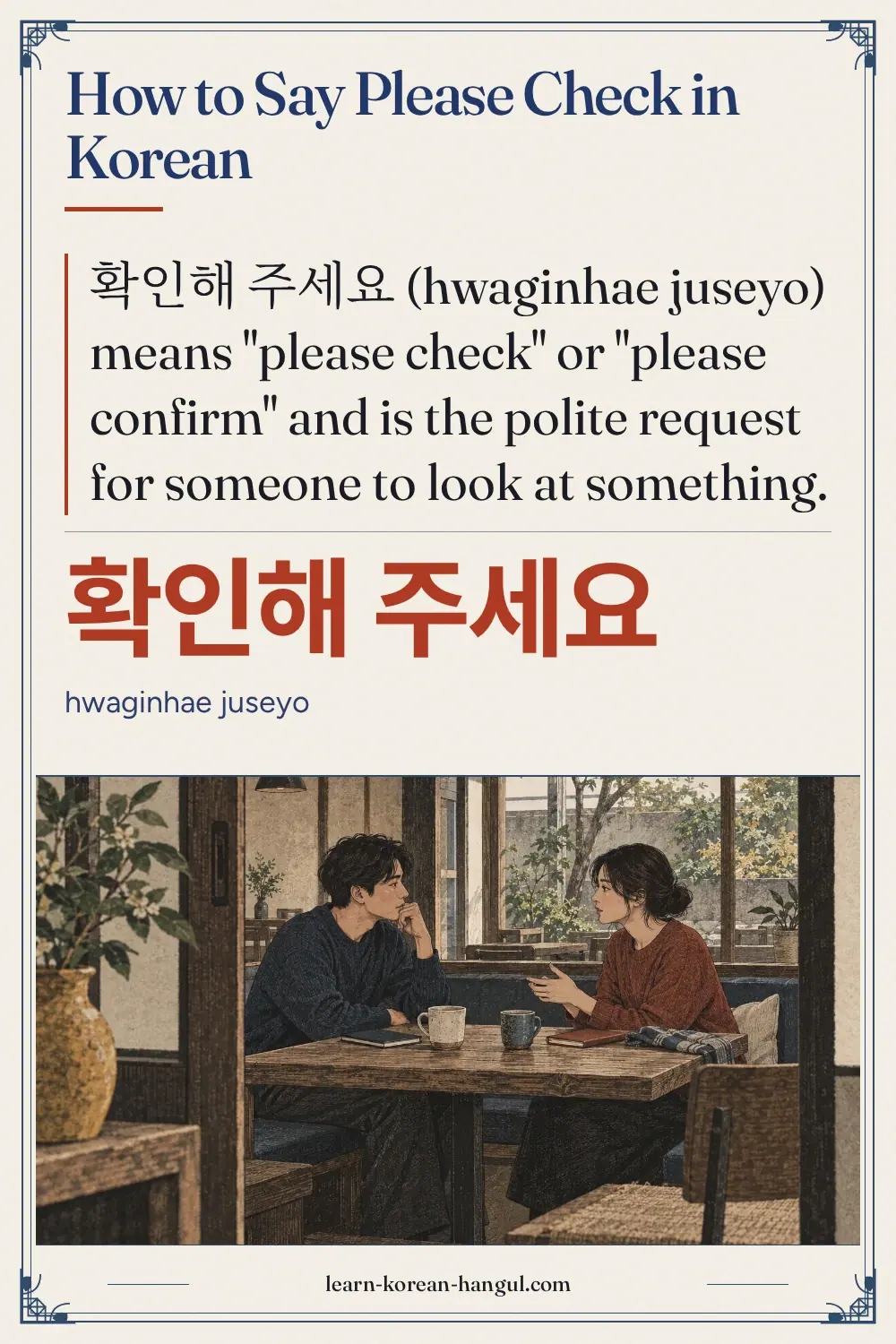
확인해 주세요
확인해 주세요
What you'll learn
- Say 확인해 주세요 aloud and ask a coworker, a customer or a shop to check something.
- Choose between 확인해 주세요, 확인 부탁드립니다 and 확인해 볼게요 for the listener in front of you.
- Explain why 확인 [화긴] and 부탁드립니다 [부탁뜨림니다] sound different from their spelling.
- Avoid the loanword 체크해 주세요 when you need a clean, polite request.
Before you start: knowing thank you in Korean helps, because most work requests end with a thank-you. Time: about 10 minutes. Audio plays only when you press a button.
How Do You Say Please Check in Korean?
The standard way to say please check in Korean is 확인해 주세요. 확인 (hwagin) is a Sino-Korean noun meaning check or confirmation, and 확인하다 (hwaginhada) is the verb "to check". Add what you want checked in front, as in 이 메일 확인해 주세요 (please check this email). In English, "check" and "confirm" are two words, but Korean uses 확인 for both, so one phrase covers please check and please confirm.
| Form | Romanization | Register | Say it to |
|---|---|---|---|
| 확인해 주세요 | hwaginhae juseyo | Polite (해요체) | Coworkers, customers, shop staff and strangers |
| 확인해 주시겠어요? | hwaginhae jusigesseoyo | Polite, extra respectful | Seniors and clients, as a question |
| 확인 부탁드립니다 | hwagin butakdeurimnida | Formal (합쇼체) | Emails, notices and messages to superiors |
| 확인해 볼게요 | hwaginhae bolgeyo | Polite (해요체) | Anyone, to say you will check |
| 확인해 줘 | hwaginhae jwo | Casual (해체) | Close friends and younger coworkers only |
Four of the five forms are polite or formal, so the choice depends on who is listening and whether you speak or write. The next section takes the three most useful forms one by one.
What Are the Formal and Polite Ways to Say Please Check?
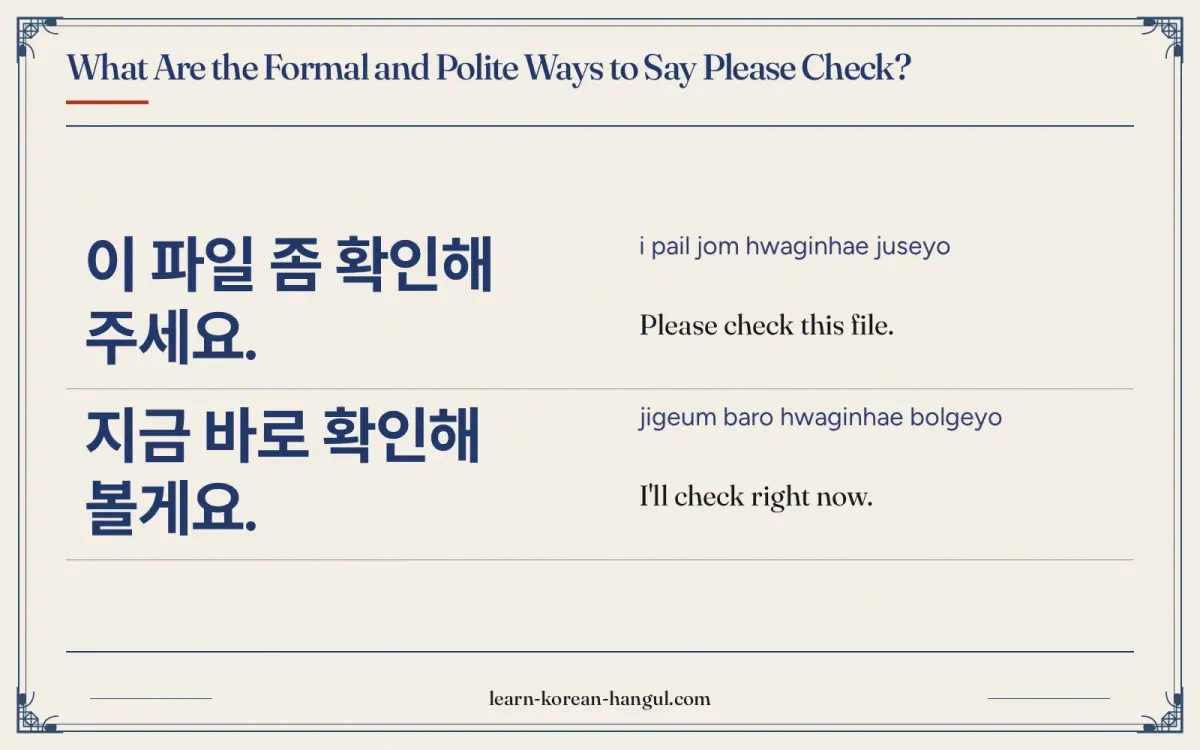
Please check follows the Korean speech levels, explained in the guide to Korean speech levels. At work the ladder is short: a polite spoken request, a formal written request and a promise to check.
Polite: 확인해 주세요 (hwaginhae juseyo)
Polite · 해요체확인해 주세요 is the everyday request. It is made from 확인하다 (to check) in its -어 form 확인해, plus 주세요 (please do it for me). Use it face to face, in chat and on the phone. Add 좀 (jom, a bit) before the verb to soften it.
이 파일 좀 확인해 주세요.
i pail jom hwaginhae juseyo
Please check this file.
Formal: 확인 부탁드립니다 (hwagin butakdeurimnida)
Formal · 합쇼체부탁 (butak) means a favor or request, and 드립니다 (deurimnida) is the humble formal form of giving. Together, 확인 부탁드립니다 means "I ask you to confirm". It uses the bare noun 확인 without 하다, which is normal in short written requests. Use it to close an email or to message a team leader.
첨부 파일 확인 부탁드립니다.
cheombu pail hwagin butakdeurimnida
Please check the attached file.
Polite: 확인해 볼게요 (hwaginhae bolgeyo)
Polite · 해요체확인해 볼게요 answers a request. 해 보다 means "to try doing" and -ㄹ게요 is a promise, so the phrase means "I'll check it and see". Say it when someone asks you something that you need to look up first. For a firmer answer, use 확인했습니다 (hwaginhaetseumnida), "I have checked".
지금 바로 확인해 볼게요.
jigeum baro hwaginhae bolgeyo
I'll check right now.
With the forms in hand, the next step is to say them clearly, so the sounds come next.
How Do You Pronounce 확인해 주세요?
확인해 주세요 is written with six syllables and pronounced [화긴해 주세요], hwaginhae juseyo. Say it as two beats: 확인해, then 주세요. The six written syllables sound like this.
- 확 (hwak): "hwa", and the final ㄱ does not stop here but moves on.
- 인 (in): "in", which picks up the ㄱ and sounds like "gin".
- 해 (hae): "heh" with a very light h.
- 주 (ju): a soft j and "oo".
- 세 (se): "seh".
- 요 (yo): "yoh".
Sound Changes to Listen For
Four details from the National Institute of Korean Language Standard Pronunciation Rules (표준 발음법) matter in these phrases.
- Linking in 확인. A final consonant moves to the next syllable when that syllable starts with the silent ㅇ. So 확인 is [화긴], and 확인해 is [화긴해]. Saying a hard stop in the middle, "hwak-in", sounds foreign.
- Tensing and nasal sound in 부탁드립니다. After the final ㄱ of 탁, the ㄷ of 드 becomes tense, and ㅂ before ㄴ becomes ㅁ, so the word is [부탁뜨림니다]. Revised Romanization shows the nasal change (butakdeurimnida) but not the tensing caused by a neighbouring sound.
- Soft ㅎ in 해. After ㄴ, the ㅎ in 해 is weak and can almost vanish in fast speech, so 확인해 can sound like [화기내]. Keep a faint h in careful speech.
- Tense ㄲ in 볼게요. After the ending -ㄹ, the ㄱ of 게요 is usually tense, so 볼게요 is pronounced [볼께요]. The spelling and the romanization (bolgeyo) stay the same.
Once the sounds are right, the question is which phrase to use with which person.
When Should You Use 확인해 주세요, and When Should You Not?
Use 확인해 주세요 when you ask someone to look at something and confirm it is right. Choose 확인 부탁드립니다 when you write, and 확인해 볼게요 when you are the one who will check.
Situations Where It Fits
- A shared document. 이 보고서 확인해 주세요. (Please check this report.)
- A reservation or booking. 예약 확인해 주세요. (Please check my reservation.)
- A formal email. 확인 부탁드립니다. closes the message politely.
- A promise to a colleague. 확인해 볼게요. (I'll check.)
Situations to Avoid
- With a boss in speech. 확인해 주세요 is polite but plain; for a senior, use 확인해 주시겠어요? or 확인 부탁드립니다.
- With close friends. 확인 부탁드립니다 sounds stiff; 확인해 줘 is natural between friends.
- For hotel check-in. 체크인 (check-in) is a different word. See check in in Korean.
- For a booking you want to lock in. To confirm a reservation, 예약 확정해 주세요 (yeyak hwakjeonghae juseyo) is more exact, while 확인 only asks someone to look.
Short scenes show how the three forms sit together in a real exchange.
What Does Please Check Sound Like in a Real Conversation?
A work request has a request, a reply and a thank-you. In each scene below, the polite ending 요 or the formal ending ㅂ니다 matches the situation.
Asking a Coworker to Check a Draft
Coworker
보고서 초안 확인해 주세요.
bogoseo choan hwaginhae juseyo
Please check the draft of the report.
You
네, 지금 확인해 볼게요.
ne, jigeum hwaginhae bolgeyo
Yes, I'll check it now.
Coworker
감사합니다.
gamsahamnida
Thank you.
What to notice: the request uses 확인해 주세요, and the answer uses 볼게요, a promise that you will check.
Messaging a Team Leader
You
팀장님, 첨부 파일 확인 부탁드립니다.
timjangnim, cheombu pail hwagin butakdeurimnida
Team leader, please check the attached file.
Team Leader
네, 확인했습니다.
ne, hwaginhaetseumnida
Yes, I have checked it.
What to notice: 팀장님 adds the honorific 님, and 확인 부탁드립니다 gives the formal tone expected toward a superior.
Checking a Reservation
Guest
예약 확인해 주세요.
yeyak hwaginhae juseyo
Please check my reservation.
Staff
성함이 어떻게 되세요?
seonghami eotteoke doeseyo
What is your name?
Guest
김민수예요.
gim minsuyeyo
It's Gim Minsu.
What to notice: the staff question asks for a name with 어떻게 (how), a wh-word, so it does not end with a sharp rise.
What Should You Know about the Culture behind Please Check?
Korean offices treat a request as a favor, and the wording shows respect for the other person's time.
- 부탁드립니다 closes many work emails. 부탁 means a favor, so 확인 부탁드립니다 reads as "I ask this favor of you" and is a standard office phrase.
- Seniority shapes the wording. The more senior the listener, the more the request gains 님 and the humble 드리다, as in 확인 부탁드립니다.
- Thank-you follows the request. Most messages end with 감사합니다 (thank you) after the request.
- Konglish is common but casual. Colleagues often say 체크해 주세요 aloud, yet written notices use 확인.
An expert insight: the loanword 체크하다 is easy to remember for English speakers, but it can sound casual in a formal workplace. 확인하다 works everywhere, from a chat with a friend to a company notice, so it is the safe choice for learners. The mistakes below show where the two words collide.
What Mistakes Do Learners Make with Please Check in Korean?
Most mistakes with please check come from word choice and from the register of the request.
| Mistake | Why it is a problem | Fix |
|---|---|---|
| Saying 체크해 주세요 in a formal email | The loanword sounds casual in writing | Write 확인 부탁드립니다 |
| Saying 확인해 only | Without 주세요 it is a bare command | Say 확인해 주세요 |
| Pronouncing 확인 as hwak-in | Linking is missing | Say [화긴] |
| Using 확인 부탁드립니다 with a friend | Too stiff for the relationship | Say 확인해 줘 or 확인해 주세요 |
| Using 확인해 주세요 to book a room | It asks someone to look, not to reserve | Use 예약해 주세요 (yeyakhae juseyo) |
Learners often assume that 확인 only means confirm. Actually, 확인 covers both check and confirm, and context decides which English word fits.
Is It the Same as Check?
The short answers below cover the other ways people search for this phrase.
- Check in Korean: 확인해 주세요 for looking something over; 체크 for a tick mark or a check-in desk.
- Confirm in Korean: 확인하다 again, or 확정하다 (hwakjeonghada) to lock in a plan.
- Please confirm in Korean: 확인해 주세요, or 확인 부탁드립니다 in a formal message.
- Check-in at a hotel: see check in in Korean.
The related pages below continue the work vocabulary.
Related Phrases to Learn Next
Please check sits beside the other lines you use in an office.
- Nice to work with you in Korean: a greeting for a new team.
- Understood in Korean: a reply that shows you have read a message.
- Thank you in Korean: the usual ending to a request.
This guide belongs to the business Korean phrases collection. What this page does not cover: how to write a full Korean business email or how to ask for payment. Add 확인해 주세요 for speech and 확인 부탁드립니다 for writing, and you can say please check in Korean at any workplace.
Practice: Say It Aloud
Play the slow clip of 확인해 주세요 and repeat it three times, then try 확인 부탁드립니다 and 확인해 볼게요. Then choose the phrase for each case. Answers follow.
- You send a file to your team leader by chat.
- A coworker asks you whether the schedule is right, and you need to look.
- You ask a hotel clerk to look up your booking.
- You write the last line of an email asking for a review.
Answers
- 팀장님, 파일 확인 부탁드립니다.
- 확인해 볼게요.
- 예약 확인해 주세요.
- 확인 부탁드립니다.
The phrase flashcards drill the work requests with audio.
Frequently Asked Questions
How do you say please check in Korean?
Say 확인해 주세요 (hwaginhae juseyo) for a polite spoken request. In an email or to a superior, write 확인 부탁드립니다 (hwagin butakdeurimnida). Put the object first, as in 이 파일 확인해 주세요, if the listener needs to know what to check.
How do you pronounce 확인해 주세요?
Pronounce it [화긴해 주세요]. The final ㄱ of 확 moves to 인, so you hear "hwa-gin", not "hwak-in". The ㅎ in 해 is weak after ㄴ. The Revised Romanization is hwaginhae juseyo, and the whole phrase has six syllables.
What is the difference between 확인해 주세요 and 확인 부탁드립니다?
확인해 주세요 is a polite spoken request in the 해요체 style. 확인 부탁드립니다 is formal and humble, built with the verb 드리다, and it fits emails, notices and messages to superiors. Both mean please check, but the second shows more respect.
Is 확인해 주세요 formal or casual?
It is polite, so it is neither formal nor casual. It suits coworkers, customers and strangers. A more formal version is 확인 부탁드립니다, and the casual version, for close friends only, is 확인해 줘.
Can I use 확인해 주세요 with friends, elders and strangers?
Yes with strangers and coworkers. With elders and seniors at work, make it more respectful with 확인해 주시겠어요? or 확인 부탁드립니다. With close friends, 확인해 줘 is natural, and 확인해 주세요 may sound slightly distant.
What is the most common mistake with please check in Korean?
The most common mistake is using the loanword 체크해 주세요 in writing or with seniors, because it sounds casual. Use 확인해 주세요, the standard word. A second mistake is dropping 주세요, which turns the request into an order.