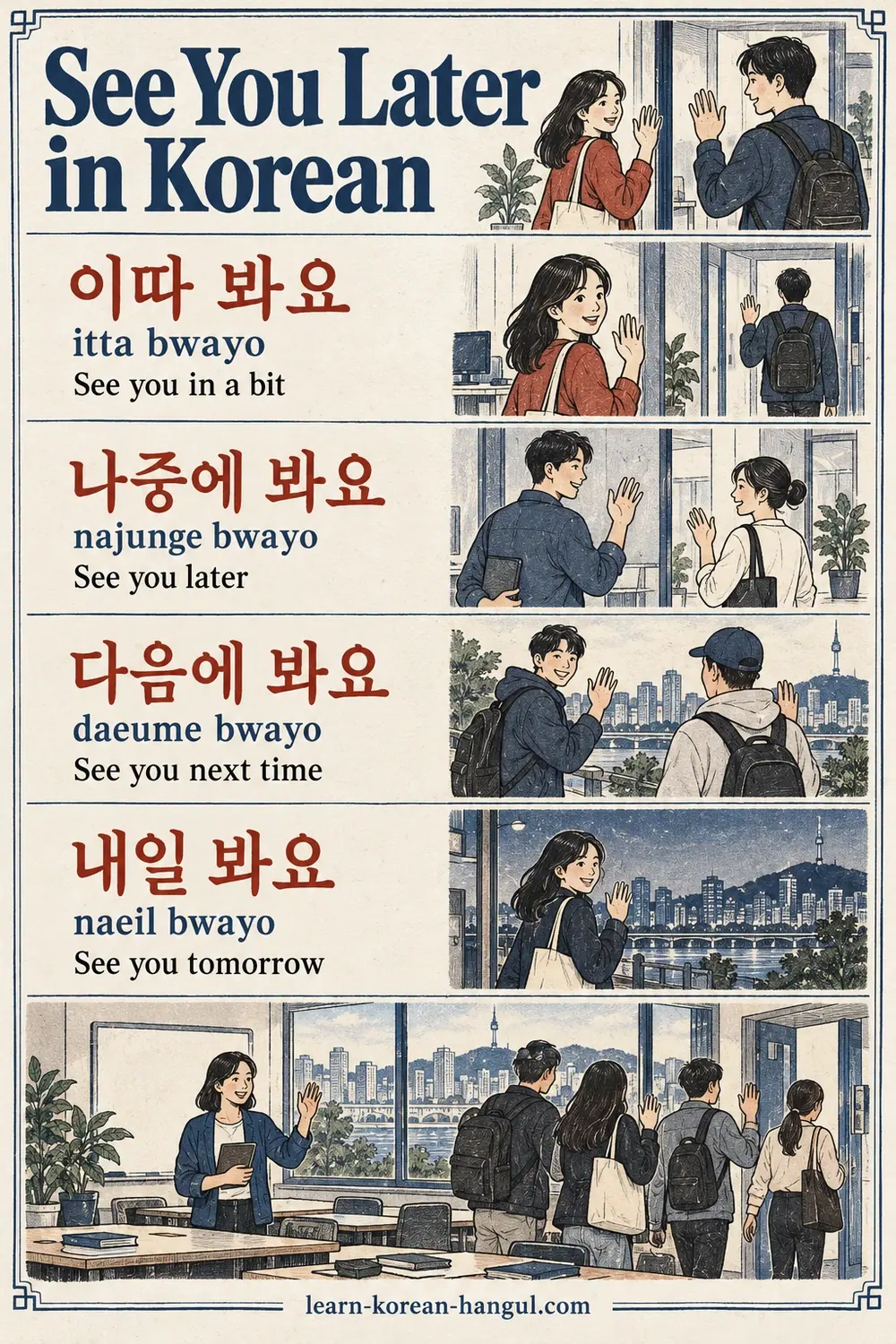
나중에 봐요
나중에 봐요
What you'll learn
- Choose between 나중에 (later, any time) and 이따 (later today).
- Switch between respectful, polite and casual forms.
- Pronounce 뵙겠습니다 as [뵙껟씀니다].
- Build a farewell that sounds friendly without making a firm plan.
Before you start: knowing goodbye in Korean helps, because 안녕히 가세요 is the main goodbye and see you later is the lighter one. Time: about 10 minutes. Audio plays only when you press a button.
Key facts
- 이따 봐 is the casual form, and 나중에 뵙겠습니다 (najunge boepgetseumnida) is the respectful form for seniors and customers.
How Do You Say See You Later in Korean?
The standard way to say see you later in Korean is 나중에 봐요, which literally means "let's see each other later". 나중에 is "at a later time" and 봐요 is the polite form of 보다, "to see". The sentence says nothing about when.
| Time | Korean | Romanization | Meaning |
|---|---|---|---|
| Later today | 이따 봐요 | itta bwayo | See you in a bit |
| Some later time | 나중에 봐요 | najunge bwayo | See you later |
| Next meeting | 다음에 봐요 | daeume bwayo | See you next time |
| Tomorrow | 내일 봐요 | naeil bwayo | See you tomorrow |
The contraction in 봐요 follows a pattern: the vowels ㅗ and ㅏ merge into ㅘ. The same pattern gives 와요 (comes) from 오다. With 가다 (to go), ㅏ and ㅏ simply merge into one ㅏ, so the form is 가요. The next section shows each form in a sentence.
What Are the Formal, Polite and Casual Ways to Say See You Later?
Korean changes the sentence ending to match the listener, a system called speech levels. The guide to Korean speech levels explains all of them, and this page uses three: formal (합쇼체), polite (해요체) and casual (해체).
Respectful: 나중에 뵙겠습니다 (najunge boepgetseumnida)
Formal · 합쇼체나중에 뵙겠습니다 means "I will see you later" and is for people clearly senior to you: a client, a professor, the head of a department. The verb itself changes, because 뵙다 is the humble verb for "to see" a senior person, so you lower yourself while you raise them. Learners who only change the ending miss this step.
그럼 나중에 뵙겠습니다.
geureom najunge boepgetseumnida
Then I will see you later.
Polite: 이따 봐요 (itta bwayo)
Polite · 해요체이따 봐요 is the natural farewell for coworkers, classmates and neighbours when you will meet again within hours. 이따 is short for 이따가, "after a while today".
이따 봐요.
itta bwayo
See you in a bit.
Polite: 나중에 봐요 (najunge bwayo)
Polite · 해요체나중에 봐요 covers every other case, from "see you after the holidays" to "see you around". Add 연락할게요 (I will contact you) when you really mean to stay in touch.
나중에 봐요. 연락할게요.
najunge bwayo. yeollakalgeyo
See you later. I'll contact you.
Polite: 다음에 봐요 (daeume bwayo)
Polite · 해요체다음에 봐요 means "see you next time" and fits regular events: classes, clubs, language exchanges and weekly meetings.
다음에 봐요.
daeume bwayo
See you next time.
Casual: 이따 봐 (itta bwa) and 나중에 봐 (najunge bwa)
Casual · 반말With friends, drop the -요. 이따 봐 means "see ya in a bit", and 나중에 봐 means "see ya". Never use them with teachers, bosses or older strangers.
이따 봐.
itta bwa
See you in a bit.
The polite 이따 봐요 and 나중에 봐요 will serve you in most situations. Next, the sounds that make them natural.
How Do You Pronounce 나중에 봐요?
나중에 봐요 is pronounced [나중에 봐요], in five syllables, with no sound changes in the spelling. The only tricky part is the glide in 봐. Build it in four steps.
- 나 (na): "nah".
- 중 (jung): "joong", with a short u.
- 에 (e): a plain "eh".
- 봐요 (bwa-yo): a quick "bwah", where ㅗ slides into ㅏ, then "yo".
Sound Changes to Listen For
Two pronunciation points matter in this group of phrases.
- Double ㄸ in 이따. The letter ㄸ is a tense consonant: say a d with a tight throat and no puff of air. Revised Romanization writes it as tt, as in itta.
- Tensification in 뵙겠습니다. After the closing ㅂ in 뵙, the ㄱ of 겠 becomes a tense [ㄲ], and after ㅆ in 겠 the ㅅ of 습 becomes [ㅆ]. The ㅂ of 습 also turns into ㅁ before ㄴ, so the word is [뵙껟씀니다]. These follow the National Institute of Korean Language Standard Pronunciation rules (표준 발음법) and are explained in Korean tensification.
Sound is only half the skill; the other half is choosing a time word that matches the plan.
When Should You Use 나중에 봐요, and When Should You Not?
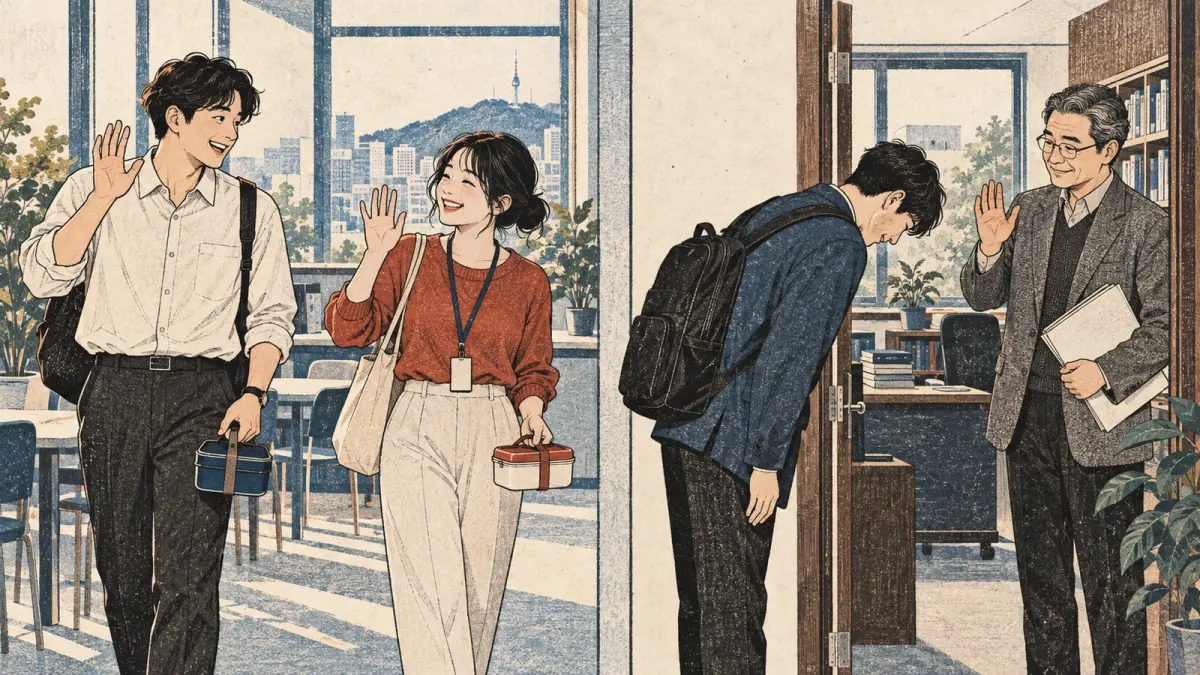
Use 나중에 봐요 when you expect to meet again but have no fixed time. Use 이따 봐요 when you will meet within hours, and 내일 봐요 when you will meet tomorrow. Pick the time word first, then the ending.
Situations Where It Fits
- Leaving the office before lunch. 이따 봐요 (see you after lunch).
- Ending a call with a friend. 나중에 봐 (see ya).
- Leaving a class or club. 다음에 봐요.
- Leaving a client's office. 그럼 나중에 뵙겠습니다.
Situations to Avoid
- For next week. 이따 means later today. Use 나중에 or 다음에.
- For a permanent goodbye. Use 안녕히 가세요 or 안녕히 계세요 instead.
- With a senior and 나중에 봐. Use 뵙겠습니다 or 봐요.
- When you have no intention to meet. Koreans often still say 나중에 봐요 out of politeness, but 안녕히 가세요 is the clearer choice for a final goodbye.
Real exchanges show how the time words work together.
What Does See You Later Sound Like in a Real Conversation?
See you later is usually the last line of an exchange, so it follows a plan or a thank you.
Before Lunch at Work
Jia
점심 먹고 이따 봐요.
jeomsim meokgo itta bwayo
Have lunch, and see you in a bit.
Minsu
네, 이따 봐요.
ne, itta bwayo
Yes, see you in a bit.
What to notice: both speakers use 이따, because they will be back at the desk within the hour. 점심 먹고 means "after having lunch".
Friends Leaving
Minsu
나 먼저 갈게. 나중에 봐.
na meonjeo galge. najunge bwa
I'm going first. See you later.
Jia
응, 이따 봐.
eung, itta bwa
Yeah, see you in a bit.
What to notice: 먼저 갈게 (I'll go first) is a polite way to leave even among friends. Jia replies with 이따 because she knows they will talk tonight. The more final goodbyes are listed in goodbye in Korean.
Leaving a Meeting with a Client
You
오늘 감사했습니다. 그럼 나중에 뵙겠습니다.
oneul gamsahaetseumnida. geureom najunge boepgetseumnida
Thank you for today. Then I will see you later.
Client
네, 안녕히 가세요.
ne, annyeonghi gaseyo
Yes, goodbye.
What to notice: the client answers with 안녕히 가세요, the goodbye for the person who is leaving. 안녕히 shares its root with 안녕하세요, as explained in hello in Korean. These habits reflect how Koreans think about partings.
What Should You Know about the Culture behind See You Later?
Korean farewells value the relationship over the schedule, so a vague see you later is normal and does not promise a date.
- Open-ended farewells. Phrases such as 나중에 봐요 and 다음에 밥 한번 먹어요 (let's eat together sometime) are polite ways to part. They often do not lead to a plan, and Koreans expect the other person to know this.
- Make it real with a detail. If you do want to meet, add a day, a time or 연락할게요. A specific plan turns the farewell into an invitation.
- Time words signal intent. Choosing 이따 instead of 나중에 tells the listener that you are definitely meeting today.
- Rank decides the verb. Seniors hear 뵙겠습니다, not 봐요.
An expert insight: learners often over-read 나중에 봐요 as a firm plan and wait for a message. Treat it as a friendly farewell, and follow up yourself if you want a real meeting. The mistakes below cover the language errors.
What Mistakes Do Learners Make with See You Later in Korean?
Most mistakes come from the time words and the choice of ending.
| Mistake | Why it is a problem | Fix |
|---|---|---|
| 이따 봐요 for next week | 이따 means later today | Say 다음 주에 봐요 or 나중에 봐요 |
| 나중에 봐 to a teacher | Casual speech is rude | Say 나중에 봐요 or 나중에 뵙겠습니다 |
| 나중에 봐요 as a goodbye to a stranger in a shop | Sounds like a plan | Say 안녕히 계세요 |
| Reading 뵙겠습니다 as "boep-get-seum-ni-da" | The tense sounds are missing | Say [뵙껟씀니다] |
| Using the same phrase for tomorrow | Loses the specific time | Say 내일 봐요 |
Learners often assume 이따 and 나중에 are interchangeable. Actually, 이따 is limited to the same day, while 나중에 has no limit, so 이따 can sound wrong if the meeting is days away.
Is It the Same as See Ya, Catch You Later or Later?
Mostly yes. The English variants all map to the short casual forms, with one polite option for each. The short answers below cover the other searches folded into this page.
- See you in Korean: 또 봐요 (see you again) in polite speech, or 또 봐 to friends.
- See ya in Korean: 나중에 봐 or 이따 봐, casual only.
- Later in Korean: 나중에 as a word; as a farewell, say 나중에 봐.
- Catch you later in Korean: 이따 봐 for the same day, 나중에 봐 for another time.
Learn the three time words 이따, 나중에 and 다음에, and the rest follows. The next step is practice.
Practice: Say It Aloud
Play the slow clip of 나중에 봐요 three times, then say 이따 봐요 after it. Choose a phrase for each situation. Answers follow.
- You will see your coworker again after lunch.
- You leave a meeting with a client you will meet again.
- A friend your age says goodbye after class.
- You see a classmate at the weekly club and say goodbye until next week.
Answers
- 이따 봐요.
- 그럼 나중에 뵙겠습니다.
- 이따 봐 or 나중에 봐.
- 다음에 봐요.
The phrase flashcards drill these with audio.
Related Phrases to Learn Next
See you later sits between a goodbye and a plan, so these are the natural next phrases.
- See you tomorrow in Korean: 내일 봐요 and 내일 뵙겠습니다.
- See you soon in Korean: 곧 봐요 and 또 만나요.
- Goodbye in Korean: 안녕히 가세요 and 안녕히 계세요.
This guide belongs to the Korean greetings collection. What this page does not cover: the full honorific system and written farewells, which have their own lessons. Choose 이따 for later today, 나중에 for an open time and 뵙겠습니다 for seniors, and you can say see you later in Korean to anyone.
Frequently Asked Questions
Is 나중에 봐요 a promise to meet again?
Not necessarily. 나중에 봐요 is a friendly farewell, like see you around, and it does not fix a time. If you really plan to meet, add a time or a day, such as 내일 봐요 or 이따 오후에 봐요. With no plan yet, add 연락할게요 (I will contact you) only if you mean to follow up.
How do I say see ya or catch you later in Korean?
Say 나중에 봐 or 이따 봐 to friends. Both are casual and short, like see ya. Use 이따 봐 when you will meet again today and 나중에 봐 when the time is open. Never use them with teachers, bosses or older strangers, who need 나중에 봐요 or 나중에 뵙겠습니다.
What is the difference between 이따 and 나중에?
이따 means later today, within hours, and 나중에 means at some later time, which can be next week or next year. If you meet your friend after lunch, 이따 봐요 fits. If you might meet next month, say 나중에 봐요. Using 이따 for next week is a common learner mistake.
How do I say see you next time in Korean?
Say 다음에 봐요 (daeume bwayo) in polite speech and 다음에 봐 (daeume bwa) in casual speech. 다음에 means next time and suits people you meet at regular events, such as classes or clubs. For a formal tone, say 다음에 뵙겠습니다, which works with teachers and clients.
Do I use 나중에 봐요 when saying goodbye to a customer?
Staff usually say 안녕히 가세요 (goodbye) or 감사합니다 to customers, not 나중에 봐요. Use 나중에 봐요 with people you expect to meet again, such as coworkers or regulars. To a client you will meet again, 나중에 뵙겠습니다 is more respectful than 나중에 봐요.