택시 승강장이 어디예요?
택시 승강장이 어디예요?
What you'll learn
- Ask where the taxi stand is, ask someone to call a taxi, and ask where you can catch one.
- Tell 승강장 (a stand or platform) from 정류장 (a bus stop).
- Say 택시 as [택씨] and 탈 수 as [탈쑤], with the tense sounds that follow a final consonant.
- Understand the short replies hotel and station staff give you.
Before you start: once you are in the taxi, you will need to give a destination, so see take me to the airport in Korean. Time: about 15 minutes. Audio plays only when you press a button.
How Do You Say Where Is the Taxi Stand in Korean?
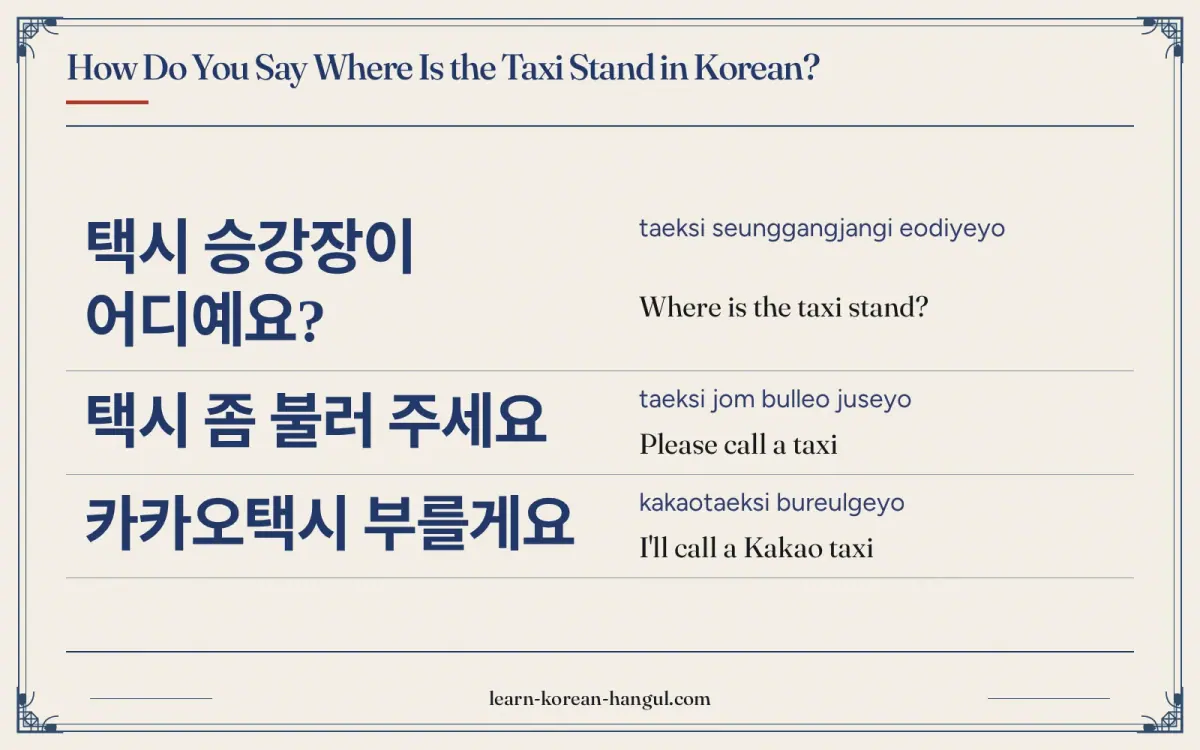
The standard question is 택시 승강장이 어디예요?, and three partners help you in other situations. Learn them as a set: one finds the stand, one gets a taxi called, one states a plan, and one asks where to board.
| Situation | Korean | Revised Romanization | Meaning |
|---|---|---|---|
| Find the stand | 택시 승강장이 어디예요? | taeksi seunggangjangi eodiyeyo | Where is the taxi stand? |
| Ask someone to call one | 택시 좀 불러 주세요 | taeksi jom bulleo juseyo | Please call a taxi |
| Say you will call | 카카오택시 부를게요 | kakaotaeksi bureulgeyo | I'll call a Kakao taxi |
| Ask where to get one | 택시 어디서 탈 수 있어요? | taeksi eodiseo tal su isseoyo | Where can I get a taxi? |
The word 승강장 (昇降場) joins 승, "go up", 강, "go down", and 장, "place", so it means a place where people get on and off. The particle 이 marks it as the subject, 어디 means "where", and 예요 is the polite "is". The next section shows each form in a sentence.
What Are the Polite Ways to Say Where Is the Taxi Stand?
Every form below is polite or formal, because you almost always ask staff or strangers. Korean marks the listener with speech levels, the sentence endings explained in the guide to Korean speech levels. The ending -요 makes a sentence polite, and -ㅂ니까 makes a question formal.
Polite: 택시 승강장이 어디예요? (taeksi seunggangjangi eodiyeyo)
Polite · 해요체This is the default. Use it with hotel clerks, mall staff and station workers. It asks only for the place, so the answer is a direction.
저기요, 택시 승강장이 어디예요?
jeogiyo, taeksi seunggangjangi eodiyeyo?
Excuse me, where is the taxi stand?
Polite: 택시 좀 불러 주세요 (taeksi jom bulleo juseyo)
Polite · 해요체불러 is the connecting form of 부르다, "to call", and 주세요 makes it a request, so the sentence means "please call a taxi for me". The small word 좀 ("a little") softens the request. Use it in a shop, a restaurant or a hotel.
죄송한데, 택시 좀 불러 주세요.
joesonghande, taeksi jom bulleo juseyo
Sorry to ask, but please call a taxi.
Polite: 카카오택시 부를게요 (kakaotaeksi bureulgeyo)
Polite · 해요체The ending -ㄹ게요 is a promise or a decision: "I will do it". Say it when you are the one who calls a taxi with the app, perhaps to tell a friend. It is pronounced [카카오택씨 부를께요].
제가 카카오택시 부를게요.
jega kakaotaeksi bureulgeyo
I'll call a Kakao taxi.
Polite: 택시 어디서 탈 수 있어요? (taeksi eodiseo tal su isseoyo)
Polite · 해요체탈 수 있어요 means "I can ride", from 타다 and the ability pattern -(으)ㄹ 수 있다. Ask this when you have no idea where to stand. A wh-question like this ends with a falling or rise-fall tone, not a sharp rise.
실례지만, 택시 어디서 탈 수 있어요?
sillyejiman, taeksi eodiseo tal su isseoyo?
Excuse me, where can I get a taxi?
Formal: 택시 승강장이 어디입니까? (taeksi seunggangjangi eodiimnikka)
Formal · 합쇼체The formal question ending -ㅂ니까 suits a hotel concierge or an official counter. It is correct, but stiff on the street.
실례합니다. 택시 승강장이 어디입니까?
sillyehamnida. taeksi seunggangjangi eodiimnikka?
Excuse me. Where is the taxi stand? (formal)
Casual: 택시 승강장 어디야? (taeksi seunggangjang eodiya)
Casual · 반말With close friends and family, drop -요 and say 어디야. Never use it with strangers, staff or elders.
야, 택시 승강장 어디야?
ya, taeksi seunggangjang eodiya?
Hey, where's the taxi stand?
Asking is only half of the exchange, so the next section covers what you will hear back.
What Will People Answer When You Ask?
Most replies are short and give a place or an instruction, so learn six. Staff often point or lead you a few steps.
| Korean | Revised Romanization | Meaning |
|---|---|---|
| 저쪽에 있어요 | jeojjoge isseoyo | It's over there |
| 역 앞에 있어요 | yeok ape isseoyo | It's in front of the station |
| 이쪽으로 오세요 | ijjogeuro oseyo | Please come this way |
| 줄을 서세요 | jureul seoseyo | Please stand in line |
| 앱으로 부르세요 | aebeuro bureuseyo | Please call one with the app |
| 택시가 바로 와요 | taeksiga baro wayo | A taxi comes right away |
The polite request -세요 appears in three of the six replies. Knowing the answers prepares you for the sounds in the question itself.
How Do You Pronounce 택시 승강장이 어디예요?
택시 승강장이 어디예요? is pronounced [택씨 승강장이 어디예요], taek-ssi seung-gang-jang-i eo-di-ye-yo, in ten syllables.
- 택 (taek): a puff of air, then "eh", closing with a short unreleased k.
- 시 (ssi): the ㅅ becomes tense after the final ㄱ, said with a tight throat.
- 승 (seung): "seung", with the unrounded ㅡ and a closing ng.
- 강 (gang): "gahng", with a soft g.
- 장 (jang): "jahng", with a soft j.
- 이 (i): "ee"; the ng of 장 stays, so there is no link.
- 어디예요 (eodiyeyo): "uh-dee-yeh-yo", said smoothly.
Sound Changes to Listen For
Four points make the question and its partners sound natural:
- Tensing in 택시. After a final ㄱ, the ㅅ is said tense, so 택시 sounds like [택씨]. The National Institute of Korean Language (국립국어원) Standard Pronunciation rules (표준 발음법) set this in Article 23. Revised Romanization writes taeksi, because it does not show tensing caused by a neighbouring sound. See Korean tensification.
- Tensing after -ㄹ. In 탈 수 the ㅅ is tense, so you say [탈쑤]. In -ㄹ게요 the ㄱ is tense, so 부를게요 is [부를께요] and 할게요 is [할께요].
- Liaison (연음). In 있어요 the ㅆ moves forward, giving [이써요]. See the liaison rules.
- 불러 has a long ㄹ. The ㄹ in 불러 is doubled in sound, a little like the "ll" in "all low". Say it as [불러], not [부러].
Once the sounds are clear, the next step is knowing when each form fits.
When Should You Use 택시 승강장이 어디예요?, and When Should You Not?
Use 택시 승강장이 어디예요? when you are near a place that has a stand, such as a station, an airport or a large hotel. Use 택시 좀 불러 주세요 when a shop or a restaurant can call one for you.
Situations Where It Fits
- Stations and airports. Large stations have a marked stand, and staff can point to it.
- Hotels and malls. The front desk can tell you where the taxis wait, or call one to the door.
- Late at night. When the streets are quiet, asking staff is faster than searching.
Situations to Avoid
- On a busy street with no stand. Hail a taxi by raising your hand instead.
- Using the casual form with staff. 택시 승강장 어디야? is for friends only.
- Asking a bus driver. Drivers may not know where taxis wait, so ask a shop worker or a station information desk instead.
Real exchanges show how the questions chain together.
What Does Asking for a Taxi Stand Sound Like in a Real Conversation?
Three short exchanges cover the usual cases: finding the stand, asking staff to call a taxi and using the app. Listen for the opening phrase and the answer.
Asking at a Hotel Desk
Guest
저기요, 택시 승강장이 어디예요?
jeogiyo, taeksi seunggangjangi eodiyeyo?
Excuse me, where is the taxi stand?
Clerk
호텔 앞에 있어요. 이쪽으로 오세요.
hotel ape isseoyo. ijjogeuro oseyo
It's in front of the hotel. Please come this way.
Guest
감사합니다.
gamsahamnida
Thank you.
What to notice: the clerk gives a place first and then an invitation, 오세요. Thank people with 감사합니다.
Asking Staff to Call a Taxi
Customer
택시 좀 불러 주세요.
taeksi jom bulleo juseyo
Please call a taxi.
Clerk
어디로 가세요?
eodiro gaseyo?
Where are you going?
Customer
서울역으로 가요.
Seoullyeogeuro gayo
I'm going to Seoul Station.
Clerk
네, 잠시만 기다려 주세요.
ne, jamsiman gidaryeo juseyo
Yes, please wait a moment.
What to notice: the clerk asks a wh-question, 어디로, which ends with a falling or rise-fall tone. 서울역으로 sounds like [서울려그로], and 기다려 주세요 is another request ending.
Using the App with a Friend
Minho
제가 카카오택시 부를게요.
jega kakaotaeksi bureulgeyo
I'll call a Kakao taxi.
Jisu
고마워요. 어디서 탈 수 있어요?
gomawoyo. eodiseo tal su isseoyo?
Thanks. Where can we get in?
Minho
저쪽 정문 앞에서 타세요.
jeojjok jeongmun apeseo taseyo
Get in at the front gate over there.
What to notice: Minho makes a promise with -ㄹ게요, and the app tells him the pickup spot. A few local habits also make taxis easier.
What Should You Know about the Culture behind Taking a Taxi?
Taxis are easy to find in Korean cities, and a few habits help visitors.
- Types of taxi. Regular taxis are the most common. There are also black 모범택시 (mobeomtaeksi, deluxe taxis) and 콜택시 (koltaeksi, call taxis).
- Apps. Many people book through an app instead of hailing. Kakao T is a well-known one, and a Korean phone number is often needed to register, so ask staff to help.
- Show the address. Give your destination in Korean or show it on your phone, because a map name may be easier for the driver than a spoken one.
- No tipping. Tipping is not the custom for taxis in Korea.
- Card payment. Most taxis take cards or transit cards, but keep some cash as a backup.
An expert insight: learners often practise a long sentence, but a hotel clerk will call the taxi for you after the single request 택시 좀 불러 주세요. The next section lists the mistakes that cause the most confusion.
What Mistakes Do Learners Make with Where Is the Taxi Stand in Korean?
Most mistakes come from the noun or from the request form.
| Mistake | Why it is a problem | Fix |
|---|---|---|
| Saying 정류장 for the stand | 정류장 is the usual word for a bus stop | Say 승강장 or 택시 타는 곳 |
| 택시 불러요 for a request | It means "I call a taxi" | Say 택시 좀 불러 주세요 |
| Reading 택시 as [택시] | The ㅅ should be tense | Say [택씨] |
| Reading 탈 수 as [탈수] | The ㅅ should be tense | Say [탈쑤] |
| Using 어디야 with staff | It is casual and abrupt | Say 어디예요 |
Learners often think 승강장 is only for trains. In fact it is used for any place where passengers get on and off, including taxis, and signs may also say 택시 타는 곳. Several other English queries fold into this page.
Is It the Same as Taxi, Call a Taxi or Taxi Stand?
Mostly yes. Each English phrase maps onto a Korean pattern you can use in a question.
- Taxi in Korean: 택시 is the loanword. See the word page on taxi in Korean.
- Call a taxi in Korean: 택시 좀 불러 주세요 asks someone else, and 택시 부를게요 says you will call one yourself.
- Taxi stand in Korean: 택시 승강장 or 택시 타는 곳 [택씨 타는 곧]. Both are heard.
- Where is the taxi stand in Korean: 택시 승강장이 어디예요? is the exact question.
Now practise the question until it feels automatic.
Practice: Say It Aloud
Play the slow clip of 택시 승강장이 어디예요? three times and repeat it. Then choose a form for each situation. Answers follow.
- You ask a hotel clerk where the stand is.
- You ask a restaurant worker to call a taxi.
- You tell a friend you will use the app.
- You are at an official counter and want the formal form.
Answers: 1. 택시 승강장이 어디예요? 2. 택시 좀 불러 주세요. 3. 카카오택시 부를게요. 4. 택시 승강장이 어디입니까?
Use the phrase flashcards to drill the question with audio.
Related Phrases to Learn Next
- Take me to the airport in Korean: the next sentence once you are in the taxi.
- Stop here please in Korean: the request for the end of the ride.
- How much is the fare in Korean: the question for the driver.
This guide belongs to the Korean taxi phrases collection. What this page does not cover: how to read the meter or how to register for a taxi app, which deserve their own lessons. Master the four sentences above, and you can say where is the taxi stand in Korean in any city.
Frequently Asked Questions
How do you say where is the taxi stand in Korean?
Say 택시 승강장이 어디예요? (taeksi seunggangjangi eodiyeyo). The word 승강장 means a place where passengers get on and off, 어디 means "where", and 예요 is the polite "is". The ending -요 makes the sentence suitable for staff and strangers. To have someone call a taxi, say 택시 좀 불러 주세요.
How do you pronounce 택시 승강장이 어디예요?
It sounds like taek-ssi seung-gang-jang-i eo-di-ye-yo, with ten syllables. The only special sound is the tense ㅆ in 택시, said with a tight throat after the short k. The ng sounds in 승강장 stay in place, so there is no link to 이. Say 예요 lightly at the end.
What is the difference between 택시 승강장이 어디예요? and 택시 좀 불러 주세요?
Both are polite, but they do different jobs. 택시 승강장이 어디예요? asks where to find the stand, so you use it when you are going to walk there. 택시 좀 불러 주세요 asks someone to call a taxi for you, so you use it in a hotel or shop.
Can I use 택시 승강장이 어디예요? with friends, elders and strangers?
Yes for strangers and elders, because the ending -요 is polite. With a close friend you can drop it and say 택시 승강장 어디야?. At an official counter, the formal 택시 승강장이 어디입니까? is also fine. Avoid the casual form with staff and with anyone you do not know well.
What is the most common mistake with where is the taxi stand in Korean?
Using 정류장, which is the usual word for a bus stop. Staff may send you to the bus stop. Use 택시 승강장 or 택시 타는 곳 instead. The second most common mistake is saying 택시 불러요 when you want a request, because that means "I call a taxi".