무슨 뜻이에요?
무슨 뜻이에요?
What you'll learn
- Say 무슨 뜻이에요?, 무슨 말이에요? and 무슨 뜻이야? and choose the one that fits the listener.
- Pronounce 무슨 뜻이에요? as [무슨 뜨시에요], with a tense ㄸ and no sharp rise.
- Ask the meaning of a word with the pattern "word + 이/가 무슨 뜻이에요?".
- Spell it 뜻이에요, not 뜻이예요.
Before you start: if you did not hear a word at all, see please say it again in Korean. Time: about 12 minutes. Audio plays only when you press a button.
How Do You Say What Do You Mean in Korean?
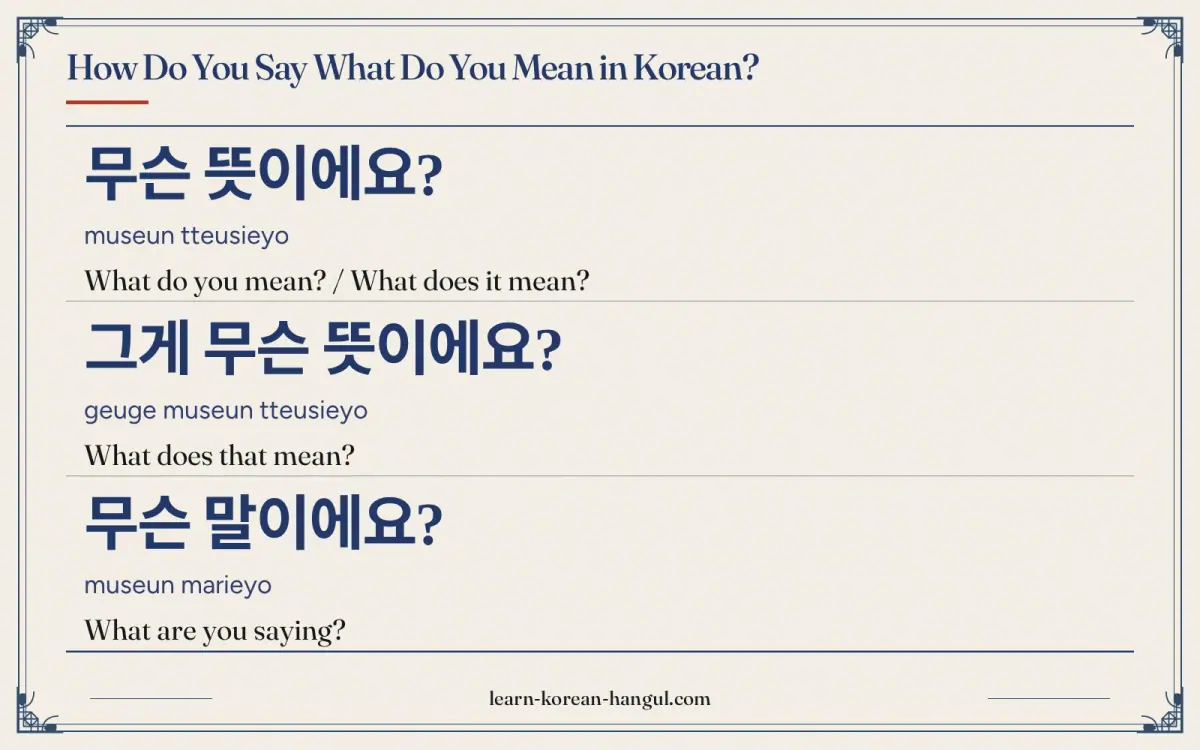
The standard way to say what do you mean in Korean is 무슨 뜻이에요? The word 무슨 means "what kind of" and comes before a noun. The noun 뜻 means "meaning" and also "intention". The ending -이에요 is the polite form of "to be". Put together, the question literally asks "what kind of meaning is it?".
| Korean | Romanization | Meaning | Where you hear it |
|---|---|---|---|
| 무슨 뜻이에요? | museun tteusieyo | What do you mean? / What does it mean? | Most people, daily life |
| 그게 무슨 뜻이에요? | geuge museun tteusieyo | What does that mean? | Asking about something said |
| 무슨 말이에요? | museun marieyo | What are you saying? | Surprise, confusion |
| 무슨 뜻입니까? | museun tteusimnikka | What does it mean? (formal) | Meetings, customer service |
| 뜻이 뭐예요? | tteusi mwoyeyo | What's the meaning? | Words and phrases |
| 무슨 뜻이야? | museun tteusiya | What do you mean? (casual) | Friends, family |
Revised Romanization (the South Korean government standard of 2000) is only a reading aid here. Learn the Hangul first. The next section shows how the forms differ.
What Are the Polite and Casual Ways to Say What Do You Mean?
What do you mean in Korean has polite, formal and casual choices. The key word 뜻 stays the same, and the ending and the focus change.
Polite: 무슨 뜻이에요? (museun tteusieyo)
Polite · 해요체무슨 뜻이에요? is the safe default. Use it for a word you do not know and for a sentence you do not follow. Name the word first, then add 이 or 가: "수고하세요"가 무슨 뜻이에요? Use 가 after a vowel and 이 after a consonant.
"수고하세요"가 무슨 뜻이에요?
"sugohaseyo"ga museun tteusieyo
What does "sugohaseyo" mean?
Polite: 무슨 말이에요? (museun marieyo)
Polite · 해요체말 means "words" or "speech", so this question asks "what are you saying?". It is natural when something surprises you, but it can sound like "I do not agree with what you said", depending on tone. When you only want an explanation, choose 뜻 instead.
Polite: 그게 무슨 뜻이에요? (geuge museun tteusieyo)
Polite · 해요체그게 is short for 그것이, "that thing". Use it when you point at something someone just said or wrote.
Formal: 무슨 뜻입니까? (museun tteusimnikka)
Formal · 합쇼체무슨 뜻입니까? is the formal form. You hear it in meetings, presentations and broadcasts. Say it as [무슨 뜨심니까]. In daily life, 무슨 뜻이에요? is enough.
Casual: 무슨 뜻이야? (museun tteusiya)
Casual · 반말With a friend or sibling, change 이에요 to 이야: 무슨 뜻이야? A short 무슨 말이야? is also common. Never use these with a boss, an elder or a stranger.
The forms share one core. The next section shows how to say it out loud.
How Do You Pronounce 무슨 뜻이에요?
무슨 뜻이에요 is pronounced [무슨 뜨시에요], in six syllables: mu-seun tteu-si-e-yo. The spelling shows ㅅ at the end of 뜻, but you do not say it as a separate sound. It moves over to the next syllable.
- 무 (mu): m plus a rounded u.
- 슨 (seun): s plus ㅡ, with the lips unrounded, and a short n.
- 뜨 (tteu): a tense d with ㅡ and no puff of air.
- 시 (si): s plus a short i. This syllable is the ㅅ that moved from 뜻.
- 에 (e): a plain vowel.
- 요 (yo): a short, light ending.
Sound Changes to Listen For
- Liaison in 뜻이에요. The final ㅅ of 뜻 moves to the next syllable, so 뜻이에요 sounds like [뜨시에요]. By itself, 뜻 sounds like [뜯]. See the Standard Pronunciation Rules (표준 발음법) on 연음.
- Tense ㄸ in 뜻. The ㄸ is a tense sound in the word itself. Tighten the throat, do not release a puff of air, and do not say a plain "d". A plain ㄷ would sound like "deut".
- ㅡ is unrounded. In 슨 and 뜨, keep the lips flat, as if you were smiling. Do not round them like "u" in 무.
- Nasal [ㅁ] in 뜻입니까. The ㅂ in 입니까 becomes [ㅁ] before ㄴ: [뜨심니까].
- Wh-questions do not need a sharp rise. 무슨 뜻이에요? puts the emphasis on 무슨 and ends with a falling or level tone. A sharp rise can turn it into "do you mean something?".
- Spelling. After a consonant, the polite copula is 이에요, so write 뜻이에요. 이예요 is a non-standard spelling, so avoid it.
Aim for a clear 무슨 and a calm ending. Next, when does each form fit?
When Should You Use 무슨 뜻이에요?, and When Should You Not?
Use 무슨 뜻이에요? when you want an explanation of a word or a statement. Use 무슨 말이에요? when you are surprised, and 무슨 뜻이야? with friends. The choice depends on your tone and your relationship, not only on the words.
Situations Where It Fits
- A new word. Point to the word and ask "word"이/가 무슨 뜻이에요?
- An unclear remark. Ask 그게 무슨 뜻이에요? after a vague comment.
- A sign or a menu. Staff will explain a dish name with the same question.
Situations to Avoid
- 무슨 말이에요? with an elder. Even in the polite form, it can sound like a challenge. Say 죄송한데, 다시 한 번 설명해 주시겠어요? ("Sorry, could you explain once more?") instead.
- 뭐예요? alone. That means "what is it?", not "what do you mean?".
- A rising ending. A sharp rise on a wh-question changes the meaning of 무슨.
Three short scenes show the forms in use.
What Does What Do You Mean Sound Like in a Real Conversation?
Questions about meaning are short. Listen for the ending of each sentence.
Asking a Teacher
Student
"수고하세요"가 무슨 뜻이에요?
"sugohaseyo"ga museun tteusieyo
What does "sugohaseyo" mean?
Teacher
일하는 사람에게 하는 인사예요.
ilhaneun saramege haneun insayeyo
It's a greeting for someone who is working.
What to notice: The student puts the word first, then 가 after the vowel, then 무슨 뜻이에요? The teacher answers with 인사예요, which uses 예요 after a vowel.
Friends Ask for Clarity
Ji-Ho
그 영화는 좀 그랬어.
geu yeonghwaneun jom geuraesseo
That film was a bit so-so.
Su-Bin
그게 무슨 뜻이야? 재미없었어?
geuge museun tteusiya? jaemieopseosseo
What do you mean by that? Was it boring?
What to notice: Both lines drop 요, because the friends are close. 그랬어 sounds like [그래써], and 재미없었어 sounds like [재미업써써]. The vague 좀 그랬어 is a good reason to ask.
Asking at a Restaurant
Guest
"비빔밥"이 무슨 뜻이에요?
"bibimbap"i museun tteusieyo
What does "bibimbap" mean?
Staff
비빈 밥이라는 뜻이에요.
bibin babiraneun tteusieyo
It means mixed rice.
What to notice: 비빔밥 sounds like [비빔빱], with a tense ㅂ, and 이라는 뜻이에요 is a way to say "it means ...". The guest uses 이 after the consonant ㅂ.
What Should You Know about the Culture behind What Do You Mean?
These are general patterns, not rules.
- Asking is welcome. Asking a teacher, a shop assistant or a friend what a word means is normal, and many people enjoy explaining idioms and expressions.
- Indirect speech. Koreans often soften opinions with 좀 or 글쎄요, as in 좀 어려울 것 같아요 ("it seems a bit difficult"). A polite 그게 무슨 뜻이에요? helps you find out whether it means "no".
- Tone matters. 무슨 말이에요? can sound like you are rejecting what was said. Keep your tone gentle and add 죄송한데 ("sorry, but") first.
- Ask for a repeat first. If you did not catch the words, say so with i don't understand in Korean or ask for a repeat with please say it again in Korean before asking for the meaning.
An expert tip: The noun 뜻 covers both "meaning" and "intention", as in 뜻대로 되다 [뜯때로 되다] ("go as you intended"). That is why 무슨 뜻이에요? works for "what does this word mean?" and also for "what do you mean by that?". Once you know this, 그런 뜻이 아니에요 ("I didn't mean it that way") is easy to guess. For how endings carry politeness, see Korean speech levels.
What Mistakes Do Learners Make with What Do You Mean in Korean?
Most errors come from the spelling of the copula and from tone.
| Mistake | Why it is a problem | Fix |
|---|---|---|
| Writing 뜻이예요 | 예요 follows a vowel, not a consonant | Write 뜻이에요 |
| Saying 뭐예요? for "what do you mean" | It means "what is it?" | Say 무슨 뜻이에요? |
| Using 무슨 말이에요? to an elder | It can sound confrontational | Say 죄송한데, 다시 설명해 주시겠어요? |
| Ending with a sharp rise | A wh-question needs no sharp rise | Keep a falling or level tone |
| Saying "deut" with a plain ㄷ | The tense ㄸ is missing | Say 뜻 with a tense sound |
Learners often translate "mean" word for word and reach for 의미하다. In daily speech, 뜻 is much more common, and 무슨 뜻이에요? is the natural question.
Is It the Same as Meaning or What's That Mean?
Mostly. Each English phrase is covered by the forms above, with a small difference in tone.
- Meaning in Korean: the noun is 뜻 (native) or 의미 (Sino-Korean, a little more formal). Asking 무슨 의미예요? is also correct.
- What's that mean in Korean: 그게 무슨 뜻이에요? or the shorter 뜻이 뭐예요?
- What do you mean in Korean: 무슨 뜻이에요?, with 무슨 말이에요? when you are surprised.
- I don't understand in Korean: that is a different request, covered in i don't understand in Korean.
Practice: Say It Aloud
Play the slow clip and repeat 무슨 뜻이에요? three times. Then choose the best question for each scene. Answers follow.
- You see the word "파이팅" and do not know it.
- A friend says "it was so-so" and you want more.
- A staff member in a meeting gives a vague answer, and you need a formal question.
- A teacher said a sentence quickly and you want it explained again.
Answers
- "파이팅"이 무슨 뜻이에요?
- 그게 무슨 뜻이야?
- 무슨 뜻입니까?
- 죄송한데, 다시 한 번 설명해 주시겠어요?
The phrase flashcards drill these questions with audio.
Related Phrases to Learn Next
Asking for meaning leads to other classroom and conversation phrases.
- i don't understand in Korean: say that you are lost before you ask.
- how do you say in Korean: ask for the Korean word for something.
- please say it again in Korean: ask for a repeat.
This guide belongs to the korean small talk collection. What this page does not cover: dictionary lookups, idiom lists and polite disagreement. Learn 무슨 뜻이에요? and 그게 무슨 뜻이에요?, and you can say what do you mean in Korean to anyone.
Frequently Asked Questions
How do you say what do you mean in Korean?
Say 무슨 뜻이에요? (museun tteusieyo) for "what do you mean?" or "what does it mean?". To ask about a word, put it first: "파이팅"이 무슨 뜻이에요? To ask what someone is saying, 무슨 말이에요? is also common, but it can sound challenging. With friends, use 무슨 뜻이야?
How do you pronounce 무슨 뜻이에요?
It has six syllables: mu-seun tteu-si-e-yo. The final ㅅ of 뜻 moves to the next syllable, so it sounds like [무슨 뜨시에요]. The ㄸ is a tense sound with no puff of air. As a wh-question, it does not need a sharp rise at the end. Revised Romanization writes museun tteusieyo.
What is the difference between 무슨 뜻이에요 and 무슨 말이에요?
무슨 뜻이에요? asks about meaning, whether of a word or of a statement. 무슨 말이에요? asks "what are you saying?" and focuses on what the person said. It can sound surprised or confrontational, depending on tone. Use 무슨 뜻이에요? when you are not sure.
Is 무슨 뜻이에요 formal or casual?
It is polite. The ending -이에요 suits teachers, shop staff and colleagues. The formal version is 무슨 뜻입니까?, and the casual version is 무슨 뜻이야?, which only fits friends and family. Choose the polite form when you are unsure.
What is the most common mistake with what do you mean in Korean?
Writing 뜻이예요 instead of 뜻이에요. After a consonant like ㅅ, the spelling is 이에요. 예요 is used only after a vowel, as in 의사예요. Another mistake is using a sharp rising ending, which makes the question sound like "what, you mean something?".