언제 만날까요?
언제 만날까요?
What you'll learn
- Ask when, where and at what time to meet, using one pattern with three question words.
- Pick the right form for a friend, a senior colleague and a close friend.
- Say 몇 시에 as [멷씨에] and 약속 as [약쏙], with the sound changes that go with them.
- Avoid the common slip of using 만나요 when you mean "shall we meet?".
Before you start: it helps to know how to ask whether someone has time, so see are you free in Korean. Time: about 15 minutes. Audio plays only when you press a button.
How Do You Say When Shall We Meet in Korean?
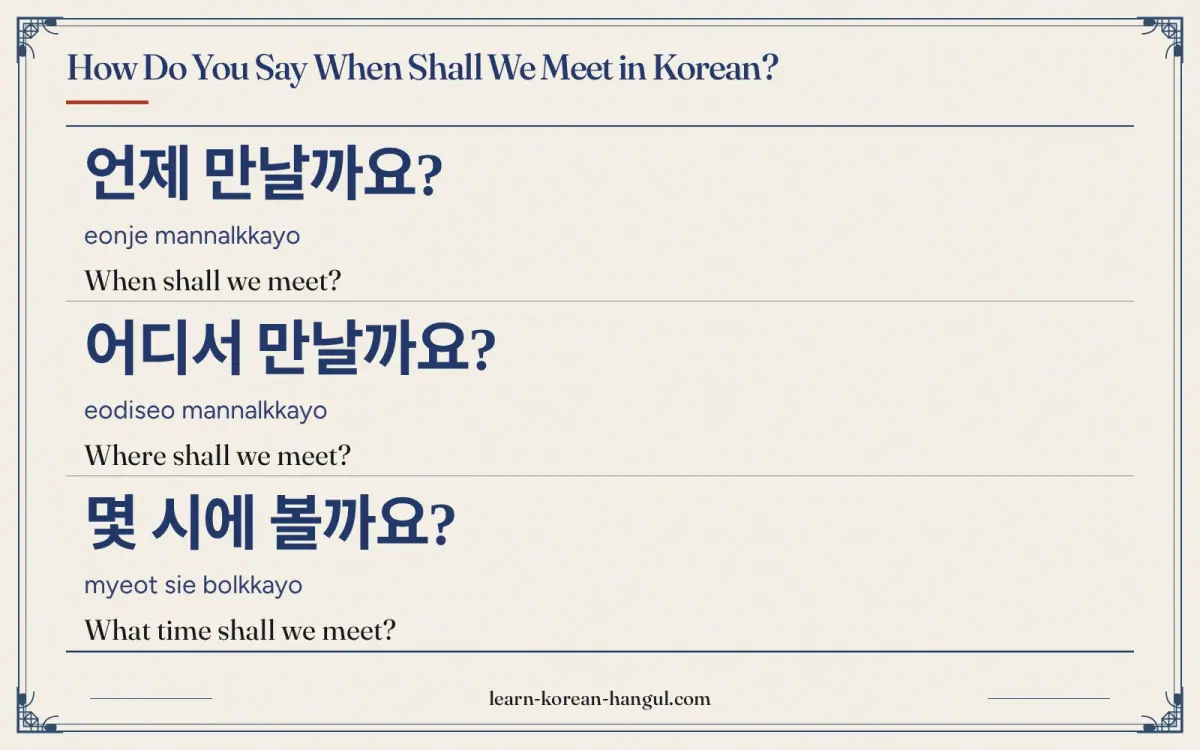
The standard question is 언제 만날까요?, and three partner questions finish the plan. Learn them as a set, because a real arrangement needs a time, a place and an hour.
| Question | Korean | Revised Romanization | Meaning |
|---|---|---|---|
| When? | 언제 만날까요? | eonje mannalkkayo | When shall we meet? |
| Where? | 어디서 만날까요? | eodiseo mannalkkayo | Where shall we meet? |
| What time? | 몇 시에 볼까요? | myeot sie bolkkayo | What time shall we meet? |
| Suggest a day | 내일 어때요? | naeil eottaeyo | How about tomorrow? |
The verb 만나다 means "to meet", and 보다 ("to see") is the everyday choice when the plan is simple, which is why 몇 시에 볼까요? literally says "what time shall we see each other?". The word 언제 means "when", 어디서 means "where (at)", and 어때요 asks "how is it?" or "how about it?". The next section shows each form in a sentence.
What Are the Polite Ways to Say When Shall We Meet?
All four partners below are polite. Korean marks the listener with speech levels, the sentence endings explained in the guide to Korean speech levels. The polite style ends in -요, and the -ㄹ까요 ending adds the meaning "shall we".
Polite: 언제 만날까요? (eonje mannalkkayo)
Polite · 해요체This is the default question. It asks the other person to name a time, so it works when you have no preference. Start from it whenever you want to open a plan.
이번 주에 언제 만날까요?
ibeon jue eonje mannalkkayo?
When shall we meet this week?
Polite: 어디서 만날까요? (eodiseo mannalkkayo)
Polite · 해요체어디서 is short for 어디에서, "where, at what place". Ask it after the day is fixed, or when you want the other person to choose the spot.
토요일에 어디서 만날까요?
toyoire eodiseo mannalkkayo?
Where shall we meet on Saturday?
Polite: 몇 시에 볼까요? (myeot sie bolkkayo)
Polite · 해요체몇 시 means "what time", and 에 marks the point in time. Using 보다 here sounds relaxed and natural, as in English "shall we see each other at six?".
저녁에 몇 시에 볼까요?
jeonyeoge myeot sie bolkkayo?
What time shall we meet in the evening?
Polite: 내일 어때요? (naeil eottaeyo)
Polite · 해요체This one proposes a specific day and asks for a reaction. Swap 내일 ("tomorrow") for 모레 ("the day after tomorrow") or 금요일 ("Friday"), or add 시간 to ask about the hour.
그럼 내일 어때요?
geureom naeil eottaeyo?
Then how about tomorrow?
Respectful: 언제 뵐까요? (eonje boelkkayo)
Polite · 해요체뵈다 and 뵙다 are the humble verbs for "to see (a senior)", and 뵐까요 comes from 뵈다. Use 언제 뵐까요? with a teacher, a client or a boss when you want to show extra respect. For everyone else, 만날까요 is fine.
선생님, 언제 뵐까요?
seonsaengnim, eonje boelkkayo?
Teacher, when shall we meet?
Casual: 언제 만날까? (eonje mannalkka)
Casual · 반말With close friends, drop -요 and say 만날까. This is the intimate style, the pattern used among friends of the same age or younger. Never use it with someone older or someone you have just met.
우리 언제 만날까?
uri eonje mannalkka?
When shall we meet?
Knowing the forms is half the skill, so the next section covers how the question is pronounced.
How Do You Pronounce 언제 만날까요?
언제 만날까요? is pronounced [언제 만날까요], eon-je man-nal-kka-yo, in six syllables, with a tense ㄲ in the fifth.
- 언 (eon): the open vowel ㅓ is unrounded, like the "u" in "bus", followed by n.
- 제 (je): a soft j and "eh".
- 만 (man): a clear m, "ah", then n.
- 날 (nal): the final ㄹ is a light tap or an l-sound that closes the syllable.
- 까 (kka): the tense ㄲ is said with a tight throat and no puff of air.
- 요 (yo): "yo", said lightly and quickly.
Say the whole question at an even speed; Korean does not stress one syllable heavily.
Sound Changes to Listen For
Four points matter in this family of questions:
- Tense ㄲ in -ㄹ까요. The ending is always written with ㄲ, so you read it as it looks: [만날까요]. No sound change is involved. Compare -ㄹ게요, which is written with ㄱ but said tense, [만날께요]; the National Institute of Korean Language (국립국어원) Standard Pronunciation rules (표준 발음법) cover that tensing after -ㄹ in Article 27. See tensification.
- 몇 시에 is [멷씨에]. The final ㅊ of 몇 is said as ㄷ, and the ㅅ after it becomes tense ㅆ. Revised Romanization writes this as myeot sie, because it does not show tensing caused by a neighbouring sound.
- 약속 is [약쏙]. After the final ㄱ, the ㅅ is said tense. You will meet this word in 약속 있어요? ("do you have plans?").
- 내일 어때요 links across the space. In natural speech the final ㄹ of 내일 moves onto 어, giving [내이러때요]. See the liaison rules.
Once the sounds feel natural, the next step is knowing when the question fits.
When Should You Use 언제 만날까요?, and When Should You Not?
Use 언제 만날까요? when you are making a plan together and want the other person to share the decision. Use a plain statement, not a question, when you already know the time.
Swap the question word to build the whole plan: 언제 for the day, 어디서 for the place, 몇 시에 for the hour. Each one asks for exactly one piece of information.
Situations Where It Fits
- Arranging with a friend. After a chat, 언제 만날까요? turns "we should meet" into a real plan.
- Setting up a work lunch. The polite ending suits colleagues of any rank; add 뵐까요 for a senior.
- Replying to an invitation. If someone says 한번 만나요, answer 좋아요, 언제 만날까요? to show you are keen.
Situations to Avoid
- When the time is already fixed. Say 내일 세 시에 만나요 as a statement, not a question.
- With a stranger or a very senior person, in casual form. 언제 만날까? is too familiar.
- For a one-sided order. -ㄹ까요 invites an answer, so it sounds odd when you only mean to inform.
Real exchanges show how the questions chain together.
What Does When Shall We Meet Sound Like in a Real Conversation?
Three short exchanges cover the usual cases: fixing a day, fixing a place and fixing a time. Listen for the question word that opens each line.
Fixing a Day
Minho
이번 주에 언제 만날까요?
ibeon jue eonje mannalkkayo?
When shall we meet this week?
Jisu
토요일 어때요?
toyoil eottaeyo?
How about Saturday?
Minho
좋아요. 토요일에 봐요.
joayo. toyoire bwayo
Sounds good. See you Saturday.
What to notice: Jisu answers a "when" question with a day plus 어때요, and Minho agrees with 좋아요. 봐요 is the polite form of 보다, here meaning "let's see each other".
Fixing a Place
Minho
어디서 만날까요?
eodiseo mannalkkayo?
Where shall we meet?
Jisu
강남역 3번 출구에서요.
Gangnamnyeok sambeon chulgueseoyo
At exit 3 of Gangnam Station.
Minho
알겠어요. 거기서 기다릴게요.
algesseoyo. geogiseo gidarilgeyo
Got it. I'll wait there.
What to notice: giving an exit number is how people name a precise spot. 기다릴게요 means "I'll wait", a promise from the speaker.
Fixing a Time
Jisu
몇 시에 볼까요?
myeot sie bolkkayo?
What time shall we meet?
Minho
여섯 시 괜찮아요?
yeoseot si gwaenchanayo?
Is six o'clock okay?
Jisu
네, 괜찮아요.
ne, gwaenchanayo
Yes, that's fine.
What to notice: hours use native Korean numbers, so six is 여섯 and "six o'clock" is 여섯 시. Making plans also has a social side.
What Should You Know about the Culture behind Making Plans?
Koreans often fix a plan in two steps, first the day and then the exact spot, and they like landmarks.
- Exit numbers. Seoul subway stations have numbered exits, so a meeting point is often "station name plus exit number". The follow-up 몇 번 출구에서요? ("which exit?") is very common.
- Messaging apps. Plans are usually settled by text. The spoken question in this lesson is what you say when you are chatting face to face or on the phone.
- Confirming again. People often repeat the plan the day before with 내일 괜찮으세요? ("is tomorrow still fine?"). It is polite, not nagging.
- Group plans. In a group, one person usually proposes the time with 어때요?, and others answer with 좋아요 or a counter-offer.
An expert insight: -ㄹ까요 is the polite way to make a suggestion without sounding pushy. Compare it with the plain 만나요, which can sound like a decision. The next section lists the mistakes that follow from that difference.
What Mistakes Do Learners Make with When Shall We Meet in Korean?
Most mistakes come from the ending, the question word or the politeness level.
| Mistake | Why it is a problem | Fix |
|---|---|---|
| 언제 만나요? to suggest | It asks "when do you meet?", a plain present question | Say 언제 만날까요? |
| Dropping 에 in 몇 시 | 몇 시 볼까요 is heard in fast speech, but it sounds clipped in careful polite talk | Say 몇 시에 볼까요? |
| 어디 만날까요 without 서 | The place marker is missing | Say 어디서 만날까요? |
| 만날까 with a teacher | The casual ending is too familiar | Say 만날까요 or 뵐까요 |
| Reading 몇 시 as [며치] | The final ㅊ is said as ㄷ and ㅅ is tense | Say [멷씨] |
Learners often think 만나요 is the only way to say "let's meet". In fact 만나요 can work as a suggestion when the context is clear, but -ㄹ까요 is the form that asks the other person to agree. Several other English questions fold into this page.
Is It the Same as Meet up, Make Plans or Let's Meet?
Mostly yes. Each English phrase maps onto the same few Korean patterns.
- Meet up in Korean: 만나다 for a planned meeting, 보다 for a casual one. 우리 만나요 ("let's meet") is the short invitation.
- Make plans in Korean: 약속 [약쏙] means "an appointment or plan". 약속을 잡아요 means "I'll set up a plan", and 약속 있어요? asks "do you have plans?".
- Where shall we meet in Korean: 어디서 만날까요? is the exact question.
- Let's meet in Korean: 만나요 (polite), 만나자 (casual) and 만납시다 (formal and rare in daily talk) all invite someone to meet.
Now practise the set until it feels automatic.
Practice: Say It Aloud
Play the slow clip of 언제 만날까요? three times and repeat it. Then pick a form for each situation. Answers follow.
- You want to ask a close friend when to meet.
- You want to ask your university professor when you can see them.
- You know the day, and you want to ask the place.
- You propose Friday and want a reaction.
Answers: 1. 언제 만날까? 2. 언제 뵐까요? 3. 어디서 만날까요? 4. 금요일 어때요?
Use the phrase flashcards to drill these questions with audio.
Related Phrases to Learn Next
- Are you free in Korean: 시간 있어요? to check before you plan.
- I'm on my way in Korean: the message you send on the day.
- Let's go in Korean: the cheerful next step once you meet.
This guide belongs to the Korean small talk collection. What this page does not cover: the full set of time words, the days of the week and how to name every meeting place, which deserve their own lessons. Master 언제 만날까요? and its three partners, and you can say when shall we meet in Korean in any friendly or work setting.
Frequently Asked Questions
How do you say when shall we meet in Korean?
Say 언제 만날까요? (eonje mannalkkayo). The ending -ㄹ까요 means "shall we?", so the sentence is a polite suggestion that asks the other person to choose. Replace 언제 with 어디서 for the place or 몇 시에 for the time, and you can plan a whole meeting with the same pattern.
How do you pronounce 언제 만날까요?
It sounds like eon-je man-nal-kka-yo, six syllables with no stress on any one of them. The only special sound is the tense ㄲ in 까, which you say with a tight throat and no puff of air. Each syllable keeps its spelling, so there are no hidden sound changes in this question.
What is the difference between 언제 만날까요? and 어디서 만날까요?
Both use the same -ㄹ까요 ending and both are polite. The difference is the question word. 언제 asks about time, so the answer is a day or an hour, while 어디서 asks about place, so the answer is a location such as a station exit. Ask them one after the other.
Can I use 언제 만날까요? with friends, elders and strangers?
Yes for strangers, co-workers and most elders, because the ending -요 is polite. With a teacher, a boss or a client, use the more respectful 언제 뵐까요?. With close friends of your age or younger, drop -요 and say 언제 만날까?, but avoid that casual form with anyone you do not know well.
What is the most common mistake with when shall we meet in Korean?
Using 만나요 as a question when you want to suggest. 언제 만나요? asks when a meeting happens, like a plain present-tense question, while 언제 만날까요? proposes a plan and invites a reply. The second most common mistake is dropping 에 from 몇 시에; that is heard in fast speech, but it sounds clipped in careful polite talk.