어디서 갈아타요?
어디서 갈아타요?
What you'll learn
- Ask where to change trains, which line to change to, and whether a train will work for you.
- Choose between 갈아타다 and 바꾸다, and between 호선 and 번.
- Say 갈아타요 as [가라타요] and 몇 호선 as [며토선], with the sound changes behind them.
- Understand the replies a station worker is likely to give.
Before you start: a transfer question usually follows finding the station, so see where is the subway station in Korean. Time: about 15 minutes. Audio plays only when you press a button.
How Do You Say Where Do I Transfer in Korean?
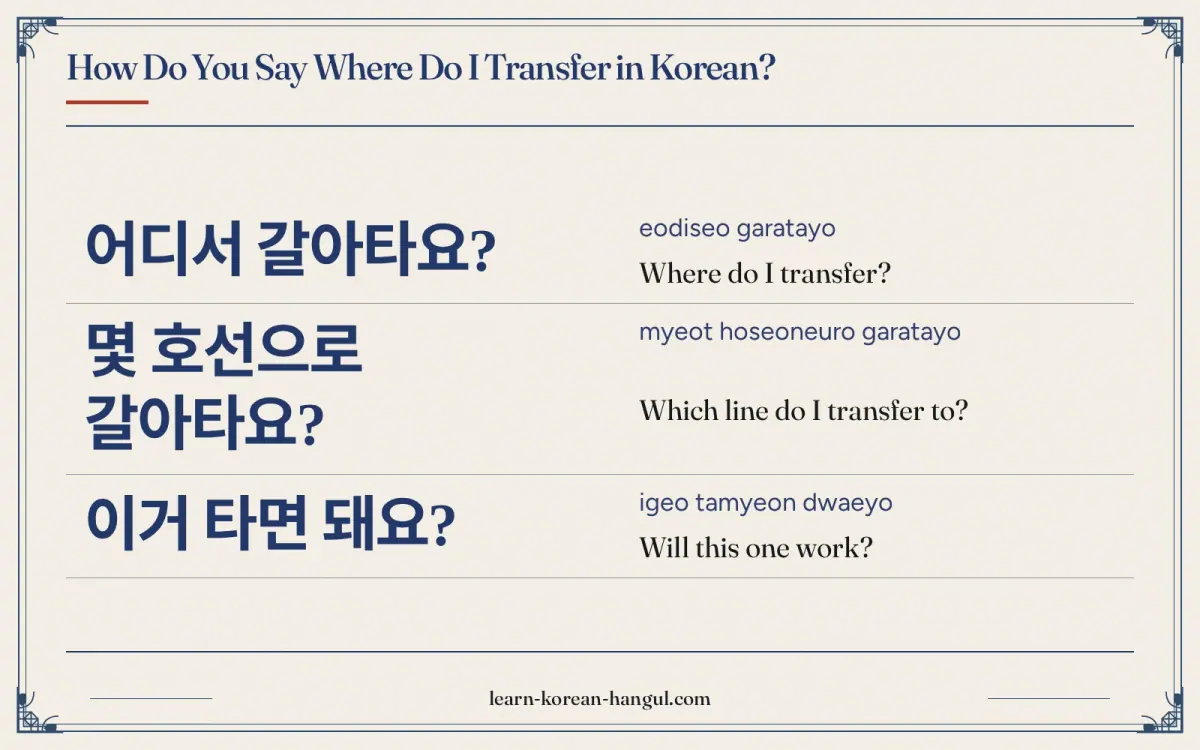
The standard question is 어디서 갈아타요?, and two partners cover the rest of a transfer. Learn all three, because one answers "where", one answers "which line", and one checks that you are on the right train.
| Situation | Korean | Revised Romanization | Meaning |
|---|---|---|---|
| Where to change | 어디서 갈아타요? | eodiseo garatayo | Where do I transfer? |
| Which line to change to | 몇 호선으로 갈아타요? | myeot hoseoneuro garatayo | Which line do I transfer to? |
| Check this train | 이거 타면 돼요? | igeo tamyeon dwaeyo | Will this one work? |
The word 어디서 is short for 어디에서, "where, at what place". The verb 갈아타다 joins 갈다 ("to replace") and 타다 ("to ride"), so the literal meaning is "to switch and ride". The ending -아요 makes the sentence polite. The next section shows each form in a sentence.
What Are the Polite Ways to Say Where Do I Transfer?
Every form below is polite, because you almost always ask staff or strangers. Korean marks the listener with speech levels, the sentence endings explained in the guide to Korean speech levels. The ending -요 makes a sentence polite, and -ㅂ니까 makes a question formal.
Polite: 어디서 갈아타요? (eodiseo garatayo)
Polite · 해요체This is the default. Use it on a platform, at a ticket window or with a driver. It asks only for the place, so the answer is a station name.
저기요, 어디서 갈아타요?
jeogiyo, eodiseo garatayo?
Excuse me, where do I transfer?
Polite: 몇 호선으로 갈아타요? (myeot hoseoneuro garatayo)
Polite · 해요체몇 means "how many" or "which number", 호선 is the counter for subway lines, and 으로 marks the direction or the thing you are switching to. Ask this when you already know where you will change but not which line to take.
홍대에 가요. 몇 호선으로 갈아타요?
hongdaee gayo. myeot hoseoneuro garatayo?
I'm going to Hongdae. Which line do I transfer to?
Polite: 이거 타면 돼요? (igeo tamyeon dwaeyo)
Polite · 해요체Here 이거 is "this one", 타면 is "if I ride", and 돼요 means "is it OK / will it do". Point at a train or a bus and ask. The structure -(으)면 돼요? is the everyday way to ask "will it be fine if I do this?".
이거 타면 돼요?
igeo tamyeon dwaeyo?
Will this one work if I take it?
Formal: 어디서 갈아탑니까? (eodiseo garatamnikka)
Formal · 합쇼체The formal question ending -ㅂ니까 suits an official counter or a business setting. It is correct but stiff on a street platform.
실례합니다. 어디서 갈아탑니까?
sillyehamnida. eodiseo garatamnikka?
Excuse me. Where do I transfer? (formal)
Casual: 어디서 갈아타? (eodiseo garata)
Casual · 반말When you travel with a friend, drop -요 and say 갈아타. Never use it with staff, strangers or elders.
우리 어디서 갈아타?
uri eodiseo garata?
Where do we transfer?
Asking is only half of the exchange, so the next section covers what you will hear back.
What Will People Answer When You Ask?
Most replies are short and name a station, a line or a direction. Learn these six, and listen for the verb ending -세요, which is the polite request ending.
| Korean | Revised Romanization | Meaning |
|---|---|---|
| 서울역에서 갈아타세요 | Seoullyeogeseo garataseyo | Change at Seoul Station |
| 4호선으로 갈아타세요 | sahoseoneuro garataseyo | Change to line 4 |
| 반대편에서 타세요 | bandaepyeoneseo taseyo | Take it on the opposite platform |
| 한 정거장 더 가세요 | han jeonggeojang deo gaseyo | Go one more stop |
| 환승 통로로 가세요 | hwanseung tongnoro gaseyo | Go through the transfer passage |
| 여기서 타면 돼요 | yeogiseo tamyeon dwaeyo | You can take it from here |
Notice that 서울역에서 is pronounced [서울려게서]: a ㄴ sound is inserted before 역 and turns into ㄹ after the ㄹ of 울, and Revised Romanization writes this as Seoullyeogeseo. Hearing the answer clearly depends on the sounds of the question, which come next.
How Do You Pronounce 어디서 갈아타요?
어디서 갈아타요? is pronounced [어디서 가라타요], eo-di-seo ga-ra-ta-yo, in seven syllables with a smooth link between 갈 and 아.
- 어 (eo): the open vowel ㅓ is unrounded, like the "u" in "bus".
- 디 (di): a soft d, like the one in "dean".
- 서 (seo): an s followed by the same ㅓ sound.
- 가 (ga): the first half of 갈아; the ㄹ moves forward.
- 라 (ra): the moved ㄹ plus 아, a quick tap close to the d in "ladder".
- 타 (ta): a puff of air, as in "top".
- 요 (yo): "yo", said lightly.
Sound Changes to Listen For
Four points make the transfer questions sound natural:
- Liaison (연음). When a syllable ends in a consonant and the next begins with the silent ㅇ, the consonant moves across. That is why 갈아타요 sounds like [가라타요]. See the liaison rules.
- Aspiration in 몇 호선. The ㅊ of 몇 is said as ㄷ, and ㄷ meeting ㅎ becomes ㅌ, so the phrase sounds like [며토선]. The National Institute of Korean Language (국립국어원) Standard Pronunciation rules (표준 발음법) describe this merger in Article 12.
- 으로 links across. After 호선, the ㄴ moves onto 으, giving [호서느로]. The whole question sounds like [며토서느로 가라타요].
- Nasalization in 갈아탑니까. ㅂ before ㄴ becomes ㅁ, giving [가라탐니까]. See ㅂ-to-ㅁ nasalization.
With the sounds in place, the next question is where each form belongs.
When Should You Use 어디서 갈아타요?, and When Should You Not?
Use 어디서 갈아타요? whenever you need to change vehicles and do not know the point. Use 이거 타면 돼요? when you are standing in front of a specific train or bus and want a yes or no.
Situations Where It Fits
- Subway platforms and ticket gates. Ask the staff member or another passenger, and show your route on a phone if the noise is loud.
- Bus stops. The same verb works for buses, so 어디서 갈아타요? is fine for a bus-to-subway change.
- Intercity stations. Ask at the information desk before a long trip.
Situations to Avoid
- Using it for a taxi. You do not transfer in a taxi, so say 여기서 세워 주세요 or name a place instead.
- Asking a stranger casually. 어디서 갈아타? is too familiar; keep the -요.
- Asking about an exit. If you want a way out, ask 몇 번 출구예요?, not a transfer question.
Short exchanges make the choice easier to remember.
What Does Asking Where to Transfer Sound Like in a Real Conversation?
Three exchanges cover the common cases: a station worker, a line question and a quick check on a platform. Listen for the line number and the polite request ending.
Asking a Station Worker
Traveller
저기요, 어디서 갈아타요?
jeogiyo, eodiseo garatayo?
Excuse me, where do I transfer?
Staff
서울역에서 4호선으로 갈아타세요.
Seoullyeogeseo sahoseoneuro garataseyo
Change to line 4 at Seoul Station.
Traveller
알겠어요. 감사합니다.
algesseoyo. gamsahamnida
Got it. Thank you.
What to notice: the staff member gives the station first and the line second. 알겠어요 means "I understand".
Asking Which Line
Traveller
홍대에 가요. 몇 호선으로 갈아타요?
hongdaee gayo. myeot hoseoneuro garatayo?
I'm going to Hongdae. Which line do I transfer to?
Passenger
시청에서 2호선으로 갈아타세요.
sicheongeseo ihoseoneuro garataseyo
Change to line 2 at City Hall.
Traveller
아, 2호선이요. 감사합니다.
a, ihoseoniyo. gamsahamnida
Oh, line 2. Thank you.
What to notice: the traveller repeats the answer with 이요 to confirm it, which is a polite habit. Repeating a number back is a quick way to be sure.
Checking a Train
Traveller
이거 타면 돼요?
igeo tamyeon dwaeyo?
Will this one work if I take it?
Passenger
아니요, 반대편에서 타세요.
aniyo, bandaepyeoneseo taseyo
No, take it on the opposite platform.
Traveller
네, 감사합니다.
ne, gamsahamnida
Yes, thank you.
What to notice: 반대편 means the opposite side, a common reason a train is wrong. Small habits at stations also help.
What Should You Know about the Culture behind Changing Trains?
Seoul and other big Korean cities run several connected lines, so a transfer is a normal part of a trip.
- Line colours and numbers. Each line has a number and a colour, so people say the number: 2호선 (line 2). Signs show the number in a coloured circle.
- Transfer stations. Stations where lines meet are called 환승역. Signs follow the line colour, and the screens often show English too.
- Reading the platform. Direction signs usually name a terminal or major station in that direction (○○ 방면), as well as the next stop, so know where your line ends before you go.
- Transit cards. A rechargeable transit card normally allows linked rides between the subway and buses, but the fare rules change, so check the notice at the station or the operator's website.
An expert insight: learners worry about the exact words, but pointing at the route map and saying the station name with 어디서 갈아타요? works almost every time. The next section lists the mistakes that cause the most confusion.
What Mistakes Do Learners Make with Where Do I Transfer in Korean?
Most mistakes come from picking the wrong verb or the wrong counter.
| Mistake | Why it is a problem | Fix |
|---|---|---|
| 어디서 바꿔요? | 바꾸다 swaps things, such as money or a seat | Say 갈아타요 for vehicles |
| 2번선 for a subway line | 번 counts exits or platforms, not lines | Say 2호선 |
| 갈아타요 as [갈아타요] | The ㄹ should move: spoken without the link it sounds foreign | Say [가라타요] |
| Missing 서 in 어디 갈아타요 | The place marker is missing | Say 어디서 갈아타요? |
| 환승 as a bare noun in a question | 환승 어디예요? is understood, but sounds clipped | Say 환승역이 어디예요? or 갈아타요 |
Learners often assume that 바꾸다 is "change" in every situation. In fact Korean separates changing vehicles (갈아타다), changing clothes (갈아입다) and exchanging items (바꾸다), so the verb is a clue to the object. Several English queries fold into this page.
Is It the Same as Transfer, Change Trains or Transfer Subway?
Yes. Each English phrase maps onto the same Korean verb or noun.
- Transfer in Korean: 환승 is the noun, as in 환승역 (transfer station), and 환승하다 is the verb: 환승해요 (hwanseunghaeyo). See the word page on transfer in Korean.
- Change trains in Korean: 열차를 갈아타요 or simply 갈아타요. The object is often dropped.
- Transfer subway in Korean: 지하철로 갈아타요 means "I change to the subway", for example from a bus. Between subway lines, name the line: 2호선으로 갈아타요. The verb for buses is the same.
- Where do I transfer in Korean: 어디서 갈아타요? is the exact question.
Now practise the question until it feels automatic.
Practice: Say It Aloud
Play the slow clip of 어디서 갈아타요? three times and repeat it. Then choose a form for each situation. Answers follow.
- You ask a station worker where to change.
- You know the station, but not the line number.
- You are pointing at a train and want to confirm.
- You are at an official counter and want the formal form.
Answers: 1. 어디서 갈아타요? 2. 몇 호선으로 갈아타요? 3. 이거 타면 돼요? 4. 어디서 갈아탑니까?
Use the phrase flashcards to drill the question with audio.
Related Phrases to Learn Next
- Where is the subway station in Korean: 지하철역이 어디예요? to find the station first.
- How do I get to in Korean: 어떻게 가요? to ask for the whole route.
This guide belongs to the Korean taxi phrases collection, with the other transport questions. What this page does not cover: reading a full route map and the fare rules, which deserve their own lessons. Master the three questions above, and you can say where do I transfer in Korean on any train or bus.
Frequently Asked Questions
How do you say where do I transfer in Korean?
Say 어디서 갈아타요? (eodiseo garatayo). The verb 갈아타다 means to change from one vehicle to another, and 어디서 means "where". The sentence ends with the polite -요, so it suits staff and strangers. For the line number, ask 몇 호선으로 갈아타요? instead.
How do you pronounce 어디서 갈아타요?
It sounds like eo-di-seo ga-ra-ta-yo, with seven syllables. The only sound change is the link between 갈 and 아: the final ㄹ moves forward, so you say 가라 and not 갈아. Keep the ㅓ vowel relaxed and unrounded, and say the last syllable lightly.
What is the difference between 어디서 갈아타요? and 몇 호선으로 갈아타요?
Both are polite and both use 갈아타요. The first asks for a place, so the answer is a station name. The second asks for a line, so the answer is a number such as 2호선. Use the first when you do not know where to change, and the second when you do.
Can I use 어디서 갈아타요? with friends, elders and strangers?
Yes for strangers and elders, because the ending -요 is polite. With a close friend you can drop it and say 어디서 갈아타?. At an official counter, the formal 어디서 갈아탑니까? is also fine. Avoid the casual form with staff and with anyone you do not know well.
What is the most common mistake with where do I transfer in Korean?
Using 바꾸다 for changing trains. 바꾸다 means to swap or exchange things, so 어디서 바꿔요? sounds like asking where to swap an item. Use 갈아타요 for vehicles. The second most common mistake is saying 번 instead of 호선 for subway lines.