ATM 어디 있어요?
ATM 어디 있어요?
What you'll learn
- Ask for a cash machine, an exchange office and a cash withdrawal with three polite forms.
- Tell the machine (ATM, 현금인출기) from the bank (은행) and the exchange office (환전소).
- Say 있어요 as [이써요] and 싶어요 as [시퍼요], with the sound changes behind them.
- Understand the short replies you will get about floors, shops and directions.
Before you start: you will often pay by card after you find cash, so do you take cards in Korean is a useful companion. Time: about 15 minutes. Audio plays only when you press a button.
How Do You Say Where Is the ATM in Korean?
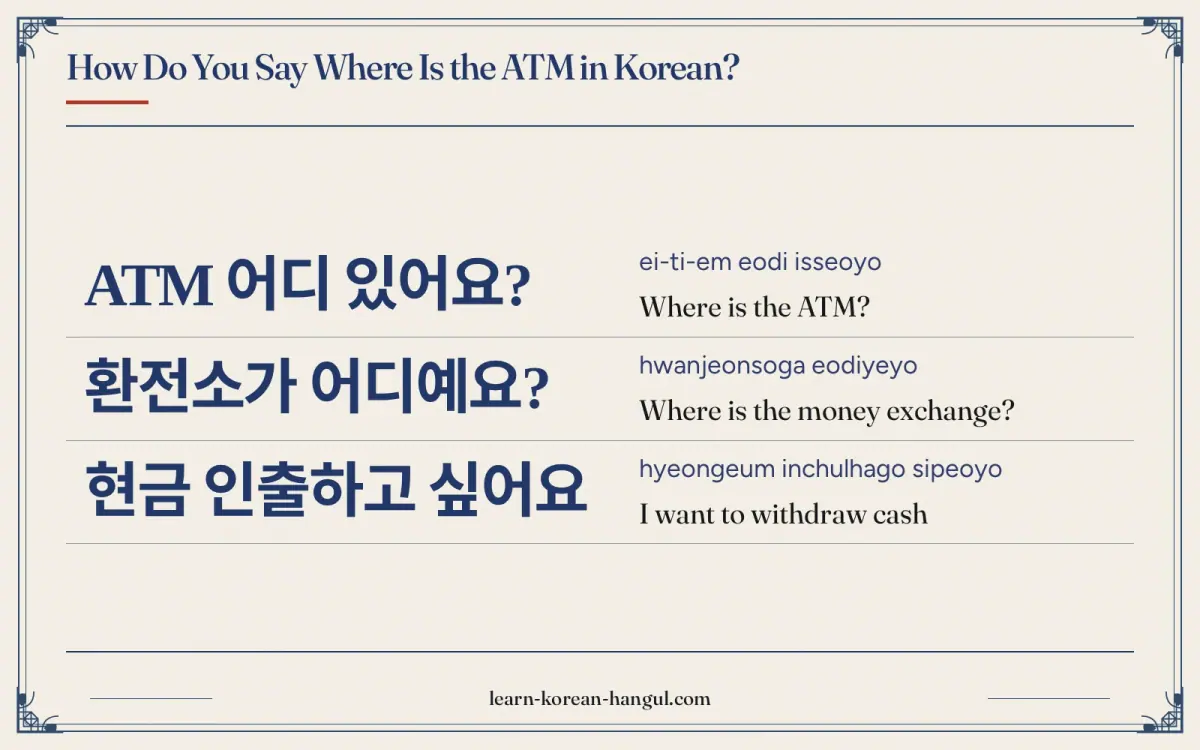
The standard question is ATM 어디 있어요?, and two partners cover the other money tasks. Pick the form by what you want: a machine, an exchange counter or a withdrawal.
| Situation | Korean | Revised Romanization | Meaning |
|---|---|---|---|
| Find a cash machine | ATM 어디 있어요? | ei-ti-em eodi isseoyo | Where is the ATM? |
| Find a money exchange | 환전소가 어디예요? | hwanjeonsoga eodiyeyo | Where is the money exchange? |
| Say what you want | 현금 인출하고 싶어요 | hyeongeum inchulhago sipeoyo | I want to withdraw cash |
The word 어디 means "where", and 있어요 is the polite form of 있다, "to exist or be located". The particle 가 in 환전소가 marks the subject, and 예요 is the polite "is". The next section shows each form in a sentence.
What Are the Polite Ways to Say Where Is the ATM?
Every form below is polite or formal, because you almost always ask strangers or staff. Korean marks the listener with speech levels, the sentence endings explained in the guide to Korean speech levels. The ending -요 makes a sentence polite, and -ㅂ니까 makes a question formal.
Polite: ATM 어디 있어요? (ei-ti-em eodi isseoyo)
Polite · 해요체This is the default. In spoken Korean the particle is often dropped, so the machine word comes straight before 어디. It suits staff, cashiers and passers-by.
저기요, ATM 어디 있어요?
jeogiyo, ei-ti-em eodi isseoyo?
Excuse me, where is the ATM?
Polite: 환전소가 어디예요? (hwanjeonsoga eodiyeyo)
Polite · 해요체환전 means "exchanging currency" and 소 means "place", so 환전소 is an exchange office. Here 어디예요 is natural, because 환전소 is a named kind of place, much like asking for a shop.
실례합니다, 환전소가 어디예요?
sillyehamnida, hwanjeonsoga eodiyeyo?
Excuse me, where is the money exchange?
Polite: 현금 인출하고 싶어요 (hyeongeum inchulhago sipeoyo)
Polite · 해요체This is not a question. It states what you want, which is useful at a bank counter. 현금 is "cash", 인출하다 is "to withdraw", and -고 싶어요 means "I want to".
현금 인출하고 싶어요.
hyeongeum inchulhago sipeoyo
I want to withdraw cash.
Polite: 환전하고 싶어요 (hwanjeonhago sipeoyo)
Polite · 해요체When you reach an exchange counter, swap the verb to say what you need. The pattern is the same: noun-verb plus -고 싶어요.
달러를 원으로 환전하고 싶어요.
dalleoreul woneuro hwanjeonhago sipeoyo
I want to exchange dollars into won.
Formal: 현금인출기가 어디에 있습니까? (hyeongeuminchulgiga eodie itseumnikka)
Formal · 합쇼체현금인출기 is the full word for a cash machine, and -ㅂ니까 is the formal question ending. It suits a hotel front desk or a business visit, and it sounds stiff in a convenience store.
실례합니다. 현금인출기가 어디에 있습니까?
sillyehamnida. hyeongeuminchulgiga eodie itseumnikka?
Excuse me. Where is the cash machine? (formal)
Casual: ATM 어디 있어? (ei-ti-em eodi isseo)
Casual · 반말With close friends, drop -요: 있어. Never use it with strangers, staff or elders.
야, ATM 어디 있어?
ya, ei-ti-em eodi isseo?
Hey, where's the ATM?
Asking is only half the exchange, so the next section covers what you will hear back.
What Will People Answer When You Ask?
Most answers are short and point to a place, so learn six replies. People often point or nod as they speak.
| Korean | Revised Romanization | Meaning |
|---|---|---|
| 저쪽에 있어요 | jeojjoge isseoyo | It's over there |
| 편의점 안에 있어요 | pyeonuijeom ane isseoyo | It's inside the convenience store |
| 은행 안에 있어요 | eunhaeng ane isseoyo | It's inside the bank |
| 길 건너편에 있어요 | gil geonneopyeone isseoyo | It's across the road |
| 1층에 있어요 | ilcheunge isseoyo | It's on the first floor |
| 지하에 있어요 | jihae isseoyo | It's in the basement |
The reply keeps the same verb as the question, 있어요, which helps you spot the answer. Knowing the replies prepares you for the sounds in the question itself.
How Do You Pronounce ATM 어디 있어요?
ATM 어디 있어요? is pronounced [에이티엠 어디 이써요], e-i-ti-em eo-di i-sseo-yo, in nine syllables with a smooth link between 있 and 어.
- 에이 (e-i): the Korean way of saying the English letter A, a short "eh-ee".
- 티 (ti): like "tee", with a puff of air.
- 엠 (em): the letter M, said "em".
- 어디 (eodi): start with the open vowel ㅓ, unrounded like the "u" in "bus", then "dee".
- 이 (i): the first half of 있어요, just "ee".
- 써 (sseo): the ㅆ of 있 moves forward and joins 어.
- 요 (yo): "yo", said lightly.
Sound Changes to Listen For
Four points make the question and its partners sound natural:
- Liaison (연음). When a syllable ends in a consonant and the next one starts with the silent ㅇ, the consonant moves across. That is why 있어요 sounds like [이써요]. See the liaison rules.
- 싶어요 is [시퍼요]. The ㅍ moves onto the next syllable in the same way, so you say 시퍼요.
- No tensing in 인출기. After a Sino-Korean ㄹ, only a following ㄷ, ㅅ or ㅈ is said tense. The ㄱ in 인출기 stays plain, so it is [인출기].
- Tensing in 있습니까. ㅆ before ㅅ is said as ㄷ, and the next ㅅ is tense, giving [읻씀니까]. See tensification.
Once the sounds are clear, the remaining skill is knowing which form fits.
When Should You Use ATM 어디 있어요?, and When Should You Not?
Use ATM 어디 있어요? when you want a cash machine and you are on the street or in a shop. Use 환전소가 어디예요? when you want to change currency, and 현금 인출하고 싶어요 when you are already at a counter.
Situations Where It Fits
- Convenience stores and cafes. Ask the clerk; many shops know the nearest machine.
- Airports and stations. Machines are common near arrival halls, and staff at information desks can point.
- Hotels. The front desk can tell you whether the building has a machine inside.
Situations to Avoid
- Asking a bank clerk for the machine. If you are already inside a bank, ask for the counter, 창구, or state what you want with 인출하고 싶어요.
- Using the casual form with staff. ATM 어디 있어? is for friends only.
- Asking for an exchange at an ATM. Most cash machines only give won, so use 환전소 to change currency.
Examples in real exchanges make the choices easier to remember.
What Does Asking Where the ATM Is Sound Like in a Real Conversation?
Three short exchanges cover the usual cases: a street question, an exchange counter and a bank withdrawal. Listen for the opening phrase and the answer.
Asking a Convenience Store Clerk
Traveller
저기요, ATM 어디 있어요?
jeogiyo, ei-ti-em eodi isseoyo?
Excuse me, where is the ATM?
Clerk
저기 편의점 안에 있어요.
jeogi pyeonuijeom ane isseoyo
There, inside the convenience store.
Traveller
감사합니다.
gamsahamnida
Thank you.
What to notice: the clerk answers with the same verb, 있어요, and a place. Thank people with 감사합니다.
Finding a Money Exchange
Traveller
환전소가 어디예요?
hwanjeonsoga eodiyeyo?
Where is the money exchange?
Hotel Clerk
길 건너편 1층에 있어요.
gil geonneopyeon ilcheunge isseoyo
It's on the first floor across the road.
Traveller
여권이 필요해요?
yeogwoni piryohaeyo?
Do I need my passport?
Hotel Clerk
네, 여권을 가져가세요.
ne, yeogwoneul gajyeogaseyo
Yes, please take your passport.
What to notice: 필요해요 means "it is needed", and exchange offices often ask to see a passport. 가져가세요 is the polite request "please take it with you".
Withdrawing Cash at a Bank
Customer
현금 인출하고 싶어요.
hyeongeum inchulhago sipeoyo
I want to withdraw cash.
Staff
카드를 넣으세요. 비밀번호를 눌러 주세요.
kadeureul neoeuseyo. bimilbeonhoreul nulleo juseyo
Please insert your card. Please enter your PIN.
Customer
네, 알겠어요.
ne, algesseoyo
Yes, I understand.
What to notice: 비밀번호 means PIN or passcode, and 눌러 주세요 is "please press". A few local habits also help when you look for cash.
What Should You Know about the Culture behind Cash in Korea?
Cards are common in Korea, but cash still helps in markets, small shops and some taxis. Knowing the habits saves time.
- Foreign cards. Some machines accept only cards issued in Korea. Look for machines marked Global or showing your card's logo. These are often found in bank branches, airports and many convenience stores, but check the screen before you insert the card.
- Fees and limits. Fees and daily limits vary by machine and card. Read the screen, and check with your own bank before you travel.
- Machine languages. Many machines have an English button, usually shown as English or 영어, on the first screen.
- Exchange offices. 환전소 are common in busy tourist areas. Counters often ask to see your passport, as in the dialogue above.
An expert insight: learners often wait to find a bank, but a short question in a convenience store is usually faster. The next section lists the mistakes that cause the most confusion.
What Mistakes Do Learners Make with Where Is the ATM in Korean?
Most mistakes come from picking the wrong noun or the wrong sound.
| Mistake | Why it is a problem | Fix |
|---|---|---|
| Saying 은행 for the machine | 은행 is the whole bank building | Say ATM or 현금인출기 |
| Looking for 환전 at an ATM | Most machines only give won | Ask 환전소가 어디예요? |
| Saying 어디 있어요 as [어디 있어요] | The link is missing, and the sound is stiff | Say [어디 이써요] |
| Using 어디 있어? with staff | It is casual and abrupt | Say 어디 있어요 |
| Saying A-T-M in English letter names | Staff may not catch it | Say 에이티엠 |
Learners often assume 어디예요 is wrong for a machine. In fact both patterns are heard, and 어디 있어요 is the usual choice when you mean "where can I find one". Several other English queries fold into this page.
Is It the Same as ATM, Exchange Money or Withdraw Cash?
Mostly yes. Each English phrase maps onto the same few Korean words.
- ATM in Korean: 에이티엠 is the spoken loanword. The formal word is 현금인출기, and signs usually show ATM or 현금인출기.
- Exchange money in Korean: 환전 is the noun, and 환전하다 is the verb: 환전하고 싶어요. You do this at a 환전소 or a bank.
- Withdraw cash in Korean: 현금 인출 or 출금 (chulgeum, with a plain ㄱ) are the usual words; casual speech also says 돈 찾다 or 돈 뽑다, as in 돈을 뽑아요.
- Money exchange in Korean: 환전소 is the place. Ask 환전소가 어디예요?
Now practise the question until it feels automatic.
Practice: Say It Aloud
Play the slow clip of ATM 어디 있어요? three times and repeat it. Then choose a form for each situation. Answers follow.
- You are at a convenience store and need cash.
- You need to change dollars into won.
- You are at a bank counter.
- You are at a hotel front desk and want the formal form.
Answers: 1. ATM 어디 있어요? 2. 환전소가 어디예요? 3. 현금 인출하고 싶어요. 4. 현금인출기가 어디에 있습니까?
Use the phrase flashcards to drill this question with audio.
Related Phrases to Learn Next
- Do you take cards in Korean: 카드 돼요? before you pay.
- How much is it in Korean: 얼마예요? once you reach the shop.
- Where is the bathroom in Korean: the same pattern with a new place.
This guide belongs to the Korean shopping phrases collection. What this page does not cover: card fees, exchange rates and the full banking vocabulary, which deserve their own lessons. Master the three forms above, and you can say where is the ATM in Korean in any city.
Frequently Asked Questions
How do you say where is the ATM in Korean?
Say ATM 어디 있어요? (ei-ti-em eodi isseoyo). Koreans pronounce the letters one by one, as 에이티엠, and 어디 있어요 asks where something is located. The ending -요 makes it polite, so it suits staff and strangers. For the machine's full name, ask 현금인출기가 어디에 있어요?
How do you pronounce ATM 어디 있어요?
It sounds like e-i-ti-em eo-di i-sseo-yo, with nine syllables. The key sound change is the link between 있 and 어: the ㅆ moves forward, so you say 이써요 and not 있어요. Keep the ㅓ vowel relaxed and unrounded, and say 요 lightly at the end.
What is the difference between ATM 어디 있어요? and 환전소가 어디예요?
Both are polite. ATM 어디 있어요? asks for a cash machine, which gives won from your card. 환전소가 어디예요? asks for an exchange office, which changes one currency for another across a counter. Choose the first for cash from an account and the second for currency.
Can I use ATM 어디 있어요? with friends, elders and strangers?
Yes for strangers and elders, because the ending -요 is polite. With close friends you can drop it and say ATM 어디 있어?. At a hotel desk or business visit, the formal 현금인출기가 어디에 있습니까? is also fine. Avoid the casual form with anyone you do not know well.
What is the most common mistake with where is the ATM in Korean?
Saying 은행 when you mean the machine. 은행 is the bank building, so staff may point you to a branch that is closed or has no machine outside. Say ATM or 현금인출기 instead. The second most common mistake is skipping the link and saying 있어요 without the [이써요] sound.