화장실이 어디예요?
화장실이 어디예요?
What you'll learn
- Ask for a public restroom with 화장실이 어디예요? and understand the usual answers.
- Choose among five forms: plain, longer, shortcut, very polite request and formal.
- Say 화장실이 as [화장시리], with the sound change that links 실 and 이.
- Avoid 욕실 and 변기 when you mean a public restroom.
Before you start: you will usually open with a short attention phrase, so excuse me in Korean helps. Time: about 15 minutes. Audio plays only when you press a button.
How Do You Say Where Is the Bathroom in Korean?
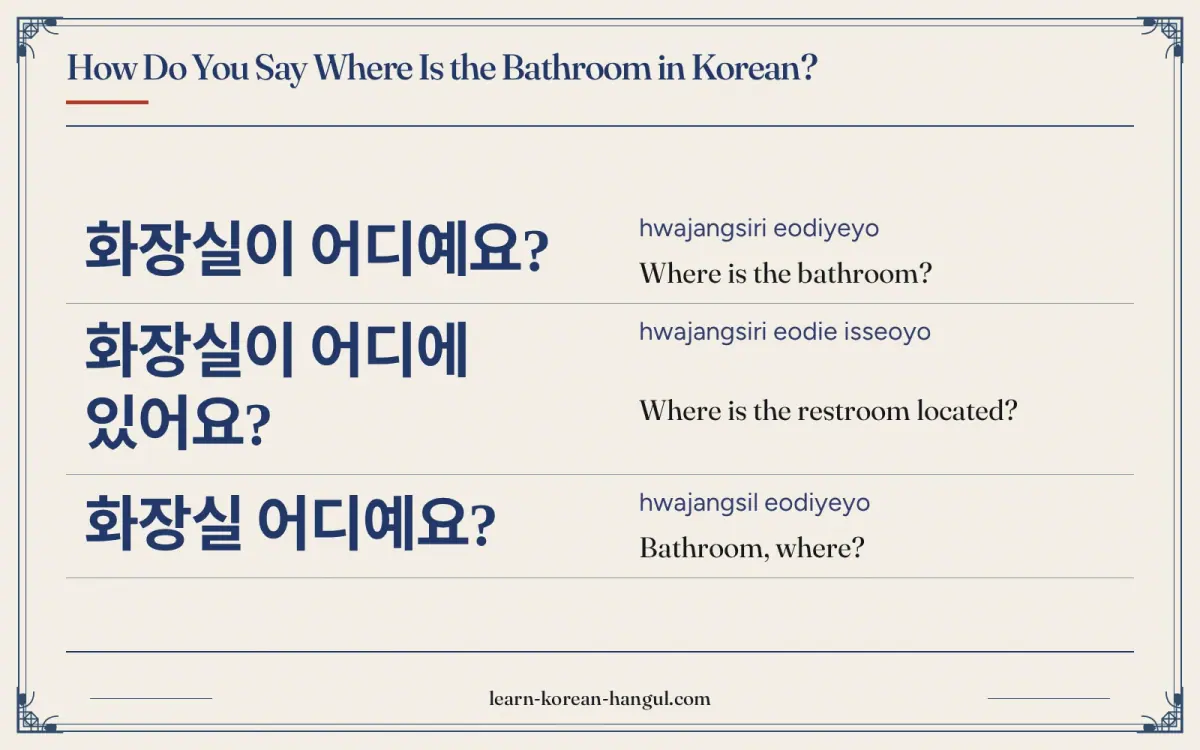
The standard way to ask is 화장실이 어디예요?, and four other forms cover other listeners and situations. Pick the form by who you are asking and whether you want directions or permission.
| Situation | Korean | Revised Romanization | Meaning |
|---|---|---|---|
| Ask where it is | 화장실이 어디예요? | hwajangsiri eodiyeyo | Where is the bathroom? |
| Ask where it is located | 화장실이 어디에 있어요? | hwajangsiri eodie isseoyo | Where is the restroom located? |
| Quick shortcut | 화장실 어디예요? | hwajangsil eodiyeyo | Bathroom, where? |
| Ask to borrow one | 화장실 좀 쓸 수 있을까요? | hwajangsil jom sseul su isseulkkayo | May I use the restroom? |
| Formal | 화장실이 어디입니까? | hwajangsiri eodiimnikka | Where is the restroom? (formal) |
The word 화장실 (化粧室) joins 화장, "grooming", and 실, "room", so the literal meaning is "grooming room". The particle 이 marks 화장실 as the subject of the question, 어디 means "where", and 예요 is the polite "is". The next section shows each form in a sentence.
What Are the Polite Ways to Say Where Is the Bathroom?
Every form below is polite or formal, because you almost always ask strangers. Korean marks the listener with speech levels, the sentence endings explained in the guide to Korean speech levels. The ending -요 makes a sentence polite; -ㅂ니까 makes a question formal.
Polite: 화장실이 어디예요? (hwajangsiri eodiyeyo)
Polite · 해요체This is the default. Use it with cafe staff, hotel clerks, mall staff, taxi drivers and passers-by. It asks only for the place, so the answer is a direction.
저기요, 화장실이 어디예요?
jeogiyo, hwajangsiri eodiyeyo?
Excuse me, where is the bathroom?
Polite: 화장실이 어디에 있어요? (hwajangsiri eodie isseoyo)
Polite · 해요체있어요 means "exists, is located", and 에 marks the place, so this version asks "where is it located?". It sounds a little fuller and more careful than the plain form, and the meaning is the same. It is a good choice when you want to sound slightly gentler.
실례합니다, 화장실이 어디에 있어요?
sillyehamnida, hwajangsiri eodie isseoyo?
Excuse me, where is the restroom located?
Polite Shortcut: 화장실 어디예요? (hwajangsil eodiyeyo)
Polite · 해요체Spoken Korean often drops the particle 이. The result, "bathroom, where?", is still polite because of -요. Use it when you are in a hurry or the place is noisy, and keep the tone friendly.
화장실 어디예요? 급해요.
hwajangsil eodiyeyo? geupaeyo
Where is the bathroom? It's urgent.
Very Polite: 화장실 좀 쓸 수 있을까요? (hwajangsil jom sseul su isseulkkayo)
Polite · 해요체This form asks permission, not directions. Use it in a small shop, an office or someone's home, where the restroom is not open to everyone. 좀 ("a little") softens the request, and -을까요 means "would it be possible?".
실례합니다, 화장실 좀 쓸 수 있을까요?
sillyehamnida, hwajangsil jom sseul su isseulkkayo?
Excuse me, may I use the restroom?
Formal: 화장실이 어디입니까? (hwajangsiri eodiimnikka)
Formal · 합쇼체The formal question ending -ㅂ니까 suits an announcement, a hotel front desk exchange or a business visit. It is correct but stiff for a street cafe.
실례합니다. 화장실이 어디입니까?
sillyehamnida. hwajangsiri eodiimnikka?
Excuse me. Where is the restroom? (formal)
Casual: 화장실 어디야? (hwajangsil eodiya)
Casual · 반말With close friends and family your own age or younger, drop -요: 어디야. Never use it with strangers, staff or elders.
야, 화장실 어디야?
ya, hwajangsil eodiya?
Hey, where's the bathroom?
Asking is only half the exchange, so the next section covers what you will hear back.
What Will People Answer When You Ask?
Most answers are short and point to a place, so learn six replies. People often point or nod as they speak.
| Korean | Revised Romanization | Meaning |
|---|---|---|
| 저쪽이에요 | jeojjogieyo | It's over there |
| 오른쪽이에요 | oreunjjogieyo | It's on the right |
| 왼쪽이에요 | oenjjogieyo | It's on the left |
| 2층이에요 | icheungieyo | It's on the second floor |
| 지하에 있어요 | jihae isseoyo | It's in the basement |
| 쭉 가세요 | jjuk gaseyo | Go straight ahead |
In Korea 1층 (icheung, "first floor") is the ground floor, so 2층 is one level up. On signs, look for 남자 (namja, men), 여자 (yeoja, women), 남녀공용 (namnyeogongyong, shared by both) and 장애인 화장실 (jangaein hwajangsil, accessible restroom). Knowing the answers prepares you for the sounds in the question itself.
How Do You Pronounce 화장실이 어디예요?
화장실이 어디예요? is pronounced [화장시리 어디예요], hwa-jang-si-ri eo-di-ye-yo, in eight syllables with a smooth link between 실 and 이.
- 화 (hwa): start with an h, then glide into "wa".
- 장 (jang): a soft j and "ahng"; the ng closes the syllable.
- 시 (si): the ㄹ of 실 moves to the next syllable, so you say only "si" here.
- 리 (ri): the moved ㄹ plus 이. Korean ㄹ between vowels is a quick tap, close to the d in "ladder".
- 어디 (eodi): start with the open vowel ㅓ, as in "uh", then "dee".
- 예요 (yeyo): "yeh-yo", said lightly.
Sound Changes to Listen For
Four points make the question and its partners sound natural:
- Liaison (연음). When a syllable ends in a consonant and the next one starts with a silent ㅇ, the consonant moves across. That is why 화장실이 sounds like [화장시리]. See the liaison rules.
- Tensification in 쓸 수. After the ending -ㄹ, the next ㅅ is said tense, so 쓸 수 sounds like [쓸쑤]. The National Institute of Korean Language (국립국어원) Standard Pronunciation rules (표준 발음법) set this in Article 27. See tensification.
- 있을까요 links across. The final ㅆ of 있 moves onto 을, giving [이쓸까요]; the whole request sounds like [화장실 좀 쓸쑤 이쓸까요].
- Nasalization in 어디입니까. ㅂ before ㄴ becomes ㅁ, giving [어디임니까]. See ㅂ-to-ㅁ nasalization.
Once the sounds are clear, the remaining skill is knowing when each form fits.
When Should You Use 화장실이 어디예요?, and When Should You Not?
Use 화장실이 어디예요? whenever you want directions to a restroom that is open to customers or the public. Choose 쓸 수 있을까요? when you must ask permission, and avoid the casual form with anyone you do not know well.
Situations Where It Fits
- Cafes, restaurants and malls. Ask a staff member, or look for the sign first.
- Hotels and stations. The formal 어디입니까 works at a front desk; the polite form works on a platform.
- With a taxi driver or a passer-by. Open with 저기요 and ask the plain question.
Situations to Avoid
- A private shop or office. The restroom may be for staff only, so ask 쓸 수 있을까요?
- Asking a friend's parents. In their home, use the polite request, not the shortcut.
- Asking for a 욕실. 욕실 means a room for bathing at home. A clerk may hear it as a shower room.
- Asking for a 변기. 변기 is the toilet bowl itself, not the room, so it sounds odd as a question about location.
Examples in real exchanges make the choices easier to remember.
What Does Asking for the Bathroom Sound Like in a Real Conversation?
Three short exchanges cover the usual cases: a cafe, a small shop and a cafe that locks its restroom. Listen for the opening phrase and the answer.
Asking at a Cafe
Customer
저기요, 화장실이 어디예요?
jeogiyo, hwajangsiri eodiyeyo?
Excuse me, where is the bathroom?
Staff
2층에 있어요. 계단으로 올라가세요.
icheunge isseoyo. gyedaneuro ollagaseyo
It's on the second floor. Please go up the stairs.
Customer
감사합니다.
gamsahamnida
Thank you.
What to notice: the staff member gives a floor and a route. 올라가세요 (please go up) uses the polite request ending -세요. Thank people with thank you in Korean.
Asking to Borrow a Restroom
Visitor
실례합니다. 화장실 좀 쓸 수 있을까요?
sillyehamnida. hwajangsil jom sseul su isseulkkayo?
Excuse me. May I use the restroom?
Clerk
네, 열쇠 드릴게요. 저쪽 문이에요.
ne, yeolsoe deurilgeyo. jeojjok munieyo
Yes, I'll give you the key. It's the door over there.
Visitor
감사합니다.
gamsahamnida
Thank you.
What to notice: 드릴게요 is the humble "I'll give you", and the clerk hands over a 열쇠 (key) because the restroom is locked.
Asking for a Passcode
Customer
화장실 비밀번호가 뭐예요?
hwajangsil bimilbeonhoga mwoyeyo?
What is the restroom passcode?
Staff
영수증에 적혀 있어요.
yeongsujeunge jeokyeo isseoyo
It's written on the receipt.
Customer
아, 감사합니다.
a, gamsahamnida
Oh, thank you.
What to notice: 비밀번호 means passcode or PIN, the word you need when a door has a keypad. These small practical details also reflect local habits.
What Should You Know about the Culture behind Asking for the Bathroom?
In Korea, restrooms are plentiful, but access rules differ by building. Knowing the habits saves an awkward moment.
- Locked or shared restrooms. Many cafes and shops in Seoul keep the restroom locked or share it with the whole building, so you may be given a key or a code. Staff are used to being asked.
- Public restrooms. Subway stations, parks and large buildings have public restrooms marked 화장실. The sign usually shows the men's and women's symbols.
- Posted instructions. In some older buildings, signs ask you to put used paper in the bin instead of the toilet. Read the sign in the stall.
- A direct question is normal. Asking staff 화장실이 어디예요? is not rude. A purchase is not always required, but in a small cafe it is polite to buy something.
An expert insight: learners often feel that asking for the bathroom is embarrassing and hunt for a sign for several minutes. In Korea a short, polite question is the efficient and expected route. The next section lists the mistakes that cause the most confusion.
What Mistakes Do Learners Make with Where Is the Bathroom in Korean?
Most mistakes come from picking the wrong noun or the wrong level of politeness.
| Mistake | Why it is a problem | Fix |
|---|---|---|
| Saying 욕실 in a public place | It means a bathing room at home | Say 화장실 |
| Saying 변기 어디예요? | It asks for the toilet bowl, not the room | Say 화장실이 어디예요? |
| Using 어디야 with staff | It is casual and abrupt | Say 어디예요 |
| Walking into a staff-only restroom | Some shops reserve it | Ask 쓸 수 있을까요? |
| Skipping the opening phrase | The question feels sudden | Start with 저기요 or 실례합니다 |
Learners often assume 화장실 only means a room with a toilet and no bath. Actually, many Korean homes have a single room with a toilet and a shower, and people call it 화장실 as well. The single-word questions folded into this page need short answers too.
Is It the Same as Restroom, Toilet or Washroom?
Yes. Every English word below maps to 화장실 in a question, and you only need to learn the Korean once.
- Restroom in Korean: 화장실. Ask 화장실이 어디예요?
- Bathroom in Korean: 화장실. See the word page on bathroom in Korean.
- Washroom in Korean: 화장실. Canadian English says washroom, and Korean has no separate word for it.
- Toilet in Korean: 화장실 for the room, 변기 for the bowl. See toilet in Korean.
- Where is the toilet in Korean: 화장실이 어디예요?
- Where's the bathroom in Korean: the same question, since the contraction changes nothing.
Now practise the question until it feels automatic.
Practice: Say It Aloud
Play the slow clip of 화장실이 어디예요? three times and repeat it. Then choose a form for each situation. Answers follow.
- You are at a mall information desk.
- You are visiting a small shop that keeps its restroom locked.
- You are asking your close friend at a party.
- You are speaking to a hotel front desk and want the formal form.
Answers: 1. 화장실이 어디예요? 2. 화장실 좀 쓸 수 있을까요? 3. 화장실 어디야? 4. 화장실이 어디입니까?
Use the phrase flashcards to drill this question with audio.
Related Phrases to Learn Next
- Excuse me in Korean: 실례합니다 and 저기요 to open the question.
- I'm lost in Korean: the next thing you may need to say.
- Where is the subway station in Korean: the same pattern with a new place.
- Thank you in Korean: 감사합니다 to close the exchange.
This guide belongs to the Korean travel phrases collection. What this page does not cover: counting floors in detail and the full direction vocabulary, which deserve their own lessons. Master the plain question 화장실이 어디예요? and the permission form, and you can say where is the bathroom in Korean in any building.
Frequently Asked Questions
What is the difference between 화장실이 어디예요? and 화장실이 어디에 있어요?
Both ask where the restroom is, and both are polite. 화장실이 어디예요? is shorter and the most common in conversation. 화장실이 어디에 있어요? literally asks "where is it located", sounds slightly fuller, and suits a careful or gentle tone. Learners can use either with staff and strangers.
Can I use 화장실이 어디예요? with friends, elders and strangers?
Yes for strangers and elders, because the ending -요 is polite. With close friends you can drop it and say 화장실 어디야?. With a boss or a hotel front desk, the formal 화장실이 어디입니까? is also fine. Avoid the casual form with anyone you do not know well.
Do I need to say 좀 when I ask for the restroom?
Not for directions. Say 좀 when you ask permission, as in 화장실 좀 쓸 수 있을까요?, because it makes the request softer, like "could I possibly use it?". Koreans also add 좀 to ordinary requests, but a plain direction question sounds natural without it.
How do I ask for the restroom key or passcode?
Say 열쇠 좀 주세요 (a key, please) for a key, or 화장실 비밀번호가 뭐예요? (what is the passcode?) for a keypad. Many shops give the key at the counter, and some print the code on the receipt. Add 감사합니다 when you receive it.
What is the most common mistake with where is the bathroom in Korean?
Using 욕실 for a public restroom. 욕실 means a bathing room at home, so staff may not understand. Ask 화장실이 어디예요? instead. The second most common mistake is skipping a polite opener such as 저기요, which makes the question sound abrupt.