Korean Conjugation Practice in Four Steps
Choose the exact target, produce an answer before revealing it, inspect the difference and retry the difficult rule. A useful round is short enough that you can explain every correction rather than rush through a large mixed list.
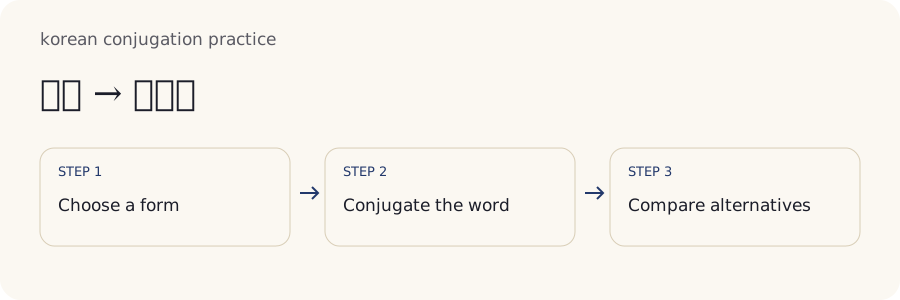
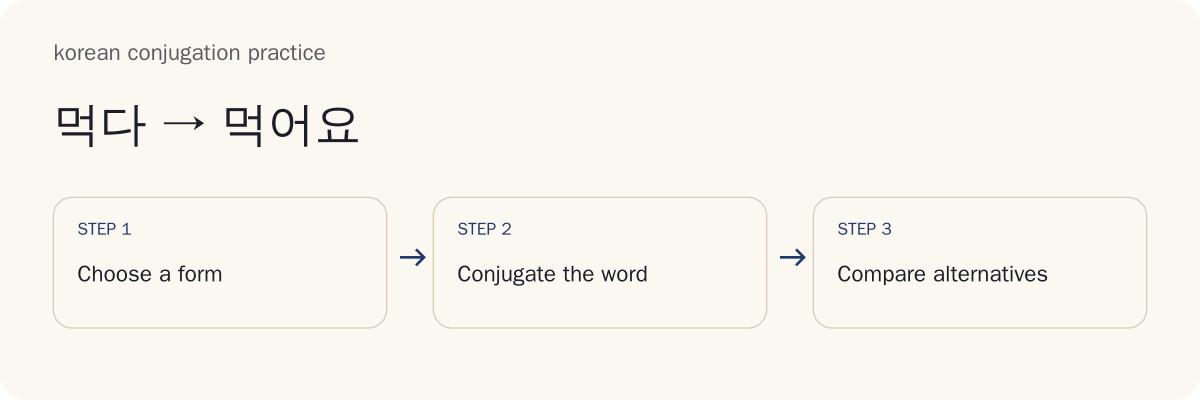
- Choose a form and dictionary sense. For example, request the polite present of 먹다, “to eat.” The prompt establishes the target before you respond.
- Retrieve the answer. Type 먹어요, select a choice or write your answer before looking at the key. Complete the last Hangul syllable before submitting.
- Check the requested form. Compare your response with the accepted answers and read the rule behind the result. A different tense or speech level can be grammatical but still miss this target.
- Retry with a reason. Name what changed, then practise the same rule in another item. Keep this supported retry separate from your first attempt.
Finish a round when you can explain one recurring error. That explanation tells you which rule to study next.
Which Practice Mode Should I Choose?
Choose typed recall to retrieve the whole form, choices to recognize it, or handwriting self-check to work on paper or the drawing surface. Different modes supply different amounts of help.
| Mode | Your Task | Main Limit |
|---|---|---|
| Typed | Enter the complete form | Typing slips can affect comparison |
| Choice | Select a supplied form | Options provide spelling clues |
| Assembly | Arrange supplied parts | Parts reduce retrieval demands |
| Handwriting self-check | Write, reveal and judge | No handwriting recognition score |
| Audio-supported practice | Listen when sound is available | Playback is assistance, not speech assessment |
Contextual sentence production requires additional judgment about meaning and situation. Automatic form matching does not provide native-speaker evaluation of a whole paragraph. Use the mode that isolates your present learning goal.
Find the Stem and Name the Requested Form
The stem is the dictionary form without its final 다. For 먹다, remove 다 to get 먹; for 가다, the stem is 가. Keep the word's dictionary sense with that stem, because matching written forms do not always imply matching meanings or conjugation behavior.
Name the requested construction before adding an ending. “Polite present,” “polite past” and “formal polite” are different targets. An English sentence alone may leave the Korean speech level unstated, so follow the prompt rather than inventing a social setting.
A stem question also differs from a sentence-form question. The answer 먹 is appropriate when the task asks only for the stem. It is incomplete when the prompt asks for the polite present, 먹어요.
Use the original answer-key table below as a reference for the retained beginner questions, rather than a list to memorize without prompts. The form only becomes meaningful when you know what the question requested. Review the stem-and-ending lesson if that first step is uncertain.
| Original question | Answer key |
|---|---|
| 1 | 가요 |
| 2 | 먹어요 |
| 3 | 해요 |
| 4 | 마셔요 |
| 5 | 갔어요 |
| 6 | 먹을 거예요 |
| 7 | 봐요 |
| 8 | 먹 |
| 9 | 앉아요 |
| 10 | 만나요 |
| 11 | 마셨어요 |
| 12 | 공부했어요 |
| 13 | 샀어요 |
| 14 | 갈 거예요 |
| 15 | 만날 거예요 |
| 16 | 읽어요 |
| 17 | 배워요 |
| 18 | 줘요 |
| 19 | 입었어요 |
| 20 | 쉬어요 |
Why Is 먹습니다 Different from 먹어요?
먹습니다 uses a formal polite ending, while 먹어요 uses the everyday polite style. Both can be grammatical Korean. A prompt asking for the polite present in the everyday style expects 먹어요, so 먹습니다 misses the requested speech level rather than proving you do not know the verb.
For this worked example, keep the dictionary word and basic meaning constant. Change only the requested style, then observe the different ending. This isolates the reason for the mismatch.
Read feedback as “different requested form” when that is what happened. Calling every rejected answer incorrect Korean would conceal a useful distinction. Before retrying, say the requested level to yourself, then produce the form.
Polite Present, past and Prospective Forms
For regular polite present forms, remove 다, examine the last stem vowel and attach the appropriate ending. A last vowel of ㅏ or ㅗ normally selects 아요; other vowels normally select 어요. 하다 follows its familiar 해요 pattern, and vowel combinations need the appropriate contraction or spelling rule.
| Dictionary Word | Polite Present | Polite Past | Prospective Form |
|---|---|---|---|
| 가다 | 가요 | 갔어요 | 갈 거예요 |
| 먹다 | 먹어요 | 먹었어요 | 먹을 거예요 |
| 만나다 | 만나요 | 만났어요 | 만날 거예요 |
| 공부하다 | 공부해요 | 공부했어요 | 공부할 거예요 |
These examples come from the existing conjugation material. For the past, the same broad vowel choice appears in 았어요 or 었어요. Prospective forms use a different construction, so they are not made by swapping the present ending for a past ending.
Do not apply the regular recipe blindly to every dictionary entry. The lexical class, requested ending and sense must be checked together. Also distinguish a prediction or intention from other modal meanings. A table supplies forms; context supplies the reason to choose one.
Can I Use a Full Form Instead of a Contraction?
A full form can be accepted when standard spelling and the item's answer policy allow it. Contraction is not a universal instruction to reject every longer form. Some combinations have established contracted spellings, while others allow alternatives that need to be specified in the key.
For the familiar worked examples, 마시다 gives 마셔요 and 보다 gives 봐요 in the retained beginner material. The first combines the final vowel with the following ending; the second combines the stem vowel with 아요. Learn the actual written result instead of deleting characters until a word looks shorter.
When you enter a fuller form, inspect the accepted-answer list rather than assuming a mismatch proves the form is always invalid. Conversely, do not assume that every stem plus ending written separately is an acceptable complete word. The original example 가요 does not license an arbitrary repeated-vowel spelling.
A teacher adding an alternative should check a reliable spelling source and record a reason. Keep the preference for a common contraction separate from the question of whether a specific alternative is acceptable.
Is -(으)ㄹ 거예요 Always a Future Tense?
The construction -(으)ㄹ 거예요 can express an intention or prediction, so “future” is a convenient beginner label rather than a complete account of its meaning. The surrounding situation determines how the speaker's statement is understood.
The example 먹을 거예요 supplies a prospective form of 먹다. Producing that form correctly is one task; choosing it appropriately in conversation is another. A drill can name the construction directly to keep the formation task clear.
Do not treat every English “will” as requiring this exact Korean construction. Other endings can carry modal meanings, and a full sentence needs context. After retrieving the requested form, place it in a meaningful situation instead of assuming one tense label explains every use.
Irregular Practice with Regular Look-Alikes
An irregular class tells you which stem change occurs with particular endings. The final letter suggests a class to inspect, but the dictionary word decides whether the change applies. A regular look-alike can keep the same final letter before the same ending.
| Pattern | Site Example | What to Inspect |
|---|---|---|
| ㄷ change | 듣다 → 들어요 | ㄷ changes to ㄹ before a vowel |
| ㅂ change | 덥다 → 더워요 | Stem change before a vowel |
| ㅅ drop | 낫다 → 나아요 | Stem-final ㅅ disappears before a vowel |
| 르 pattern | 모르다 → 몰라요 | Change before 아/어 |
| ㅎ pattern | 그렇다 → 그래요 | Stem and vowel behavior |
| ㅡ drop | 쓰다 → 써요 | Change before 아/어 |
| ㄹ drop | 살다 → 삽니다 | Change before the relevant consonant ending |
The site's learner grouping includes ㄹ and ㅡ patterns even though grammatical traditions classify them differently. Learn the form and trigger before arguing about the label. Less common patterns also require their particular dictionary entries; the short table is an orientation, not a complete catalog.
Compare an ending that triggers a change with one that does not. Then test a regular word with similar final letters. This contrast prevents you from treating the class name as a rule for every word of that shape.
Why Does the Dictionary Sense Matter?
The dictionary sense can determine which conjugation pattern belongs to a written headword. A form-only prompt may therefore be underdetermined when a headword has different lexical meanings. Resolve the sense before practising rather than allowing the tool to choose a meaning silently.
A source-backed contrast is 듣다 and 받다. The irregular listening verb gives 들어요, while the regular receiving verb gives 받아요. Both stems end in ㄷ, but their dictionary entries require different behavior. The shared last letter is evidence to investigate, not enough information to apply the change.
For a homograph in a custom set, include a meaning label or clear context. If the sense remains unresolved, inspect it before starting automatic practice. A learner should not lose credit because the author omitted information needed to choose the pattern.
After correction, store the sense with the form. That pairing keeps future practice about the intended word instead of a guessed interpretation of its spelling.
Test the Change, Then Try a New Word
Practise the missed change once, then try another known word with the same pattern. This is a way to check whether you are applying a rule rather than remembering the exact answer you just revealed.
For example, explain why 듣다 becomes 들어요, then compare the regular 받다 example. The contrast checks whether you know when the change applies. A supported correction and an independent response to a different item should remain separately labeled.
Avoid changing the word, speech level and tense all at once when diagnosing a problem. Hold most conditions steady so the next result answers one clear question. This is practical study advice, not a guarantee of a measured improvement.
Verbs, Adjectives, Copulas and Existential Words
Korean action verbs and descriptive words can both take endings, but they do not share every construction. A descriptive word often corresponds to an English adjective while functioning as a conjugating predicate in Korean. The English translation alone therefore does not identify the Korean grammatical class.
Copulas connect a noun with a predicate meaning; existential words express existence or possession in appropriate contexts. These require their own patterns and cannot always be treated as ordinary action verbs. A custom list should retain the relevant part-of-speech information, not only the translated gloss.
The distinction becomes especially important for modifiers and auxiliary constructions. A form used to modify a noun can depend on whether the underlying predicate describes an action or a state. The drill should specify that grammatical target instead of merely asking for a vaguely “shortened” form.
Begin with a familiar complete predicate, then learn the requested modifier or connective from its own lesson. Keep the dictionary sense and grammatical category visible while practising. When a construction is incompatible with the selected entry, choose a supported construction rather than expecting the tool to produce a mechanically attached ending.
Can an Adjective Take Every Verb Ending?
An adjective cannot simply take every action-verb construction with the same meaning. The construction's grammar and the intended situation both matter. A proposal to perform an action differs from a wish that someone be happy or well.
Avoid a blanket rule that all descriptive words are banned from every expression that resembles a proposal. Particular expressions can have established uses, while an arbitrary new combination may sound unnatural or change the intended meaning.
For a drill, choose a construction that is supported for the selected lexical category and explain the context. For an open sentence, ask a qualified speaker or teacher to evaluate usage. A matching suffix is not enough evidence that the sentence expresses the intended idea naturally.
Negative Forms and Honorific Subjects
Negation changes meaning as well as form. A simple negative statement differs from saying that someone cannot do something, and a longer negative construction may attach differently from a short negative word. Choose the intended meaning before checking spelling.
Subject honorification and listener politeness are separate decisions. A polite ending addresses the listener; a subject-honorific marker raises the person whose action or state the sentence describes. Neither decision can be inferred solely from an English verb in isolation.
A useful custom prompt includes the negative meaning, subject and requested speech level. If the prompt only says “make this negative,” more than one defensible construction may exist. Narrow the task or list the intended alternatives before treating one answer as uniquely correct.
When feedback points to the wrong construction, check the meaning first, then the stem and ending. Spelling practice cannot repair a prompt that asks for inability while the key expresses an ordinary negative statement. Establish the target before practising its surface form.
Where Does 안 Go with 하다 Words?
The placement of 안 depends on the lexical word and construction, so it should not be decided by searching for the letters 하다 alone. Some expressions contain an activity noun with “do,” while other predicates are lexical units that need a different analysis.
For a worked practice case, take the source word 공부하다 and specify ordinary negative meaning plus the requested polite style. Before creating its key, check how the activity expression is negated in the relevant lesson or dictionary. Keep that verified key with the item; do not assume that replacing any segment containing “do” yields a correct sentence.
A teacher should also state whether longer negative alternatives are accepted. Two expressions can both negate the action while differing in construction, emphasis or target.
A result on this item should identify the requested negative construction. If the placement is uncertain, resolve the key before assigning the question rather than using learner scores to decide the grammar.
Who Is Respected by -(으)시-?
The marker -(으)시- respects the subject being discussed, rather than automatically making the listener ending more polite. The site's example 선생님이 오세요 means “The teacher is coming”: the teacher is the honored subject, and the ending is polite to the listener.
Keep three roles separate: the speaker says the sentence, the subject performs or experiences what it describes, and the listener hears it. A teacher can be the subject while a friend is the listener. A sentence can also be polite to the listener without honoring its subject.
For practice, identify those roles before adding the marker. The honorifics guide supplies the comparison. A correct ending with the wrong honored person can still fail the intended social meaning.
Connectives, Modifiers and Auxiliary Patterns
Connectives join clauses; modifiers describe nouns; auxiliary patterns add meanings to a predicate. Their formation depends on the chosen ending and the grammatical properties of the dictionary entry. Knowing the polite present is useful groundwork but does not generate every other construction by itself.
Choose one function at a time: a reason, a condition, simultaneous activity or a noun-modifying expression. Read its formation rule, name the target in the prompt and practise only entries supported for that construction. Progressive and result-state patterns also express different meanings, so they should not be interchangeable labels in a key.
Passive meanings may require a separate dictionary headword or a licensed construction. Avoid building an unfamiliar passive solely by guessing a suffix from another verb.
Use the full conjugation reference to inspect the specific form after retrieval. Return to a sentence lesson when the difficulty is choosing the construction, because a form table cannot supply the missing context by itself.
Practise a Sentence, Then a Short Routine
Start with a guided sentence whose target is named, then use the retrieved form in a short personal routine. For example, choose a known verb and requested polite past before constructing a sentence about yesterday. Check the requested form first, then review the sentence's meaning and particles.
A dialogue gap provides surrounding context, while a free sentence leaves more choices to you. Moving between them changes the task, so keep a guided form score separate from feedback on independent writing.
A short routine can contain several familiar predicates, but each should express its own intended meaning. Automatic comparison can verify a listed target form; it cannot certify that the whole passage sounds natural. Use teacher feedback for that wider question and retain your original sentence for discussion.
Understand Your Feedback and Review Queue
Feedback is most useful when it identifies the particular mismatch: stem, vowel choice, contraction, tense, speech level, spacing or requested construction. Read that category before repeating the same question. A response that is valid in another register should be distinguished from a malformed word.
Keep accepted alternatives with the item and its version. A hint supplies information before you answer; a reveal supplies the key itself. Both affect how independent the response is. A later correct retry demonstrates practice after support rather than replacing the original attempt.
Review queues organize future practice, but the due date is a study aid rather than proof that a word is mastered. Inspect which rule or sense led to the review entry. Several misses on a single pattern can justify a focused lesson before another mixed round.
Common mistakes include leaving dictionary 다 attached, choosing an ending from English tense alone, applying an irregular change to a regular look-alike, overlooking the speech level, treating a typo as forgotten grammar and counting a reveal as first-try success. Give each problem its own correction.
Does the Score Show My Korean Level?
The score shows performance on this set under its recorded conditions, not your overall Korean level. An illustrative 17/20 means seventeen successful answers in twenty questions under that session's scoring policy. It does not certify a TOPIK or CEFR level.
Check whether those answers were independent, assisted or retried. A choice round also supplies more clues than typed recall. For progress, compare similar modes and support conditions, then try different material with the same rules. Memorizing the exact old key and applying a pattern to another word are different achievements.
Audio, Handwriting and Keyboard Practice
Use keyboard practice to produce composed Hangul blocks, completing input-method composition before checking. The visible letters may still belong to an unfinished syllable. A mid-composition submission or misplaced caret can produce a typing mismatch that is unrelated to the grammar rule.
Handwriting self-check lets you write before revealing the answer. Inspect the letters and form yourself; the drawing surface does not recognize handwriting or assess stroke quality automatically. Paper is also a useful alternative when digital entry distracts from retrieval.
Listen after retrieving the form when playable audio is available. Playback can connect the written result with its sound, but it is not pronunciation assessment. Approved public recordings are not supplied for every practice item, so do not assume every answer has native recorded speech.
Romanization can be a temporary reading aid, but it provides clues and does not replace Hangul. Record its use when comparing sessions. Choose a text alternative when audio is unavailable, and label that attempt by the skill actually practised.
Create, Share and Print a Custom Set
Build a custom set from material you have permission to use, preserving dictionary sense, requested form and source information. Import columns carefully: a heading or translated gloss placed in the answer field can create a misleading key.
Preview unresolved entries and ambiguous senses before starting. Unknown words need a resolved entry or an author-supplied private key; they should not be silently converted into authoritative dictionary items. Keep custom accepted variants separate from the shared catalog.
For a teacher workflow, choose the entries, verify every key, save the set and print a student worksheet plus a matching answer key. Inspect the print preview so that answer material is not accidentally included in the student copy. Retain the same item versions for later discussion.
Share files deliberately. A settings fragment can carry selected controls, while a private exported set can include the actual words and answers. Inspect what you are sending. Local progress does not automatically appear in a hosted classroom.
Export a JSON backup when you want to continue on another device. Keep source notes and version information with the file so a changed key can be distinguished from an earlier assignment.
What Stays Available without Internet?
Already available local text and saved files can support practice without a connection, but a first visit without cached page assets cannot be assumed to work. Test the exact page and set before relying on them during travel.
Audio has separate requirements. A saved text key does not guarantee a playable recording or installed voice. Missing media should leave you with text practice rather than a false listening result.
Keep a backup outside browser storage, since clearing site data can remove saved progress. Reopen the set, inspect a few prompts and try the needed media before leaving the network. Offline availability depends on what is actually saved.
How Are the Answers Checked?
Answers are compared with the item's accepted records for its requested sense and construction. The result establishes agreement with that key; it does not independently prove that every private key is correct.
Reliable keys should be checked against dictionary and spelling guidance, with the source and item version retained. An automatically generated form is not an independent reference for checking the same generator. Teacher overrides need a written reason and their own version history.
For a disputed result, inspect the exact prompt, accepted variants and version before reporting it. Resolve uncertain Korean with a qualified teacher. A transparent key makes the feedback explainable and keeps corrections from silently changing earlier attempts.
Limits of Automatic Contextual Feedback
A fixed form check answers a narrower question than evaluation of an open sentence. Naturalness, social context and intended meaning can remain uncertain even when a suffix matches.
Contextual AI feedback is unavailable here, and a fluent-looking explanation would still require scrutiny if supplied elsewhere. Keep uncertain sentences for teacher or native-speaker discussion. State what you intended to say and include the original prompt. That information helps a teacher distinguish a formation mistake from a different valid interpretation.
Frequently Asked Questions
The answers below explain portability, private imports, teacher changes, version history and optional reminders. Use the saved item version when discussing a result so everyone is looking at the same question and key.
Can I continue the same round on another device?
Export your private set and progress as JSON, then import it on the other device. The file includes item versions and your answers. Device saving alone stays in the browser where you saved it. Keep a backup and inspect the imported set before continuing the same round elsewhere.
Will importing a list publish my words?
No. Lists are parsed in your browser. Unknown entries and ambiguous dictionary senses need resolution before automatic practice. Author-supplied keys remain private and are identified separately from the dictionary catalog. Exporting and sharing a file is a deliberate action; inspect its contents before sending it to another person.
Can a teacher change the acceptable answers?
The private teacher view can add an accepted answer with a written reason. It records an override and increments that item’s version. It does not change the shared dictionary catalog or a public answer bank. Check the alternative against an appropriate source before adding it to the private key.
Why does an old result change after an answer correction?
A changed private key receives a new item version. Earlier attempts keep the version and result recorded at their check. They are not silently rewritten to inflate the first-attempt score. Compare the version labels when discussing a correction, and retain the earlier prompt and key for a clear history.
Can I turn off achievement and review reminders?
Yes. Calendar reminders are optional, and no email subscription is created automatically. Basic practice has no required timer or achievement streak. You can study without saving progress or enabling reminders. Choose the settings that help your routine, and export a backup only when you want to retain the work.
Continue Korean Conjugation Practice
Continue Korean conjugation practice with the rule behind your most frequent mismatch. Review irregular verb lessons for stem changes, use the focused irregular quiz after that review, or apply a recalled form in sentence building.
Keep one independent answer before revealing help, explain its correction and try another familiar word with the same construction. Save the set if you want a fair comparison next time.
Use the full conjugation reference, irregular verb lessons, the focused irregular quiz and sentence building for your next task.