
Korean Particles Flashcards: Study the 26 Cards
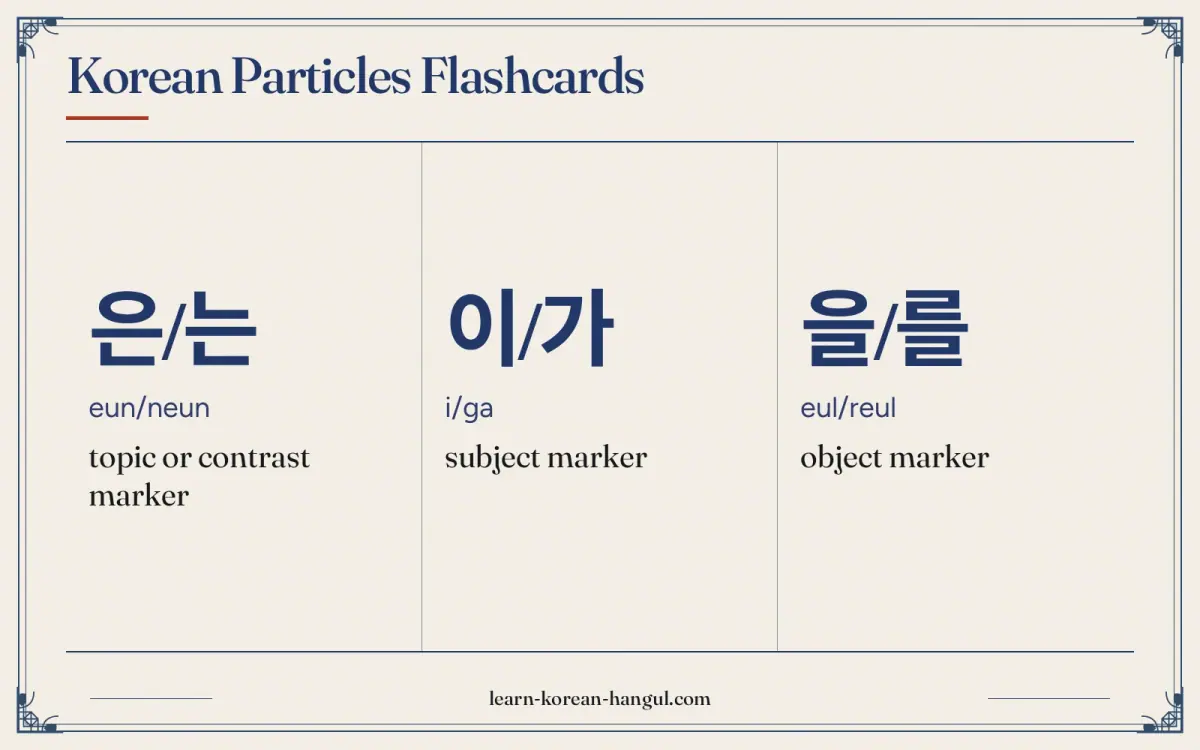
A particle card shows the particle on the front and plays an example sentence, because a particle is never said alone. The lesson behind this deck is korean particles, so read it first if a card is new, then use the cards to build the habit of attaching the right particle without thinking.
How Do I Use These Flashcards?
Use the deck above in four steps. It works with tap, click or keyboard, and nothing plays until you press an audio button.
- Choose a mode. Start with recognition (Hangul to meaning). Switch to recall (meaning to Hangul) or listening (audio to meaning) once recognition feels easy.
- Show the answer. Think of what the particle does and one example noun first, then press Show answer (or Space). Say the example sentence aloud before you reveal it. Turn on the romanization toggle only if you need it; the 26-card table below always shows it.
- Grade yourself. Press Got it if you answered correctly without help, or Not yet if you hesitated or guessed.
- Finish the session. A session holds up to 20 cards (you can set 10, 20 or 40). With 26 cards, a first-time learner can split the deck over 3 days, using the default limit of 10 new cards a day.
The Three Study Modes
Recognition shows the Hangul and asks for the meaning, which trains reading. Recall shows the meaning and asks for the Hangul, which trains remembering; you may type the answer with your Hangul keyboard or just recall it in your head. Listening plays a clip and hides the letters, which trains the ear. The pronunciation audio is generated with text-to-speech and a Korean teacher approves it before it is switched on. Listening mode only uses cards whose audio is approved, and cards without approved audio are skipped in that mode with a note.
Got It and Not Yet
Got it moves the card up one Leitner box, so it comes back later. Not yet sends the card back to box 1, so it returns in the same session or within 10 minutes. The grades are your own judgement; the deck does not score you or claim fluency.
Deck Scope: What Is and Is Not Covered
The deck covers about 25 high-frequency particles with one example each. They include the topic and subject markers (은/는, 이/가), the object marker (을/를), the place and time particles (에, 에서), the person particles (에게, 한테, 께, 에게서), the means and direction particle (으)로, the joining particles (와/과, 하고, (이)랑), and the extent particles (만, 밖에, 보다, 처럼, 까지, 부터, 마다, 쯤, (이)나, 들, 요). 에 appears twice, once for place and once for time, because learners confuse the two uses.
What Is Left out of This Deck?
The deck does not give every finer rule, such as the contrast between 에 and 에서 in each case; the 에 versus 에서 lesson covers that. It also does not cover verb endings or connectors. For verb endings, use the beginner Korean grammar flashcards. Rarer particles such as 조차, 마저 and (이)라도 are left out.
All 26 Cards in One Table
All 26 cards appear below in deck order. The table is plain HTML, so you can use it as a drill without the deck: cover the Meaning column, say the job of the particle and an example aloud, then uncover it.
| # | Hangul | Revised Romanization | Meaning | Note | Lesson | Audio assetId |
|---|---|---|---|---|---|---|
| 1 | 은/는 | eun/neun | topic or contrast marker | Example: 저는 학생이에요. (jeoneun haksaengieyo) As for me, I am a student. Also contrasts: 커피는 좋아요 (coffee, yes, but ...). | topic particle 은/는 | au-pg-flashcards-particles-flashcards-1 |
| 2 | 이/가 | i/ga | subject marker | Example: 친구가 왔어요. (chinguga wasseoyo) A friend came. The answer to 누가 왔어요? | subject particle 이/가 | au-pg-flashcards-particles-flashcards-2 |
| 3 | 을/를 | eul/reul | object marker | Example: 꽃을 사요. (kkocheul sayo) I buy flowers. 꽃을 is said [꼬츨]. | object particle 을/를 | au-pg-flashcards-particles-flashcards-3; slow: au-pg-flashcards-particles-flashcards-27 |
| 4 | 에 (장소) | e | at, to (place) | Example: 학교에 가요. (hakgyoe gayo) I go to school. Also 학교에 있어요, I am at school. | location particle 에 | au-pg-flashcards-particles-flashcards-4 |
| 5 | 에서 | eseo | at (place of action); from | Example: 학교에서 공부해요. (hakgyoeseo gongbuhaeyo) I study at school. 에 (card 4) marks where something is; 에서 marks where an action happens. | location particle 에서 | au-pg-flashcards-particles-flashcards-5; slow: au-pg-flashcards-particles-flashcards-28 |
| 6 | 에 (시간) | e | at, on (time) | Example: 일곱 시에 일어나요. (ilgop sie ireonayo) I get up at seven. Not used after 오늘, 내일 or 어제. | time particle 에 | au-pg-flashcards-particles-flashcards-6 |
| 7 | 에게/한테 | ege/hante | to (a person) | Example: 친구에게 선물을 줘요. (chinguege seonmureul jwoyo) I give a present to a friend. 한테 is the casual form. | 에게/한테/께 lesson | au-pg-flashcards-particles-flashcards-7 |
| 8 | 께 | kke | to (a respected person) | Example: 선생님께 드려요. (seonsaengnimkke deuryeoyo) I give it to the teacher. Honorific; 드리다 is the humble verb for giving. | 에게/한테/께 lesson | au-pg-flashcards-particles-flashcards-8 |
| 9 | 에게서/한테서 | egeseo/hanteseo | from (a person) | Example: 친구한테서 편지를 받았어요. (chinguhanteseo pyeonjireul badasseoyo) I got a letter from a friend. 한테서 is the casual form. | 에게서/한테서 lesson | au-pg-flashcards-particles-flashcards-9 |
| 10 | (으)로 | (eu)ro | by (means); toward | Example: 버스로 가요. (beoseuro gayo) I go by bus. Also direction: 오른쪽으로. | particle (으)로 | au-pg-flashcards-particles-flashcards-10 |
| 11 | 의 | ui | of, 's (possessive) | Example: 선생님의 책이에요. (seonsaengnimui chaegieyo) It is the teacher's book. Often dropped in speech. | possessive particle 의 | au-pg-flashcards-particles-flashcards-11 |
| 12 | 와/과 | wa/gwa | and, with (formal or written) | Example: 빵과 우유를 샀어요. (ppanggwa uyureul sasseoyo) I bought bread and milk. 와 after a vowel, 과 after a consonant. | 와/과 lesson | au-pg-flashcards-particles-flashcards-12 |
| 13 | 하고 | hago | and, with | Example: 친구하고 가요. (chinguhago gayo) I go with a friend. Works in speech and writing. | particle 하고 | au-pg-flashcards-particles-flashcards-13 |
| 14 | (이)랑 | (i)rang | and, with (casual) | Example: 친구랑 먹어요. (chingurang meogeoyo) I eat with a friend. 이랑 after a consonant, 랑 after a vowel. | particle (이)랑 | au-pg-flashcards-particles-flashcards-14 |
| 15 | 도 | do | also, too | Example: 저도 가요. (jeodo gayo) I am going too. Replaces 은/는, 이/가 and 을/를. | particle 도 | au-pg-flashcards-particles-flashcards-15 |
| 16 | 만 | man | only | Example: 물만 마셔요. (mulman masyeoyo) I drink only water. Works with positive and negative verbs. | particle 만 | au-pg-flashcards-particles-flashcards-16 |
| 17 | 밖에 | bakke | only (with a negative) | Example: 천 원밖에 없어요. (cheon wonbakke eopseoyo) I only have 1,000 won. Needs a negative verb. Said [바께]. | particle 밖에 | au-pg-flashcards-particles-flashcards-17; slow: au-pg-flashcards-particles-flashcards-29 |
| 18 | 보다 | boda | than | Example: 버스보다 지하철이 빨라요. (beoseuboda jihacheori ppallayo) The subway is faster than the bus. Marks the thing compared against. | comparison particle 보다 | au-pg-flashcards-particles-flashcards-18 |
| 19 | 처럼 | cheoreom | like, as | Example: 가수처럼 노래해요. (gasucheoreom noraehaeyo) I sing like a singer. Similar to 같이. | particle 처럼 | au-pg-flashcards-particles-flashcards-19 |
| 20 | 까지 | kkaji | until, to, as far as | Example: 열 시까지 일해요. (yeol sikkaji ilhaeyo) I work until ten. Pairs with 부터. | particle 까지 | au-pg-flashcards-particles-flashcards-20 |
| 21 | 부터 | buteo | from (a starting point) | Example: 아홉 시부터 시작해요. (ahop sibuteo sijakaeyo) It starts from nine. Pairs with 까지. | particle 부터 | au-pg-flashcards-particles-flashcards-21 |
| 22 | 마다 | mada | every, each | Example: 날마다 운동해요. (nalmada undonghaeyo) I exercise every day. 매일 means the same. | particle 마다 | au-pg-flashcards-particles-flashcards-22 |
| 23 | 쯤 | jjeum | about, around | Example: 세 시쯤 만나요. (se sijjeum mannayo) Let us meet around three. Used for time and amounts. | particle 쯤 | au-pg-flashcards-particles-flashcards-23 |
| 24 | (이)나 | (i)na | or; as many as | Example: 커피나 차를 마셔요. (keopina chareul masyeoyo) I drink coffee or tea. 이나 after a consonant, 나 after a vowel. | particle (이)나 | au-pg-flashcards-particles-flashcards-24 |
| 25 | 들 | deul | plural marker | Example: 친구들이 와요. (chingudeuri wayo) Friends are coming. Often left out when the number is clear. | plural marker 들 | au-pg-flashcards-particles-flashcards-25 |
| 26 | 요 | yo | polite softener | Example: 네, 저도요. (ne, jeodoyo) Yes, me too. Makes a short phrase polite. | particle 요 | au-pg-flashcards-particles-flashcards-26 |
Reading the Table
Hangul is the particle. Revised Romanization (RR) is a learning aid, so try to read the Hangul before you look at it. The Meaning column gives a short English gloss, and the Note column gives an example sentence with its RR and meaning and a use hint. The Lesson column links to the lesson for each particle, and the last column lists the audio assetId. The clip for each card says the example sentence, because a particle cannot be spoken on its own. A second ID marks a slow clip (0.8x) for the cards where the spelling and the sound differ most.
Usage Notes for These Cards
Particles attach straight to the noun with no space. Write 학교에, not 학교 에. After a consonant and after a vowel a few particles take two forms: 은/는, 이/가, 을/를 and 와/과. Choose the first of each pair after a consonant and the second after a vowel, as in 책을 and 의자를.
은/는 sets up a topic or contrast, while 이/가 introduces new information. 저는 학생이에요 states who you are, but 누가 왔어요? is answered with 친구가 왔어요, because the friend is the answer. The 은/는 versus 이/가 lesson shows more pairs.
에 marks where something is or a destination; 에서 marks where an action takes place. 학교에 있어요 means I am at school, 학교에 가요 means I go to school, and 학교에서 공부해요 means I study at school.
People take their own particles. Use 에게 or the casual 한테 for a person you give to, and the honorific 께 for a respected person. 선생님께 is right, and 선생님한테 is only casual.
밖에 must be followed by a negative. 천 원밖에 없어요 means I only have 1,000 won. 천 원밖에 있어요 is wrong, and 만 is the particle to use with a positive verb.
Which Sounds Do Not Match the Spelling?
학교에서 is said [학꾜에서]. The ㄱ of 교 turns tense after the final ㄱ of 학. This is tensification, and Revised Romanization does not mark it, so the RR stays hakgyoeseo.
꽃을 is said [꼬츨]. The final ㅊ moves intact onto the empty ㅇ of 을, so the sound ㅊ is heard at the start of the next syllable (liaison). Compare the bare word 꽃, which is said [꼳] on its own.
밖에 is said [바께]. The final ㄲ moves onto the empty ㅇ of 에 and is heard as ㄲ (liaison). So 천 원밖에 is [천 원바께].
What Mistakes Do Learners Make with Korean Particles?
- Using 에 for an action place, as in 학교에 공부해요. Use 학교에서 공부해요, because 에서 marks where the action happens.
- Using 을/를 with 있다, as in 책을 있어요. The thing that exists takes 이/가: 책이 있어요.
- Using 와/과 in speech to a friend. 하고 or (이)랑 sounds more natural in conversation, and 와/과 is mostly written or formal.
- Adding 에 to 오늘, 내일 or 어제, as in 내일에 가요. Say 내일 가요 with no particle.
The 에 and 에서 pair causes the most slips, so give cards 4, 5 and 6 extra passes in recall mode.
How Does the Review Schedule Work?
The deck uses a simplified Leitner system with five boxes. A new card starts in box 1. Each Got it moves it up one box, and each Not yet returns it to box 1. The box sets how long the card waits before it is due again.
| Box | Wait until the next review |
|---|---|
| 1 | same session or 10 minutes |
| 2 | 1 day |
| 3 | 3 days |
| 4 | 7 days |
| 5 | 21 days |
Each session shows due cards first, oldest due first, and then up to 10 new cards a day by default. A deck of 26 cards is introduced over 3 days at the default of 10 new cards a day, and the later boxes bring each card back at longer gaps. Progress is saved only in this browser, so clearing site data deletes it. Use the export button to save a small JSON file with card IDs, boxes and due dates, and import it on another device. No account is needed.
Cultural and Practical Context
Particles do the work that word order and prepositions do in English, so they are the first grammar that foreign learners hear in everyday Korean. In speech, subject and object particles are often dropped, especially with friends: 밥 먹었어? is normal where 밥을 먹었어? is the full form. Learners should still write the particles in full, and drop them only when the meaning is clear from context.
Limits of This Deck
The deck holds 26 cards and one example per particle, so it does not show every use. 에 and (으)로 each have several meanings, and the pair 은/는 and 이/가 is explained in one line here; the lessons give the rest. The remark that particles are dropped in casual speech is a general tendency, not a rule. All Korean text is generated and was reviewed and signed off by Min-ji Park on 15 October 2026, and each audio clip is checked by a Korean teacher before publication.
Next Steps after This Deck
After these korean particles flashcards, check what you recalled with the korean particles quiz and write the particles by hand with the korean particles worksheet. Practise attaching them in full sentences with the korean sentence builder, and later the advanced korean grammar flashcards add the connectors that build on them. The Korean grammar flashcards page lists every grammar deck, and the Korean flashcards hub lists all topics.
Frequently Asked Questions
What Is the Difference between 은/는 and 이/가?
은/는 marks the topic or a contrast, and 이/가 marks the subject, especially new information or the answer to a question word. 저는 학생이에요 says who you are, and 누가 왔어요? is answered with 친구가 왔어요. In a first mention, 이/가 is usually the better choice.
How Do I Choose between 에 and 에서?
Use 에 for where something is or where you go (학교에 있어요, 학교에 가요) and for a point in time (일곱 시에). Use 에서 for where an action happens (학교에서 공부해요) and for a starting point (서울에서 왔어요).
Can I Drop Particles in Speech?
Yes, subject and object particles are often dropped in casual speech when the meaning is clear, as in 밥 먹었어? for 밥을 먹었어?. Keep them in writing and in careful speech, and never drop a particle that decides the meaning, such as 에서 or (으)로.
Which Particle Do I Use with a Person?
Use 에게 or the casual 한테 for a person who receives something, and 께 for a respected person. For a person you get something from, use 에게서 or 한테서. So 선생님께 드려요 is right for a teacher, and 친구한테 줘요 is right for a friend.
Is My Progress Saved If I Close the Page?
Yes, in the same browser on the same device. Card boxes and due dates are stored locally and nothing is sent to a server. Clearing site data, using a private window or switching browsers removes them, so use the export button to keep a backup file. No account is needed.