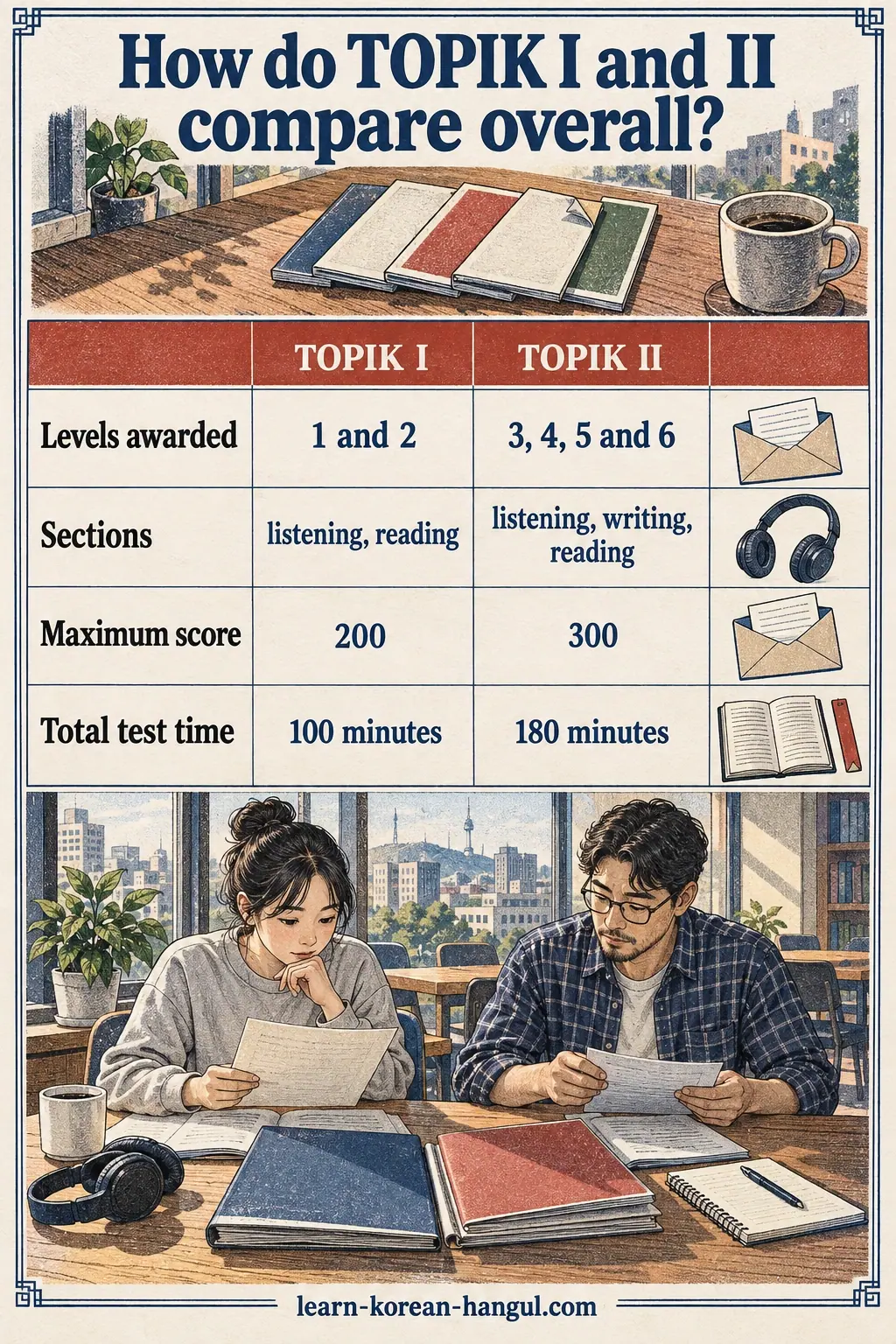
The difference between TOPIK 1 and 2 is level and length: TOPIK I is the beginner test, awarding Levels 1-2 from listening and reading in 100 minutes, while TOPIK II awards Levels 3-6 and adds a writing section, in 180 minutes. Choose TOPIK I until your practice scores reach about 120 out of 300 on TOPIK II.
Difference between TOPIK 1 and 2: the Essentials
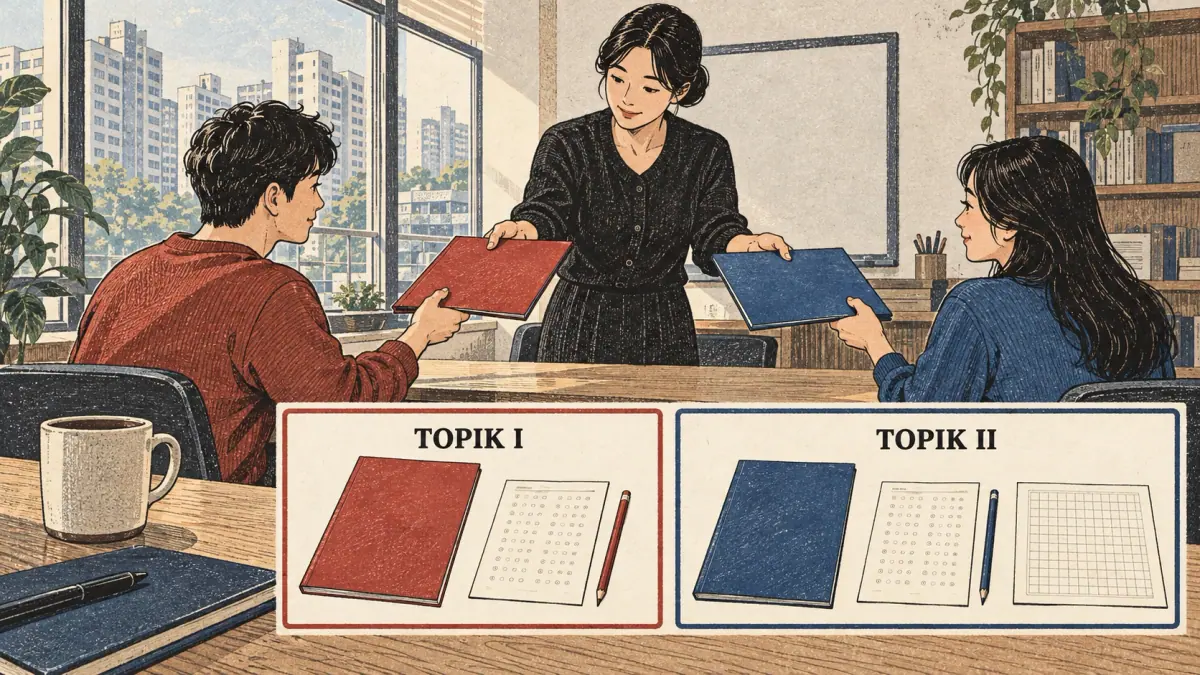
TOPIK I and TOPIK II are two separate tests under one name, 한국어능력시험 (hangugeoneungnyeoksiheom, "Test of Proficiency in Korean"). They are not two halves of one exam. You register for one of them, sit the whole paper, and your total on that paper decides your level.
Quick verdict by learner type:
- Complete beginner (under about six months of study): take TOPIK I and aim for Level 1.
- About one year of steady study: take TOPIK I and aim for Level 2, unless your TOPIK II practice score is already above 120.
- Degree applicant who needs Level 3 or 4: take TOPIK II; TOPIK I cannot give you the level you need.
- Considering work in Korea under the Employment Permit System: neither; you probably need EPS-TOPIK, a different test.
- Heritage speaker who understands a lot but has never studied writing: take a TOPIK II practice paper first; strong listening may already carry you past 120.
The rest of the page explains each verdict with numbers, starting with the side-by-side table.
How Do TOPIK I and II Compare Overall?
TOPIK I and TOPIK II compare as a short beginner test and a long three-skill test. The master table shows the paper-based test (PBT), following the official guide published by the National Institute for International Education (NIIED, 국립국제교육원) on topik.go.kr.
| Criterion | TOPIK I | TOPIK II |
|---|---|---|
| Levels awarded | 1 and 2 | 3, 4, 5 and 6 |
| Korean band name | 초급 (beginner) | 중급 (intermediate) for 3-4, 고급 (advanced) for 5-6 |
| Sections | listening, reading | listening, writing, reading |
| Questions | 70 (30 listening + 40 reading) | 104 (50 listening + 4 writing + 50 reading) |
| Test time | 100 minutes in one period | 180 minutes in two periods with a break |
| Maximum score | 200 | 300 |
| Cut scores | 80 (Level 1), 140 (Level 2) | 120, 150, 190, 230 (Levels 3-6) |
| Writing | none | 4 questions worth 100 points, including a 600-700 character essay |
| Fee | lower | higher; both set by country |
| Typical uses | personal progress, beginner course credit, some scholarships | university admission, graduation rules, jobs, some visa and residence rules |
The band names appear on Korean study materials and on the official site, so they are worth recognising.
The internet-based test (IBT) awards the same levels with the same cut scores, but its question counts and timings differ; the TOPIK exam format page sets the two side by side. The table gives the overview; the next three sections take one criterion at a time.
How Do Sections and Length Differ?

Sections and length differ in two ways: TOPIK II adds a writing section, and it takes 80 minutes longer. TOPIK I is one 100-minute period of listening then reading. TOPIK II is a 110-minute first period of listening then writing, a break, and a 70-minute second period of reading.
| Section | TOPIK I | TOPIK II |
|---|---|---|
| Listening | 30 questions, 40 minutes | 50 questions, 60 minutes |
| Writing | none | 4 questions, 50 minutes |
| Reading | 40 questions, 60 minutes | 50 questions, 70 minutes |
| Total test time | 100 minutes | 180 minutes |
The writing section changes the nature of the test. Listening and reading are multiple choice with four options, so you recognise the right answer. Writing asks you to produce Korean: two sentence-completion questions, a 200-300 character paragraph describing a chart and a 600-700 character opinion essay. That is the step many learners find hardest, because recognising grammar is easier than using it under time pressure.
Length matters too. Reading speed and concentration over three hours are skills in themselves, and candidates who have practised only short exercises often lose points in the final reading passages. Full section layouts are on the TOPIK I and TOPIK II guides.
Winner for sections and length: TOPIK I is shorter and has no writing, so it is the lighter test; TOPIK II is the only one that measures writing.
How Do Levels and Scores Differ?
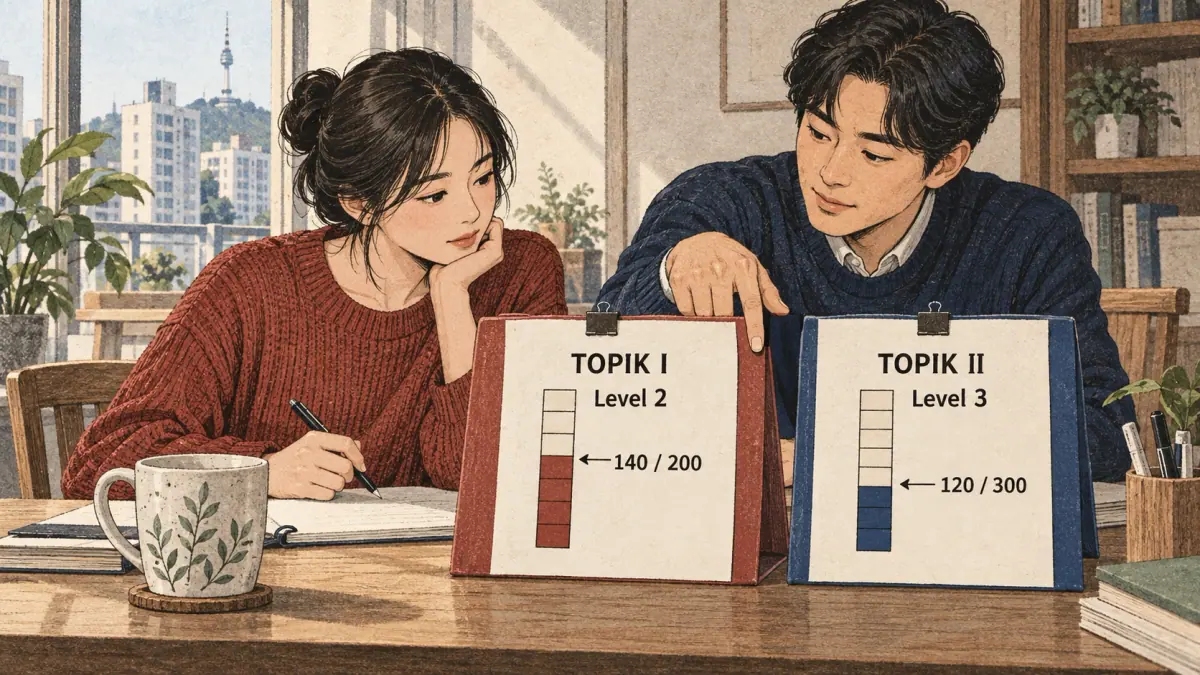
Levels and scores differ because each test has its own scale: TOPIK I is scored out of 200 and can award only Levels 1-2, while TOPIK II is scored out of 300 and can award only Levels 3-6. No result on one test can give a level from the other.
| Level | Test | Cut score | Share of the maximum |
|---|---|---|---|
| Level 1 | TOPIK I | 80 / 200 | 40% |
| Level 2 | TOPIK I | 140 / 200 | 70% |
| Level 3 | TOPIK II | 120 / 300 | 40% |
| Level 4 | TOPIK II | 150 / 300 | 50% |
| Level 5 | TOPIK II | 190 / 300 | about 63% |
| Level 6 | TOPIK II | 230 / 300 | about 77% |
Two consequences follow:
- The ceiling of TOPIK I is Level 2. A perfect 200 on TOPIK I is still Level 2. If you need Level 3, only TOPIK II can give it.
- The floor of TOPIK II is Level 3. A TOPIK II total of 119 or below earns no level, even though that candidate may be well past beginner. TOPIK II does not hand out Level 1 or 2 as a consolation.
A worked example shows why this matters. A learner scores 150 out of 200 on a TOPIK I practice paper (Level 2) and 105 out of 300 on a TOPIK II practice paper (no level). On test day, TOPIK I gives a certificate; TOPIK II gives a score report with no level. Section weights and points per question are explained on the TOPIK score page, and what each level means in daily life on TOPIK levels.
Winner for levels and scores: TOPIK II, for anyone who can reach 120, because it is the only route to Levels 3-6; TOPIK I for anyone below that, because it is the only route to a level at all.
How Does Difficulty Differ?

Difficulty differs most in the texts and in writing. TOPIK I uses short everyday dialogues, notices and messages about familiar topics. TOPIK II moves from everyday conversations to news, lectures, opinion pieces and academic passages, and it adds writing in the formal written style.
| Feature | TOPIK I | TOPIK II |
|---|---|---|
| Typical listening | short dialogues in shops, at home, on the phone | interviews, news, lectures, debates at near-natural speed |
| Typical reading | notices, signs, text messages, short paragraphs | articles, editorials, literary extracts, academic texts |
| Vocabulary | everyday words on familiar topics | abstract and Sino-Korean vocabulary, idioms |
| Grammar | basic endings and connectors | complex connectors, formal written forms |
| Production | none | writing in the written plain style ending in -다 |
Difficulty is relative to your level, not absolute. For a learner of one year, TOPIK I feels fair and TOPIK II feels very hard. For a learner of three years, TOPIK I feels easy and wastes a test date. The test that is "easier" is the one that matches where you are now, which is why practice papers are the best guide; how hard TOPIK is breaks this down by level and section.
Winner for difficulty: TOPIK I is easier in absolute terms, but the right choice is the test whose cut scores you can reach in practice.
Which Test Do Institutions Accept?

Institutions accept whichever test gives the level they name, so in practice the level decides the test. A requirement of "TOPIK Level 3" or higher can only be met with TOPIK II. A requirement of "any TOPIK level" can be met with TOPIK I.
| Goal | Level usually named | Test that can meet it |
|---|---|---|
| Korean-taught degree admission | often Level 3 or 4 | TOPIK II |
| Graduation requirement at some universities | often Level 4 | TOPIK II |
| Office job in a Korean-speaking team | often Level 4 or 5 | TOPIK II |
| Scholarship that gives credit for any Korean | any level | TOPIK I or II |
| Personal progress or a beginner course | any level | TOPIK I |
These are typical patterns, not rules. Each university, employer and government programme sets its own requirement, and visa rules change. The TOPIK requirements page shows how to find the exact sentence in an official notice.
One special case causes confusion. Workers coming to Korea under the Employment Permit System take EPS-TOPIK, which is run by a different organisation for a different purpose and is not interchangeable with TOPIK I or II. The details are on TOPIK vs EPS-TOPIK.
Winner for institutional use: TOPIK II, because most formal requirements start at Level 3.
Cost, Dates and Registration
Cost, dates and registration work the same way for both tests, with one difference: TOPIK II has a higher fee than TOPIK I. Fees are set by country and by format, in local currency overseas, and they change, so this page gives no figures. Check the amount in the official notice or on your local host's page.
Both tests are offered at the same sessions, on paper and on computer, in Korea and at many overseas centres. You register for one test per registration. In Korea, the two paper tests have been scheduled at different times on the same day, so sitting both can be possible; overseas and internet-based sessions may not allow it. Check the timetable for your session. The full process is on TOPIK registration. With the criteria covered, the next section turns them into a decision.
Which Should You Choose?

Choose TOPIK I if your goal is a first certificate or your practice scores on TOPIK II are below about 120 out of 300. Choose TOPIK II if you need Level 3 or above, or if your TOPIK II practice score is already above 120. Each case below follows the same order: who you are, the recommendation, and the check to make first.
The Complete Beginner
You finished Hangul and a first course book, and you have studied for under about six months. Take TOPIK I and aim for Level 1 (80 points). Before registering, sit one timed TOPIK I past paper. If you score 60 or more, a few weeks of focused practice usually closes the gap; below 40, consider waiting for a later session.
The Learner after about One Year
You use past and future tenses, read short notices and follow slow conversations. Take TOPIK I and aim for Level 2 (140 points). Then try one TOPIK II practice paper. If it scores above 120, you are near the boundary, and TOPIK II may give a more useful result. Below 100, TOPIK I is the safer choice.
The Degree Applicant
Your admission notice says "TOPIK Level 3" or "Level 4". Take TOPIK II. TOPIK I cannot meet the requirement, however high you score. Plan for a margin of 10 to 15 points above the cut score, and check that your result will still be valid on the application deadline.
The Worker Considering EPS-TOPIK
You want to work in manufacturing, agriculture or a similar sector in Korea through a government work-permit scheme. Check EPS-TOPIK first. TOPIK I or II may still be useful later for other goals, but they are not the test for that scheme.
The Heritage Speaker
You grew up hearing Korean at home, understand a lot, but have never studied reading or writing formally. Sit a TOPIK II practice paper before deciding. Strong listening can lift your total above 120 even with weak writing. If reading is the problem, TOPIK I may give a quicker first certificate while you build literacy.
A Two-Minute Self-Check
Use this check with one recent, timed practice paper of each test. The thresholds are editorial rules of thumb, not official guidance.
| Your practice result | Suggested test |
|---|---|
| TOPIK I below 80 | TOPIK I, with more preparation |
| TOPIK I 80-139 | TOPIK I, aiming for Level 2 |
| TOPIK I 140+ and TOPIK II below 120 | TOPIK I to secure Level 2, or wait and train for TOPIK II |
| TOPIK II 120-149 | TOPIK II, aiming for Level 3 or 4 |
| TOPIK II 150+ | TOPIK II |
Run the check under real timing with a TOPIK mock test, because untimed practice inflates scores. Even with a clear rule, there are cases where the "wrong" test is the right one.
When the Other Test Is the Better Choice
TOPIK II is the stronger certificate, but it disappoints when a candidate is not ready. A learner who sits TOPIK II too early pays the higher fee, spends three hours on texts that are too hard and may leave with no level. A Level 2 certificate from TOPIK I is more useful than an empty TOPIK II report.
TOPIK I has its own drawback: it stops at Level 2. A learner who already reads intermediate texts may "waste" a session on TOPIK I and then need to sit TOPIK II anyway for university. If your practice scores are close to the TOPIK II boundary and your deadline is far away, a few months of extra preparation for TOPIK II may be the better investment.
The honest limit of this page is that no table can replace a timed practice paper. Your own score on official past papers is better evidence than any general advice.
Common Misconceptions
Learners often assume you must pass TOPIK I before you can take TOPIK II. Actually, there is no such rule; you choose the test that matches your level.
Learners also assume a very high TOPIK I score counts as Level 3. Actually, TOPIK I stops at Level 2, even at 200 out of 200.
A third assumption is that TOPIK II gives Level 1 or 2 to weaker candidates. Actually, a TOPIK II total below 120 earns no level.
A fourth assumption is that you choose a level when you register. Actually, you choose a test, and the total decides the level.
What This Page Covers and Does Not
This page compares TOPIK I and TOPIK II on levels, sections, length, scores, difficulty and use, and helps you choose one. It does not give fees, dates or registration windows, because they change by session and country; check them on topik.go.kr or with your local host. Figures follow the official guide from NIIED, and if the current guide differs, the guide is right.
Frequently Asked Questions
Can I skip TOPIK I and take TOPIK II? Yes. There is no rule that you must pass TOPIK I first, and many learners go straight to TOPIK II. Skip TOPIK I only if your practice scores on a TOPIK II paper are above 120 out of 300, because a lower total earns no level at all, while the same learner might earn Level 2 on TOPIK I.
Can I take TOPIK I and TOPIK II on the same day? Sometimes. In Korea, the two paper tests have been scheduled at different times on the same day, so some candidates register for both. Overseas centres and internet-based sessions may not allow it. Whether you can sit both depends on the timetable and rules for your session, so check the official notice on topik.go.kr before you pay.
Which TOPIK is needed for a student visa? Neither test is a universal visa rule. Korean-taught degree programmes often ask for Level 3 or 4, which only TOPIK II can award, while language programmes at university institutes usually accept beginners without TOPIK. Visa conditions are set separately and change, so check the admission notice and the current Korea Immigration Service guidance.
Can I get Level 3 on TOPIK I? No. TOPIK I can award only Level 1 or Level 2, even with a perfect 200 out of 200. Level 3 and above come only from TOPIK II, which has a writing section and a 300-point scale. If your goal is Level 3 or higher, register for TOPIK II.
Do I register for a level or for a test? You register for a test, not a level. You choose TOPIK I or TOPIK II, sit the whole paper, and your total decides which level, if any, you receive. You cannot sign up for Level 4 specifically; you aim for the Level 4 cut score of 150 inside TOPIK II.
The Bottom Line
The difference between TOPIK 1 and 2 comes down to range and writing: TOPIK I gives Levels 1-2 from 100 minutes of listening and reading, and TOPIK II gives Levels 3-6 from 180 minutes that include writing. Two nuances decide most choices: TOPIK II gives no level below 120 points, and TOPIK I can never give more than Level 2. Take a timed practice paper of each, then use the self-check above. Next, see how each section is built on the TOPIK exam format page.