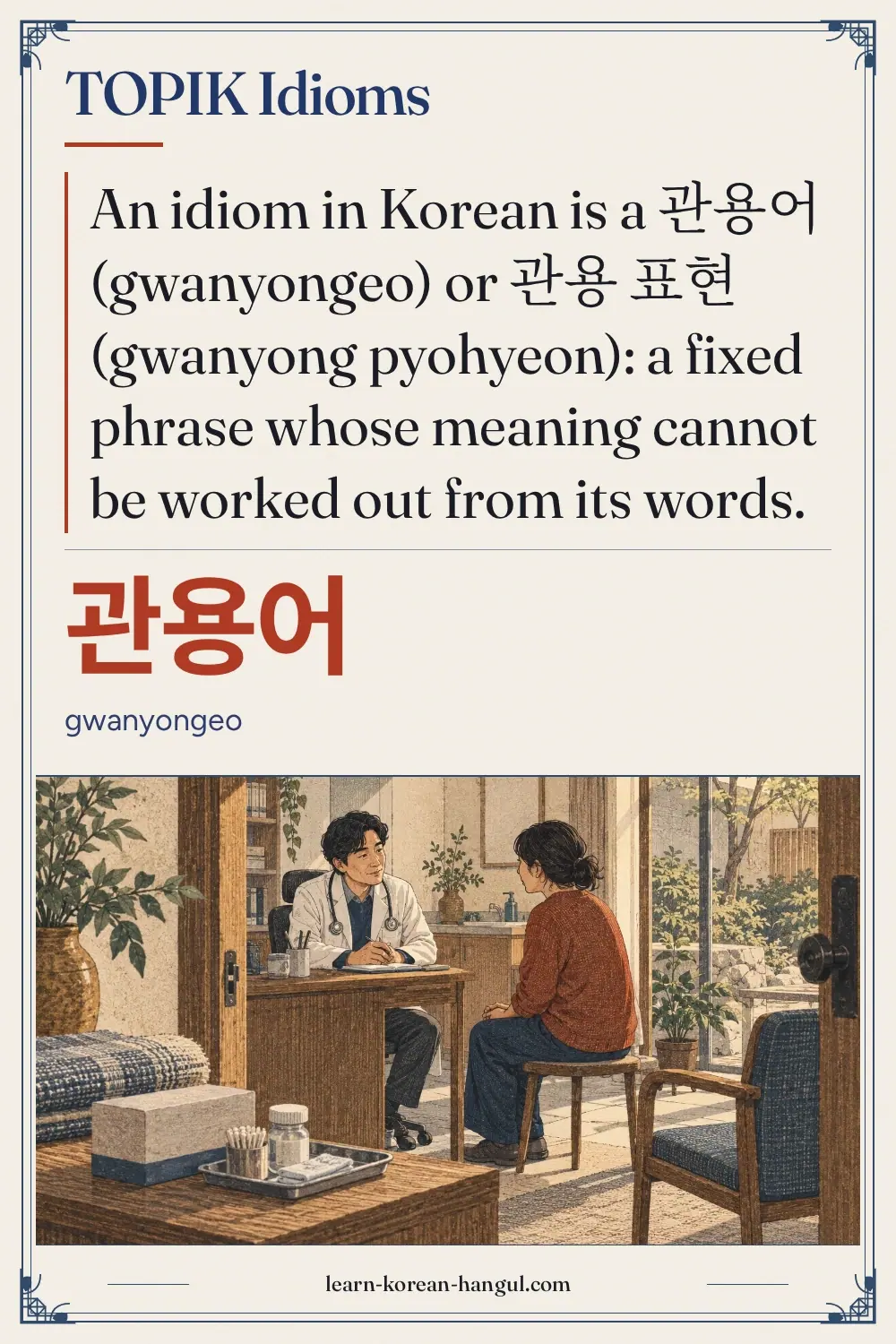
What Are TOPIK Idioms?
TOPIK idioms are the 관용어, or idiomatic expressions, that appear in Test of Proficiency in Korean (TOPIK) items, mostly from Level 3 upward. An idiom is a fixed combination of words whose meaning is not the sum of its parts: 입이 무겁다 means literally "the mouth is heavy", but it describes someone who keeps secrets.
관용어 (gwanyongeo) is said [과뇽어], with the ㄴ moving into the next syllable. The wider term 관용 표현 (gwanyong pyohyeon, "idiomatic expression") covers idioms and other fixed phrases, and TOPIK materials use both.
Korean has three kinds of fixed expression that learners often mix up. The table separates them by form and by how TOPIK uses them.
| Type | Korean term | Form | Example | Meaning |
|---|---|---|---|---|
| Idiom | 관용어 | a short phrase, usually a noun + particle + verb or adjective | 발이 넓다 (bari neolda) | to know many people |
| Proverb | 속담 (sokdam) | a full sentence of folk wisdom | 가는 말이 고와야 오는 말이 곱다 | speak kindly and you will be spoken to kindly |
| Four-character idiom | 사자성어 (sajaseongeo) | four Sino-Korean syllables | 일석이조 (ilseogijo) | two birds with one stone |
This page covers the first type; the site also has full lists of Korean idioms, Korean proverbs and Korean four character idioms. Idioms are the most frequent of the three in TOPIK dialogues, because Koreans use them in everyday speech, not only in writing. Knowing what an idiom is leads straight to the question of which ones to learn first.
Which Idioms Are Common?
The most common TOPIK idioms are body-part idioms, because Korean builds many everyday expressions on 손, 발, 눈, 입, 귀 and 머리. The 20 below are a core set that course books for Levels 3-4 teach and that past-paper dialogues and stories use. Each group has the same structure: a table with the literal and real meaning, then one example sentence with audio.
Romanization follows Revised Romanization and is only a learning aid. Spaced words are romanized separately, and the [bracket] shows the spoken form where it differs from the spelling.
Idioms with 손 (hand)
손 idioms describe generosity, work and involvement.
| Idiom | Romanization | Literal meaning | Real meaning |
|---|---|---|---|
| 손이 크다 | soni keuda | the hands are big | to be generous; to make or buy things in large amounts |
| 손을 떼다 | soneul tteda | to take one's hands off | to stop being involved, to wash one's hands of something |
| 손이 모자라다 | soni mojarada | hands are short | to be short-handed |
| 손에 땀을 쥐다 [소네 따믈 쥐다] | sone ttameul jwida | to grip sweat in one's hands | to be on the edge of one's seat with suspense |
우리 어머니는 손이 커서 음식을 항상 많이 만드신다.
uri eomeonineun soni keoseo eumsigeul hangsang mani mandeusinda.
My mother is generous with food, so she always makes a lot.
손이 크다 can also be literal: 아기 손이 크다 simply means the baby has big hands. Context decides, and TOPIK items choose contexts where only one reading fits.
Idioms with 발 (foot)
발 idioms describe social networks, movement and commitment.
| Idiom | Romanization | Literal meaning | Real meaning |
|---|---|---|---|
| 발이 넓다 [바리 널따] | bari neolda | the feet are wide | to know many people |
| 발을 끊다 [바를 끈타] | bareul kkeunta | to cut off one's feet | to stop visiting a place or person |
| 발 벗고 나서다 [발 벋꼬 나서다] | bal beotgo naseoda | to step forward barefoot | to throw oneself into helping |
| 발이 묶이다 [바리 무끼다] | bari mukkida | the feet are tied | to be stuck and unable to leave |
민수 씨는 발이 넓어서 어디를 가도 아는 사람이 있다.
minsu ssineun bari neolbeoseo eodireul gado aneun sarami itda.
Minsu knows so many people that wherever he goes, there is someone he knows.
발이 묶이다 is a favourite in news items about weather: when heavy snow cancels flights, travellers' feet are "tied" at the airport.
Idioms with 눈 (eye)
눈 idioms describe standards, speed and busyness.
| Idiom | Romanization | Literal meaning | Real meaning |
|---|---|---|---|
| 눈이 높다 [누니 놉따] | nuni nopda | the eyes are high | to have high standards |
| 눈 깜짝할 사이 [눈 깜짜칼싸이] | nun kkamjjakal sai | the time it takes to blink | in the blink of an eye |
| 눈코 뜰 새 없다 [눈코 뜰쌔 업따] | nunko tteul sae eopda | no time to open eyes and nose | to be extremely busy |
| 눈에 띄다 [누네 띠다] | nune ttuida | to catch the eye | to stand out, to be noticeable |
요즘 눈코 뜰 새 없이 바쁘다.
yojeum nunko tteul sae eopsi bappeuda.
I am run off my feet these days.
눈코 뜰 새 없다 almost always appears as 눈코 뜰 새 없이 바쁘다, with 없이 ("without") leading into 바쁘다 (busy). Learning the whole chunk is easier than learning the idiom alone.
Idioms with 입 (mouth)
입 idioms describe secrets, gossip and agreement.
| Idiom | Romanization | Literal meaning | Real meaning |
|---|---|---|---|
| 입이 무겁다 [이비 무겁따] | ibi mugeopda | the mouth is heavy | to keep secrets, to be discreet |
| 입이 가볍다 [이비 가볍따] | ibi gabyeopda | the mouth is light | to be unable to keep a secret |
| 입을 모으다 [이블 모으다] | ibeul moeuda | to gather mouths | to say the same thing with one voice |
그 친구는 입이 무거우니까 비밀을 말해도 괜찮다.
geu chinguneun ibi mugeounikka bimireul malhaedo gwaenchanta.
That friend keeps secrets, so it is fine to tell them.
입을 모으다 is common in news language: 전문가들이 입을 모아 말했다 means "experts said with one voice". The pair 무겁다 / 가볍다 makes a natural opposite, which TOPIK distractors exploit.
Idioms with 귀 (ear)
귀 idioms describe persuasion and attention.
| Idiom | Romanization | Literal meaning | Real meaning |
|---|---|---|---|
| 귀가 얇다 [귀가 얄따] | gwiga yalda | the ears are thin | to be easily persuaded |
| 귀를 기울이다 [귀를 기우리다] | gwireul giurida | to tilt one's ears | to listen carefully, to pay attention |
| 귀에 못이 박히다 [귀에 모시 바키다] | gwie mosi bakida | calluses form in the ears | to hear something so often one is tired of it |
그는 귀가 얇아서 광고만 보면 물건을 산다.
geuneun gwiga yalbaseo gwanggoman bomyeon mulgeoneul sanda.
He is so easily persuaded that he buys things as soon as he sees an advert.
In 귀에 못이 박히다, 못 is a callus (hardened skin), not a nail, although the two words are spelled the same. Learners who picture a nail still reach the right meaning, but the callus image explains the idiom: you have heard something so often that your ears have hardened.
Idioms with 머리 (head)
머리 idioms describe thinking and rest.
| Idiom | Romanization | Literal meaning | Real meaning |
|---|---|---|---|
| 머리를 맞대다 [머리를 맏때다] | meorireul matdaeda | to put heads together | to discuss something together, to confer |
| 머리를 식히다 [머리를 시키다] | meorireul sikida | to cool one's head | to take a break and clear one's mind |
우리는 문제를 해결하려고 머리를 맞대고 의논했다.
urineun munjereul haegyeolharyeogo meorireul matdaego uinonhaetda.
We put our heads together to solve the problem.
These 20 idioms cover the body parts that TOPIK dialogues use most. Before looking at the test, it helps to see how an idiom behaves inside a real sentence.
How Do You Use Idioms in Your Own Sentences?
You use a Korean idiom by keeping the noun and particle fixed and conjugating the final verb or adjective like any other. The idiom 손이 크다 is a dictionary form; in a sentence it becomes 손이 커요 (polite), 손이 컸다 (written past) or 손이 큰 사람 (a generous person). The table shows five idioms in the three forms you will use most.
| Idiom | Polite present | Written past | Before a noun |
|---|---|---|---|
| 손이 크다 | 손이 커요 | 손이 컸다 [컫따] | 손이 큰 사람 |
| 발이 넓다 | 발이 넓어요 [널버요] | 발이 넓었다 [널벋따] | 발이 넓은 사람 [널븐] |
| 눈이 높다 | 눈이 높아요 [노파요] | 눈이 높았다 [노팓따] | 눈이 높은 사람 [노픈] |
| 입이 무겁다 | 입이 무거워요 | 입이 무거웠다 [무거웓따] | 입이 무거운 사람 |
| 귀가 얇다 | 귀가 얇아요 [얄바요] | 귀가 얇았다 [얄받따] | 귀가 얇은 사람 [얄븐] |
Two adjectives in the table are irregular. 크다 drops its ㅡ before -어요, giving 커요, and 무겁다 changes its final ㅂ to 우 before a vowel, giving 무거워요 and 무거운. The same ㅂ change applies to 입이 가볍다 (가벼워요). The other three are regular.
The modifier form is where idioms become most useful: 발이 넓은 사람 (a well-connected person) or 눈이 높은 손님 (a demanding customer) describe people in one phrase. Two habits keep your own sentences natural:
- Keep the particle in writing. 손이 커요 is correct everywhere; 손 커요, without 이, is casual speech only.
- Do not swap the body part or the adjective. 발이 크다 means only "to have big feet"; the idiom is 발이 넓다. A changed word breaks the idiom.
Using five of these idioms in your own sentences, aloud and in writing, is the fastest way to recognise them under exam pressure. The next question is where they appear in the test itself.
How Are Idioms Tested in TOPIK?
TOPIK tests idioms indirectly: you rarely see a question that asks "what does this idiom mean?", but an idiom often carries the key information in a dialogue, a blank or a literary passage. Three patterns recur across past TOPIK II papers.
| Pattern | Section | What you must do | Example idiom use |
|---|---|---|---|
| Blank in a dialogue or short text | Reading | choose the expression that fits the situation | 손이 모자라서 in a dialogue about a busy event |
| Feeling or attitude in a story | Reading | infer how a character feels from an underlined phrase | 가슴이 철렁하다 (gaseumi cheolleonghada, one's heart sinks) |
| Main idea of a conversation | Listening | understand a speaker who uses an idiom instead of plain words | 귀가 얇아서 큰일이에요 (I'm too easily persuaded, it's a problem) |
The table describes typical patterns, not an official list of item types. TOPIK I rarely uses idioms, because beginner items keep to literal everyday language; idioms become frequent from the intermediate reading items onward. The site's guide to TOPIK reading question types shows where the blank and feeling items sit in the paper, and the TOPIK listening guide covers the dialogue items. Idioms become more frequent as the target rises: Level 4 is the first level whose official description mentions idiomatic expressions, and TOPIK level 5 texts use a wider range of them.
Here is a practice item in the dialogue style, written for this page. 가 and 나 mark the two speakers, as in TOPIK booklets.
가: 이번 행사를 준비할 사람이 부족하네요. 나: 맞아요. 지금 손이 모자라서 다른 부서에 도움을 요청해야겠어요.
ga: ibeon haengsareul junbihal sarami bujokaneyo. na: majayo. jigeum soni mojaraseo dareun buseoe doumeul yocheonghaeyagesseoyo.
A: We don't have enough people to prepare this event. B: Right. We're short-handed, so we'll have to ask another department for help.
In a real item, 손이 모자라서 would be the blank, and the options would include 귀가 얇아서, 입이 무거워서 and 눈이 높아서. Only 손이 모자라서 fits "not enough people". The trap is to pick an idiom you recognise without checking it against the situation, which leads to the main skill of this page.
How to Avoid the Literal-Meaning Trap
Avoid the literal-meaning trap by treating every body-part phrase as a possible idiom and checking it against the situation before you translate it word by word. Five steps work in the exam:
- Notice the pattern. A body part + 이/가 or 을/를 + a short adjective or verb (손이 크다, 귀가 얇다) is a strong idiom signal.
- Test the literal reading. Ask whether the literal meaning makes sense in context. "His ears are thin, so he buys everything" does not, so the phrase is figurative.
- Look for the cause and effect. Idioms usually explain a result: 귀가 얇아서 (because he's easily persuaded) → 물건을 산다 (he buys things). The result tells you the meaning.
- Check the opposite. Many idioms come in pairs, such as 입이 무겁다 and 입이 가볍다. A distractor often uses the opposite of the right answer.
- Choose the option that matches the speaker's attitude. In listening, an idiom often signals praise, complaint or worry. Match the option to that attitude, not to the words.
The common mistake is to translate the idiom into English first. English has its own body idioms, and they rarely match: "thin-skinned" in English means easily offended, while 귀가 얇다 (thin ears) means easily persuaded. Steps like these only become automatic with regular practice.
Practice Routine for TOPIK Idioms
A short routine, repeated daily, turns this list into recognition you can use under time pressure. Spend 10-15 minutes a day for two weeks:
- Days 1-6: learn one body-part group a day. Read the table, play the example sentence, and write one sentence of your own with the idiom conjugated (손이 커요, 손이 큰 사람).
- Day 7: mixed review. Cover the meaning column and say each meaning aloud.
- Days 8-13: meet them in real texts. Read one TOPIK II reading passage or a news article a day and mark any idiom you find, including ones not on this list.
- Day 14: take the drill below. Note any idiom you miss and add it to your review deck.
Idioms work best in speech after the exam too: 머리 좀 식히고 올게요 ("I'll go and clear my head") is a natural thing to say before a break. The drill below has 10 items with answers and explanations.
Practice · 10
As an idiom, 발이 넓다 means:
Show answer
to know many people
발이 넓다 (feet are wide) means having a wide social network: you know people everywhere.
입이 무겁다 describes someone who:
Show answer
keeps secrets well
A heavy mouth does not open easily, so 입이 무겁다 describes a discreet person who keeps secrets.
귀가 얇다 describes someone who:
Show answer
is easily persuaded
Thin ears let every opinion in, so 귀가 얇다 means easily persuaded or easily swayed.
Choose the expression that fits: 요즘 일이 너무 많아서 ______ 바빠요.
Show answer
눈코 뜰 새 없이
눈코 뜰 새 없이 바쁘다 means extremely busy. The other options do not combine with 바쁘다.
머리를 맞대다 means:
Show answer
to discuss a problem together
Putting heads together means conferring: 머리를 맞대다 is to work something out together.
손을 떼다 means:
Show answer
to stop being involved
Taking your hands off something means stopping your involvement in it, like 'washing your hands of it'.
Which idiom means 'to listen carefully'?
Show answer
귀를 기울이다
귀를 기울이다 (tilt one's ears) means to listen attentively.
눈이 높다 describes someone who:
Show answer
has high standards
High eyes look only at the best, so 눈이 높다 means having high standards, for example when choosing a partner or a product.
The opposite of 입이 무겁다 is:
Show answer
입이 가볍다
입이 가볍다 (the mouth is light) describes someone who cannot keep a secret.
폭설로 공항에 발이 묶였다. What happened to the travellers?
Show answer
They were stuck and could not leave.
발이 묶이다 (feet are tied) means being stuck. Heavy snow (폭설) kept the travellers at the airport.
If you scored 8 or more, move on to idioms in real reading passages; if fewer, repeat the day 7 review. Before you rely on this list, one limitation is worth knowing.
What This List Does Not Cover
This page covers 20 body-part idioms, the core set for TOPIK II, not every idiom in the test. Advanced reading items also use idioms built on other words, such as 가슴 (chest) and 마음 (heart, mind), plus proverbs and four-character idioms, which have their own lists. Meanings here are the standard dictionary senses; some idioms carry extra nuances in particular regions or generations.
No official TOPIK idiom list exists, so this selection is editorial, based on intermediate course books and the patterns in past papers. For words rather than idioms, continue with the TOPIK 2 vocabulary list. For more body vocabulary, the Korean body parts lesson gives the literal words these idioms are built on. Proverbs and four-character idioms are best learned as separate lists once these 20 feel natural, and the TOPIK II guide links every other page for the test.
Frequently Asked Questions
Are Idioms Tested on TOPIK 1?
Rarely. TOPIK I items for Levels 1 and 2 use literal, everyday language, so idioms seldom carry an answer. A few very common ones, such as 눈이 높다, can appear in a dialogue, but they are not a priority for beginners. Idioms become important in TOPIK II, especially in reading dialogues and literary passages.
How Many Idioms Should I Learn for TOPIK?
No official number exists. A practical rule of thumb is to start with the 20 body-part idioms on this page for Levels 3-4, then grow to around 100 by Level 5 through reading. Recognising an idiom in context matters more than producing it, so learn each one with an example sentence.
What Are 사자성어?
사자성어 (sajaseongeo) are four-character idioms built from four Sino-Korean syllables, usually from Chinese classical stories. Examples are 일석이조 (two birds with one stone) and 고진감래 (gojingamnae, joy comes after hardship). They appear in advanced TOPIK reading and are learned as a separate list from body-part idioms.
Do Idioms Appear in TOPIK Writing?
Idioms are not required in TOPIK writing, and questions 53 and 54 are marked on content, organisation and language use. A well-chosen idiom can make an essay sound natural, but a misused one costs accuracy. In question 53, which describes a graph, avoid idioms entirely; in question 54, use one only if you are sure of it.
Do Idioms Change with the Verb Ending?
Yes. The predicate conjugates like any verb or adjective: 손이 크다 becomes 손이 커요 (polite), 손이 컸다 (past, written) or 손이 큰 사람 (a generous person). The noun and particle stay fixed, though the particle is often dropped in casual speech, as in 손 커요.
TOPIK Idioms: the Bottom Line
TOPIK idioms are most often body-part phrases such as 발이 넓다, 귀가 얇다 and 입이 무겁다, and they appear in TOPIK II dialogues, blanks and stories rather than in direct definition questions. Learn the 20 on this page with their example sentences, test every body-part phrase against its context, and practise until the figurative reading comes before the literal one.