
The costliest mistakes at a glance
- Costliest overall: Mistake 1, having no time plan for reading. It loses points on questions you could answer.
- Costliest in writing: Mistake 8, writing questions 53 and 54 in the polite spoken style instead of the plain written style.
- Easiest to fix: Mistake 2, leaving answers blank. One rule fixes it on the day.
- Most hidden: Mistake 4, practising listening only from text. It shows up only under timed audio.
TOPIK Common Mistakes: the Essentials
TOPIK common mistakes fall into two kinds: knowledge gaps, which need study, and test-taking errors, which need drills. This page is about the second kind. A test-taking error loses points on questions you already know how to answer, so fixing it is the fastest way to raise a score.
The "points at risk" rating below is editorial. It weighs how many points a mistake can affect, how often learners make it in practice, and whether it applies to TOPIK I, TOPIK II or both. No official source ranks candidate errors.
| No. | Mistake | Section | Test | Points at risk |
|---|---|---|---|---|
| 1 | No time plan for reading | Timing | both | high |
| 2 | Leaving answers blank | Timing | both | medium |
| 3 | Running out of time in writing | Timing | TOPIK II | high |
| 4 | Practising listening only from text | Listening | both | high |
| 5 | Falling for listening distractors | Listening | both | medium |
| 6 | Reading every word of every text | Reading | both | medium |
| 7 | Answering from general knowledge | Reading | both | low |
| 8 | Wrong style in questions 53-54 | Writing | TOPIK II | high |
| 9 | Writing too little in 53-54 | Writing | TOPIK II | medium |
| 10 | Copying the prompt into your essay | Writing | TOPIK II | low |
| 11 | Misaligning the answer sheet | Answer sheet | both (paper) | medium |
| 12 | Leaving answer marking to the end | Answer sheet | both (paper) | medium |
Every mistake below follows the same structure: a verdict, why it happens, the fix, the drawback of the fix, and a quick test of whether it applies to you. The timing mistakes come first because they affect every section.
Which Timing Mistakes Cost Points?
The timing mistakes that cost the most points are having no reading time plan, leaving blanks, and running out of time in the writing period. All three come from treating the clock as something to watch rather than something to plan.
1. Having No Time Plan for Reading
Verdict: candidates who read at their natural pace usually run out of time before the last, longest texts, which carry many points.
Why it happens: early reading items are short and feel easy, so candidates spend too long checking them. On the paper test, TOPIK I reading gives 60 minutes for 40 questions, an average of 90 seconds each, and TOPIK II reading gives 70 minutes for 50 questions, an average of 84 seconds each. The final texts need more than the average, so early items must take less.
Fix: write three checkpoints on a card before your next mock, and practise until they feel normal. A skip-and-return rule helps: if one TOPIK II item has taken more than about 84 seconds and you are still unsure, mark your best guess, flag the number, and move on.
| Test | Checkpoint 1 | Checkpoint 2 | Checkpoint 3 |
|---|---|---|---|
| TOPIK I reading | question 50 by minute 20 | question 60 by minute 40 | question 70 with 5 minutes left |
| TOPIK II reading | question 20 by minute 20 | question 35 by minute 45 | question 50 with 5 minutes left |
These checkpoints are editorial suggestions built from the official timings, not official rules. Adjust them after two mocks.
Drawback of the fix: moving on from an unsure item feels wrong, and you will sometimes skip a question you could have solved with one more minute.
This is your mistake if you have ever left the last three or more reading items unread. It is not your problem if you finish every mock with ten minutes to spare.
2. Leaving Answers Blank
Verdict: a blank multiple-choice answer is a guaranteed zero, while a guess has a one-in-four chance of scoring.
Why it happens: some candidates come from tests that subtract points for wrong answers. TOPIK, under its current rules, does not: a wrong answer and a blank both score zero.
Fix: in the last two minutes of every listening and reading section, fill every blank with your best guess. If you have no idea at all, pick any option; each guess still has a one-in-four chance. Confirm the no-deduction rule in the current test guide on the official TOPIK website (topik.go.kr) before your test.
Drawback of the fix: none for scoring; the only cost is the discipline of watching the clock in the final minutes.
This is your mistake if your mocks ever end with empty answer rows. It is not your problem if you always mark every item.
3. Running out of Time in the Writing Section
Verdict: spending too long on questions 51-53 leaves too few minutes for question 54, the longest and highest-value writing task.
Why it happens: on the paper test, TOPIK II listening and writing share one 110-minute period. Listening takes the first 60 minutes, so writing gets the remaining 50 for all four questions. Candidates who polish questions 51 and 52 start question 54 with 15 minutes left.
Fix: a commonly used budget, consistent with the TOPIK exam format, is about 10 minutes for questions 51 and 52 together, 15 for question 53 and 25 for question 54. Many candidates write question 54 first for this reason. Practise the order you choose at least twice in timed conditions.
Drawback of the fix: writing question 54 first can rattle you if the topic is hard, and some candidates lose easy points on 51-52 by rushing them at the end.
This is your mistake if your practice question 54 essays are unfinished. It is not your problem if you finish all four questions with time to reread.
Which Listening Mistakes Cost Points?
The listening mistakes that cost points are practising only from text and falling for distractors. Both are invisible until you sit a timed audio section. The TOPIK listening tips page covers the full set of strategies, and the TOPIK listening hub gathers practice sets and question types.
4. Practising Listening Only from Text
Verdict: learners who study Korean mostly by reading often score far lower in listening than in reading, because they have never trained processing speed.
Why it happens: reading lets you pause, reread and look up words. Listening does not. A word you recognise in writing may be unrecognisable in speech: 먹었어요 sounds like [머거써요], and 같이 sounds like [가치].
Fix: add 10-15 minutes of daily listening for at least four weeks. Alternate dictation (writing down a sentence you hear) with shadowing (repeating audio aloud just after the speaker). Use past-paper transcripts so the vocabulary matches the test.
Drawback of the fix: it is slow and feels unproductive for the first week or two; the gain shows up only in timed tests.
This is your mistake if your listening mock score is 15 or more points below your reading score. It is not your problem if the two sections are within a few points of each other.
5. Falling for Listening Distractors
Verdict: many wrong listening answers come from three traps: an option that repeats words from the audio, an option about the other speaker, and an option built on a detail that is later corrected.
Why it happens: under time pressure, the brain matches sounds. An option containing words you just heard feels right.
If the speaker says 가격은 비싸지만 맛있어요 (it's expensive but tasty), an option saying "it is cheap and tasty" repeats the "tasty" part and reverses the price. That is the trap.
Fix: before marking any answer, ask two questions: does the option mean the same, or only use the same words; and is it about the right person and the final version of the detail? Log every trap you fall for by type.
Drawback of the fix: the check takes a second or two, which you only have if you previewed the options in the pause before the recording.
This is your mistake if you often feel certain about listening answers that turn out wrong. It is not your problem if your listening errors are mostly unknown words.
Which Reading Mistakes Cost Points?
The reading mistakes that cost points are reading every word and answering from general knowledge. Both waste time or trade the text's answer for your own. More strategy is on the TOPIK reading hub.
6. Reading Every Word of Every Text
Verdict: reading each text from start to finish before looking at the question wastes time on early items that need only one detail.
Why it happens: it feels thorough, and course books train careful reading.
Fix: read the question first, then the options, then search the text for the part that decides between them. For early items, such as notices, ads and short descriptions, this often takes under a minute. Save full careful reading for the long texts at the end, where questions test the main idea or the writer's attitude.
Drawback of the fix: on a few items the answer depends on the whole text, so skimming too fast causes errors; learn which item types need full reading by checking past papers.
This is your mistake if you read at the same speed for every item. It is not your problem if you already finish reading with time to spare.
7. Answering from General Knowledge
Verdict: in content-match items, the correct option is what the text says, not what is true in the real world.
Why it happens: an option such as "Exercise is good for health" sounds correct, so candidates choose it without checking whether the text says it.
Fix: for every content-match answer, put your finger on the sentence in the text that supports it. If you cannot find one, the option is probably a distractor, however true it sounds.
Drawback of the fix: finding the supporting line takes extra seconds, so use it mainly when two options both seem plausible.
This is your mistake if you pick "sensible" answers you cannot locate in the text. It is not your problem if you already verify answers against the text.
Which Writing Mistakes Cost Points?
The writing mistakes that cost points are the wrong style, writing too little and copying the prompt. All apply only to TOPIK II, which is the only test with a writing section.
8. Writing Questions 53 and 54 in the Wrong Style
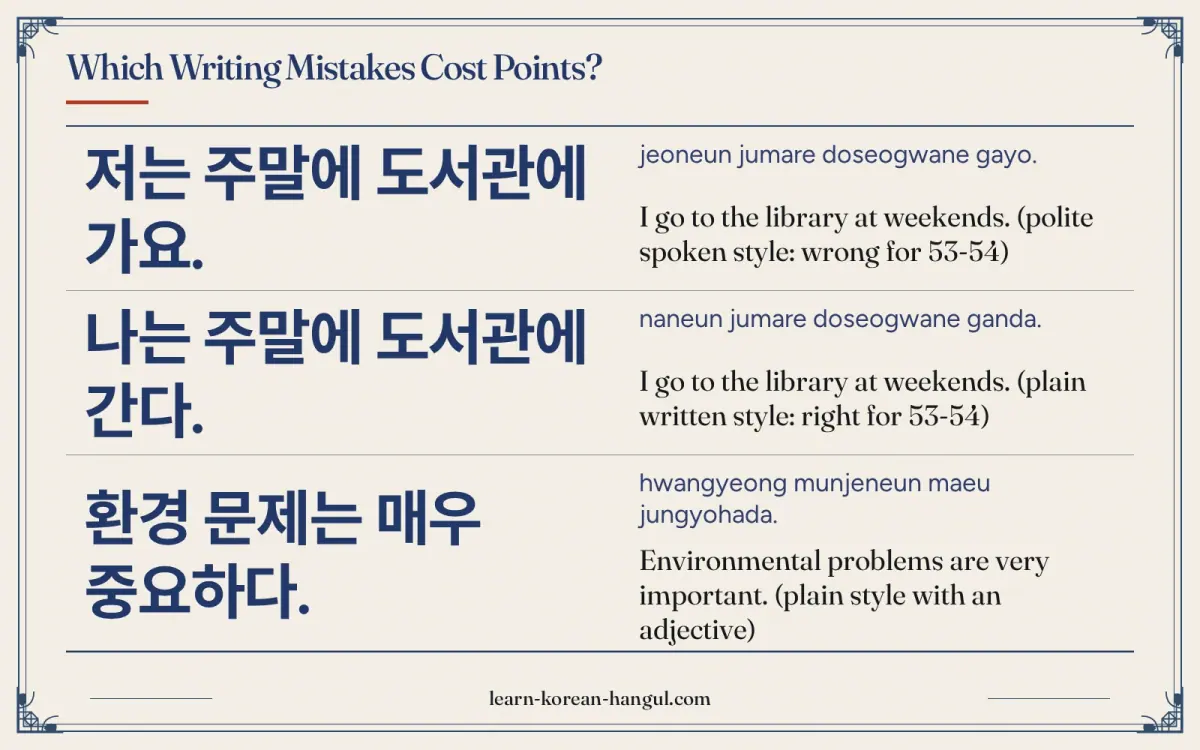
Verdict: writing the TOPIK II essay questions in the polite spoken style (-아/어요) or the formal style (-(스)ㅂ니다) costs marks, because these questions expect the plain written style (-ㄴ/는다).
This mistake can lower the score on the two highest-value writing questions at once, which is why it sits among the costliest.
Why it happens: most course books teach speaking first, so learners write the way they speak. The plain written style, called 해라체 (haerache) in Korean grammar, is used in essays, newspapers and reports, but rarely in beginner classes.
저는 주말에 도서관에 가요.
jeoneun jumare doseogwane gayo.
I go to the library at weekends. (polite spoken style: wrong for 53-54)
나는 주말에 도서관에 간다.
naneun jumare doseogwane ganda.
I go to the library at weekends. (plain written style: right for 53-54)
Fix: drill the plain style for one week before you write a single practice essay. Turn ten polite sentences a day into the plain style: verbs take -ㄴ다 after a vowel and -는다 after a consonant (간다, 먹는다), adjectives take -다 (중요하다), and 이에요/예요 becomes 이다/다. Note that 저 also changes to 나, and 저희 to 우리.
환경 문제는 매우 중요하다.
hwangyeong munjeneun maeu jungyohada.
Environmental problems are very important. (plain style with an adjective)
The short gap-fill questions 51 and 52 are different: the answer should match the style of the surrounding text, which can be polite in a notice or email.
Drawback of the fix: the plain style feels unnatural at first, and mixing styles inside one essay is as bad as using the wrong one, so you need enough practice to stay consistent.
This is your mistake if your practice essays contain -요 or -습니다 endings. It is not your problem if you are taking TOPIK I, which has no writing section.
9. Writing Too Little in Questions 53 and 54
Verdict: an answer that falls short of the length range usually loses marks, because it cannot cover everything the task asks for.
Why it happens: candidates run out of time (Mistake 3), or they do not know how much 600 Korean characters looks like on paper. On paper tests, writing goes on 원고지 (wongoji), manuscript paper with one box per character, so the length is easy to see once you have practised on it.
Question 53 asks for about 200-300 characters, and question 54 for about 600-700 characters, including spaces. Question 54 prompts usually contain two or three sub-questions; skipping one costs content marks even if the essay is long enough.
Fix: practise on printed 원고지 until you can fill 600 boxes in 25 minutes. Before writing, number the sub-questions in the prompt and plan one paragraph for each.
Drawback of the fix: chasing length can lead to padding and repetition, which raters also mark down; length is a minimum, not a goal.
This is your mistake if your practice essays stop well before the bottom of the range. It is not your problem if your essays already land in the middle of each range.
10. Copying the Prompt into Your Essay
Verdict: sentences copied from the question prompt do not show your own writing, so they add length without adding value.
Why it happens: the prompt contains useful vocabulary, and copying it feels like a safe start.
Fix: reuse the prompt's key words, but write your own sentences around them. For example, if the prompt mentions 환경 보호 (environmental protection), start with your own claim about it in the plain style, not with the prompt's wording.
Drawback of the fix: paraphrasing takes more time than copying; practise it so it does not slow you down.
This is your mistake if your opening sentences match the prompt word for word. It is not your problem if you already write your own opening.
Which Answer-Sheet Mistakes Cost Points?
The answer-sheet mistakes that cost points are misalignment and late marking. Both apply to the paper test, where multiple-choice answers go on a machine-read answer sheet.
11. Misaligning the Answer Sheet
Verdict: marking answers one row off can turn a run of correct answers into a run of wrong ones.
Why it happens: skipping an item and forgetting to skip its row is the usual cause. TOPIK II adds a trap of its own: reading starts again at question 1 in the second period, while in the first period listening runs 1-50 and writing continues as 51-54.
Fix: every time you skip, say the next question number under your breath as you mark it. At the end of each block of ten, check that the last mark sits on the right number. Use the pen and correction method that the current official guide specifies; it is usually supplied or explained at the centre.
Drawback of the fix: checking costs a few seconds per block, which you must budget into your reading checkpoints.
This is your mistake if you have ever found an extra or missing row at the end of a mock. It is not your problem if you have never skipped an item.
12. Leaving Answer Marking to the End
Verdict: writing all your answers in the booklet and transferring them at the end risks running out of time with an empty sheet.
Why it happens: it feels efficient, and some school exams give extra time to transfer answers. TOPIK does not set aside time for this, so check the instructions on the day.
Fix: mark the answer sheet in blocks of five to ten questions as you go. In listening, mark during the short gaps between recordings, not at the end of the section.
Drawback of the fix: switching between booklet and sheet breaks your rhythm slightly; blocks of five are a good compromise.
This is your mistake if your mocks end with a rush to fill the sheet. It is not your problem if you already mark as you go.
How Do You Fix TOPIK Common Mistakes?
You fix TOPIK common mistakes with drills, not with more reading about them. Take one timed TOPIK mock test, list which of the 12 mistakes you made, and give each one a drill for two weeks.
| Mistake | Drill | Time per day | Check it worked |
|---|---|---|---|
| 1. No reading time plan | Timed reading with checkpoints | 20 minutes, 3 times a week | All items reached in the mock |
| 2. Blank answers | Fill-every-blank rule in the last 2 minutes | in every mock | Zero empty rows |
| 3. Writing time | Fixed 10/15/25 minute budget | one timed writing set a week | Question 54 finished |
| 4. Text-only listening | Dictation or shadowing | 10-15 minutes | Listening within a few points of reading |
| 5. Listening distractors | Two-question check, log traps | with every set | Fewer trap errors in the log |
| 6. Reading every word | Question first, then text | with every set | Faster early items |
| 7. General knowledge | Find the supporting line | with every set | Every answer located |
| 8. Wrong writing style | Turn 10 polite sentences into plain style | 10 minutes | No -요 or -습니다 in essays |
| 9. Too-short writing | Fill 600 boxes of 원고지 | 25 minutes, twice a week | Middle of the length range |
| 10. Copied prompt | Write your own opening | with every essay | No copied sentences |
| 11. Misaligned sheet | Say the number when you skip | in every mock | No misaligned rows |
| 12. Late marking | Mark in blocks of 5-10 | in every mock | Sheet full when time ends |
A useful rule of thumb: fix no more than three mistakes at once. Working on all twelve at the same time spreads your attention and fixes none. Start with the mistake that cost you the most points in your last mock.
Can Fixing Mistakes Raise Your Level on Its Own?
Not always. Fixing test-taking mistakes recovers points you were already able to earn. It cannot add knowledge you do not have yet. If your mocks are far below the cut score for your target level, vocabulary, grammar and listening volume matter more than any of these fixes. Also note that the internet-based TOPIK has its own layout and timing, so the answer-sheet advice does not apply to it. For a schedule that combines fixes with new study, use the TOPIK study plan.
TOPIK Common Mistakes: the Bottom Line
The TOPIK common mistakes that cost the most points are poor time management and the wrong writing style in questions 53 and 54, followed by blank answers and listening practised only from text. None of them is about how much Korean you know, so each one can be fixed with a drill in two to four weeks. Take a timed mock, find your top three, and fix those first. For the rest of the preparation pages, return to TOPIK preparation.
Frequently Asked Questions
Is Guessing Penalised on TOPIK?
No. Under the current rules, TOPIK does not subtract points for wrong answers in listening or reading, so a wrong answer and a blank both score zero. That makes guessing free. Always mark an answer for every multiple-choice item, and confirm the rule in the test guide on topik.go.kr for your session.
What Happens If My Writing Is Too Short?
A short answer to question 53 or 54 usually loses marks, because it cannot cover everything the task asks for and falls outside the length range printed with the question. Questions 53 and 54 ask for about 200-300 and 600-700 Korean characters. Aim for the middle of each range, and check the current guide.
How Do I Avoid Running out of Time on TOPIK?
Set checkpoints before the test: by a fixed minute you should be at a fixed question. In TOPIK II reading, 70 minutes for 50 questions is 84 seconds a question on average. If an item takes much longer, mark your best guess, flag it, and return only if time remains.
What Is the Biggest TOPIK Mistake?
Poor time management is the most costly mistake for most candidates, because it loses points on questions they could have answered. Running out of time in reading, or giving question 54 too few minutes, affects many points at once. A timed mock with a written checkpoint plan is the fix.
Do These Mistakes Apply to the Internet-Based TOPIK?
Most do: timing, writing style, essay length, traps and reading habits apply to both versions. The answer-sheet mistakes apply only to the paper test. The internet-based test has its own question counts, timing and screen layout, so practise with its official sample materials if you choose it.