
What you will be able to do after this lesson
- Describe the taste of 8 dishes with the right adjective.
- Form 맵다, 달다, 짜다, 시다, 쓰다 and 싱겁다 in the polite present and as modifiers.
- Ask for less spicy or less salty food with -게 해 주세요.
- Follow a six-line restaurant dialogue and use its sentences.
Before you start: read verbs vs adjectives, because taste words are adjectives that conjugate like verbs. Time: about 30 minutes. Level: A1.
Which Adjectives Describe Taste in Korean?
Korean has six core taste adjectives: 달다 (sweet), 짜다 (salty), 맵다 (spicy), 시다 (sour), 쓰다 (bitter) and 싱겁다 (bland, not salty enough). They describe food and drink, and each ends in 다 in the dictionary form. To use one, change it to the polite present: 달아요, 짜요, 매워요, 셔요, 써요, 싱거워요. Pair them with 맛있다 (tasty) and 맛없다 (not tasty) and you can say most things about a meal.
| Word | Meaning | RR | Polite present | Modifier | Class |
|---|---|---|---|---|---|
| 달다 | sweet | dalda | 달아요 | 단 | ㄹ-drop |
| 짜다 | salty | jjada | 짜요 | 짠 | regular |
| 맵다 | spicy | maepda | 매워요 | 매운 | ㅂ irregular |
| 시다 | sour | sida | 셔요 | 신 | regular (contracts) |
| 쓰다 | bitter | sseuda | 써요 | 쓴 | ㅡ-drop |
| 싱겁다 | bland | singgeopda | 싱거워요 | 싱거운 | ㅂ irregular |
Four of the six are irregular and a fifth contracts, so the pattern is the real lesson of this page. The sections below take the words in two groups, then explain the irregular forms.
Sweet, Salty, Sour and Bitter
Sweet, salty, sour and bitter are the four tastes that most dishes name. Each is a state of the food, so the food is the subject and takes 이/가. A sentence is subject + adjective: 케이크가 달아요 means "The cake is sweet".
| Dish or item | Taste | Sentence | Meaning |
|---|---|---|---|
| 케이크 | 달다 | 케이크가 달아요. | The cake is sweet. |
| 라면 국물 | 짜다 | 라면 국물이 짜요. | The ramyeon broth is salty. |
| 레몬 | 시다 | 레몬이 셔요. | The lemon is sour. |
| 아메리카노 | 쓰다 | 아메리카노가 써요. | The Americano is bitter. |
Each word has a helpful twin. 달다 has the gentler 달콤하다 ("pleasantly sweet"), as in 달콤한 케이크. 시다 has 새콤하다 ("pleasantly tart"), which describes fruit and dressings you enjoy. Koreans use these twins for flavours they like. 쓰다 has a trap: the same spelling means "to write", "to use" and "to wear on the head", so 커피가 써요 ("The coffee is bitter") and 편지를 써요 ("I write a letter") look identical in the polite present. The noun next to the verb tells you which one you have. The 쓰다 dictionary page lists the other meanings.
Spicy and Bland
Spicy and bland are the two words learners use most in restaurants, because Korean food can be very spicy or quite mild. 맵다 is spicy heat from chili. 싱겁다 means too little salt or flavour, and it is the opposite of 짜다. A plain broth that needs salt is 싱거워요.
| Dish | Taste | Sentence | Meaning |
|---|---|---|---|
| 김치찌개 | 맵다 | 김치찌개가 매워요. | The kimchi stew is spicy. |
| 떡볶이 | 맵다, 달다 | 떡볶이가 맵고 달아요. | The tteokbokki is spicy and sweet. |
| 설렁탕 | 싱겁다 | 설렁탕이 싱거워요. | The seolleongtang is bland. |
| 평양냉면 | 싱겁다 | 평양냉면은 조금 싱거워요. | Pyongyang-style cold noodles are a little bland. |
Be careful with 맵다. English uses "hot" for temperature and for chili, but Korean uses two words. 맵다 is for spice, and 뜨겁다 is for temperature, so a stew that is hot to touch and spicy is 뜨겁고 매워요. For the weather and touch words, see hot and cold in Korean. A dish can be mild by design: with 설렁탕, people add salt at the table to their own taste.
Which Other Words Describe Flavour?
Three more words appear in menus and reviews. They are not part of the six core tastes, but you will hear them often.
| Word | Meaning | Polite present | Example |
|---|---|---|---|
| 느끼하다 | greasy, rich, heavy on oil | 느끼해요 | 피자가 느끼해요. (The pizza is greasy.) |
| 고소하다 | nutty, savoury like sesame or roasted nuts | 고소해요 | 참기름이 고소해요. (The sesame oil smells and tastes nutty.) |
| 맛있다 / 맛없다 | tasty / not tasty | 맛있어요 / 맛없어요 | 이 집 김치가 맛있어요. (The kimchi here is tasty.) |
The adjective 맛있다 is special in the modifier. It takes -는, not -ㄴ: 맛있는 음식 is "tasty food". The same is true of 맛없는 음식. The other taste adjectives take -(으)ㄴ: 매운 음식 ("spicy food"), 단 커피 ("sweet coffee"), 짠 반찬 ("salty side dish"), 신 사과 ("a sour apple"), 쓴 약 ("bitter medicine"), 싱거운 국 ("bland soup"). Pronunciation shifts in the dictionary forms: 맵다 is said [맵따], 싱겁다 [싱겁따], 맛있다 [마싣따] or [마딛따] and 맛없다 [마덥따].
Which Taste Adjectives Are Irregular?
Four taste adjectives are irregular: 달다 (ㄹ-drop), 맵다 and 싱겁다 (ㅂ irregular), and 쓰다 (ㅡ-drop). 시다 contracts, and 짜다 is fully regular. The irregular ones are worth drilling, because you will use them every time you describe food. The forms below come from the site's conjugation engine.
| Word | Class | Polite present | Polite past | Modifier | "because" (-아/어서) | Negative with 안 |
|---|---|---|---|---|---|---|
| 달다 | ㄹ-drop | 달아요 | 달았어요 | 단 | 달아서 | 안 달아요 |
| 짜다 | regular | 짜요 | 짰어요 | 짠 | 짜서 | 안 짜요 |
| 맵다 | ㅂ irregular | 매워요 | 매웠어요 | 매운 | 매워서 | 안 매워요 |
| 시다 | regular (contracts) | 셔요 | 셨어요 | 신 | 셔서 | 안 셔요 |
| 쓰다 | ㅡ-drop | 써요 | 썼어요 | 쓴 | 써서 | 안 써요 |
| 싱겁다 | ㅂ irregular | 싱거워요 | 싱거웠어요 | 싱거운 | 싱거워서 | 안 싱거워요 |
Here is what happens in each irregular word.
- 맵다 and 싱겁다 (ㅂ irregular). The ㅂ at the end of the stem becomes 우 before a vowel: 맵 + 어요 becomes 매워요 and not 맵어요. Before a consonant the ㅂ stays: 맵고, 맵지 않아요. See the ㅂ irregular lesson.
- 달다 (ㄹ-drop). The ㄹ drops before ㄴ, ㅂ and ㅅ, so the modifier is 단 (단 커피) and not 달은. It stays before a vowel: 달아요. See the ㄹ irregular lesson.
- 쓰다 (ㅡ-drop). The ㅡ drops before 어: 쓰 + 어요 becomes 써요. See the ㅡ irregular lesson.
- 시다. The stem 시 plus 어요 contracts to 셔요, and the past is 셨어요.
How Do You Build a Sentence about Taste?
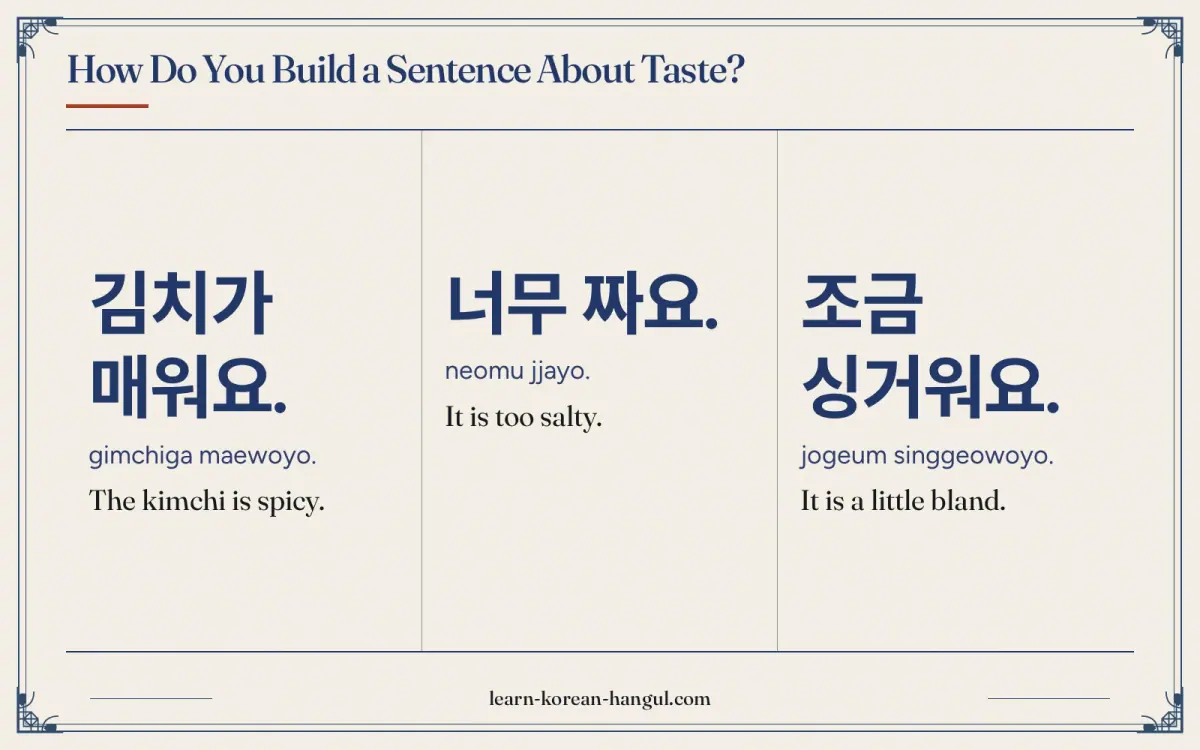
A taste sentence needs the food, the particle 이/가 and the adjective, and you can add a degree word before the adjective. The adverbs 너무 (too, very), 아주 (very), 조금 (a little) and 별로 (not very, used with a negative) change how strong the taste is. The adverbs of degree page explains them.
| Pattern | Example | Meaning |
|---|---|---|
| food + 이/가 + adjective | 김치가 매워요. | The kimchi is spicy. |
| 너무 + adjective | 너무 짜요. | It is too salty. |
| 조금 + adjective | 조금 싱거워요. | It is a little bland. |
| 아주 + adjective | 아주 달아요. | It is very sweet. |
| 별로 안 + adjective | 별로 안 매워요. | It is not very spicy. |
| adjective + -지 않아요 | 맵지 않아요. | It is not spicy. |
| adjective + 은/ㄴ + noun | 매운 음식 | spicy food |
김치가 매워요.
gimchiga maewoyo.
The kimchi is spicy.
너무 짜요.
neomu jjayo.
It is too salty.
조금 싱거워요.
jogeum singgeowoyo.
It is a little bland.
별로 안 매워요.
byeollo an maewoyo.
It is not very spicy.
맵지 않아요.
maepji anayo.
It is not spicy.
The difference between 안 and -지 않다 is small: 안 매워요 is shorter and more spoken, and 맵지 않아요 is slightly more careful. Both mean "not spicy". The same patterns work for any taste adjective, so once you have the frame, you can swap in 달다, 짜다, 시다 or 쓰다.
Food Has Five Taste Nouns
Korean also makes taste nouns from the modifier plus 맛 ("taste"): 단맛 (sweetness), 짠맛 (saltiness), 신맛 (sourness), 쓴맛 (bitterness) and 매운맛 (spiciness). They show up on menus and in food reviews, and you can use them as nouns: 이 소스는 단맛이 강해요 ("This sauce has a strong sweet taste").
| Noun | Meaning | Pronunciation | RR |
|---|---|---|---|
| 단맛 | sweet taste | [단맏] | danmat |
| 짠맛 | salty taste | [짠맏] | jjanmat |
| 신맛 | sour taste | [신맏] | sinmat |
| 쓴맛 | bitter taste | [쓴맏] | sseunmat |
| 매운맛 | spicy taste | [매운맏] | maeunmat |
On some menus you will also see 순한맛 ("mild flavour") and 매운맛 ("spicy flavour") as two options for one dish, such as instant noodles or fried chicken. The word 순한 comes from 순하다 (mild, gentle).
How Do You Ask for Less Spicy Food?
Use the pattern adjective + -게 해 주세요, which means "please make it ___". Add 덜 ("less") before the adjective to ask for a smaller amount. The adjective stem takes -게 directly: 맵 + 게 becomes 맵게. The restaurant phrases page gives more options.
| Request | Meaning | RR |
|---|---|---|
| 덜 맵게 해 주세요. | Please make it less spicy. | deol maepge hae juseyo. |
| 안 맵게 해 주세요. | Please make it not spicy. | an maepge hae juseyo. |
| 맵지 않게 해 주세요. | Please make it not spicy (careful form). | maepji anke hae juseyo. |
| 덜 짜게 해 주세요. | Please make it less salty. | deol jjage hae juseyo. |
| 맵게 해 주세요. | Please make it spicy. | maepge hae juseyo. |
Many kitchens cannot make a dish fully mild, because the heat is built into the sauce. 덜 맵게 is the safer request. After the food arrives, say 너무 매워요 ("It is too spicy") and ask for water: 물 좀 주세요. In speech, 안 맵게 and 덜 맵게 are said as [안맵께] and [덜맵께], with a tense ㄲ after the ㅂ.
Restaurant Dialogue: Ordering a Milder Stew
This six-line dialogue puts the taste words to work. A customer asks about the stew, asks for it to be milder and then finds it a little bland. The lines are short, so you can role-play both parts.
| Speaker | Korean | English |
|---|---|---|
| 손님 | 김치찌개는 많이 매워요? | Is the kimchi stew very spicy? |
| 직원 | 네, 조금 매워요. 덜 맵게 해 드릴까요? | Yes, it is a little spicy. Shall I make it less spicy? |
| 손님 | 네, 덜 맵게 해 주세요. | Yes, please make it less spicy. |
| 직원 | 맛있게 드세요. | Enjoy your meal. |
| 손님 | 음, 조금 싱거워요. 소금 좀 주세요. | Hmm, it is a little bland. Some salt, please. |
| 직원 | 네, 여기 있습니다. | Yes, here you are. |
The first line has a rising question ending, because it is a yes or no question (매워요? with a rise). The staff say 해 드릴까요? to offer help, and the customer replies with 해 주세요 to make the request. For more ordering vocabulary, see Korean restaurant vocabulary.
Practice: Choose the Taste Word
Pick the best answer for each question, then check the explanation.
Practice · 6
Which word means "spicy"?
Show answer
맵다
맵다 means spicy. Its polite present is 매워요, because ㅂ becomes 우 before 어.
What is the polite present of 맵다?
Show answer
매워요
맵다 is ㅂ irregular: the ㅂ changes to 우 before a vowel, giving 매워요.
Which is the correct modifier of 달다 in "sweet coffee"?
Show answer
단 커피
달다 loses its ㄹ before ㄴ, so the modifier is 단.
In 커피가 써요, what does 써요 mean?
Show answer
It is bitter
With 커피 as the subject, 써요 comes from the adjective 쓰다 (bitter).
Which word describes food with too little salt?
Show answer
싱겁다
싱겁다 means bland. 짜다 means salty.
How do you ask for the stew to be less spicy?
Show answer
덜 맵게 해 주세요.
덜 맵게 해 주세요 means "please make it less spicy". 덜 is "less".
Four mistakes cause most errors with taste adjectives.
- Writing 맵어요 for the polite present. The ㅂ turns into 우: write 매워요.
- Writing 달은 커피. The ㄹ drops before ㄴ: write 단 커피.
- Using 맵다 for temperature. 맵다 is for spice; hot to the touch is 뜨겁다.
- Reading 써요 without checking the subject. 쓰다 can mean bitter, write, use or wear on the head, and the noun decides.
What this page does not cover. It covers the six core taste adjectives plus three common flavour words. It does not list every flavour word, dish names or ordering patterns beyond the examples. For the weather and touch meanings of "hot", see hot and cold in Korean. For the phrases in full, use the restaurant phrases page.
What Should You Learn after Korean Taste Adjectives?
After Korean taste adjectives, learn hot and cold in Korean, which separates 덥다, 뜨겁다 and 맵다 and gives the other ㅂ-irregular words you will need at the table.
Frequently Asked Questions
How do I say spicy in Korean? Say 맵다 (maepda). The polite present is 매워요, as in 김치찌개가 매워요 ("The kimchi stew is spicy"). The modifier is 매운, as in 매운 음식 ("spicy food"). Do not say 뜨겁다 for chili heat, because that word means hot to the touch. To ask "Is this spicy?" say 이거 매워요?
What is the Korean for sweet? Sweet is 달다 (dalda). The polite present is 달아요, and the modifier is 단, as in 단 커피 ("sweet coffee"). The ㄹ drops before ㄴ, which is why 단 and not 달은 is correct. For a pleasant, gentle sweetness, Koreans also use 달콤하다: 달콤한 케이크.
Is 쓰다 bitter or write? Both. The spelling 쓰다 covers several dictionary words: verbs meaning to write, to use (or spend) and to wear on the head, and an adjective meaning bitter. In the polite present they look the same, 써요. The noun decides: 커피가 써요 is bitter, and 편지를 써요 is write.
How do I say not spicy? To state a fact, say 안 매워요 or 맵지 않아요. To ask a kitchen for a milder dish, say 덜 맵게 해 주세요 or 안 맵게 해 주세요. The first pair describes the food, and the second pair is a request. Say it when you order, because the heat is usually built into the cooking.
What does 싱겁다 mean? 싱겁다 means bland or not salty enough. It is the opposite of 짜다 (salty), and it is a ㅂ-irregular adjective, so the polite present is 싱거워요. It is common with soups and noodles. It can also describe a person who tells flat jokes, but for food it simply means too little salt.
About this page. Last updated 2026-10-09. The Korean text on this page was machine-generated and reviewed and signed off by Min-ji Park on 15 October 2026. Forms were cross-checked with the site's rule-based conjugation engine. Romanization follows the Revised Romanization of Korean and is shown only as a learning aid.