
What you will be able to do after this lesson
- Match 30 Korean adjectives to their opposites and give the polite present of each.
- Write 10 contrast sentences with -고 and -지만 and the right pair.
- Tell which pairs are gradable and which are all-or-nothing.
- Spot the irregular adjectives in the pairs before they surprise you.
Before you start: read the lesson on common Korean adjectives. Time: about 40 minutes. Level: A1.
Which Korean Adjectives Are Opposites?
Korean adjectives are opposites when they name the two ends of one quality: 크다 (big) and 작다 (small) are the ends of size, and 덥다 (hot) and 춥다 (cold) are the ends of weather temperature. Korean adjectives are verbs of state, so they conjugate like verbs (커요, 작아요). That means every pair also teaches you two sets of endings.
The 30 pairs sit in five groups. The table counts them and says what each group measures.
| Group | Pairs | What it measures |
|---|---|---|
| Size and amount | 7 | big, many, long, thick, heavy, ample |
| Position and distance | 4 | high, far, wide, deep |
| Speed and time | 3 | fast, early, new |
| Difficulty, value and quality | 5 | easy, expensive, good, safe, tasty |
| State and feeling | 11 | hot, bright, quiet, clean, comfortable, happy, same |
Each pair has a pair type. A gradable pair has a scale with a middle: between 크다 and 작다 sits 보통이에요 ("it is average"). A complementary pair has no middle: something either exists (있다) or does not (없다). A pair with the prefix 불- turns the first word into its opposite by adding "not". The type column in every table tells you which one you have.
Size and Amount Pairs
Size and amount pairs are the first ones most learners need, because they describe things you can see. They include two pairs for "thick" and "thin" that depend on the shape of the thing, and the last pair, 넉넉하다 and 부족하다, covers whether you have enough.
| Pair | Meaning | Polite present | Class | Pair type |
|---|---|---|---|---|
| 크다 (keuda) / 작다 (jakda) | big / small | 커요 / 작아요 | ㅡ-drop / regular | gradable |
| 많다 (manta) / 적다 (jeokda) | many, much / few, little | 많아요 / 적어요 | regular / regular | gradable |
| 길다 (gilda) / 짧다 (jjalda) | long / short | 길어요 / 짧아요 | ㄹ-drop / regular | gradable |
| 두껍다 (dukkeopda) / 얇다 (yalda) | thick (flat things) / thin (flat things) | 두꺼워요 / 얇아요 | ㅂ irregular / regular | gradable |
| 굵다 (gukda) / 가늘다 (ganeulda) | thick (round things) / thin, fine | 굵어요 / 가늘어요 | regular / ㄹ-drop | gradable |
| 무겁다 (mugeopda) / 가볍다 (gabyeopda) | heavy / light | 무거워요 / 가벼워요 | ㅂ irregular / ㅂ irregular | gradable |
| 넉넉하다 (neongneokada) / 부족하다 (bujokada) | ample, enough / insufficient, lacking | 넉넉해요 / 부족해요 | 하다 / 하다 | gradable |
Choose between the two thick/thin pairs by shape. 두껍다 and 얇다 describe flat things such as clothes, books, paper and slices. 굵다 and 가늘다 describe round or long things such as rope, a finger, hair or a pencil line. A winter coat is 두꺼운 코트, and a thin rope is 가는 줄. The adjective 길다 loses its ㄹ before ㄴ, so the modifier is 긴 (긴 치마) and not 길은.
- 이 방은 크고 저 방은 작아요. (This room is big and that room is small.)
- 이 식당은 손님이 많고 저 식당은 손님이 적어요. (This restaurant has many customers and that one has few.)
- 이 치마는 길고 저 치마는 짧아요. (This skirt is long and that skirt is short.)
- 겨울 옷은 두껍고 여름 옷은 얇아요. (Winter clothes are thick and summer clothes are thin.)
- 이 줄은 굵고 저 줄은 가늘어요. (This rope is thick and that rope is thin.)
- 이 가방은 무겁고 저 가방은 가벼워요. (This bag is heavy and that bag is light.)
- 음식은 넉넉하지만 물은 부족해요. (There is plenty of food, but there is not enough water.)
Note that 많다 and 적다 are used for countable and uncountable things alike (손님이 많다, 돈이 적다). The next group is about where things are.
Position and Distance Pairs
Position and distance pairs describe height, distance and space. They are regular except for 멀다 (ㄹ-drop) and 가깝다 (ㅂ irregular), which are worth drilling because you will use them to give directions.
| Pair | Meaning | Polite present | Class | Pair type |
|---|---|---|---|---|
| 높다 (nopda) / 낮다 (natda) | high / low | 높아요 / 낮아요 | regular / regular | gradable |
| 멀다 (meolda) / 가깝다 (gakkapda) | far / near | 멀어요 / 가까워요 | ㄹ-drop / ㅂ irregular | gradable |
| 넓다 (neolda) / 좁다 (jopda) | wide, spacious / narrow, cramped | 넓어요 / 좁아요 | regular / regular | gradable |
| 깊다 (gipda) / 얕다 (yatda) | deep / shallow | 깊어요 / 얕아요 | regular / regular | gradable |
The adjective 멀다 drops its ㄹ before ㄴ: 먼 곳 means "a far place", not 멀은 곳. The adjective 가깝다 changes its ㅂ into 우 before a vowel, so you say 가까워요 and 가까운 곳. The pair also describes time: 가까운 미래 means "the near future". The place particle is 에서: 학교에서 멀어요 means "it is far from the school".
- 이 산은 높고 저 산은 낮아요. (This mountain is high and that mountain is low.)
- 학교는 멀고 시장은 가까워요. (The school is far and the market is near.)
- 거실은 넓고 부엌은 좁아요. (The living room is spacious and the kitchen is cramped.)
- 이 강은 깊고 저 강은 얕아요. (This river is deep and that river is shallow.)
Pronunciation changes here too. The final consonant cluster in 넓다 is said [널따], and 얕다 is said [얃따]. The spelling shows the cluster, and Revised Romanization writes neolda and yatda. The next group has only three pairs, but each shows a different irregular class.
Speed and Time Pairs
Speed and time pairs are short. 빠르다 and 이르다 are both 르 irregular, which means the 르 becomes ㄹ라 or ㄹ러 before 아/어. A learner who sees 빠르다 and 느리다 together gets a good contrast: one irregular and one regular adjective.
| Pair | Meaning | Polite present | Class | Pair type |
|---|---|---|---|---|
| 빠르다 (ppareuda) / 느리다 (neurida) | fast / slow | 빨라요 / 느려요 | 르 irregular / regular | gradable |
| 이르다 (ireuda) / 늦다 (neutda) | early / late | 일러요 / 늦어요 | 르 irregular / regular | gradable |
| 새롭다 (saeropda) / 낡다 (nakda) | new, fresh / old, worn | 새로워요 / 낡아요 | ㅂ irregular / regular | gradable |
The adjective 이르다 has a trap. It means "early" here and it is 르 irregular (일러요), but a different verb with the same spelling means "to reach" and is a 러 irregular (이르러요). The sentence tells you which one you have. The pair 새롭다 and 낡다 is also less direct than it looks: for an everyday "new" object Koreans usually say the word 새 before a noun (새 옷, "new clothes") and use 새롭다 for something fresh or novel, as in 새로운 경험 ("a new experience"). Its opposite for objects is 낡은 (worn, old) or 오래된 (old, long-standing), so the example below uses 새 집, not 새로운 집.
- 기차는 빠르고 버스는 느려요. (The train is fast and the bus is slow.)
- 아침 여섯 시는 이르고 밤 열두 시는 늦어요. (Six in the morning is early and twelve at night is late.)
- 새 집은 비싸고 낡은 집은 싸요. (The new house is expensive and the old house is cheap.)
The fourth group is about judgments.
Difficulty, Value and Quality Pairs
These five pairs are the ones that carry opinions: easy and difficult, expensive and cheap, good and bad, safe and dangerous, tasty and not tasty. Four of the five are gradable, and the last pair, 맛있다 and 맛없다, is built from the noun 맛 (taste) plus 있다 and 없다.
| Pair | Meaning | Polite present | Class | Pair type |
|---|---|---|---|---|
| 쉽다 (swipda) / 어렵다 (eoryeopda) | easy / difficult | 쉬워요 / 어려워요 | ㅂ irregular / ㅂ irregular | gradable |
| 비싸다 (bissada) / 싸다 (ssada) | expensive / cheap | 비싸요 / 싸요 | regular / regular | gradable |
| 좋다 (jota) / 나쁘다 (nappeuda) | good / bad | 좋아요 / 나빠요 | regular / ㅡ-drop | gradable |
| 안전하다 (anjeonhada) / 위험하다 (wiheomhada) | safe / dangerous | 안전해요 / 위험해요 | 하다 / 하다 | gradable |
| 맛있다 (masitda) / 맛없다 (madeopda) | tasty / not tasty | 맛있어요 / 맛없어요 | regular / regular | has / lacks |
Two cautions. First, 싸다 as an adjective means "cheap". A different verb 싸다 means "to wrap", and 싸요 is the polite present of both, so the context decides. Second, 맛있다 and 맛없다 take the present modifier -는, as in 맛있는 음식 ("tasty food"). They look like adjectives, but they end in 있다 and 없다, which behave like verbs in the present modifier. The forms for 있다 and 없다 are in the 있다 and 없다 adjectives lesson.
- 이 문제는 쉽고 저 문제는 어려워요. (This problem is easy and that problem is difficult.)
- 이 가방은 비싸고 저 가방은 싸요. (This bag is expensive and that bag is cheap.)
- 이 방법은 좋고 저 방법은 나빠요. (This method is good and that method is bad.)
- 이 길은 안전하고 저 길은 위험해요. (This road is safe and that road is dangerous.)
- 이 집 김치는 맛있고 저 집 김치는 맛없어요. (The kimchi at this restaurant is tasty and the kimchi at that one is not.)
Pronunciation: 맛있다 is said [마싣따] or [마딛따], and 맛없다 is said [마덥따]. The standard pronunciation rules accept both pronunciations of 맛있다. The last and largest group covers states.
State and Feeling Pairs
State and feeling pairs are the largest group because they cover weather, light, sound, cleanliness and mood. Most pairs include a ㅂ-irregular adjective, and 덥다/춥다 and 뜨겁다/차갑다 are ㅂ-irregular on both sides, so this group is also a drill for that rule.
| Pair | Meaning | Polite present | Class | Pair type |
|---|---|---|---|---|
| 덥다 (deopda) / 춥다 (chupda) | hot (weather) / cold (weather) | 더워요 / 추워요 | ㅂ irregular / ㅂ irregular | gradable |
| 뜨겁다 (tteugeopda) / 차갑다 (chagapda) | hot (to touch) / cold (to touch) | 뜨거워요 / 차가워요 | ㅂ irregular / ㅂ irregular | gradable |
| 밝다 (bakda) / 어둡다 (eodupda) | bright / dark | 밝아요 / 어두워요 | regular / ㅂ irregular | gradable |
| 조용하다 (joyonghada) / 시끄럽다 (sikkeureopda) | quiet / noisy | 조용해요 / 시끄러워요 | 하다 / ㅂ irregular | gradable |
| 깨끗하다 (kkaekkeutada) / 더럽다 (deoreopda) | clean / dirty | 깨끗해요 / 더러워요 | 하다 / ㅂ irregular | gradable |
| 편하다 (pyeonhada) / 불편하다 (bulpyeonhada) | comfortable, convenient / uncomfortable, inconvenient | 편해요 / 불편해요 | 하다 / 하다 | prefix 불- |
| 행복하다 (haengbokada) / 불행하다 (bulhaenghada) | happy / unhappy, unfortunate | 행복해요 / 불행해요 | 하다 / 하다 | prefix 불- |
| 있다 (itda) / 없다 (eopda) | to exist, to have / not to exist, not to have | 있어요 / 없어요 | special / special | complementary |
| 강하다 (ganghada) / 약하다 (yakada) | strong / weak | 강해요 / 약해요 | 하다 / 하다 | gradable |
| 부드럽다 (budeureopda) / 딱딱하다 (ttakttakada) | soft / hard | 부드러워요 / 딱딱해요 | ㅂ irregular / 하다 | gradable |
| 같다 (gatda) / 다르다 (dareuda) | same / different | 같아요 / 달라요 | regular / 르 irregular | complementary |
Hot and cold need one extra step. 덥다 and 춥다 describe weather and how a person feels, while 뜨겁다 and 차갑다 describe things you touch. The page on hot and cold in Korean gives the full rule. The pair 같다 and 다르다 is a good test of the 르 class: 달라요 is the polite present of 다르다, and the modifier is 다른 (다른 사람, "another person").
- 여름에는 덥고 겨울에는 추워요. (It is hot in summer and cold in winter.)
- 국은 뜨겁고 물은 차가워요. (The soup is hot and the water is cold.)
- 거실은 밝고 방은 어두워요. (The living room is bright and the bedroom is dark.)
- 도서관은 조용하고 시장은 시끄러워요. (The library is quiet and the market is noisy.)
- 이 컵은 깨끗하고 저 컵은 더러워요. (This cup is clean and that cup is dirty.)
- 이 의자는 편하고 저 의자는 불편해요. (This chair is comfortable and that chair is uncomfortable.)
- 행복한 사람도 있고 불행한 사람도 있어요. (There are happy people and there are unhappy people.)
- 저는 시간은 있지만 돈은 없어요. (I have time, but I have no money.)
- 오늘 바람은 강하고 햇빛은 약해요. (Today the wind is strong and the sunlight is weak.)
- 빵은 부드럽고 과자는 딱딱해요. (The bread is soft and the snack is hard.)
- 두 사람은 나이는 같지만 성격은 달라요. (The two people are the same age, but their personalities are different.)
The next sections cover three topics that the tables only touch: the prefix 불-, the middle of a scale, and tall versus short.
How Do Korean Prefixes Make Opposites?
Korean makes some opposites by adding the prefix 불- ("not, un-") to a Sino-Korean adjective: 편하다 (comfortable) becomes 불편하다 (uncomfortable). 행복하다 (happy) and 불행하다 (unhappy) are a looser case: 불행 is 불- added to the root 행 (幸, "good fortune"), not to the whole word 행복. Other common pairs of this kind are 가능하다 and 불가능하다, and 필요하다 and 불필요하다. English does this with un-, in-, and dis-, but not as consistently.
| Base word | Prefix word | Meaning | Polite present |
|---|---|---|---|
| 편하다 (pyeonhada) | 불편하다 (bulpyeonhada) | comfortable / uncomfortable | 편해요 / 불편해요 |
| 행복하다 (haengbokada) | 불행하다 (bulhaenghada) | happy / unhappy | 행복해요 / 불행해요 |
| 가능하다 (ganeunghada) | 불가능하다 (bulganeunghada) | possible / impossible | 가능해요 / 불가능해요 |
| 필요하다 (piryohada) | 불필요하다 (bulpiryohada) | necessary / unnecessary | 필요해요 / 불필요해요 |
The prefix works only with Sino-Korean words, which are words built from Chinese-origin roots, so you cannot add it to native words: there is no 불크다 or 불쉽다. A negative with 안 is different from a 불- word. 안 편해요 says "it is not comfortable" and is a spoken statement, while 불편해요 means "it is uncomfortable" or "it is inconvenient", and is the word for the quality. Use 불- words when the dictionary has them. The forms of all four pairs come from the same 하다 pattern: 가능해요, 불가능해요.
What If the Quality Is in the Middle?
Many Korean opposites are gradable, which means they have a middle. To say something is in the middle, use 보통이에요 ("it is average") or 괜찮아요 ("it is okay"). Do not use the negative of one end for the other end. The table shows why.
| You say | It means | It does not mean |
|---|---|---|
| 안 커요 | It is not big | It is small |
| 크지 않아요 | It is not big | It is small |
| 작아요 | It is small | It is average |
| 보통이에요 | It is average | It is big or small |
So "not big" can mean small or average, and you must use 작다 when you mean small. The same logic holds for 비싸다 and 싸다: 안 비싸요 is "not expensive", which may mean cheap or only normal. For the full set of negatives, see how conjugation works in the conjugation overview. Complementary pairs behave differently: 없어요 is the opposite of 있어요 with nothing between them.
Why Do Tall and Short Use 크다 and 작다?
For people, Korean uses 크다 and 작다 with 키 (height): 키가 커요 means "tall" and 키가 작아요 means "short". The adjectives 높다 and 낮다 are for things that rise from the ground or from a level, such as mountains, buildings, ceilings, prices and scores. English uses tall for people and high for buildings, and Korean makes a similar split with a different word.
| English | Korean | Used for |
|---|---|---|
| tall (person) | 키가 크다 | people, children |
| short (person) | 키가 작다 | people, children |
| high | 높다 | mountains, buildings, ceilings, scores |
| low | 낮다 | ceilings, tables, scores, prices |
| long | 길다 | hair, rivers, roads, time |
| short (length) | 짧다 | hair, skirts, time |
Notice that 짧다 is "short" in length, and 키가 작다 is "short" in height. English uses one word for both, and Korean uses two. If you say 저는 키가 높아요, a Korean speaker will understand you but find it unusual, because 높다 is not the usual word for a person's height. The next section lets you practise.
Write Contrast Sentences
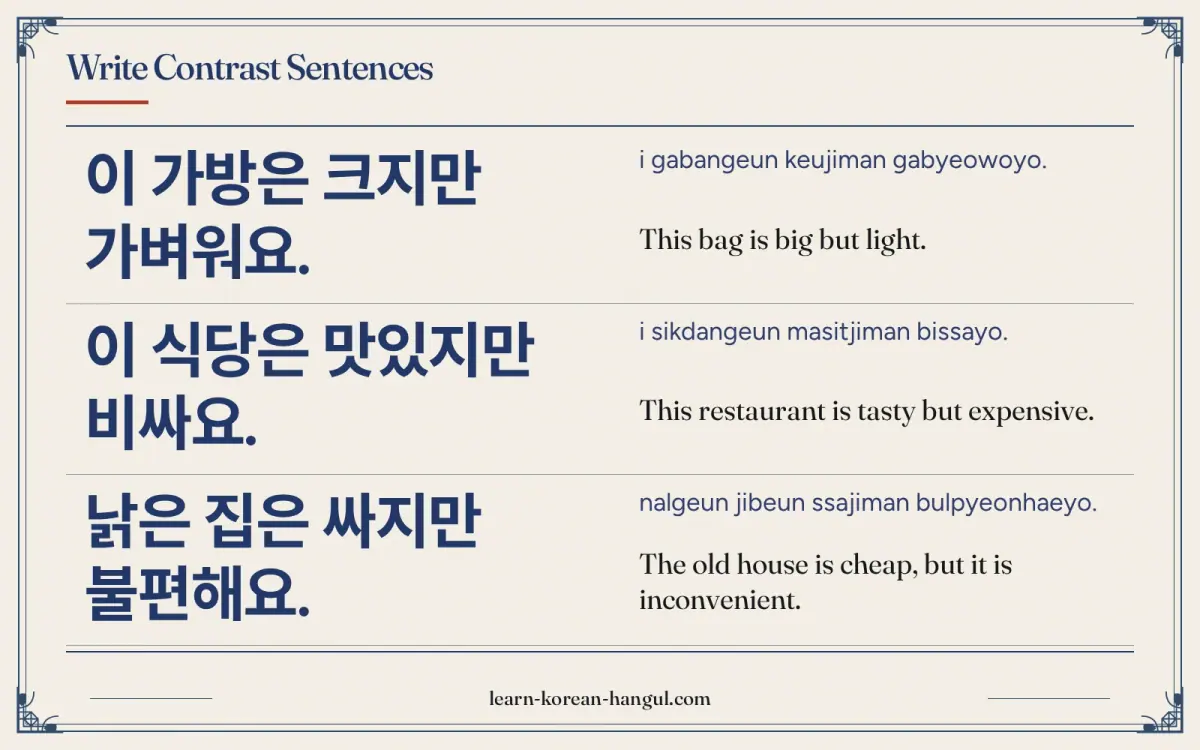
A contrast sentence puts both adjectives of a pair into one sentence. The simplest pattern is A은/는 X-고 B은/는 Y, where -고 means "and" and the subjects differ. When one adjective reduces the other, use -지만 ("but"). Learn the pattern with these examples, some with -고 and some with -지만. The -고 and -지만 lessons explain each ending.
큰 방은 비싸고 작은 방은 싸요.
keun bangeun bissago jageun bangeun ssayo.
The big room is expensive and the small room is cheap.
그 사람은 키가 크고 저는 키가 작아요.
geu sarameun kiga keugo jeoneun kiga jagayo.
That person is tall and I am short.
이 가방은 크지만 가벼워요.
i gabangeun keujiman gabyeowoyo.
This bag is big but light.
이 식당은 맛있지만 비싸요.
i sikdangeun masitjiman bissayo.
This restaurant is tasty but expensive.
부엌은 넓지 않지만 깨끗해요.
bueokeun neolji anchiman kkaekkeutaeyo.
The kitchen is not wide, but it is clean.
낡은 집은 싸지만 불편해요.
nalgeun jibeun ssajiman bulpyeonhaeyo.
The old house is cheap, but it is inconvenient.
이 길은 안전하지만 멀어요.
i gireun anjeonhajiman meoreoyo.
This road is safe, but it is far.
이 커피는 뜨겁고 저 물은 차가워요.
i keopineun tteugeopgo jeo mureun chagawoyo.
This coffee is hot and that water is cold.
두 사람은 나이는 같지만 성격은 달라요.
du sarameun naineun gatjiman seonggyeogeun dallayo.
The two people are the same age, but their personalities are different.
오늘은 시간이 있지만 돈이 없어요.
oneureun sigani itjiman doni eopseoyo.
I have time today, but I have no money.
After you read these, write your own ten: choose ten pairs from the tables, put each in a sentence with a different noun, and check that the adjective form is the polite present. Say each sentence aloud, then listen to the audio of the examples for rhythm.
Which Pairs Are Irregular?
Twenty-three of the 60 adjectives in these pairs follow an irregular class (ㅂ, 르, ㄹ-drop or ㅡ-drop), so the pair list doubles as a drill. The table counts each class and gives a model from this page.
| Class | What happens | Count | Example from the pairs |
|---|---|---|---|
| ㅂ irregular | ㅂ becomes 우 before a vowel | 15 | 쉽다 → 쉬워요 |
| 르 irregular | 르 becomes ㄹ라 or ㄹ러 | 3 | 빠르다 → 빨라요 |
| ㄹ-drop | ㄹ drops before ㄴ, ㅂ, ㅅ | 3 | 길다 → 긴 |
| ㅡ-drop | ㅡ drops before 아/어 | 2 | 크다 → 커요 |
| 하다 type | 하다 becomes 해요 | 13 | 조용하다 → 조용해요 |
| regular | the stem does not change | 22 | 작다 → 작아요 |
| existential | 있다 and 없다 take -는 in the present modifier | 2 | 있는, 없는 |
The rules are on the ㅂ irregular page, and the 르 pattern is on the 르 irregular page. All forms in the tables were generated with the site's conjugation engine, not typed by hand.
Drill the Pairs with Flashcards
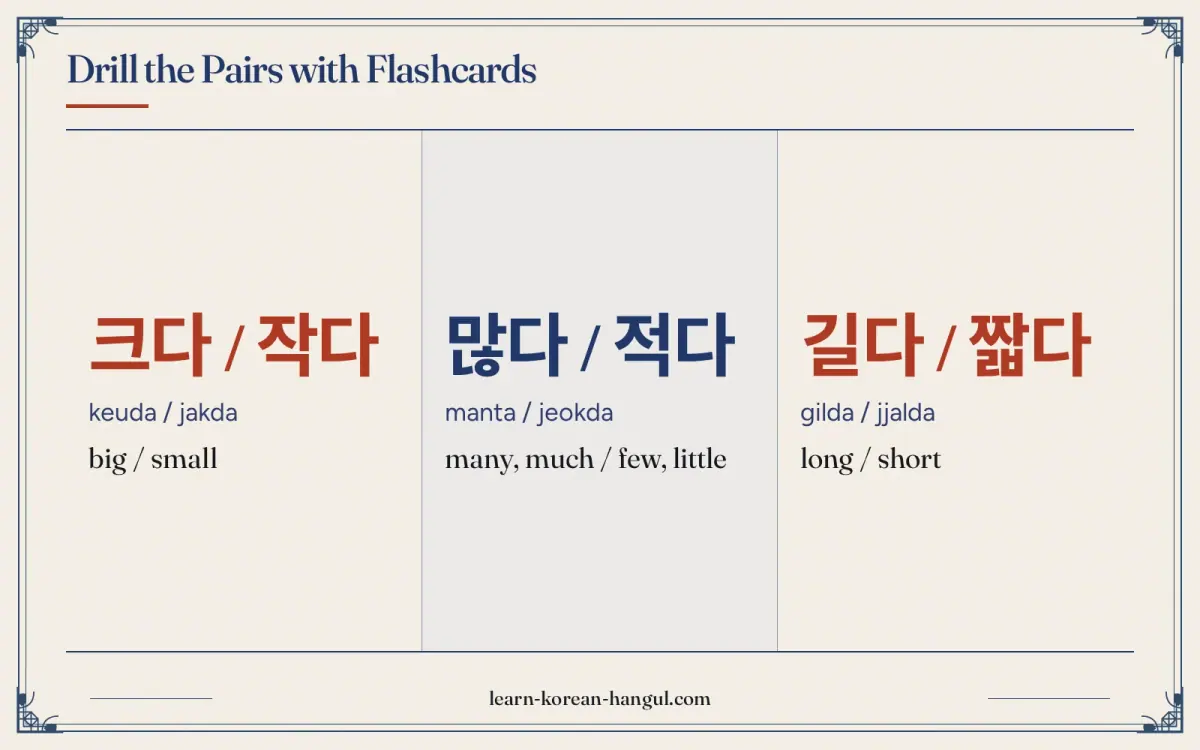
Use a pair as one card: say the first adjective, guess the second, then check. The table lists all 30 cards, and the deck has the same cards.
| # | Pair | Romanization | Meaning | Type |
|---|---|---|---|---|
| 1 | 크다 / 작다 | keuda / jakda | big / small | Gradable pair |
| 2 | 많다 / 적다 | manta / jeokda | many, much / few, little | Gradable pair |
| 3 | 길다 / 짧다 | gilda / jjalda | long / short | Gradable pair |
| 4 | 두껍다 / 얇다 | dukkeopda / yalda | thick (flat things) / thin (flat things) | Gradable pair |
| 5 | 굵다 / 가늘다 | gukda / ganeulda | thick (round things) / thin, fine | Gradable pair |
| 6 | 무겁다 / 가볍다 | mugeopda / gabyeopda | heavy / light | Gradable pair |
| 7 | 넉넉하다 / 부족하다 | neongneokada / bujokada | ample, enough / insufficient, lacking | Gradable pair |
| 8 | 높다 / 낮다 | nopda / natda | high / low | Gradable pair |
| 9 | 멀다 / 가깝다 | meolda / gakkapda | far / near | Gradable pair |
| 10 | 넓다 / 좁다 | neolda / jopda | wide, spacious / narrow, cramped | Gradable pair |
| 11 | 깊다 / 얕다 | gipda / yatda | deep / shallow | Gradable pair |
| 12 | 빠르다 / 느리다 | ppareuda / neurida | fast / slow | Gradable pair |
| 13 | 이르다 / 늦다 | ireuda / neutda | early / late | Gradable pair |
| 14 | 새롭다 / 낡다 | saeropda / nakda | new, fresh / old, worn | Gradable pair |
| 15 | 쉽다 / 어렵다 | swipda / eoryeopda | easy / difficult | Gradable pair |
| 16 | 비싸다 / 싸다 | bissada / ssada | expensive / cheap | Gradable pair |
| 17 | 좋다 / 나쁘다 | jota / nappeuda | good / bad | Gradable pair |
| 18 | 안전하다 / 위험하다 | anjeonhada / wiheomhada | safe / dangerous | Gradable pair |
| 19 | 맛있다 / 맛없다 | masitda / madeopda | tasty / not tasty | Has / lacks pair |
| 20 | 덥다 / 춥다 | deopda / chupda | hot (weather) / cold (weather) | Gradable pair |
| 21 | 뜨겁다 / 차갑다 | tteugeopda / chagapda | hot (to touch) / cold (to touch) | Gradable pair |
| 22 | 밝다 / 어둡다 | bakda / eodupda | bright / dark | Gradable pair |
| 23 | 조용하다 / 시끄럽다 | joyonghada / sikkeureopda | quiet / noisy | Gradable pair |
| 24 | 깨끗하다 / 더럽다 | kkaekkeutada / deoreopda | clean / dirty | Gradable pair |
| 25 | 편하다 / 불편하다 | pyeonhada / bulpyeonhada | comfortable, convenient / uncomfortable, inconvenient | Prefix 불- pair |
| 26 | 행복하다 / 불행하다 | haengbokada / bulhaenghada | happy / unhappy, unfortunate | Prefix 불- pair |
| 27 | 있다 / 없다 | itda / eopda | to exist, to have / not to exist, not to have | Complementary pair |
| 28 | 강하다 / 약하다 | ganghada / yakada | strong / weak | Gradable pair |
| 29 | 부드럽다 / 딱딱하다 | budeureopda / ttakttakada | soft / hard | Gradable pair |
| 30 | 같다 / 다르다 | gatda / dareuda | same / different | Complementary pair |
Practice · 30
- 01크다 / 작다
Show answer
keuda / jakda
big / small
- 02많다 / 적다
Show answer
manta / jeokda
many, much / few, little
- 03길다 / 짧다
Show answer
gilda / jjalda
long / short
- 04두껍다 / 얇다
Show answer
dukkeopda / yalda
thick (flat things) / thin (flat things)
- 05굵다 / 가늘다
Show answer
gukda / ganeulda
thick (round things) / thin, fine
- 06무겁다 / 가볍다
Show answer
mugeopda / gabyeopda
heavy / light
- 07넉넉하다 / 부족하다
Show answer
neongneokada / bujokada
ample, enough / insufficient, lacking
- 08높다 / 낮다
Show answer
nopda / natda
high / low
- 09멀다 / 가깝다
Show answer
meolda / gakkapda
far / near
- 10넓다 / 좁다
Show answer
neolda / jopda
wide, spacious / narrow, cramped
- 11깊다 / 얕다
Show answer
gipda / yatda
deep / shallow
- 12빠르다 / 느리다
Show answer
ppareuda / neurida
fast / slow
- 13이르다 / 늦다
Show answer
ireuda / neutda
early / late
- 14새롭다 / 낡다
Show answer
saeropda / nakda
new, fresh / old, worn
- 15쉽다 / 어렵다
Show answer
swipda / eoryeopda
easy / difficult
- 16비싸다 / 싸다
Show answer
bissada / ssada
expensive / cheap
- 17좋다 / 나쁘다
Show answer
jota / nappeuda
good / bad
- 18안전하다 / 위험하다
Show answer
anjeonhada / wiheomhada
safe / dangerous
- 19맛있다 / 맛없다
Show answer
masitda / madeopda
tasty / not tasty
- 20덥다 / 춥다
Show answer
deopda / chupda
hot (weather) / cold (weather)
- 21뜨겁다 / 차갑다
Show answer
tteugeopda / chagapda
hot (to touch) / cold (to touch)
- 22밝다 / 어둡다
Show answer
bakda / eodupda
bright / dark
- 23조용하다 / 시끄럽다
Show answer
joyonghada / sikkeureopda
quiet / noisy
- 24깨끗하다 / 더럽다
Show answer
kkaekkeutada / deoreopda
clean / dirty
- 25편하다 / 불편하다
Show answer
pyeonhada / bulpyeonhada
comfortable, convenient / uncomfortable, inconvenient
- 26행복하다 / 불행하다
Show answer
haengbokada / bulhaenghada
happy / unhappy, unfortunate
- 27있다 / 없다
Show answer
itda / eopda
to exist, to have / not to exist, not to have
- 28강하다 / 약하다
Show answer
ganghada / yakada
strong / weak
- 29부드럽다 / 딱딱하다
Show answer
budeureopda / ttakttakada
soft / hard
- 30같다 / 다르다
Show answer
gatda / dareuda
same / different
Practice: Choose the Opposite
Pick the right answer for each question, then read the explanation.
Practice · 8
What is the opposite of 크다 (big)?
Show answer
작다
작다 is the opposite of 크다. 적다 means few or little, and it is the opposite of 많다.
Which adjective completes the pair 높다 / ___?
Show answer
낮다
낮다 is the opposite of 높다: 산이 높아요 / 천장이 낮아요.
How do you say "He is tall" in Korean?
Show answer
키가 커요.
For a person's height Korean uses 키가 크다. 높다 is used for things that rise from the ground.
Which prefix makes 편하다 into its opposite?
Show answer
불-
불- makes 불편하다 (uncomfortable). 안 편해요 is a spoken negative, not the same word.
What is the polite present of 쉽다 (easy)?
Show answer
쉬워요
쉽다 is ㅂ irregular: the ㅂ becomes 우 before 어, giving 쉬워요.
Which pair has nothing between its two ends?
Show answer
있다 / 없다
있다 and 없다 are complementary: something exists or it does not. The other pairs are gradable.
What does 안 비싸요 mean?
Show answer
It is not expensive
안 비싸요 means "it is not expensive". It may mean cheap or only average, so use 싸요 when you mean cheap.
Which adjective is the opposite of 빠르다 (fast)?
Show answer
느리다
느리다 means slow. 늦다 means late, and it pairs with 이르다 (early).
Four mistakes cause most errors with opposites.
- Saying 키가 높아요 for a person. Use 키가 커요 or 키가 작아요.
- Writing 덥은 날 or 쉽은 문제. The ㅂ turns into 우: 더운 날 and 쉬운 문제.
- Using the negative of one end for the other end. 안 커요 is "not big", not "small".
- Treating 불- as a general negative. The prefix works only with certain Sino-Korean words, and 안 is the spoken negative for the rest.
What this page does not cover. It lists 30 pairs and not every antonym in the language. It leaves out adjectives for taste, personality and emotion, which have their own pages, such as Korean taste adjectives, and it does not cover verb pairs. Those are on Korean opposite verbs. The core 50 adjectives are on common Korean adjectives, and size words are on Korean size adjectives.
What Should You Learn after Korean Opposite Adjectives?
After Korean opposite adjectives, learn Korean taste adjectives, where 맵다, 달다 and 짜다 add more irregular forms. They also show how one adjective can have several opposites, depending on what it describes.
Frequently Asked Questions
What is the opposite of 크다? The opposite of 크다 (big) is 작다 (small): 방이 커요 means "the room is big" and 방이 작아요 means "the room is small". For people's height, say 키가 크다 and 키가 작다. For amount, use 많다 and 적다. The word 크다 is ㅡ-drop, so its polite present is 커요, not 크어요.
How do I say tall in Korean? For a person, say 키가 크다: 그 사람은 키가 커요. Use 높다 for things that rise from the ground, such as a mountain or a building: 산이 높아요. If you use 높다 for a person, the Korean listener will understand, but it sounds unusual. The opposite of a tall person is 키가 작다.
Which adjectives have prefix opposites? The prefix 불- makes opposites of some Sino-Korean 하다 adjectives: 편하다/불편하다, 행복하다/불행하다 (where 불- attaches to the root 행), 가능하다/불가능하다 and 필요하다/불필요하다. It does not work with native adjectives such as 크다 or 쉽다. For those, use the word-pair opposite (크다/작다, 쉽다/어렵다).
Are all opposites listed in pairs? No. Gradable adjectives have a middle, so 크다 and 작다 leave room for 보통이에요. Some adjectives pair differently by use: 높다 pairs with 낮다 for height, but 키가 크다 pairs with 키가 작다 for people. Complementary pairs such as 있다 and 없다 have no middle. The pair type column shows which kind each pair is.
Do both adjectives in a pair follow the same irregular rule? Not always. In 빠르다/느리다, 빠르다 is 르 irregular and 느리다 is regular. In 크다/작다, 크다 is ㅡ-drop and 작다 is regular. Check each adjective on its own. Pairs such as 쉽다/어렵다 and 덥다/춥다 are both ㅂ irregular.
About this page. Last updated 2026-10-09. The Korean text on this page was machine-generated and reviewed and signed off by Min-ji Park on 15 October 2026. Forms were cross-checked with the site's rule-based conjugation engine. Romanization follows the Revised Romanization of Korean and is shown only as a learning aid.