What you will be able to do after this page
- Say you take, change and leave a bus, subway or taxi with 타다, 갈아타다 and 내리다.
- Choose the right particle: 을/를 for what you ride, 에서 for where you get off, 에 for where you arrive.
- Say how long a trip takes with 걸리다 and ask for a stop with 세워 주세요.
- Conjugate the irregular verb 걷다 (walk) correctly.
Before you start: read go vs come in Korean, because the transport verbs build on 가다 and 오다. Time: about 30 minutes. Level: A2.
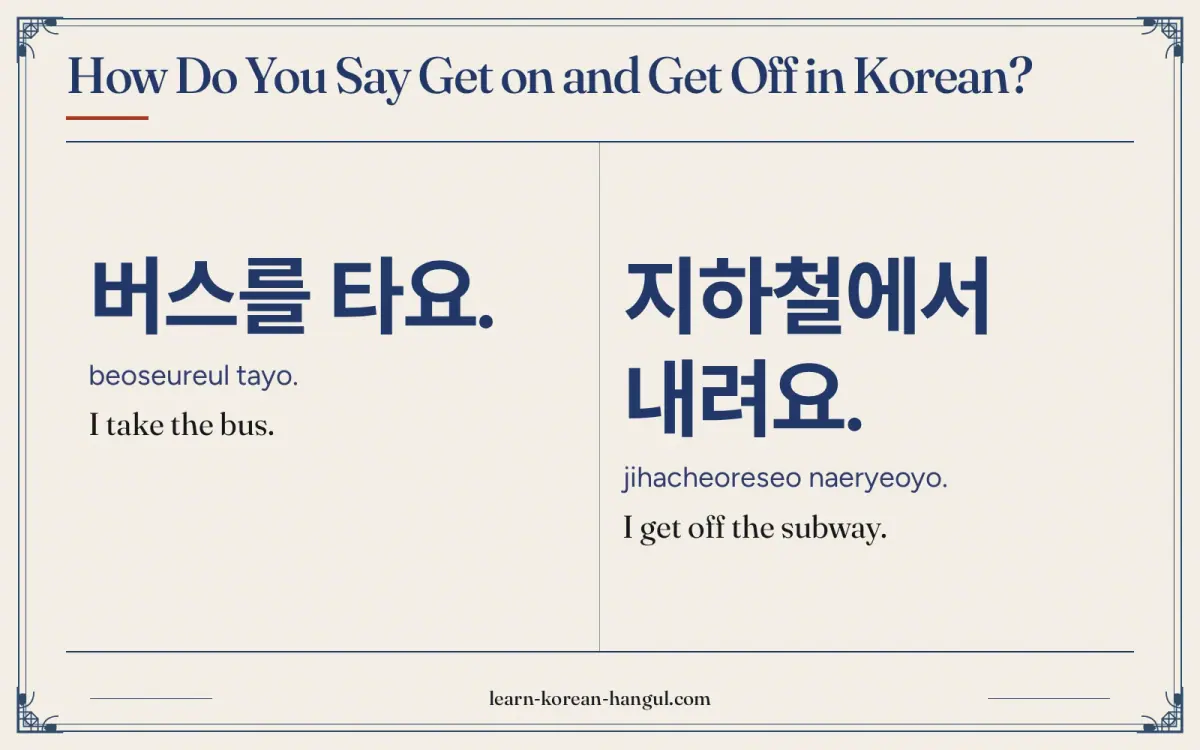
How Do You Say Get on and Get off in Korean?
Korean uses one verb for getting on and a different verb for getting off. 타다 (tada) means to ride or get on. It covers buses, trains, subways, taxis, planes, bikes and even horses. 내리다 (naerida) means to get off or get out, and it is the opposite of 타다. English says "take the bus", "get on the bus" and "ride the bus" with different words. Korean says 버스를 타요 for all three.
The place or vehicle comes first, then its particle, then the verb. A particle is a short word that attaches to a noun and shows its job in the sentence. For 타다, the vehicle takes the object particle 을/를: 지하철을 타요. For 내리다, the place you leave takes 에서, the particle for the place where an action happens: 지하철에서 내려요.
버스를 타요.
beoseureul tayo.
I take the bus.
지하철에서 내려요.
jihacheoreseo naeryeoyo.
I get off the subway.
Both sentences use the polite present ending -요, which is the style you hear in shops, on the street and with people you have just met. The forms come from the verb stems 타 and 내리 plus -아요 or -어요: 타 + 아요 contracts to 타요, and 내리 + 어요 contracts to 내려요. If you want the full rule, read the Korean verb conjugator.
One extra detail matters. 타다 also takes 에 when you stress the moment of boarding: 버스에 타요 can mean "I get on the bus". The object marker 을/를 is the safe default, and it is the form dictionaries and textbooks give. The difference between 을/를 and 에 with movement verbs is explained in the motion verbs particle lesson.
Which 13 Transport Verbs Should You Learn?
These 13 verbs cover a whole trip, from waiting at the stop to arriving. The table gives each verb with its Revised Romanization, its meaning, the polite present form (the one you will say most) and the polite past form. The last column shows the particle pattern to use.
| Verb | Revised Romanization | Meaning | Polite present | Polite past | Particle pattern |
|---|---|---|---|---|---|
| 타다 | tada | to ride; to get on; to take (a vehicle) | 타요 | 탔어요 | vehicle + 을/를 (or 에) |
| 내리다 | naerida | to get off; to get out | 내려요 | 내렸어요 | place + 에서 |
| 갈아타다 | garatada | to transfer; to change (trains, buses) | 갈아타요 | 갈아탔어요 | from 에서, onto (으)로 |
| 환승하다 | hwanseunghada | to transfer (formal; signs and announcements) | 환승해요 | 환승했어요 | place + 에서 |
| 걷다 | geotda | to walk | 걸어요 | 걸었어요 | path + 을/를; goal + 에 |
| 도착하다 | dochakada | to arrive | 도착해요 | 도착했어요 | place + 에 |
| 출발하다 | chulbalhada | to depart; to set off | 출발해요 | 출발했어요 | place + 에서 |
| 지나가다 | jinagada | to pass by; to go past | 지나가요 | 지나갔어요 | place + 을/를 |
| 건너다 | geonneoda | to cross | 건너요 | 건넜어요 | place + 을/를 |
| 운전하다 | unjeonhada | to drive | 운전해요 | 운전했어요 | vehicle + 을/를 |
| 세우다 | seuda | to stop (something); to pull over | 세워요 | 세웠어요 | vehicle + 을/를 |
| 기다리다 | gidarida | to wait (for) | 기다려요 | 기다렸어요 | thing or person + 을/를 |
| 걸리다 | geollida | to take (time) | 걸려요 | 걸렸어요 | amount of time, no particle |
Four of the 13 are 하다 verbs: 환승하다, 도착하다, 출발하다 and 운전하다. A 하다 verb is a noun plus 하다, and its polite present is always the noun plus 해요: 도착 (arrival) becomes 도착해요. The rule is explained in Korean hada verbs explained. Note the romanization: 도착하다 is said [도차카다], and Revised Romanization writes it as it sounds, dochakada, not dochak-hada.
You already know 타다, 걷다 and 기다리다 from the A1 list. The A2 additions are 내리다, 갈아타다, 도착하다, 출발하다, 지나가다, 건너다, 운전하다 and 걸리다. 환승하다 and 세우다 are not on the site's level lists, but you will see 환승 on every subway sign and hear 세워 주세요 in every taxi, so they belong in this set.
Which Particle Goes with Each Transport Verb?
Particles are the main reason transport sentences go wrong. English uses "on", "off", "at" and "to" with these verbs. Korean uses a different particle for each job, and the choice depends on what the noun is doing: a thing you ride, a place you leave, a place you reach or the ground you cross.
| Job of the noun | Particle | Pattern | Example |
|---|---|---|---|
| The vehicle you ride | 을/를 | vehicle + 을/를 + 타다 | 택시를 타요 (I take a taxi) |
| The vehicle you drive | 을/를 | vehicle + 을/를 + 운전하다 | 차를 운전해요 (I drive a car) |
| The place you get off or leave | 에서 | place + 에서 + 내리다 | 시청역에서 내려요 (I get off at City Hall Station) |
| The line or bus you change to | (으)로 | line + (으)로 + 갈아타다 | 2호선으로 갈아타요 (I transfer to Line 2) |
| The place you reach | 에 | place + 에 + 도착하다 | 부산에 도착해요 (I arrive in Busan) |
| The place you set out from | 에서 | place + 에서 + 출발하다 | 서울에서 출발해요 (I depart from Seoul) |
| The road or bridge you cross | 을/를 | place + 을/를 + 건너다 | 다리를 건너요 (I cross the bridge) |
| The stop or place you pass | 을/를 | place + 을/를 + 지나가다 | 은행을 지나가요 (I pass the bank) |
| The thing you wait for | 을/를 | thing + 을/를 + 기다리다 | 버스를 기다려요 (I wait for the bus) |
| How long it takes | none | time + 걸리다 | 한 시간 걸려요 (It takes an hour) |
Two points keep the table safe. First, 에서 marks the place of an action or a starting point, while 에 marks a destination, so 서울에서 출발해요 and 부산에 도착해요 use different particles even though both verbs describe the same trip. The 에 vs 에서 lesson shows the split with more verbs. Second, (으)로 marks a means or a direction: 택시로 가요 means "I go by taxi", and 2호선으로 갈아타요 means "I change onto Line 2". The form is 로 after a vowel or ㄹ and 으로 after any other consonant, as explained in the 으로 lesson.
시청역에서 2호선으로 갈아타요.
sicheongyeogeseo ihoseoneuro garatayo.
I transfer to Line 2 at City Hall Station.
기차가 열 시에 도착해요.
gichaga yeol sie dochakaeyo.
The train arrives at ten o'clock.
버스는 아홉 시에 출발해요.
beoseuneun ahop sie chulbalhaeyo.
The bus leaves at nine o'clock.
The time word takes 에 in the last two sentences: 열 시에 and 아홉 시에. That 에 is the time particle, a separate job from the destination 에. Spoken, 아홉 시 is [아홉씨], with a tense ㅅ after the stop sound. 열 시 is [열시] in the standard pronunciation, though you will often hear [열씨].
How Do You Say Transfer in Korean?
Say 갈아타다 for transfer in everyday speech, and 환승하다 on signs and in announcements. 갈아타다 is a compound of 갈다 (to change) and 타다 (to ride): you change what you ride. It works with vehicles and with lines: 버스를 갈아타요 (I change buses) and 2호선으로 갈아타요 (I change onto Line 2). To say where you change, add 에서 for the station: 시청역에서 갈아타요.
환승 (hwanseung) is a Sino-Korean noun meaning a transfer. You will see it as 환승역 (transfer station) and 환승 할인 (transfer discount) in the subway and on bus cards. In speech, learners can say 환승해요 and be understood, and 환승하다 is the more formal word. To say you do not transfer, put 안 before the verb: 안 갈아타요 ("I don't transfer"). For travel in general, the Korean transportation vocabulary page lists the nouns that go with these verbs.
다음 역에서 환승해요.
daeum yeogeseo hwanseunghaeyo.
I transfer at the next station.
Why Is 걷다 (walk) an Irregular Verb?
걷다 is a ㄷ irregular verb: its final ㄷ changes to ㄹ before a vowel. The dictionary form is 걷다, but "I walk" is 걸어요, not 걷어요. The change happens only when the next sound is a vowel. Before a consonant the ㄷ stays: 걷고, 걷습니다.
| Ending | Form | Meaning |
|---|---|---|
| Polite present | 걸어요 | I walk |
| Polite past | 걸었어요 | I walked |
| Polite future | 걸을 거예요 | I will walk |
| Formal present | 걷습니다 | I walk (formal) |
| Because / and then (-어서) | 걸어서 | walking, so / by walking |
| Describing a noun (-는) | 걷는 | walking |
The formal present is said [걷씀니다]: the final ㄷ closes the syllable, the next ㅅ is tense, and ㄴ makes ㅂ sound like ㅁ. Compare 걷다 with regular verbs that also end in ㄷ. 받다 (receive) and 닫다 (close) keep their ㄷ: 받아요 and 닫아요. 듣다 (listen) behaves like 걷다 and gives 들어요. You can only tell by memory or by the irregular verb recognition guide. The whole class is in the ㄷ irregular lesson.
A note on homographs: 걷다 also means "to roll up" (소매를 걷다, to roll up your sleeves) and "to clear" (안개가 걷다, the fog clears). Those meanings are regular and give 걷어요. The walking sense is the irregular one.
집에서 학교까지 걸어서 십 분 걸려요.
jibeseo hakgyokkaji georeoseo sip bun geollyeoyo.
It takes ten minutes to walk from home to school.
How Do You Say How Long It Takes in Korean?
Use 걸리다 (geollida), which means to take time, with a length of time and no particle: 한 시간 걸려요 (It takes an hour). The question is 얼마나 걸려요? ("How long does it take?"). The English verb "take" appears in many meanings, and Korean uses a different verb for each. Time uses 걸리다, a bus or taxi uses 타다, and a photograph uses 찍다, as explained in Korean verb phrases.
Lengths of time use two number systems. Minutes take Sino-Korean numbers with 분: 삼십 분 (30 minutes). Hours take native Korean numbers with 시간: 한 시간 (one hour), 두 시간 (two hours). The place the trip starts takes 에서 and the place it ends takes 까지, so 집에서 회사까지 means "from home to the office".
집에서 회사까지 한 시간 걸려요.
jibeseo hoesakkaji han sigan geollyeoyo.
It takes an hour from home to the office.
지하철로 이십 분 걸려요.
jihacheollo isip bun geollyeoyo.
It takes twenty minutes by subway.
Here 지하철로 uses the means particle: the subway is the way you go. For more on counting hours and minutes, see the lessons on Korean numbers and telling time.
How Do You Ask a Driver to Stop in Korean?
To ask a taxi driver to stop, say 여기에서 세워 주세요 ("Please stop here"). 세우다 (seuda) means to stop something, here the car, and 주세요 turns the verb into a polite request. The casual form of 세워요 is 세워, and 주세요 after it makes the request. Add 주세요 to any such verb to ask a favour: 내려 주세요 ("Please let me out"), 기다려 주세요 ("Please wait").
여기에서 세워 주세요.
yeogieseo sewo juseyo.
Please stop here.
여기서 내려 주세요.
yeogiseo naeryeo juseyo.
Please let me out here.
여기서 is the short form of 여기에서, common in speech. 운전하다 is for the person at the wheel: 저는 매일 차를 운전해요 (I drive a car every day). A passenger uses 타다. For a full set of taxi sentences, read Korean taxi phrases.
What Does a Trip Dialogue Sound Like?
This short dialogue uses 타다, 걸리다, 내리다 and 갈아타다 with the particles above. Read each line aloud, then listen. Notice that the two questions with a question word, 어떻게 (how) and 얼마나 (how long), do not end with a sharp rise. Their meaning is already in the question word, so the voice usually falls or rises and falls. Only the yes/no question 갈아타요? rises at the end.
민수:
서울역에 어떻게 가요?
seoullyeoge eotteoke gayo?
How do I get to Seoul Station?
지하철 4호선을 타세요.
jihacheol sahoseoneul taseyo.
Take subway Line 4.
얼마나 걸려요?
eolmana geollyeoyo?
How long does it take?
삼십 분쯤 걸려요.
samsip bunjjeum geollyeoyo.
It takes about thirty minutes.
어디에서 내려요?
eodieseo naeryeoyo?
Where do I get off?
서울역에서 내리세요.
seoullyeogeseo naeriseyo.
Get off at Seoul Station.
갈아타요?
garatayo?
Do I have to transfer?
아니요, 안 갈아타요.
aniyo, an garatayo.
No, you don't transfer.
The speaker 지아 uses -세요 to give directions: 타세요 and 내리세요. This is the polite request form, built from the honorific infix -시- plus -어요. It sounds friendly and respectful, not bossy. The pattern is explained in Korean honorifics.
What Mistakes Do Learners Make with Transport Verbs?
| Wrong | Right | Why |
|---|---|---|
| 버스를 내려요 | 버스에서 내려요 | The place you leave takes 에서, not 을/를. |
| 걷어요 | 걸어요 | 걷다 is ㄷ irregular: ㄷ becomes ㄹ before a vowel. |
| 택시를 가요 | 택시로 가요 / 택시를 타고 가요 | 가다 does not take the vehicle as an object. Use the means particle 로, or ride first with 타고. |
| 서울에 출발해요 | 서울에서 출발해요 | A starting point takes 에서; only a destination takes 에. |
| 사십 분이 타요 | 사십 분 걸려요 | Time is "taken" with 걸리다, never with 타다. |
| 길에 건너요 | 길을 건너요 | Ground you cross takes 을/를, not 에. |
The pattern 버스를 타고 가요 ("I ride the bus and go", so "I go by bus") joins two verbs with -고, the connective for "and then". Use it when the vehicle matters: 버스를 타고 가요 and 택시를 타고 가요. For a short sentence, 버스로 가요 says the same thing.
버스를 타고 가요.
beoseureul tago gayo.
I go by bus.
택시로 가요.
taeksiro gayo.
I go by taxi.
Quick Check: Six Questions
Choose the best answer, then check the explanation.
Practice · 6
Which sentence means "I get off the bus"?
Show answer
버스에서 내려요
The place you leave takes 에서.
What is the polite present of 걷다 (to walk)?
Show answer
걸어요
걷다 is a ㄷ irregular verb: ㄷ becomes ㄹ before 어.
Which verb means "transfer" on the subway?
Show answer
갈아타다
갈아타다 means to change what you ride.
How do you say "It takes an hour"?
Show answer
한 시간 걸려요
Time is taken with 걸리다.
Which sentence means "I cross the street"?
Show answer
길을 건너요
Ground you cross takes 을/를.
Which sentence means "I go by taxi"?
Show answer
택시로 가요
The means of transport takes 로.
What Should You Learn after Transport Verbs?
Move on to the nouns for what you ride and where you wait, in Korean transportation vocabulary. Then use the verbs in real requests with Korean taxi phrases. If the 가다 and 오다 choice still feels shaky, return to go vs come in Korean. The wider set of movement verbs is on the Korean motion verbs page.
What this page does not cover. It does not cover flights and airport verbs, driving verbs such as 주차하다, or honorific forms such as 타시다. It also does not list the names of subway lines or stations.
About this page. Last updated 2026-10-09. The Korean text and example sentences were drafted with AI assistance and cross-checked with the site's rule-based conjugation engine; a Korean reviewer checks every lesson before it is marked as reviewed.
Frequently Asked Questions
How Do You Say Get on and Get off in Korean?
Say 타다 for getting on or riding and 내리다 for getting off. 버스를 타요 means "I take the bus" and 버스에서 내려요 means "I get off the bus". The vehicle takes 을/를 with 타다, and the place you leave takes 에서 with 내리다.
How Do You Say Transfer in Korean?
Say 갈아타다 in everyday speech: 2호선으로 갈아타요 means "I transfer to Line 2". 환승하다 is the formal word you see on signs and hear in announcements, and 환승 is the noun for a transfer.
Why Is the Polite Present of 걷다 걸어요?
걷다 is a ㄷ irregular verb. Its final ㄷ changes to ㄹ before a vowel, so 걷 + 어요 becomes 걸어요. Before a consonant the ㄷ stays, as in 걷고 and 걷습니다. Regular ㄷ verbs such as 받다 and 닫다 do not change.
Does 타다 Take 을/를 or 에?
The default is 을/를: 지하철을 타요. The form with 에, as in 버스에 타요, is also used when the speaker stresses boarding. Learners can use 을/를 everywhere and be correct.
How Do You Say How Long It Takes in Korean?
Use 걸리다 with a length of time: 삼십 분 걸려요 means "it takes thirty minutes". Ask 얼마나 걸려요? for "how long does it take?". Minutes use Sino-Korean numbers and hours use native Korean numbers.
How Do You Ask a Taxi Driver to Stop?
Say 여기에서 세워 주세요, which means "Please stop here". To get out, say 여기서 내려 주세요 ("Please let me out here").