What you will be able to do after this page
- Recognise the meaning and polite present of the B1 to B2 verbs and adjectives.
- Use 10 honorific, humble and formal verbs correctly, such as 드시다, 주무시다, 계시다, 드리다 and 뵙다.
- Pair transitive and intransitive verbs such as 올리다 and 오르다.
- Spot the 40 irregular entries on the list and give their polite present.
Before you start: read elementary Korean verbs, because this page assumes the A1 and A2 verbs and the polite present. Time: about four hours spread over eight weeks. Level: B1 to B2.
Which Verbs Are on the Intermediate Korean Verbs List?
The list has 179 entries, grouped by topic: 134 verbs in ten topic groups and 45 adjectives in three groups. 163 entries are at B1 and 16 at B2. The levels follow the CEFR labels (a European scale for language level), but the placement is the site's editorial judgement, not an official list and not a frequency count. A learner may meet a B1 word earlier in a song or a drama. The level scale is explained in Korean verbs by level.
B1 and B2 verbs differ from A2 verbs in three ways. The vocabulary becomes formal and abstract. Pairs of related verbs multiply. And the irregular classes spread out: the list holds every irregular class the site teaches.
| Measure | Count |
|---|---|
| Entries at B1 to B2 | 179 |
| Verbs / adjectives | 134 / 45 |
| At B1 / at B2 | 163 / 16 |
| 하다 words | 68 (38% of the list) |
| Special-class verbs (드시다, 주무시다, 계시다, 뵙다) | 4 |
| Irregular entries | 40 (ㄹ 13, ㅂ 11, ㅅ 4, ㄷ 3, 르 3, ㅡ 2, 러 2, 우 1, ㅎ 1) |
Each table has five columns: the word with a link to its dictionary page, its Revised Romanization, the meaning, the polite present form and the type (regular, 하다, special or an irregular class). The polite present is the everyday -요 form, so you can say the verb in a sentence at once. The first group is the one that changes how you speak to people.
Honorific and Formal Verbs
Honorific verbs raise the person you talk about, and humble verbs lower yourself. They are the clearest sign that you have moved past the beginner stage. Six of the ten verbs below are honorific or humble, and the other four (허락하다, 환영하다, 방문하다, 참석하다) are formal 하다 verbs you meet in notices and announcements.
| Word | Revised Romanization | Meaning | Polite present | Type |
|---|---|---|---|---|
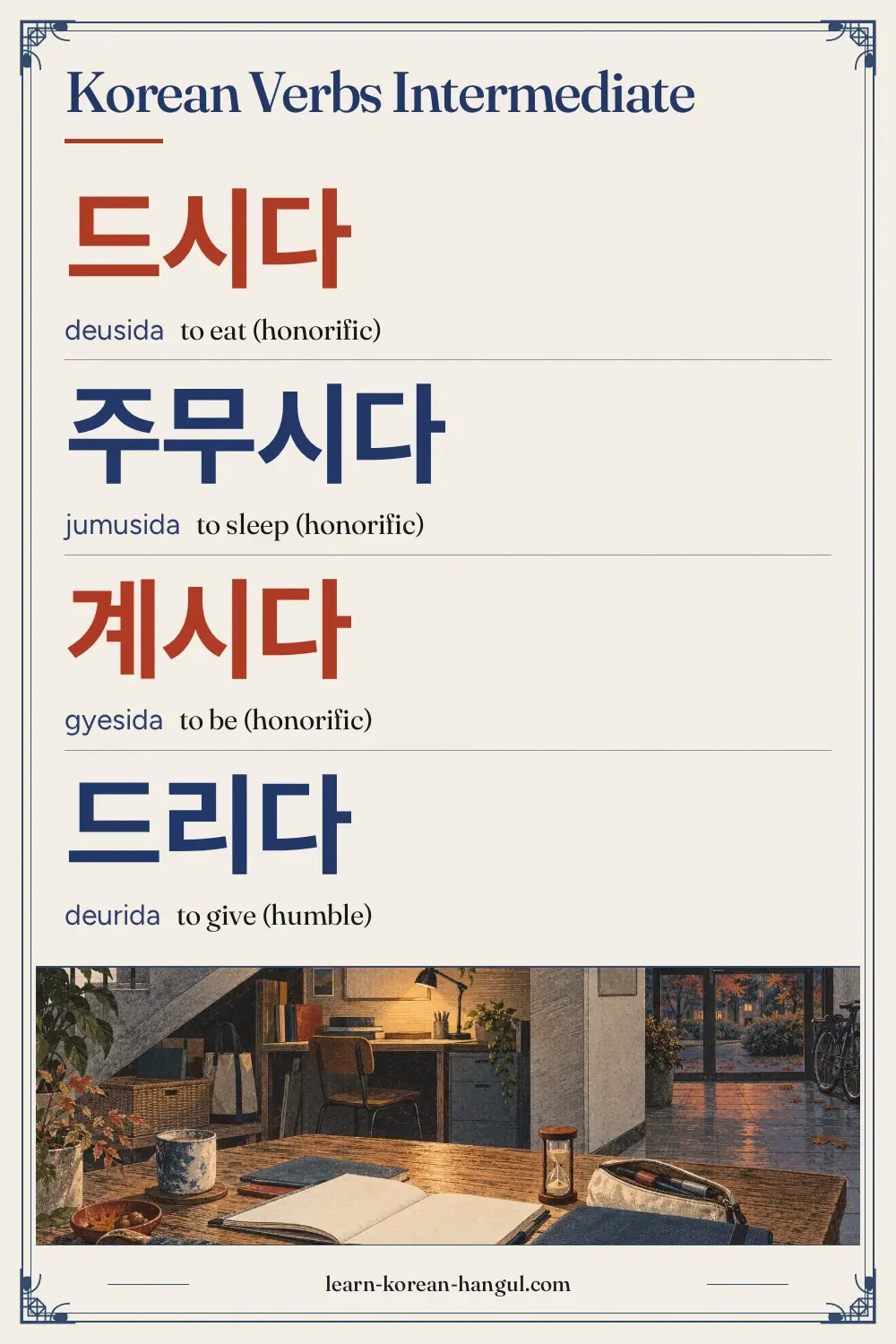
| 드시다 | deusida | to eat (honorific) | 드세요 | special |
| 주무시다 | jumusida | to sleep (honorific) | 주무세요 | special |
| 계시다 | gyesida | to be (honorific) | 계세요 | special |
| 말씀하다 | malsseumhada | to speak (honorific) | 말씀해요 | 하다 |
| 드리다 | deurida | to give (humble) | 드려요 | regular |
| 뵙다 | boepda | to meet (humble) | 뵈어요 | special |
| 허락하다 | heorakada | to permit | 허락해요 | 하다 |
| 환영하다 | hwanyeonghada | to welcome | 환영해요 | 하다 |
| 방문하다 | bangmunhada | to visit | 방문해요 | 하다 |
| 참석하다 | chamseokada | to attend | 참석해요 | 하다 |
How Do Honorific and Humble Verbs Replace Plain Verbs?
An honorific verb shows respect to the person who does the action. A humble verb lowers the speaker and so raises the listener. Both replace the plain verb. The table shows the plain verb, its replacement and the polite present of each.
| Plain verb | Replacement | Kind | Plain polite present | Replacement polite present |
|---|---|---|---|---|
| 먹다 | 드시다 | honorific | 먹어요 | 드세요 |
| 자다 | 주무시다 | honorific | 자요 | 주무세요 |
| 있다 | 계시다 | honorific (people) | 있어요 | 계세요 |
| 말하다 | 말씀하시다 | honorific | 말해요 | 말씀하세요 |
| 주다 | 드리다 | humble | 줘요 | 드려요 |
| 만나다 | 뵙다 | humble | 만나요 | 뵈어요 |
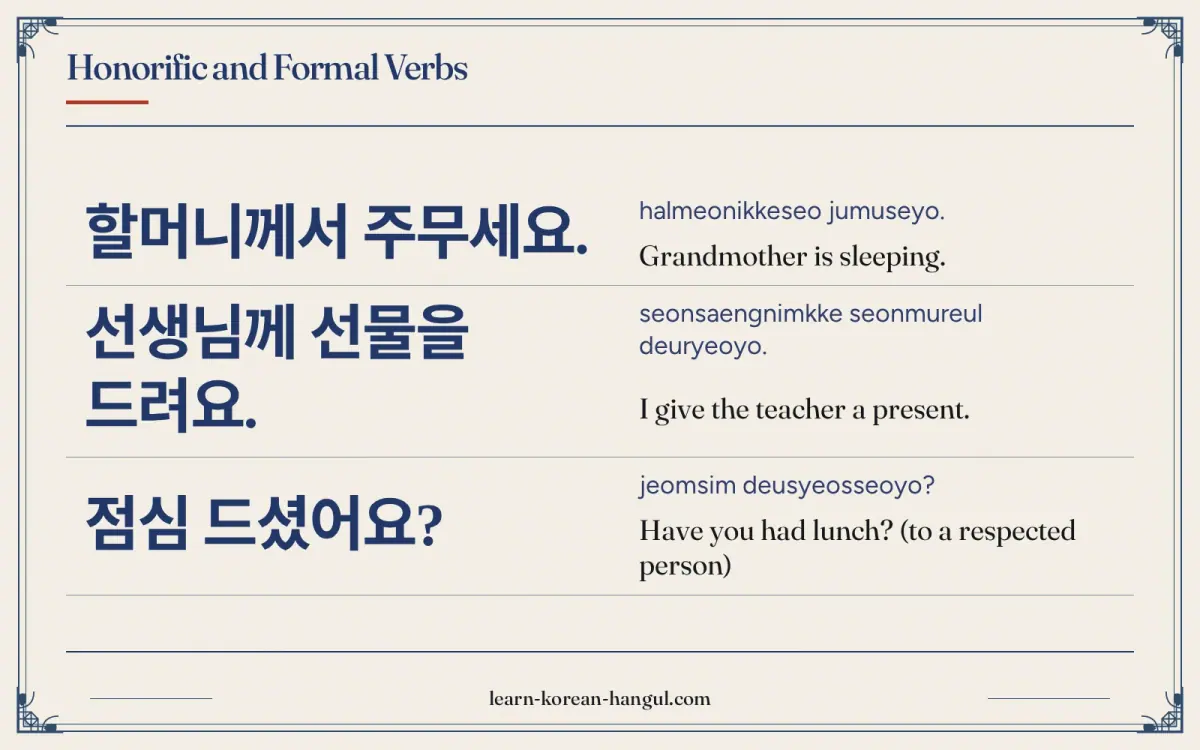
Honorific verbs go with the person you respect as the subject: 할머니께서 주무세요 (Grandmother is sleeping). Humble verbs go with yourself as the subject and the respected person as the receiver: 선생님께 선물을 드려요 (I give the teacher a present). Never use 드시다 or 주무시다 for yourself. The system behind these forms is explained in Korean honorifics.
할머니께서 주무세요.
halmeonikkeseo jumuseyo.
Grandmother is sleeping.
선생님께 선물을 드려요.
seonsaengnimkke seonmureul deuryeoyo.
I give the teacher a present.
점심 드셨어요?
jeomsim deusyeosseoyo?
Have you had lunch? (to a respected person)
계시다 is the honorific of 있다 when it means "to be present" for a person: 어머니는 집에 계세요 (Mother is at home). For a thing a person owns, use 있으세요. 뵙다 has a short polite form, but you will most often hear it in the formal pattern 뵙겠습니다 (I will see you), which is the polite greeting 처음 뵙겠습니다.
Work, School and Office Verbs
These verbs describe life events: entering school, getting a job, passing an exam, holding a meeting and cancelling a plan. Ten of the eleven are 하다 verbs built on Sino-Korean nouns, so a learner who knows 취직 (getting a job) or 합격 (passing) can already guess the verb.
| Word | Revised Romanization | Meaning | Polite present | Type |
|---|---|---|---|---|
| 취직하다 | chwijikada | to get a job | 취직해요 | 하다 |
| 입학하다 | ipakada | to enter school | 입학해요 | 하다 |
| 합격하다 | hapgyeokada | to pass (exam) | 합격해요 | 하다 |
| 예습하다 | yeseupada | to preview | 예습해요 | 하다 |
| 회의하다 | hoeuihada | to hold a meeting | 회의해요 | 하다 |
| 발표하다 | balpyohada | to present | 발표해요 | 하다 |
| 참가하다 | chamgahada | to participate | 참가해요 | 하다 |
| 그만두다 | geumanduda | to quit | 그만둬요 | regular |
| 지불하다 | jibulhada | to pay | 지불해요 | 하다 |
| 취소하다 | chwisohada | to cancel | 취소해요 | 하다 |
| 예매하다 | yemaehada | to book tickets | 예매해요 | 하다 |
Money, Choices and Effort Verbs
Here the vocabulary turns abstract: choosing, comparing, succeeding, failing and hoping. Most of the 하다 verbs are formal, and 바라다, 꿈꾸다, 참다 and 견디다 are the plain native verbs for wanting and enduring.
| Word | Revised Romanization | Meaning | Polite present | Type |
|---|---|---|---|---|
| 갚다 | gapda | to repay | 갚아요 | regular |
| 모으다 | moeuda | to gather/save | 모아요 | ㅡ |
| 벌다 | beolda | to earn | 벌어요 | ㄹ |
| 구하다 | guhada | to seek/save | 구해요 | 하다 |
| 선택하다 | seontaekada | to select | 선택해요 | 하다 |
| 결정하다 | gyeoljeonghada | to decide | 결정해요 | 하다 |
| 비교하다 | bigyohada | to compare | 비교해요 | 하다 |
| 이용하다 | iyonghada | to use; to make use of | 이용해요 | 하다 |
| 성공하다 | seonggonghada | to succeed | 성공해요 | 하다 |
| 실패하다 | silpaehada | to fail | 실패해요 | 하다 |
| 포기하다 | pogihada | to give up | 포기해요 | 하다 |
| 도전하다 | dojeonhada | to challenge | 도전해요 | 하다 |
| 바라다 | barada | to hope | 바라요 | regular |
| 희망하다 | huimanghada | to hope | 희망해요 | 하다 |
| 기대하다 | gidaehada | to look forward to; to expect | 기대해요 | 하다 |
| 꿈꾸다 | kkumkkuda | to dream | 꿈꿔요 | regular |
| 참다 | chamda | to endure | 참아요 | regular |
| 견디다 | gyeondida | to bear | 견뎌요 | regular |
What Is the Pattern for the 하다 Verbs on This List?
68 of the 179 entries are 하다 words, mostly nouns from Chinese-derived (Sino-Korean) roots. The rule is the same as at A2: a noun for an activity plus 하다 makes a verb, and its polite present is the noun plus 해요. 취직 (getting a job) gives 취직해요, and 결정 (a decision) gives 결정해요. If you know the noun, you can often guess the verb, and the reverse is also true. Read Sino-Korean vocabulary to see how the same syllables repeat across words. The structure lesson is Korean hada verbs explained.
저는 새 회사에 취직했어요.
jeoneun sae hoesae chwijikaesseoyo.
I got a job at a new company.
내일 회의에서 발표해요.
naeil hoeuieseo balpyohaeyo.
I present at tomorrow's meeting.
시험에 합격했어요.
siheome hapgyeokaesseoyo.
I passed the exam.
Digital Verbs
Computer verbs are loanword + 하다: you add 하다 to a borrowed noun. The noun keeps its English sound, and the polite present is always noun + 해요.
| Word | Revised Romanization | Meaning | Polite present | Type |
|---|---|---|---|---|
| 다운로드하다 | daunrodeuhada | to download | 다운로드해요 | 하다 |
| 저장하다 | jeojanghada | to save | 저장해요 | 하다 |
| 로그인하다 | rogeuinhada | to log in | 로그인해요 | 하다 |
| 클릭하다 | keullikada | to click | 클릭해요 | 하다 |
| 입력하다 | imnyeokada | to input | 입력해요 | 하다 |
Change, Growth and Recovery Verbs
These verbs describe things that become different on their own: prices rise, children grow, a cold gets better. Many are intransitive partners of a transitive verb you learned earlier, such as 열리다 (opens) beside 열다 (open something).
| Word | Revised Romanization | Meaning | Polite present | Type |
|---|---|---|---|---|
| 변하다 | byeonhada | to change (intrans.) | 변해요 | 하다 |
| 늘다 | neulda | to increase | 늘어요 | ㄹ |
| 줄다 | julda | to decrease | 줄어요 | ㄹ |
| 커지다 | keojida | to grow bigger | 커져요 | regular |
| 작아지다 | jagajida | to get smaller | 작아져요 | regular |
| 나빠지다 | nappajida | to get worse | 나빠져요 | regular |
| 좋아지다 | joajida | to get better | 좋아져요 | regular |
| 자라다 | jarada | to grow up | 자라요 | regular |
| 늙다 | neukda | to grow old; to age | 늙어요 | regular |
| 낫다 | natda | to recover | 나아요 | ㅅ |
| 치료하다 | chiryohada | to treat | 치료해요 | 하다 |
| 열리다 | yeollida | to be opened; to open (intransitive) | 열려요 | regular |
| 닫히다 | dachida | to be closed; to close (intransitive) | 닫혀요 | regular |
| 녹다 | nokda | to melt | 녹아요 | regular |
| 피다 | pida | to bloom | 피어요 | regular |
| 지다 | jida | to lose/set/fall | 져요 | regular |
Which Verbs Come in Transitive and Intransitive Pairs?
A transitive verb takes an object, and an intransitive verb does not. The B1 list brings the partner of many verbs you know. The pair changes the particle: the transitive verb takes 을/를 on the thing, and the intransitive verb takes 이/가.
| Verb A (someone acts on something) | Verb B (the partner) | Example pair |
|---|---|---|
| 열다 | 열리다 | 문을 열어요. / 문이 열려요. (I open the door. / The door opens.) |
| 닫다 | 닫히다 | 창문을 닫아요. / 창문이 닫혀요. (I close the window. / The window closes.) |
| 올리다 | 오르다 | 가격을 올려요. / 가격이 올라요. (I raise the price. / The price rises.) |
| 돌리다 | 돌다 | 핸들을 돌려요. / 바퀴가 돌아요. (I turn the wheel. / The wheel turns.) |
| 붙이다 | 붙다 | 우표를 붙여요. / 우표가 붙어요. (I stick on a stamp. / The stamp sticks.) |
| 먹이다 | 먹다 | 아기에게 밥을 먹여요. / 아기가 밥을 먹어요. (I feed the baby. / The baby eats.) |
| 입히다 | 입다 | 아이에게 옷을 입혀요. / 아이가 옷을 입어요. (I dress the child. / The child puts on clothes.) |
Three observations help. The partner often adds 이, 히, 리 or 기 to the stem, as in 열 → 열리 and 닫 → 닫히. Some pairs use two different stems, as in 오르다 and 올리다. And the last two pairs are different in kind: in the first five, verb B is intransitive, but 먹이다 and 입히다 are causatives of 먹다 and 입다, meaning "make someone eat" and "make someone wear". Causatives and passives have their own lessons in passive and causative verbs.
Moving, Carrying and Following Verbs
This group covers moving people and things: throwing, picking up, pushing, pulling, climbing and following. Several verbs form pairs with a verb you already know, such as 올리다 (raise) and 오르다 (rise).
| Word | Revised Romanization | Meaning | Polite present | Type |
|---|---|---|---|---|
| 던지다 | deonjida | to throw | 던져요 | regular |
| 줍다 | jupda | to pick up | 주워요 | ㅂ |
| 밀다 | milda | to push | 밀어요 | ㄹ |
| 당기다 | danggida | to pull | 당겨요 | regular |
| 끌다 | kkeulda | to drag | 끌어요 | ㄹ |
| 돌리다 | dollida | to turn | 돌려요 | regular |
| 돌다 | dolda | to turn; to spin | 돌아요 | ㄹ |
| 흔들다 | heundeulda | to shake | 흔들어요 | ㄹ |
| 올리다 | ollida | to raise | 올려요 | regular |
| 오르다 | oreuda | to climb; to rise | 올라요 | 르 |
| 업다 | eopda | to carry on back | 업어요 | regular |
| 싣다 | sitda | to load; to carry (cargo) | 실어요 | ㄷ |
| 쓰러지다 | sseureojida | to collapse | 쓰러져요 | regular |
| 넘어지다 | neomeojida | to fall down | 넘어져요 | regular |
| 따라가다 | ttaragada | to follow; to go along | 따라가요 | regular |
| 찾아가다 | chajagada | to visit | 찾아가요 | regular |
| 데려가다 | deryeogada | to take (person) | 데려가요 | regular |
| 데려오다 | deryeooda | to bring (person) | 데려와요 | regular |
| 멈추다 | meomchuda | to stop | 멈춰요 | regular |
| 빼다 | ppaeda | to take out/subtract | 빼요 | regular |
Fixing, Folding and Joining Verbs
Handling verbs for repairs, packages and crafts. Note the pair 붙이다 (attach) and 붙다 (stick), and the compound 갈아입다 (change clothes), built from 갈다 (change) and 입다 (wear).
| Word | Revised Romanization | Meaning | Polite present | Type |
|---|---|---|---|---|
| 고치다 | gochida | to fix | 고쳐요 | regular |
| 수리하다 | surihada | to repair | 수리해요 | 하다 |
| 접다 | jeopda | to fold | 접어요 | regular |
| 펴다 | pyeoda | to spread | 펴요 | regular |
| 싸다 | ssada | to wrap; to pack | 싸요 | regular |
| 풀다 | pulda | to untie/solve | 풀어요 | ㄹ |
| 묶다 | mukda | to tie | 묶어요 | regular |
| 붙이다 | buchida | to attach | 붙여요 | regular |
| 붙다 | butda | to stick | 붙어요 | regular |
| 잇다 | itda | to connect; to link | 이어요 | ㅅ |
| 짓다 | jitda | to build; to make (a name, a meal) | 지어요 | ㅅ |
| 나누다 | nanuda | to divide; to share | 나눠요 | regular |
| 깎다 | kkakda | to peel/shave/discount | 깎아요 | regular |
| 모이다 | moida | to gather | 모여요 | regular |
| 끼다 | kkida | to wear (gloves/rings) | 껴요 | regular |
| 갈아입다 | garaipda | to change clothes | 갈아입어요 | regular |
Cooking and Kitchen Verbs
Kitchen verbs let you follow a recipe. Most are regular. Watch 따르다 (pour; a ㅡ verb that gives 따라요), 붓다 (pour; a ㅅ verb that gives 부어요) and 푸다 (scoop; the only 우 verb, 퍼요).
| Word | Revised Romanization | Meaning | Polite present | Type |
|---|---|---|---|---|
| 튀기다 | twigida | to deep-fry | 튀겨요 | regular |
| 찌다 | jjida | to steam | 쪄요 | regular |
| 삶다 | samda | to boil (food) | 삶아요 | regular |
| 데우다 | deuda | to heat up | 데워요 | regular |
| 얼리다 | eollida | to freeze | 얼려요 | regular |
| 썰다 | sseolda | to slice | 썰어요 | ㄹ |
| 섞다 | seokda | to mix | 섞어요 | regular |
| 담다 | damda | to put into | 담아요 | regular |
| 따르다 | ttareuda | to pour/follow | 따라요 | ㅡ |
| 붓다 | butda | to pour; to swell | 부어요 | ㅅ |
| 푸다 | puda | to scoop; to ladle | 퍼요 | 우 |
Body, Senses and Personal Care Verbs
The senses and grooming. 맛보다, 맡다 and 만지다 are the senses of taste, smell and touch, and 화장하다, 면도하다 and 빗다 are daily care verbs.
| Word | Revised Romanization | Meaning | Polite present | Type |
|---|---|---|---|---|
| 먹이다 | meogida | to feed | 먹여요 | regular |
| 입히다 | ipida | to dress (someone) | 입혀요 | regular |
| 들리다 | deullida | to be heard | 들려요 | regular |
| 맛보다 | matboda | to taste | 맛봐요 | regular |
| 냄새나다 | naemsaenada | to smell | 냄새나요 | regular |
| 맡다 | matda | to smell/take charge | 맡아요 | regular |
| 만지다 | manjida | to touch | 만져요 | regular |
| 화장하다 | hwajanghada | to put on makeup | 화장해요 | 하다 |
| 면도하다 | myeondohada | to shave | 면도해요 | 하다 |
| 빗다 | bitda | to comb | 빗어요 | regular |
| 졸다 | jolda | to doze | 졸아요 | ㄹ |
| 불다 | bulda | to blow | 불어요 | ㄹ |
| 깨다 | kkaeda | to wake/break | 깨요 | regular |
Feelings, Relationships and Understanding Verbs
Feelings verbs at B1 often use the pattern adjective + 하다: 기뻐하다 (be glad), 무서워하다 (fear), 부끄러워하다 (be shy). They describe how someone else feels, or a feeling shown outwardly. This group also holds relationship verbs and the verbs of understanding.
| Word | Revised Romanization | Meaning | Polite present | Type |
|---|---|---|---|---|
| 화내다 | hwanaeda | to get angry | 화내요 | regular |
| 기뻐하다 | gippeohada | to be glad | 기뻐해요 | 하다 |
| 미안해하다 | mianhaehada | to feel sorry | 미안해해요 | 하다 |
| 부끄러워하다 | bukkeureowohada | to be shy | 부끄러워해요 | 하다 |
| 무서워하다 | museowohada | to fear | 무서워해요 | 하다 |
| 용서하다 | yongseohada | to forgive | 용서해요 | 하다 |
| 화해하다 | hwahaehada | to reconcile | 화해해요 | 하다 |
| 즐기다 | jeulgida | to enjoy | 즐겨요 | regular |
| 사귀다 | sagwida | to date | 사귀어요 | regular |
| 이혼하다 | ihonhada | to divorce | 이혼해요 | 하다 |
| 깨닫다 | kkaedatda | to realize | 깨달아요 | ㄷ |
| 알아듣다 | aradeutda | to understand (hearing) | 알아들어요 | ㄷ |
| 닮다 | damda | to resemble | 닮아요 | regular |
| 이르다 | ireuda | to reach; to arrive at | 이르러요 | 러 |
What Are the Intermediate Korean Adjectives?
The list holds 45 adjectives, in three tables. Adjectives are conjugated like verbs, so each polite present below ends in -요. In Korean grammar they are "descriptive verbs": they take the same endings.
Adjectives for Character and Manner
Ten adjectives describe a person. Nine are 하다 adjectives, whose polite present is the stem + 해요, and 예의 바르다 is a 르 adjective that becomes 예의 발라요.
| Word | Revised Romanization | Meaning | Polite present | Type |
|---|---|---|---|---|
| 부지런하다 | bujireonhada | diligent | 부지런해요 | 하다 |
| 상냥하다 | sangnyanghada | gentle | 상냥해요 | 하다 |
| 영리하다 | yeongnihada | clever | 영리해요 | 하다 |
| 멍청하다 | meongcheonghada | stupid | 멍청해요 | 하다 |
| 유쾌하다 | yukwaehada | pleasant | 유쾌해요 | 하다 |
| 무례하다 | muryehada | rude | 무례해요 | 하다 |
| 예의 바르다 | yeui bareuda | polite | 예의 발라요 | 르 |
| 솔직하다 | soljikada | honest | 솔직해요 | 하다 |
| 성실하다 | seongsilhada | sincere/diligent | 성실해요 | 하다 |
| 용감하다 | yonggamhada | brave | 용감해요 | 하다 |
Adjectives for Feelings and Judgments
Eighteen adjectives name a feeling or a judgment, such as proud, embarrassed, certain or convenient. The ㅂ adjectives drop the ㅂ and add 워: 부럽다 becomes 부러워요, and 그립다 becomes 그리워요.
| Word | Revised Romanization | Meaning | Polite present | Type |
|---|---|---|---|---|
| 부럽다 | bureopda | envious | 부러워요 | ㅂ |
| 그립다 | geuripda | to miss | 그리워요 | ㅂ |
| 아쉽다 | aswipda | regrettable | 아쉬워요 | ㅂ |
| 불쌍하다 | bulssanghada | pitiful | 불쌍해요 | 하다 |
| 답답하다 | dapdapada | frustrating/stuffy | 답답해요 | 하다 |
| 창피하다 | changpihada | embarrassing | 창피해요 | 하다 |
| 부끄럽다 | bukkeureopda | shy/ashamed | 부끄러워요 | ㅂ |
| 자랑스럽다 | jarangseureopda | proud | 자랑스러워요 | ㅂ |
| 괴롭다 | goeropda | to be painful; to be distressing | 괴로워요 | ㅂ |
| 신기하다 | singihada | amazing/curious | 신기해요 | 하다 |
| 당연하다 | dangyeonhada | natural/obvious | 당연해요 | 하다 |
| 확실하다 | hwaksilhada | certain | 확실해요 | 하다 |
| 정확하다 | jeonghwakada | accurate | 정확해요 | 하다 |
| 분명하다 | bunmyeonghada | clear | 분명해요 | 하다 |
| 다양하다 | dayanghada | to be diverse | 다양해요 | 하다 |
| 어색하다 | eosaekada | to be awkward | 어색해요 | 하다 |
| 편리하다 | pyeollihada | convenient | 편리해요 | 하다 |
| 한가하다 | hangahada | free/idle | 한가해요 | 하다 |
Adjectives for Things, Shapes and Textures
Seventeen adjectives describe how something looks or feels: thick, thin, deep, soft, hard, round, blue-green. 이르다 here means early, and it is the 르 adjective that gives 일러요, not the 러 verb 이르다 (to reach).
| Word | Revised Romanization | Meaning | Polite present | Type |
|---|---|---|---|---|
| 두껍다 | dukkeopda | thick | 두꺼워요 | ㅂ |
| 얇다 | yalda | thin | 얇아요 | regular |
| 굵다 | gukda | to be thick (round things) | 굵어요 | regular |
| 가늘다 | ganeulda | to be thin (narrow) | 가늘어요 | ㄹ |
| 깊다 | gipda | deep | 깊어요 | regular |
| 얕다 | yatda | shallow | 얕아요 | regular |
| 부드럽다 | budeureopda | soft | 부드러워요 | ㅂ |
| 딱딱하다 | ttakttakada | hard | 딱딱해요 | 하다 |
| 단단하다 | dandanhada | firm | 단단해요 | 하다 |
| 날씬하다 | nalssinhada | slim | 날씬해요 | 하다 |
| 동그랗다 | donggeurata | to be round | 동그래요 | ㅎ |
| 둥글다 | dunggeulda | to be round | 둥글어요 | ㄹ |
| 푸르다 | pureuda | to be blue-green (leafy, sky) | 푸르러요 | 러 |
| 곱다 | gopda | to be pretty; to be fine | 고와요 | ㅂ |
| 이르다 | ireuda | early | 일러요 | 르 |
| 싱겁다 | singgeopda | bland | 싱거워요 | ㅂ |
| 미지근하다 | mijigeunhada | to be lukewarm | 미지근해요 | 하다 |
Which Intermediate Korean Verbs Are Irregular?
40 entries are irregular, and they cover every class on the site. The table shows each class, the number of entries and the entries themselves with the polite present. Learn them as part of the list, and read the lesson for each class when you meet it. The overview is in Korean irregular verbs.
| Class | Entries | Words and polite present | What changes |
|---|---|---|---|
| ㄹ | 13 | 벌다 (벌어요), 늘다 (늘어요), 줄다 (줄어요), 밀다 (밀어요), 끌다 (끌어요), 돌다 (돌아요), 흔들다 (흔들어요), 풀다 (풀어요), 썰다 (썰어요), 불다 (불어요), 졸다 (졸아요), 둥글다 (둥글어요), 가늘다 (가늘어요) | ㄹ drops before ㄴ, ㅂ and ㅅ: formal present of 벌다 is 법니다 |
| ㅂ | 11 | 줍다 (주워요), 두껍다 (두꺼워요), 싱겁다 (싱거워요), 부럽다 (부러워요), 그립다 (그리워요), 아쉽다 (아쉬워요), 부끄럽다 (부끄러워요), 자랑스럽다 (자랑스러워요), 부드럽다 (부드러워요), 괴롭다 (괴로워요), 곱다 (고와요) | ㅂ becomes 워 or 와 before a vowel |
| ㅅ | 4 | 붓다 (부어요), 낫다 (나아요), 짓다 (지어요), 잇다 (이어요) | ㅅ drops before a vowel |
| ㄷ | 3 | 알아듣다 (알아들어요), 깨닫다 (깨달아요), 싣다 (실어요) | ㄷ becomes ㄹ before a vowel |
| 르 | 3 | 이르다 (일러요), 예의 바르다 (예의 발라요), 오르다 (올라요) | ㅡ drops and ㄹ doubles: 오르다 → 올라요 |
| ㅡ | 2 | 모으다 (모아요), 따르다 (따라요) | ㅡ drops before 아/어 |
| 러 | 2 | 이르다 (이르러요), 푸르다 (푸르러요) | 어 becomes 러 after a stem that ends in 르 |
| 우 | 1 | 푸다 (퍼요) | ㅜ drops before 어 |
| ㅎ | 1 | 동그랗다 (동그래요) | ㅎ drops and the vowel changes |
Two traps stand out. 이르다 is two different words on this list: 이르다 (early) is a 르 adjective with the polite present 일러요, 이르다 (reach) is a 러 verb with 이르러요, and the two forms look alike. The second trap is a pair of verbs that both end in ㅂ: 줍다 (pick up) is irregular and gives 주워요, but 접다 (fold) is regular and gives 접어요. The rare 러 and 우 classes have their own page, Korean 러 irregular explained.
How Do You Practise 10 Intermediate Verbs in Sentences?
Read each sentence, cover the English, then say the sentence aloud. All ten use verbs from the list.
매달 돈을 모아요.
maedal doneul moayo.
I save money every month.
친구에게 돈을 갚았어요.
chinguege doneul gapasseoyo.
I repaid my friend.
저녁에 국을 데워요.
jeonyeoge gugeul dewoyo.
I heat up the soup in the evening.
날씨가 점점 나빠져요.
nalssiga jeomjeom nappajyeoyo.
The weather is getting worse.
아이가 빨리 자라요.
aiga ppalli jarayo.
The child grows up fast.
바닥에서 동전을 주웠어요.
badageseo dongjeoneul juwosseoyo.
I picked up a coin from the floor.
감기가 다 나았어요.
gamgiga da naasseoyo.
My cold has completely healed.
저는 절대 포기하지 않아요.
jeoneun jeoldae pogihaji anayo.
I never give up.
친구가 약속을 취소해서 화가 났어요.
chinguga yaksogeul chwisohaeseo hwaga nasseoyo.
My friend cancelled our plan, so I got angry.
선생님을 내일 뵈어요.
seonsaengnimeul naeil boeeoyo.
I will see my teacher tomorrow.
What Mistakes Do Learners Make with Intermediate Verbs?
| Wrong | Right | Why |
|---|---|---|
| 제가 밥을 드세요 | 제가 밥을 먹어요 | Honorific verbs are for the person you respect, never for yourself. |
| 동전을 주어요 | 동전을 주워요 | 줍다 is a ㅂ verb: ㅂ becomes 워. |
| 감기가 낫아요 | 감기가 나아요 | 낫다 is a ㅅ verb: ㅅ drops before a vowel. |
| 결론에 일러요 | 결론에 이르러요 | To reach is the 러 verb; early is the 르 adjective. |
| 문이 열어요 | 문이 열려요 | A door cannot open itself with 열다; the intransitive partner is 열리다. |
| 밥을 푸어요 | 밥을 퍼요 | 푸다 is the only 우 verb: 푸 + 어요 gives 퍼요. |
Which 20 Intermediate Verbs Should You Learn First?
A full list of 179 entries is a lot. Start with this deck of 20 cards: the honorific verbs, the work verbs you need to talk about plans, and the abstract verbs you will meet in news. The cards below are identical to the table.
| # | Word | Revised Romanization | Meaning | Note |
|---|---|---|---|---|
| 1 | 드시다 | deusida | to eat (honorific) | Honorific of 먹다 and 마시다; polite 드세요. |
| 2 | 주무시다 | jumusida | to sleep (honorific) | Honorific of 자다; polite 주무세요. |
| 3 | 계시다 | gyesida | to be (honorific) | Honorific of 있다 for a person; polite 계세요. |
| 4 | 드리다 | deurida | to give (humble) | Humble of 주다; give to a respected person. |
| 5 | 뵙다 | boepda | to meet (humble) | Humble of 만나다; 처음 뵙겠습니다 means nice to meet you. |
| 6 | 결정하다 | gyeoljeonghada | to decide | From the noun 결정 (a decision) + 하다. |
| 7 | 선택하다 | seontaekada | to select | From 선택 (a choice) + 하다; the pair is 선택하다 / 선택되다. |
| 8 | 비교하다 | bigyohada | to compare | From 비교 (comparison) + 하다. |
| 9 | 취직하다 | chwijikada | to get a job | From 취직 (getting a job) + 하다; used with 에: 회사에 취직하다. |
| 10 | 합격하다 | hapgyeokada | to pass (exam) | From 합격 (passing) + 하다; 시험에 합격하다. |
| 11 | 발표하다 | balpyohada | to present | From 발표 (a presentation) + 하다. |
| 12 | 참석하다 | chamseokada | to attend | From 참석 (attendance) + 하다; formal. |
| 13 | 갚다 | gapda | to repay | To repay; polite 갚아요. |
| 14 | 모으다 | moeuda | to gather/save | To save or gather; ㅡ verb, polite 모아요. |
| 15 | 벌다 | beolda | to earn | To earn; ㄹ verb, polite 벌어요. |
| 16 | 포기하다 | pogihada | to give up | From 포기 (giving up) + 하다. |
| 17 | 도전하다 | dojeonhada | to challenge | From 도전 (a challenge) + 하다. |
| 18 | 용서하다 | yongseohada | to forgive | From 용서 (forgiveness) + 하다. |
| 19 | 변하다 | byeonhada | to change (intrans.) | Changes by itself, with no doer: 날씨가 변해요. |
| 20 | 고치다 | gochida | to fix | To fix; polite 고쳐요. |
Practice · 20
- 01드시다
Show answer
deusida
to eat (honorific)
- 02주무시다
Show answer
jumusida
to sleep (honorific)
- 03계시다
Show answer
gyesida
to be (honorific)
- 04드리다
Show answer
deurida
to give (humble)
- 05뵙다
Show answer
boepda
to meet (humble)
- 06결정하다
Show answer
gyeoljeonghada
to decide
- 07선택하다
Show answer
seontaekada
to select
- 08비교하다
Show answer
bigyohada
to compare
- 09취직하다
Show answer
chwijikada
to get a job
- 10합격하다
Show answer
hapgyeokada
to pass (exam)
- 11발표하다
Show answer
balpyohada
to present
- 12참석하다
Show answer
chamseokada
to attend
- 13갚다
Show answer
gapda
to repay
- 14모으다
Show answer
moeuda
to gather/save
- 15벌다
Show answer
beolda
to earn
- 16포기하다
Show answer
pogihada
to give up
- 17도전하다
Show answer
dojeonhada
to challenge
- 18용서하다
Show answer
yongseohada
to forgive
- 19변하다
Show answer
byeonhada
to change (intrans.)
- 20고치다
Show answer
gochida
to fix
Review the deck in sessions of 10, once a day. When 15 of the 20 cards feel easy, move on to the full tables above. More decks are in the vocabulary flashcard decks.
How Can You Learn 179 Verbs in Eight Weeks?
This plan is an estimate, not a rule. It gives each week one or two topics from the tables above, in eight weeks. Study on five days and review on the other two. Weeks 4 and 8 are heavier than the others, so split them across two sittings or add a week if you need it.
| Week | Focus | Entries (about) |
|---|---|---|
| 1 | Honorific and formal verbs; digital verbs | 15 |
| 2 | Work, school and office verbs | 11 |
| 3 | Money, choices and effort verbs | 18 |
| 4 | Change, growth and moving verbs | 36 |
| 5 | Fixing, folding and joining verbs | 16 |
| 6 | Cooking and body verbs | 24 |
| 7 | Feelings and relationship verbs | 14 |
| 8 | The 45 adjectives | 45 |
The weekly totals add up to 179. The levels map roughly to TOPIK I and II, but that mapping is an editorial estimate and not an official equivalence. The exam is run by the National Institute for International Education, and its current format and levels are on topik.go.kr, which you should check before you plan an exam date.
Quick Check: Six Questions
Practice · 6
Which verb do you use for your grandmother sleeping?
Show answer
주무세요
주무시다 is the honorific of 자다.
Which verb means "to give to a respected person"?
Show answer
드려요
드리다 is the humble form of 주다.
What is the polite present of 줍다 (to pick up)?
Show answer
주워요
줍다 is a ㅂ irregular verb: ㅂ becomes 워.
Which sentence means "The door opens"?
Show answer
문이 열려요
The intransitive partner 열리다 goes with 이/가.
Which polite present belongs to 이르다 (to reach)?
Show answer
이르러요
The 러 verb gives 이르러요; the 르 adjective (early) gives 일러요.
How do you form the verb "to download"?
Show answer
다운로드 + 하다
Loanword nouns take 하다: 다운로드해요.
What Should You Learn after Intermediate Korean Verbs?
Next, compare this list with the 100 most useful verbs in 100 Korean verbs, which is grouped by theme and is useful whatever your level. For respectful speech, continue with Korean honorifics. For the Sino-Korean roots behind many 하다 verbs, read Sino-Korean vocabulary. If any entry in the A2 range still feels shaky, return to elementary Korean verbs.
What this page does not cover. It does not cover the A1 and A2 lists, full conjugation tables for each entry (see the verb dictionary), or passive and causative grammar in depth.
About this page. Last updated 2026-10-09. The Korean text and example sentences were drafted with AI assistance and cross-checked with the site's rule-based conjugation engine; a Korean reviewer checks every lesson before it is marked as reviewed.
Frequently Asked Questions
How Many Korean Verbs Are at the Intermediate Level?
The site's intermediate list has 179 entries at B1 to B2: 134 verbs and 45 adjectives. The placement is an editorial judgement, not an official list, so treat the number as a study target.
What Are the Honorific Verbs I Should Learn First?
Start with 드시다 (to eat or drink), 주무시다 (to sleep), 계시다 (to be) and 말씀하시다 (to speak), which replace 먹다, 자다, 있다 and 말하다 for a respected person. The humble verbs 드리다 (to give) and 뵙다 (to meet) lower yourself. Their polite forms are 드세요, 주무세요, 계세요, 드려요 and 뵈어요.
Why Are There so Many 하다 Verbs at B1?
Intermediate topics such as work, school, news and computers use Sino-Korean and loanword nouns, and these nouns take 하다 to form verbs. 68 of the 179 entries on the list are 하다 words, and each one has the polite present noun + 해요.
Which Intermediate Korean Verbs Are Irregular?
40 entries are irregular: ㄹ 13, ㅂ 11, ㅅ 4, ㄷ 3, 르 3, ㅡ 2, 러 2, 우 1, ㅎ 1. Examples are 줍다 (주워요), 낫다 (나아요) and 푸다 (퍼요). Learn them with the lesson for each class.
Is This List the Same as the TOPIK Verb List?
No. The levels on this page are the site's own study levels. TOPIK is run by the National Institute for International Education, and its official information is on topik.go.kr. No official list assigns single verbs to B1 or B2.