What you will be able to do after this lesson
- Conjugate 14 stems that end in ㅐ or ㅔ into the polite present and past.
- Say which vowel is dropped and why the ending starts as 어.
- Tell 끝내다 (to finish) from 끝나다 (to end) in a sentence.
- Use one shortcut that covers five stem vowels.
Before you start: read 하다 to 해요 and vowel dropping, because this lesson reuses both ideas. Time: about 25 minutes. Level: A2.
How Does Korean ㅐ ㅔ Stem Conjugation Work?
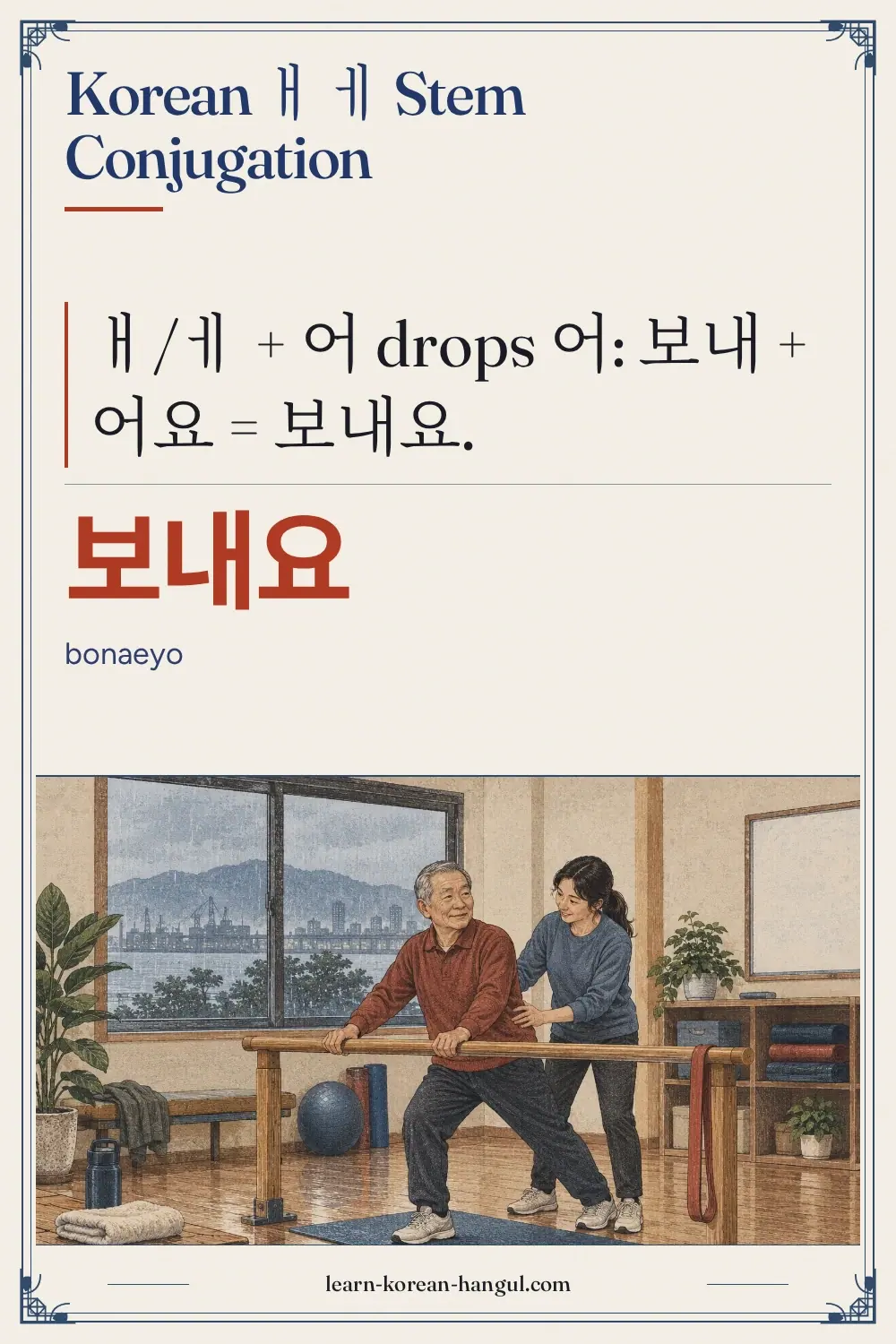
Korean ㅐ ㅔ stem conjugation works in two moves: choose the ending, then drop its vowel. Take 보내다 (to send). The stem is 보내, which ends in ㅐ. By the one-vowel test, ㅐ is not ㅏ or ㅗ, so the ending is 어요. That would give 보내어요, with two vowels in a row. Standard spelling shortens it by dropping 어, and the result is 보내요.
| Step | What happens | Result |
|---|---|---|
| 1. Remove 다 | 보내다 → stem | 보내 |
| 2. Choose the ending | last vowel ㅐ is not ㅏ or ㅗ | 어요 |
| 3. Drop the duplicate vowel | 보내 + 어요 | 보내요 |
The same steps work for ㅔ: 세다 (to count) gives the stem 세, the ending 어요, and the result 세요.
This is the cousin of the rule in vowel dropping, with one difference. In 가 + 아요 the two vowels are identical. In 보내 + 어요 they are ㅐ and ㅓ, which are different vowels, yet the ending still loses its 어 and the stem vowel stays. Hangul Orthography (한글 맞춤법), the National Institute of Korean Language's spelling standard, covers this shortening in its Article 34 and its notes.
Revised Romanization (RR) writes bonaeyo and seyo as reading aids only.
Worked Example: a Verb You Have Not Met
Try the rule on 헤매다 (to wander), which is not in most beginner lists.
- Remove 다. The stem is 헤매.
- Read the last vowel. 매 has ㅐ, which is not ㅏ or ㅗ, so the ending is 어요.
- The stem ends in a vowel, so contract. 어 drops after ㅐ: 헤매 + 어요 = 헤매요.
- For the past, use 었: 헤매 + 었 = 헤맸, so 헤맸어요 [헤매써요].
The method needs no memorised list. Any new verb whose dictionary form ends in 내다, 매다, 세다, 베다 or a similar ㅐ/ㅔ + 다 will behave the same way, and a dictionary entry for the verb confirms the meaning.
Now it helps to see how many verbs follow the same move.
Which Verbs Have ㅐ or ㅔ Stems?
Dozens of verbs have stems that end in ㅐ or ㅔ, including every verb that ends in 내다, such as 꺼내다 (take out), and every one follows the same rule. The table lists 14 frequent ones.
| Dictionary form | Meaning | Polite present | Polite past |
|---|---|---|---|
| 보내다 | send; spend (time) | 보내요 | 보냈어요 [보내써요] |
| 지내다 | live, get along, spend time | 지내요 | 지냈어요 [지내써요] |
| 끝내다 | finish (something) | 끝내요 [끈내요] | 끝냈어요 [끈내써요] |
| 내다 | pay; put out | 내요 | 냈어요 [내써요] |
| 새다 | leak | 새요 | 샜어요 [새써요] |
| 세다 | count | 세요 | 셌어요 [세써요] |
| 메다 | carry on the shoulder | 메요 | 멨어요 [메써요] |
| 베다 | cut | 베요 | 벴어요 [베써요] |
| 개다 | fold (bedding) | 개요 | 갰어요 [개써요] |
| 헤매다 | wander, be lost | 헤매요 | 헤맸어요 [헤매써요] |
| 깨다 | wake up; break | 깨요 | 깼어요 [깨써요] |
| 빼다 | take out, subtract | 빼요 | 뺐어요 [빼써요] |
| 매다 | tie | 매요 | 맸어요 [매써요] |
| 떼다 | detach | 떼요 | 뗐어요 [떼써요] |
Nearly all these words are verbs. The common adjective with such a stem is 세다 (to be strong), which also gives 세요 (바람이 세요, "the wind is strong"). The adjective 새롭다 (new) ends in a consonant and is ㅂ-irregular, and the look-alike 그렇다 gives 그래요 by the ㅎ-irregular rule, not by dropping. So this rule mainly affects verbs. Sentences make the forms easier to remember.
- 친구에게 선물을 보내요. = I send a gift to a friend.
- 요즘 어떻게 지내요? = How are you these days?
- 제가 커피값을 내요. = I pay for the coffee.
- 지붕에서 비가 새요. = Rain leaks through the roof.
The present forms are settled, so the past tense is the next test.
What Is the past Tense of ㅐ and ㅔ Stems?
The past tense of a ㅐ or ㅔ stem is the stem plus ㅆ plus 어요. The marker 었 is chosen because ㅐ and ㅔ are not ㅏ or ㅗ, then its 어 drops after the stem vowel, and the ㅆ attaches to the stem: 보내 + 었 = 보냈, and then 어요 follows. The result is 보냈어요 [보내써요].
| Stem + marker | Fused form | Polite past |
|---|---|---|
| 보내 + 었 | 보냈 | 보냈어요 |
| 지내 + 었 | 지냈 | 지냈어요 |
| 끝내 + 었 | 끝냈 | 끝냈어요 |
| 세 + 었 | 셌 | 셌어요 |
| 헤매 + 었 | 헤맸 | 헤맸어요 |
The logic matches the pattern in past tense conjugation, where the stem vowel and 았/었 fuse into one syllable with a final ㅆ. If you know the present form, you know the past: take 보내요 and write 보냈어요.
Example sentences:
- 어제 친구에게 편지를 보냈어요. = I sent a letter to a friend yesterday.
- 주말을 집에서 지냈어요. = I spent the weekend at home.
One pair of ㅐ-stem and ㅏ-stem verbs is easy to confuse, so it needs its own section.
What Is the Difference between 끝내다 and 끝나다?
끝내다 means to finish something and takes an object, while 끝나다 means to end by itself and takes only a subject. In grammar terms, 끝내다 is transitive (타동사, tadongsa) and 끝나다 is intransitive (자동사, jadongsa).
| 끝내다 | 끝나다 | |
|---|---|---|
| Meaning | finish (something) | end, be over |
| Verb type | transitive | intransitive |
| Stem ends in | ㅐ | ㅏ |
| Takes an object (을/를)? | yes | no |
| Polite present | 끝내요 [끈내요] | 끝나요 [끈나요] |
| Polite past | 끝냈어요 [끈내써요] | 끝났어요 [끈나써요] |
| Example | 숙제를 끝내요. = I finish my homework. | 수업이 끝나요. = Class ends. |
The forms look almost the same, but the stems behave differently: 끝내 + 어요 drops 어, and 끝나 + 아요 drops 아. The first is the rule of this page, and the second is the rule of the vowel dropping page. In speech, 끝내요 and 끝나요 sound close. Check the object marker: if there is an 을/를, use 끝내요.
Many Korean verbs come in such pairs, and related pairs built with suffixes are explained in passive and causative verbs.
The pair also shows a spelling problem, because ㅐ and ㅔ sound alike for most speakers.
How Do You Spell ㅐ and ㅔ Stems When They Sound Alike?
You spell them from memory of the word, because ㅐ and ㅔ are pronounced the same by most Seoul speakers today, although the standard pronunciation rules (Article 4) still list them as two vowels. The pair 새다 (to leak) and 세다 (to count) sounds nearly identical, and so do 새요 and 세요. In writing, only the verb tells you which vowel to use.
Two habits help:
- Learn the verb with its meaning, not by sound. Memorise 보내다 as "send" and 베다 as "cut".
- Use the ending as a check. Both vowels give the same polite shape (stem + 요), so a spelling error does not change the ending rule. It only changes which word you wrote.
The distinction between ㅐ and ㅔ in older and careful speech is described in Korean ㅐ vs ㅔ pronunciation.
Is the Full Form 보내어요 Wrong?
The full form 보내어요 is the underlying long form, and it is rare in everyday Korean. Standard spelling writes the shortened result 보내요 when the vowel is dropped. You may meet 보내어 in older writing, in song lyrics and in formal prose, but a learner should write 보내요.
Treat the long forms like this:
- Speech: the vowels run together, so you hear 보내요.
- Writing: write 보내요, 지내요 and 세요.
- Reading: if you see 보내어 or 지내어, read it as the same word.
For comparison, the same logic works in the past: 보내었어요 is the long form of 보냈어요, and ordinary writing uses 보냈어요.
Why Can 세요 Mean Two Things?
세요 can come from two sources, so the same sound has two meanings. 세요 can be the polite present of 세다 (to count), or it can be the honorific ending -(으)세요 attached to another verb, as in 가세요 ("please go" or "he goes", said respectfully). Context separates them.
| Form | Source | Meaning |
|---|---|---|
| 세요 | 세다 + 어요 | counts (polite) |
| 가세요 | 가다 + -(으)세요 | goes (honorific), please go |
| 보내세요 | 보내다 + -(으)세요 | sends (honorific), please send |
| 보내요 | 보내다 + 어요 | sends (plain polite) |
The honorific -(으)시- is taught in honorific -(으)시-, and the comparison with plain polite forms is in -(으)세요 vs -아요/어요. For now, remember that 보내요 and 보내세요 are different forms of the same verb.
How Do ㅐ and ㅔ Stems Look in Other Endings?
ㅐ and ㅔ stems follow the same drop in every ending that starts with 어, and they behave like any vowel-final stem with the other endings. The table shows 보내다, 지내다 and 세다 in six forms.
| Form | 보내다 (send) | 지내다 (spend time) | 세다 (count) |
|---|---|---|---|
| Polite present | 보내요 | 지내요 | 세요 |
| Polite past | 보냈어요 | 지냈어요 | 셌어요 |
| Formal present (-ㅂ니다) | 보냅니다 | 지냅니다 | 셉니다 |
| Casual present | 보내 | 지내 | 세 |
| "and then", "because" (-어서) | 보내서 | 지내서 | 세서 |
| Future (-ㄹ 거예요) | 보낼 거예요 | 지낼 거예요 | 셀 거예요 |
보내다
| Form | Korean | Romanization | Rule |
|---|---|---|---|
| Polite present | 보내요 | bonaeyo | 보내 + 어요, 어 drops after ㅐ |
| Polite past | 보냈어요 | bonaesseoyo | 보내 + 었 = 보냈, then 어요 |
| Formal present | 보냅니다 | bonaemnida | 보내 + ㅂ니다 |
Notice the casual forms 보내, 지내 and 세. As with ㅏ stems, the casual present of a ㅐ or ㅔ stem is identical to the bare stem. Only intonation and context tell a stem from a casual sentence. The formal style and the future are covered in formal conjugation and future tense conjugation.
Which Mistakes Do Learners Make with ㅐ and ㅔ Stems?
Learners make three real mistakes with ㅐ and ㅔ stems and often over-use one rare form; each has a quick fix.
| Wrong form | Correct form | Cause |
|---|---|---|
| 보내아요 | 보내요 | ㅐ is not ㅏ or ㅗ, so the ending is 어요, not 아요 |
| 보내여요 | 보내요 | 여요 belongs to 하다 only; other stems take 어요 |
| 보내어요 | 보내요 | not an error: the long form is standard but rare, so prefer 보내요 |
| 보냈아요 | 보냈어요 | after the fused ㅆ syllable the polite ending is 어요 |
A fifth mistake is spelling, not conjugation. 새요 (it leaks) and 세요 (counts) differ by one vowel letter that sounds almost the same, so check the word in a dictionary when the meaning is not clear from context.
Which Five Stem Vowels Mean Stem + 요?
Five stem vowels need no extra letter in the polite present: ㅏ, ㅓ, ㅕ, ㅐ and ㅔ. When a stem ends in one of them, write the stem and add 요. The one exception is the 하 of 하다, which gives 해요. Then the ending vowel has dropped, and nothing else changes.
| Stem ends in | Example | Polite present |
|---|---|---|
| ㅏ | 가다 | 가요 |
| ㅓ | 서다 | 서요 |
| ㅕ | 켜다 | 켜요 |
| ㅐ | 보내다 | 보내요 |
| ㅔ | 세다 | 세요 |
The remaining vowel endings behave differently. ㅗ, ㅜ and ㅣ merge with the ending (와요, 배워요, 마셔요), ㅡ drops from the stem (써요), ㅚ merges in 돼요, and 하 becomes 해. Check the present tense recipe for the full map.
Practice
Write the polite present and past forms. Answers follow.
- 보내다 (send)
- 지내다 (spend time)
- 세다 (count)
- 깨다 (wake up)
- 끝내다 (finish)
- Choose: "Class ends." Is it 수업이 끝내요 or 수업이 끝나요?
Answers to the Practice
- 보내요, 보냈어요 [보내써요].
- 지내요, 지냈어요 [지내써요].
- 세요, 셌어요 [세써요].
- 깨요, 깼어요 [깨써요].
- 끝내요 [끈내요], 끝냈어요 [끈내써요].
- 수업이 끝나요. The class ends by itself, so the intransitive 끝나다 is correct.
If you wrote 보내어요 or 보내었어요, those are the long forms. They are standard but rare, so learners usually write the short forms.
What to Learn Next
Korean ㅐ ㅔ stem conjugation reduces to one move: pick 어요, then drop the 어. The next lesson is 돼요 vs 되요, which explains the spelling of 되다, a stem that ends in ㅚ. For the past tense in full, read past tense conjugation.
This lesson covers regular ㅐ/ㅔ stems in the polite present and past. It treats the long form 보내어요 as rare rather than wrong, and it does not teach causative or passive verbs. The forms follow standard written Korean, and the bracketed pronunciations are standard Seoul approximations.
Frequently Asked Questions
Why is 보내다 보내요 and not 보내어요? The stem 보내 ends in ㅐ, which is not ㅏ or ㅗ, so the ending is 어요. The 어 then drops after ㅐ, just as it drops after ㅓ. Standard spelling writes the shortened result 보내요. The long form 보내어요 is the underlying full form and is rarely used.
Is 보내어요 wrong? It is not a spelling error in the full-form sense, but it is rare and sounds heavy in everyday Korean. Ordinary speech and writing use the shortened 보내요. Learners should write 보내요. If you meet 보내어요 in a poem or a song, it is the same word in its longer form.
What is the past tense of 보내다? The polite past of 보내다 (to send) is 보냈어요 [보내써요]. The stem 보내 ends in ㅐ, so it takes 었, the 어 drops, and the ㅆ attaches to the stem: 보내 + 었 = 보냈. Then 어요 follows. The formal past is 보냈습니다, and the casual past is 보냈어.
What is the difference between 끝내다 and 끝나다? 끝내다 is transitive: a person finishes something and the thing takes 을/를, as in 숙제를 끝내요. 끝나다 is intransitive: something ends by itself, as in 수업이 끝나요. The stems end in ㅐ and ㅏ, so the polite forms are 끝내요 and 끝나요. The past forms are 끝냈어요 and 끝났어요.
Does the same rule apply to adjectives? Yes, but few adjectives qualify. The common one is 세다 (to be strong), which gives 세요 like the verb 세다 (to count), as in 바람이 세요 (the wind is strong). Look-alikes such as 그렇다, which gives 그래요, belong to the ㅎ-irregular class and follow a different rule.