Korean Household Appliances Vocabulary at a Glance
This list has 30 words in five groups of six: cooling and heating, kitchen appliances, laundry and cleaning, entertainment and small gadgets. It belongs to House and Home. Most words are loanwords or Sino-Korean compounds, so many are easy to guess once you learn the patterns, especially the -기 ending that means a device.
| Group | Words | Use |
|---|---|---|
| Cooling and heating | 6 | Staying comfortable in summer and winter |
| Kitchen appliances | 6 | Cooking, chilling and heating food |
| Laundry and cleaning | 6 | Washing clothes and keeping air clean |
| Entertainment | 6 | Watching, listening and getting online |
| Small gadgets | 6 | Charging, grooming and heating water |
The words also reflect Korean seasons. Summer needs a fan and an air conditioner, and winter needs a boiler and a heater. The next section ranks the words by usefulness and names the pattern that helps you remember them.
Which Household Appliances Should You Learn First?
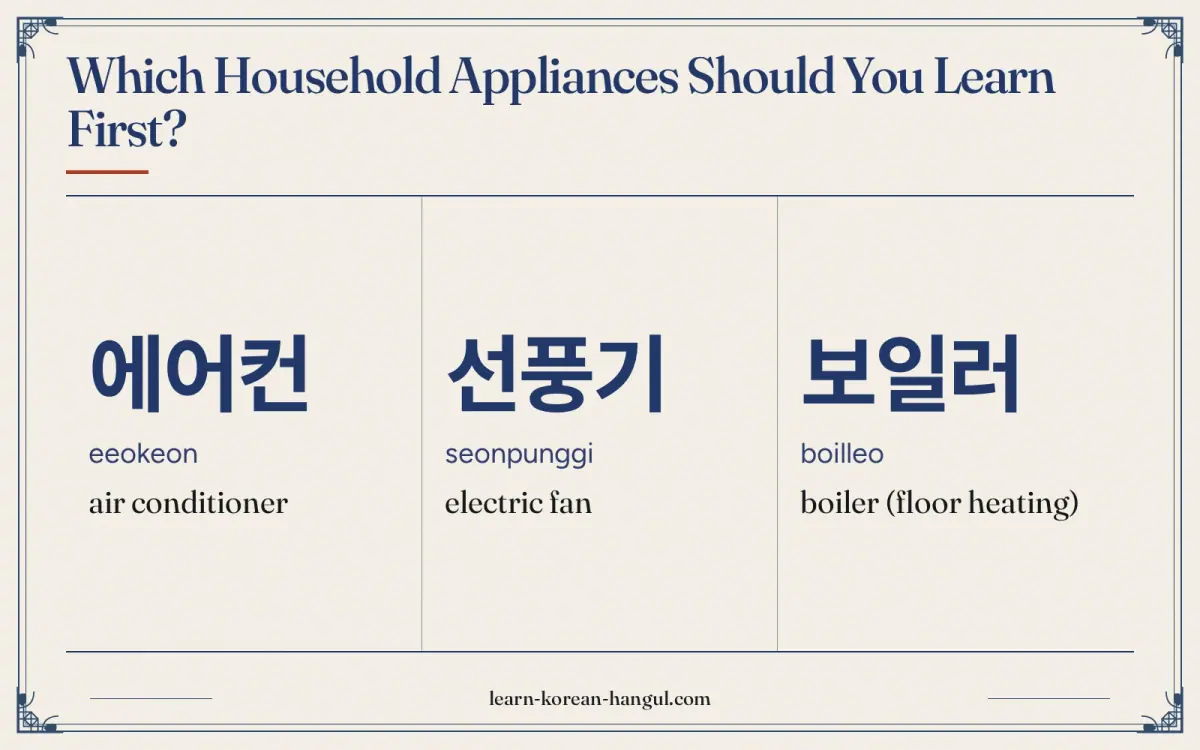
Learn 에어컨 (air conditioner), 냉장고 (refrigerator), 세탁기 (washing machine), 리모컨 (remote control) and 와이파이 (Wi-Fi) first. They are the machines a guest, a tenant or a traveller asks about most often, because they decide whether a room is comfortable and whether you can do laundry or get online.
- Words to say. 에어컨, 리모컨, 와이파이, 충전기. Use these when you ask for help or an item.
- Words to recognise. 세탁기, 건조기, 전자레인지, 정수기. These appear on labels and in a flat's instructions.
- Words to decode. Any noun that ends in 기 is probably a machine. 가습기 and 제습기 are both devices that change humidity.
Appliance names follow a clear pattern. 기 (機 or 器) means a machine or a device, so 세탁기 is a washing device (세탁 means washing), 청소기 is a cleaning device and 충전기 is a charging device. The refrigerator breaks the pattern: 냉장고 uses 고 (庫), a storehouse, so it is a cold storehouse. The scene below shows a living room and kitchen with numbered objects that match the list.
Word · 9
- 1
에어컨
eeokeon
air conditioner
- 2
선풍기
seonpunggi
electric fan
- 3
보일러
boilleo
boiler (floor heating)
- 4
냉장고
naengjanggo
refrigerator
- 5
전자레인지
jeonjareinji
microwave oven
- 6
세탁기
setakgi
washing machine
- 7
청소기
cheongsogi
vacuum cleaner
- 8
텔레비전
tellebijeon
television
- 9
리모컨
rimokeon
remote control
Cooling and Heating
Korean summers are hot and humid, and winters are cold and dry, so these six words show up often in everyday talk. 에어컨 is a loanword that means only the air conditioner, not air conditioning in general. 선풍기 is an electric fan, built from 선 (扇, fan), 풍 (風, wind) and 기 (機, machine). 보일러 is the boiler that heats the floor in many flats, so it is a heating appliance of a special kind.
| No. | Hangul | Revised Romanization | Meaning and note | Example sentence | Audio assetId |
|---|---|---|---|---|---|
| 1 | 에어컨 | eeokeon | air conditioner. Short for air conditioner; 켜다 means to switch on. | 에어컨을 켜요. (I turn on the air conditioner.) | au-pg-vocabulary-daily-life-home-appliances-1; example: au-pg-vocabulary-daily-life-home-appliances-31 |
| 2 | 선풍기 | seonpunggi | electric fan. 시원하다 describes a pleasant coolness. | 선풍기가 시원해요. (The fan feels nice and cool.) | au-pg-vocabulary-daily-life-home-appliances-2; example: au-pg-vocabulary-daily-life-home-appliances-32 |
| 3 | 히터 | hiteo | heater. Also the word for a car heater. | 히터를 켜요. (I turn on the heater.) | au-pg-vocabulary-daily-life-home-appliances-3; example: au-pg-vocabulary-daily-life-home-appliances-33 |
| 4 | 보일러 | boilleo | boiler (floor heating). Runs the underfloor 온돌 system. | 보일러를 켜요. (I turn on the boiler.) | au-pg-vocabulary-daily-life-home-appliances-4; example: au-pg-vocabulary-daily-life-home-appliances-34 |
| 5 | 가습기 | gaseupgi | humidifier. Said [가습끼]; common in dry winters. | 가습기를 켜요. (I turn on the humidifier.) | au-pg-vocabulary-daily-life-home-appliances-5; example: au-pg-vocabulary-daily-life-home-appliances-35 |
| 6 | 제습기 | jeseupgi | dehumidifier. Said [제습끼]; used in the rainy season. | 제습기를 틀어요. (I run the dehumidifier.) | au-pg-vocabulary-daily-life-home-appliances-6; example: au-pg-vocabulary-daily-life-home-appliances-36 |
Three verbs work with machines. 켜다 means to switch on, 끄다 means to switch off, and 틀다 means to turn on something that runs or plays, such as a fan or a dehumidifier. In casual speech 에어컨을 틀어요 is as common as 에어컨을 켜요.
Example Sentences
Three frames carry the examples. The first is machine + 을/를 켜요 (turn on the machine), as in 에어컨을 켜요. The second is machine + 이/가 어디 있어요? (where is the machine?), as in 리모컨이 어디 있어요?. The third is machine + 이/가 없어요 (there is no machine), as in 충전기가 없어요. Particles matter: 을 follows a final consonant (에어컨을) and 를 follows a vowel (히터를). Say each sentence aloud after the audio, then swap the noun.
How Do You Say Kitchen Appliances in Korean?
Kitchen appliance names mix Sino-Korean words and loanwords. 냉장고 is the refrigerator, and its freezer part is 냉동실. 밥솥 is the rice cooker, one of the most used appliances in a Korean kitchen, because rice is eaten with most meals. A gas hob is a 가스레인지, a loanword from gas range, and a microwave is a 전자레인지, which is literally an electronic range.
| No. | Hangul | Revised Romanization | Meaning and note | Example sentence | Audio assetId |
|---|---|---|---|---|---|
| 7 | 냉장고 | naengjanggo | refrigerator. 냉 means cold; 고 means storehouse. | 냉장고에 우유가 있어요. (There is milk in the refrigerator.) | au-pg-vocabulary-daily-life-home-appliances-7; example: au-pg-vocabulary-daily-life-home-appliances-37 |
| 8 | 전자레인지 | jeonjareinji | microwave oven. 데우다 means to warm food. | 전자레인지에 데워요. (I heat it in the microwave.) | au-pg-vocabulary-daily-life-home-appliances-8; example: au-pg-vocabulary-daily-life-home-appliances-38 |
| 9 | 밥솥 | bapsot | rice cooker. Said [밥쏟]. | 밥솥에 밥이 있어요. (There is rice in the rice cooker.) | au-pg-vocabulary-daily-life-home-appliances-9; example: au-pg-vocabulary-daily-life-home-appliances-39 |
| 10 | 가스레인지 | gaseureinji | gas hob; gas range. Cooking surface with burners. | 가스레인지를 켜요. (I turn on the gas hob.) | au-pg-vocabulary-daily-life-home-appliances-10; example: au-pg-vocabulary-daily-life-home-appliances-40 |
| 11 | 식기세척기 | sikgisecheokgi | dishwasher. Said [식끼세척끼]; 식기 means tableware. | 식기세척기를 써요. (I use the dishwasher.) | au-pg-vocabulary-daily-life-home-appliances-11; example: au-pg-vocabulary-daily-life-home-appliances-41 |
| 12 | 정수기 | jeongsugi | water purifier. Common in Korean homes and offices. | 정수기 물을 마셔요. (I drink water from the purifier.) | au-pg-vocabulary-daily-life-home-appliances-12; example: au-pg-vocabulary-daily-life-home-appliances-42 |
Korean homes often have a second refrigerator, called a 김치냉장고 (kimchi refrigerator), made to keep kimchi at a steady temperature. You will see it in many flats, and it tells you something about food habits. The Korean Kitchen Vocabulary page has more cooking words.
Laundry and Cleaning
These six appliances help with laundry and cleaning. 세탁기 is the washing machine and 건조기 is the dryer. 청소기 is the vacuum cleaner, and the robot version is a 로봇 청소기. A clothes iron is a 다리미. 공기청정기 is an air purifier, a common appliance in Korean homes because of seasonal air pollution.
| No. | Hangul | Revised Romanization | Meaning and note | Example sentence | Audio assetId |
|---|---|---|---|---|---|
| 13 | 세탁기 | setakgi | washing machine. 돌리다 is the verb for running a machine. | 세탁기를 돌려요. (I run the washing machine.) | au-pg-vocabulary-daily-life-home-appliances-13; example: au-pg-vocabulary-daily-life-home-appliances-43 |
| 14 | 건조기 | geonjogi | clothes dryer. 건조 means drying. | 건조기에 넣어요. (I put it in the dryer.) | au-pg-vocabulary-daily-life-home-appliances-14; example: au-pg-vocabulary-daily-life-home-appliances-44 |
| 15 | 청소기 | cheongsogi | vacuum cleaner. 청소 means cleaning. | 청소기를 돌려요. (I run the vacuum cleaner.) | au-pg-vocabulary-daily-life-home-appliances-15; example: au-pg-vocabulary-daily-life-home-appliances-45 |
| 16 | 로봇 청소기 | robot cheongsogi | robot vacuum cleaner. Written as two words. | 로봇 청소기가 청소해요. (The robot vacuum is cleaning.) | au-pg-vocabulary-daily-life-home-appliances-16; example: au-pg-vocabulary-daily-life-home-appliances-46 |
| 17 | 다리미 | darimi | clothes iron. 다리다 means to iron. | 다리미로 다려요. (I iron with the iron.) | au-pg-vocabulary-daily-life-home-appliances-17; example: au-pg-vocabulary-daily-life-home-appliances-47 |
| 18 | 공기청정기 | gonggicheongjeonggi | air purifier. 공기 means air. | 공기청정기를 켜요. (I turn on the air purifier.) | au-pg-vocabulary-daily-life-home-appliances-18; example: au-pg-vocabulary-daily-life-home-appliances-48 |
Notice the repeated verb 돌리다, to make something turn. It works for washing machines, vacuum cleaners and fans, because the machine's motion is the point. For the sequence of a laundry day, see the Korean Cleaning Vocabulary page.
How Do You Say Entertainment in Korean?
Entertainment appliances are almost all loanwords, so you can say them by sounding out the English. 텔레비전 is the full word, and 티비 (TV) is the common spoken short form. 리모컨 is the remote control, shortened from the English remote controller. 와이파이 is Wi-Fi, and asking for its 비밀번호 (password) is a useful sentence in cafes and guesthouses.
| No. | Hangul | Revised Romanization | Meaning and note | Example sentence | Audio assetId |
|---|---|---|---|---|---|
| 19 | 텔레비전 | tellebijeon | television. Often shortened to 티비. | 텔레비전을 봐요. (I watch television.) | au-pg-vocabulary-daily-life-home-appliances-19; example: au-pg-vocabulary-daily-life-home-appliances-49 |
| 20 | 리모컨 | rimokeon | remote control. Short for remote controller. | 리모컨이 어디 있어요? (Where is the remote control?) | au-pg-vocabulary-daily-life-home-appliances-20; example: au-pg-vocabulary-daily-life-home-appliances-50 |
| 21 | 스피커 | seupikeo | speaker. 소리 means sound. | 스피커 소리가 커요. (The speaker sound is loud.) | au-pg-vocabulary-daily-life-home-appliances-21; example: au-pg-vocabulary-daily-life-home-appliances-51 |
| 22 | 컴퓨터 | keompyuteo | computer. Desktop computer. | 컴퓨터를 켜요. (I turn on the computer.) | au-pg-vocabulary-daily-life-home-appliances-22; example: au-pg-vocabulary-daily-life-home-appliances-52 |
| 23 | 노트북 | noteubuk | laptop. Short for notebook computer. | 노트북을 써요. (I use a laptop.) | au-pg-vocabulary-daily-life-home-appliances-23; example: au-pg-vocabulary-daily-life-home-appliances-53 |
| 24 | 와이파이 | waipai | Wi-Fi. The sentence to learn first. | 와이파이 비밀번호가 뭐예요? (What is the Wi-Fi password?) | au-pg-vocabulary-daily-life-home-appliances-24; example: au-pg-vocabulary-daily-life-home-appliances-54 |
The word 리모컨 is a good example of how Korean shortens long loanwords. Remote controller becomes 리모컨, and the same cutting gives 에어컨 from air conditioner. Learners can guess many words by thinking of a shortened English phrase.
Small Gadgets
Small gadgets are the smallest group but the one a traveller needs most. A 충전기 is a charger, and asking 충전기 있어요? in a cafe is a common request. A 헤어드라이어 is a hair dryer, usually shortened to 드라이어. A 전기 포트 is an electric kettle, standard in Korean homes for making tea and instant noodles.
| No. | Hangul | Revised Romanization | Meaning and note | Example sentence | Audio assetId |
|---|---|---|---|---|---|
| 25 | 충전기 | chungjeongi | charger. 충전 means charging. | 충전기 있어요? (Do you have a charger?) | au-pg-vocabulary-daily-life-home-appliances-25; example: au-pg-vocabulary-daily-life-home-appliances-55 |
| 26 | 헤어드라이어 | heeodeuraieo | hair dryer. Often shortened to 드라이어. | 헤어드라이어를 써요. (I use the hair dryer.) | au-pg-vocabulary-daily-life-home-appliances-26; example: au-pg-vocabulary-daily-life-home-appliances-56 |
| 27 | 전기 포트 | jeongi poteu | electric kettle. 끓이다 means to boil. | 전기 포트로 물을 끓여요. (I boil water with the kettle.) | au-pg-vocabulary-daily-life-home-appliances-27; example: au-pg-vocabulary-daily-life-home-appliances-57 |
| 28 | 믹서 | mikseo | blender. 갈다 means to grind. | 믹서로 갈아요. (I grind it with the blender.) | au-pg-vocabulary-daily-life-home-appliances-28; example: au-pg-vocabulary-daily-life-home-appliances-58 |
| 29 | 면도기 | myeondogi | shaver; razor. 면도 means shaving. | 면도기를 써요. (I use a shaver.) | au-pg-vocabulary-daily-life-home-appliances-29; example: au-pg-vocabulary-daily-life-home-appliances-59 |
| 30 | 배터리 | baeteori | battery. 배터리가 없어요 literally says there is no battery. | 배터리가 없어요. (The battery is dead.) | au-pg-vocabulary-daily-life-home-appliances-30; example: au-pg-vocabulary-daily-life-home-appliances-60 |
Counting machines uses 대 (dae), the counter for vehicles and machines. A television is 한 대 and two fans are 두 대. The counter follows a native Korean number in its short form, as in 세 대 (three units). See counters for things for the other counters.
What Does the -기 Ending Tell You about Appliance Names?
The ending 기 (機 or 器) means a machine or device, and an action noun before it tells you the job. The table decodes seven common names, and the pattern lets you guess new ones. Learn a handful of job words and the names come almost free.
| Word | Job word | Device |
|---|---|---|
| 세탁기 | 세탁 (washing) | washing machine |
| 청소기 | 청소 (cleaning) | vacuum cleaner |
| 충전기 | 충전 (charging) | charger |
| 건조기 | 건조 (drying) | dryer |
| 가습기 | 가습 (adding moisture) | humidifier |
| 면도기 | 면도 (shaving) | shaver |
| 정수기 | 정수 (purifying water) | water purifier |
Among the words that are not loanwords, two break the pattern. 냉장고 ends in 고 (storehouse), and 다리미 uses a native Korean word, 다리다 (to iron), plus 미. The other Sino-Korean machine names follow the -기 rule, so a new word that ends in 기 and names a job is nearly always a machine.
How Do You Pronounce These Words?
Appliance words contain tense sounds at syllable boundaries. Standard pronunciation follows the National Institute of Korean Language (국립국어원) rules, and the romanization follows the Revised Romanization of Korean, which does not mark every sound change.
| Spelling | Sounds like | What changes |
|---|---|---|
| 가습기 | [가습끼] | After a final ㅂ, the next ㄱ is said as a tense [ㄲ]. |
| 밥솥 | [밥쏟] | ㅂ + ㅅ gives a tense [ㅆ]; the final ㅌ is said [ㄷ]. |
| 식기세척기 | [식끼세척끼] | ㄱ + ㄱ gives a tense [ㄲ] twice in this long word. |
| 선풍기 | [선풍기] | No change: the final ㄴ stays [n] before ㅍ. |
| 리모컨 | [리모컨] | No change: 컨 is aspirated ㅋ plus ㅓ plus ㄴ. |
The tense sound [ㄲ] after a final stop is the pattern most often missed. Practise it by saying the first syllable with a quick stop and the second with a tight throat. The tense sounds are explained in detail on the pronunciation pages.
Audio and Slow Playback
Each word and sentence has its own clip. The five clips below replay the hardest words slowly. Play one, repeat it aloud, then play it again and compare.
What Mistakes Do Learners Make with Household Appliances?
Five mistakes are especially common with appliances.
- Using 에어컨 for air conditioning in general. 에어컨 names the machine. To say the room is cool, use 시원해요. For the machine on, say 에어컨을 켜요.
- Using 개 for large machines. Count appliances such as air conditioners and washing machines with 대: 에어컨 한 대 (one air conditioner). 개 is fine for small items such as chargers.
- Mixing 켜다 and 틀다. 켜다 is to switch on and 틀다 is to run or play. Both are fine for fans and air conditioners, but 켜다 is the safe choice for lights and computers.
- Treating 냉장고 as a -기 word. 냉장고 ends in 고, not 기. The other cold-storage word, 냉동실, names the freezer part.
- Forgetting the shortened loanwords. 리모컨, 에어컨 and 티비 are the spoken forms. Full forms like 리모트 컨트롤러 sound odd in daily speech.
Learn the -기 pattern and the 대 counter, and most of these mistakes disappear. The practice section below turns the list into drills.
Practice: Flashcards and Worksheet
Study in three steps. First, run the flashcard deck in recognition mode until you recognise all 30 words. Second, switch to listening mode. Third, take the quiz. The deck holds all 30 words with audio, and your progress stays in your browser. The vocabulary flashcard decks page lists the other decks.
Practice · 65
- 01에어컨
Show answer
headword 1: air conditioner
- 02선풍기
Show answer
headword 2: electric fan
- 03히터
Show answer
headword 3: heater
- 04보일러
Show answer
headword 4: boiler (floor heating)
- 05가습기
Show answer
headword 5: humidifier
- 06제습기
Show answer
headword 6: dehumidifier
- 07냉장고
Show answer
headword 7: refrigerator
- 08전자레인지
Show answer
headword 8: microwave oven
- 09밥솥
Show answer
headword 9: rice cooker
- 10가스레인지
Show answer
headword 10: gas hob; gas range
- 11식기세척기
Show answer
headword 11: dishwasher
- 12정수기
Show answer
headword 12: water purifier
- 13세탁기
Show answer
headword 13: washing machine
- 14건조기
Show answer
headword 14: clothes dryer
- 15청소기
Show answer
headword 15: vacuum cleaner
- 16로봇 청소기
Show answer
headword 16: robot vacuum cleaner
- 17다리미
Show answer
headword 17: clothes iron
- 18공기청정기
Show answer
headword 18: air purifier
- 19텔레비전
Show answer
headword 19: television
- 20리모컨
Show answer
headword 20: remote control
- 21스피커
Show answer
headword 21: speaker
- 22컴퓨터
Show answer
headword 22: computer
- 23노트북
Show answer
headword 23: laptop
- 24와이파이
Show answer
headword 24: Wi-Fi
- 25충전기
Show answer
headword 25: charger
- 26헤어드라이어
Show answer
headword 26: hair dryer
- 27전기 포트
Show answer
headword 27: electric kettle
- 28믹서
Show answer
headword 28: blender
- 29면도기
Show answer
headword 29: shaver; razor
- 30배터리
Show answer
headword 30: battery
- 31에어컨을 켜요.
Show answer
example sentence for headword 1
- 32선풍기가 시원해요.
Show answer
example sentence for headword 2
- 33히터를 켜요.
Show answer
example sentence for headword 3
- 34보일러를 켜요.
Show answer
example sentence for headword 4
- 35가습기를 켜요.
Show answer
example sentence for headword 5
- 36제습기를 틀어요.
Show answer
example sentence for headword 6
- 37냉장고에 우유가 있어요.
Show answer
example sentence for headword 7
- 38전자레인지에 데워요.
Show answer
example sentence for headword 8
- 39밥솥에 밥이 있어요.
Show answer
example sentence for headword 9
- 40가스레인지를 켜요.
Show answer
example sentence for headword 10
- 41식기세척기를 써요.
Show answer
example sentence for headword 11
- 42정수기 물을 마셔요.
Show answer
example sentence for headword 12
- 43세탁기를 돌려요.
Show answer
example sentence for headword 13
- 44건조기에 넣어요.
Show answer
example sentence for headword 14
- 45청소기를 돌려요.
Show answer
example sentence for headword 15
- 46로봇 청소기가 청소해요.
Show answer
example sentence for headword 16
- 47다리미로 다려요.
Show answer
example sentence for headword 17
- 48공기청정기를 켜요.
Show answer
example sentence for headword 18
- 49텔레비전을 봐요.
Show answer
example sentence for headword 19
- 50리모컨이 어디 있어요?
Show answer
example sentence for headword 20
- 51스피커 소리가 커요.
Show answer
example sentence for headword 21
- 52컴퓨터를 켜요.
Show answer
example sentence for headword 22
- 53노트북을 써요.
Show answer
example sentence for headword 23
- 54와이파이 비밀번호가 뭐예요?
Show answer
example sentence for headword 24
- 55충전기 있어요?
Show answer
example sentence for headword 25
- 56헤어드라이어를 써요.
Show answer
example sentence for headword 26
- 57전기 포트로 물을 끓여요.
Show answer
example sentence for headword 27
- 58믹서로 갈아요.
Show answer
example sentence for headword 28
- 59면도기를 써요.
Show answer
example sentence for headword 29
- 60배터리가 없어요.
Show answer
example sentence for headword 30
- 61선풍기
Show answer
slow playback of headword 2: electric fan
- 62가습기
Show answer
slow playback of headword 5: humidifier
- 63밥솥
Show answer
slow playback of headword 9: rice cooker
- 64식기세척기
Show answer
slow playback of headword 11: dishwasher
- 65전자레인지
Show answer
slow playback of headword 8: microwave oven
Practice · 5
What does 에어컨 (eeokeon) mean?
Show answer
air conditioner
에어컨 means air conditioner. Example: 에어컨을 켜요. (I turn on the air conditioner.)
What does 선풍기 (seonpunggi) mean?
Show answer
electric fan
선풍기 means electric fan. Example: 선풍기가 시원해요. (The fan feels nice and cool.)
What does 냉장고 (naengjanggo) mean?
Show answer
refrigerator
냉장고 means refrigerator. Example: 냉장고에 우유가 있어요. (There is milk in the refrigerator.)
What does 세탁기 (setakgi) mean?
Show answer
washing machine
세탁기 means washing machine. Example: 세탁기를 돌려요. (I run the washing machine.)
What does 리모컨 (rimokeon) mean?
Show answer
remote control
리모컨 means remote control. Example: 리모컨이 어디 있어요? (Where is the remote control?)
Korean Household Appliances Vocabulary Worksheet (PDF)
A printable worksheet for these words (word list, matching, writing practice, fill-in-the-blank exercises and answer key) is available in A4 and US Letter from the download card on this page. For practice, walk around your home and write the Korean name of every machine you see. Add 한 대 or 두 대 to practise the counter.
Where to Go Next
After this page, continue with Korean Cleaning Vocabulary or go back to Korean Bedroom Vocabulary. For counters, see counters for things. To move up a level, return to House and Home.
Frequently Asked Questions
How Do You Say Air Conditioner in Korean?
Air conditioner is 에어컨 (eeokeon), a shortened loanword from English air conditioner. To switch it on, say 에어컨을 켜요, and to switch it off, say 에어컨을 꺼요. Count units with the counter 대: 에어컨 한 대 is one air conditioner.
How Do You Pronounce 선풍기 (seonpunggi)?
Say seon-pung-gi in three even beats. The first syllable seon ends in n, the second pung has an aspirated p with a puff of air and ends in ng, and gi is soft. The word means electric fan. Press the audio button to hear it and the slow version.
How Many Household Appliances Should I Learn First?
Five first: 에어컨, 냉장고, 세탁기, 리모컨 and 와이파이. At five new words a day the whole list of 30 takes six days plus review. Learn the -기 pattern before the rest, because it decodes 12 of the 30 words.
Where Can I Practise Household Appliances with Flashcards?
Use the vocabulary flashcard decks. The deck for this page holds all 30 words with Hangul, romanization and audio, with recognition and listening modes. Your progress stays in your browser. Return daily and review the cards you missed.
Is the Romanization on This Page Official?
It follows the Revised Romanization of Korean, which South Korea adopted on 7 July 2000 and whose rules the National Institute of Korean Language (국립국어원) publishes. It is a learning aid and does not mark every sound change, so rely on the Hangul and the audio.
Is There a Printable Worksheet for Household Appliances?
A printable worksheet for these words (word list, matching, writing practice, fill-in-the-blank exercises and answer key) is available in A4 and US Letter from the download card on this page. For practice, copy the tables on this page by hand or use the flashcard deck, which carries the same 30 words.