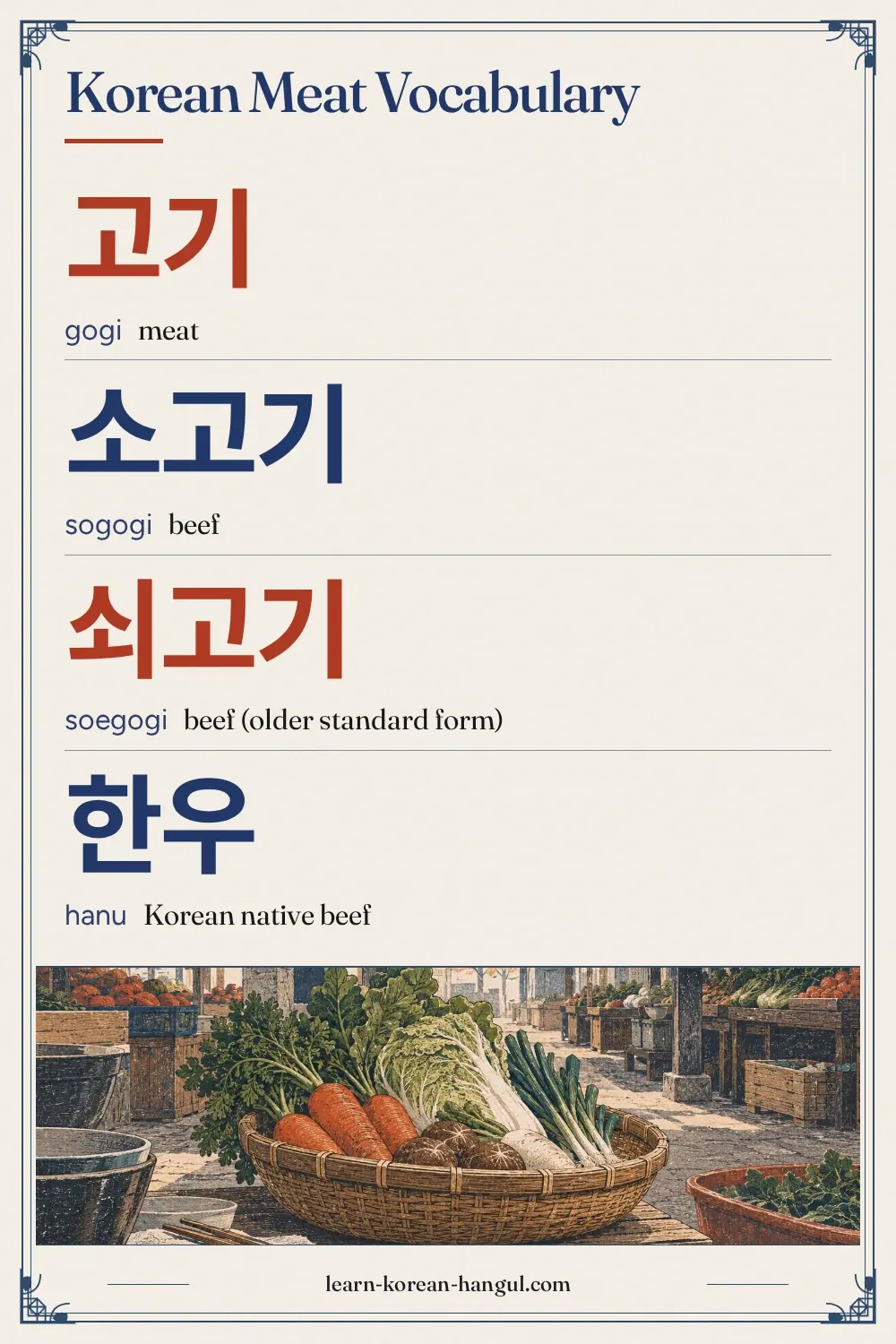
Korean Meat Vocabulary at a Glance
This list has 30 words in five groups. It belongs to Ingredients. The first three groups follow the animal: cow, pig and bird. The last two are the words for cuts and organs, and the nouns for how the meat is cooked. Most are native or Sino-Korean words, and only 베이컨 is a loanword.
| Group | Words | Use |
|---|---|---|
| Meat and beef | 7 | Meat in general, and beef cuts |
| Pork | 6 | Pork cuts and pork dishes |
| Chicken and duck | 5 | Poultry words |
| Cuts and parts | 7 | Organ meats, bones and fat |
| Cooking styles for meat | 5 | Grilled, boiled, raw, steamed and fried |
The key to the whole list is 고기. Once you know that 고기 is meat and that the animal word sits in front of it, you can build the word for any meat: 양고기 (lamb) and 말고기 (horse meat) follow the same pattern.
Which Meat Words Should You Learn First?
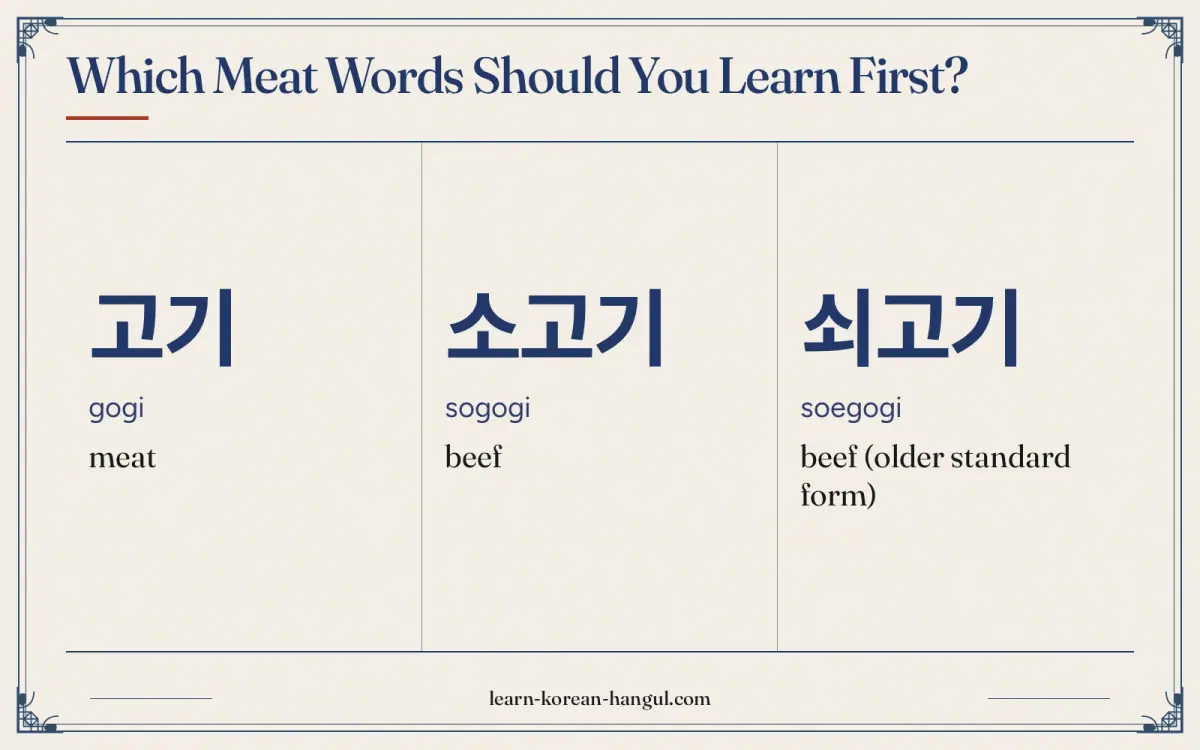
Learn 고기, 소고기, 돼지고기, 닭고기 and 삼겹살 first. They give you the general word, the three main meats and the best-known grilled cut. A sentence such as 삼겹살 이 인분 주세요 (two servings of pork belly, please) uses the last of them with a serving counter.
- Words to say. 소고기, 돼지고기, 닭고기, 삼겹살, 갈비. Use these at a table or in a shop.
- Words to recognise. 등심, 안심, 목살, 곱창, 막창. You read these on menus and meat-counter labels.
- Words for how it is cooked. 구이, 수육, 찜, 튀김. They appear after the name of the dish.
A grilled-meat restaurant counts portions with 인분. The scene below shows a restaurant table with numbered objects that match the list.
Word · 24
- 1
고기
gogi
meat
- 2
소고기
sogogi
beef
- 3
쇠고기
soegogi
beef (older standard form)
- 4
한우
hanu
Korean native beef
- 5
등심
deungsim
sirloin; loin
- 6
안심
ansim
tenderloin
- 7
갈비
galbi
ribs
- 8
돼지고기
dwaejigogi
pork
- 9
삼겹살
samgyeopsal
pork belly
- 10
목살
moksal
pork neck
- 11
항정살
hangjeongsal
pork jowl
- 12
족발
jokbal
pig trotters
- 13
베이컨
beikeon
bacon
- 14
닭고기
dakgogi
chicken (meat)
- 15
닭
dak
chicken (bird)
- 16
닭가슴살
dakgaseumsal
chicken breast
- 17
닭다리
dakdari
chicken leg; drumstick
- 18
오리고기
origogi
duck meat
- 19
곱창
gopchang
small intestine
- 20
막창
makchang
abomasum (last stomach)
- 21
대창
daechang
large intestine
- 22
내장
naejang
internal organs
- 23
사골
sagol
leg bone (for broth)
- 24
살코기
salkogi
lean meat
Beef
Beef is the prestige meat in Korean cooking. The base noun is 고기 (meat), and the animal word goes in front of it: 소 (cow) gives 소고기 (beef). Every other meat word on this page follows the same pattern, so learn 고기 well. A shop sells beef by cut, and 등심 and 안심 are the two cuts you see most on a menu.
| No. | Hangul | Revised Romanization | Meaning and note | Example sentence | Audio assetId |
|---|---|---|---|---|---|
| 1 | 고기 | gogi | meat. The base word for meat; also used for fish flesh. | 고기를 좋아해요. (I like meat.) | au-pg-vocabulary-food-ingredients-meat-1; example: au-pg-vocabulary-food-ingredients-meat-31 |
| 2 | 소고기 | sogogi | beef. 소 (cow) + 고기 (meat). | 소고기를 사요. (I buy beef.) | au-pg-vocabulary-food-ingredients-meat-2; example: au-pg-vocabulary-food-ingredients-meat-32 |
| 3 | 쇠고기 | soegogi | beef (older standard form). Means the same as 소고기; both are standard. | 쇠고기와 소고기는 같은 말이에요. (쇠고기 and 소고기 are the same word.) | au-pg-vocabulary-food-ingredients-meat-3; example: au-pg-vocabulary-food-ingredients-meat-33 |
| 4 | 한우 | hanu | Korean native beef. 한 means Korean; 우 means cow. Marks domestic beef. Said [하누]. | 한우는 가격이 비싸요. (Hanwoo beef costs a lot.) | au-pg-vocabulary-food-ingredients-meat-4; example: au-pg-vocabulary-food-ingredients-meat-34 |
| 5 | 등심 | deungsim | sirloin; loin. 등 means back; a common grilling cut. | 등심을 구워요. (I grill the sirloin.) | au-pg-vocabulary-food-ingredients-meat-5; example: au-pg-vocabulary-food-ingredients-meat-35 |
| 6 | 안심 | ansim | tenderloin. The soft inner cut. | 안심은 부드러워요. (Tenderloin is tender.) | au-pg-vocabulary-food-ingredients-meat-6; example: au-pg-vocabulary-food-ingredients-meat-36 |
| 7 | 갈비 | galbi | ribs. Short ribs, grilled or braised. | 갈비를 양념에 재워요. (I marinate the ribs in sauce.) | au-pg-vocabulary-food-ingredients-meat-7; example: au-pg-vocabulary-food-ingredients-meat-37 |
쇠고기 and 소고기 are both found. 쇠고기 is the older form of the word and 소고기 is the form most people write today. The word 한우 appears on shop signs and menus as a mark of the native Korean cattle breed. Labels beside it often show a quality grade such as 1++ or 1+; ask the butcher if you need the details. For grilled-beef dishes, see Korean BBQ vocabulary.
Example Sentences
Three frames carry most of the examples. The first is meat + 을/를 + cooking verb, as in 등심을 구워요 (I grill the sirloin). The second is meat + 은/는 + describing word, as in 안심은 부드러워요 (tenderloin is tender). The third is meat + 이 인분 + 주세요, as in 돼지고기 이 인분 주세요. Say each aloud after the audio and swap in another meat. Use 을 after a consonant (등심을) and 를 after a vowel (소고기를).
How Do You Say Pork in Korean?
Pork is the everyday meat. 돼지 is the pig, and 돼지고기 is pork. The cut names end in 살, which means flesh or meat from a part of the body, so 삼겹살 is the three-layer belly and 목살 is the neck. Grilling pork at the table is a very common meal out in Korea.
| No. | Hangul | Revised Romanization | Meaning and note | Example sentence | Audio assetId |
|---|---|---|---|---|---|
| 8 | 돼지고기 | dwaejigogi | pork. 돼지 (pig) + 고기 (meat). | 돼지고기 이 인분 주세요. (Two servings of pork, please.) | au-pg-vocabulary-food-ingredients-meat-8; example: au-pg-vocabulary-food-ingredients-meat-38 |
| 9 | 삼겹살 | samgyeopsal | pork belly. 삼 means three; 겹 means layer. Said [삼겹쌀]. | 삼겹살은 기름이 많아요. (Pork belly has a lot of fat.) | au-pg-vocabulary-food-ingredients-meat-9; example: au-pg-vocabulary-food-ingredients-meat-39 |
| 10 | 목살 | moksal | pork neck. 목 means neck. Said [목쌀]. | 목살은 담백해요. (Pork neck is clean in flavour.) | au-pg-vocabulary-food-ingredients-meat-10; example: au-pg-vocabulary-food-ingredients-meat-40 |
| 11 | 항정살 | hangjeongsal | pork jowl. A small, chewy cut near the neck. Said [항정쌀]. | 항정살은 쫄깃해요. (Pork jowl is chewy.) | au-pg-vocabulary-food-ingredients-meat-11; example: au-pg-vocabulary-food-ingredients-meat-41 |
| 12 | 족발 | jokbal | pig trotters. Said [족빨]. Braised and sliced. | 족발을 시켜요. (I order pig trotters.) | au-pg-vocabulary-food-ingredients-meat-12; example: au-pg-vocabulary-food-ingredients-meat-42 |
| 13 | 베이컨 | beikeon | bacon. A loanword. | 베이컨은 짜요. (Bacon is salty.) | au-pg-vocabulary-food-ingredients-meat-13; example: au-pg-vocabulary-food-ingredients-meat-43 |
Look at the 살 ending. 삼겹살, 목살 and 항정살 all end in 살, and in speech its ㅅ is tense. After a stop such as ㅂ or ㄱ the change is automatic, so 삼겹살 sounds like [삼겹쌀] and 목살 like [목쌀]. After ㅇ, as in 항정살 [항정쌀], the tense sound is a habit of compound cut names rather than an automatic rule.
Chicken and Duck
Poultry words use 닭 (chicken, the bird) and 오리 (duck). The meat adds 고기, so 닭고기 is chicken meat and 오리고기 is duck meat. The final consonant cluster in 닭 makes the word look hard, but you say only one of its two final letters.
| No. | Hangul | Revised Romanization | Meaning and note | Example sentence | Audio assetId |
|---|---|---|---|---|---|
| 14 | 닭고기 | dakgogi | chicken (meat). Said [닥꼬기]; the ㄱ after ㄱ is tense. | 닭고기를 삶아요. (I boil the chicken.) | au-pg-vocabulary-food-ingredients-meat-14; example: au-pg-vocabulary-food-ingredients-meat-44 |
| 15 | 닭 | dak | chicken (bird). The final ㄺ is said [ㄱ], so 닭 alone is [닥]. | 닭이 울어요. (The chicken crows.) | au-pg-vocabulary-food-ingredients-meat-15; example: au-pg-vocabulary-food-ingredients-meat-45 |
| 16 | 닭가슴살 | dakgaseumsal | chicken breast. 가슴 means chest. Said [닥까슴살], often heard as [닥까슴쌀]. | 닭가슴살을 먹어요. (I eat chicken breast.) | au-pg-vocabulary-food-ingredients-meat-16; example: au-pg-vocabulary-food-ingredients-meat-46 |
| 17 | 닭다리 | dakdari | chicken leg; drumstick. 다리 means leg. Said [닥따리]. | 닭다리를 튀겨요. (I fry the drumsticks.) | au-pg-vocabulary-food-ingredients-meat-17; example: au-pg-vocabulary-food-ingredients-meat-47 |
| 18 | 오리고기 | origogi | duck meat. 오리 (duck) + 고기 (meat). | 오리고기 주세요. (Duck meat, please.) | au-pg-vocabulary-food-ingredients-meat-18; example: au-pg-vocabulary-food-ingredients-meat-48 |
Fried chicken is a dish word more than a meat word. It has its own page at fried chicken in Korean. For the animal itself, 닭 appears again in chicken (animal) in Korean.
How Do You Say Cuts and Parts in Korean?
Cuts and parts words matter when you read a barbecue menu. Korean restaurants serve organ cuts that are rarely on English menus: 곱창 (small intestine), 막창 (a cow's fourth stomach, or the last part of a pig's large intestine) and 대창 (large intestine). Bones and fat have their own words, which also appear on supermarket labels.
| No. | Hangul | Revised Romanization | Meaning and note | Example sentence | Audio assetId |
|---|---|---|---|---|---|
| 19 | 곱창 | gopchang | small intestine. Grilled or in stew; a popular drinking food. | 곱창은 고소해요. (Small intestine tastes rich.) | au-pg-vocabulary-food-ingredients-meat-19; example: au-pg-vocabulary-food-ingredients-meat-49 |
| 20 | 막창 | makchang | abomasum (last stomach). A chewy grilled cut; pork 막창, popular in Daegu, is the end of a pig's large intestine. | 막창을 좋아해요. (I like abomasum.) | au-pg-vocabulary-food-ingredients-meat-20; example: au-pg-vocabulary-food-ingredients-meat-50 |
| 21 | 대창 | daechang | large intestine. Rich in fat. | 대창은 기름져요. (Large intestine is fatty.) | au-pg-vocabulary-food-ingredients-meat-21; example: au-pg-vocabulary-food-ingredients-meat-51 |
| 22 | 내장 | naejang | internal organs. The general word for innards. | 내장을 깨끗이 씻어요. (I wash the innards thoroughly.) | au-pg-vocabulary-food-ingredients-meat-22; example: au-pg-vocabulary-food-ingredients-meat-52 |
| 23 | 사골 | sagol | leg bone (for broth). Boiled for hours to make white stock. | 사골을 오래 끓여요. (I boil the leg bones for a long time.) | au-pg-vocabulary-food-ingredients-meat-23; example: au-pg-vocabulary-food-ingredients-meat-53 |
| 24 | 살코기 | salkogi | lean meat. 살 (flesh) + 고기 (meat); an old ㅎ at the end of 살 turns the ㄱ into ㅋ. | 살코기를 주세요. (Please give me lean meat.) | au-pg-vocabulary-food-ingredients-meat-24; example: au-pg-vocabulary-food-ingredients-meat-54 |
| 25 | 비계 | bigye | fat; fatty edge. The white fat on a cut of meat. | 비계는 떼어 주세요. (Please cut off the fat.) | au-pg-vocabulary-food-ingredients-meat-25; example: au-pg-vocabulary-food-ingredients-meat-55 |
Organ meats are not for every visitor, but the words help you avoid or choose them. If you have a dietary need, do not rely on one word. Use the longer requests on the restaurant phrases page.
Cooking Styles for Meat
Cooking-style nouns tell you how the meat arrives. A noun such as 구이 (grilled) or 찜 (braised, steamed) usually follows the meat: 갈비찜 is braised ribs. Learn these five and a menu line becomes readable.
| No. | Hangul | Revised Romanization | Meaning and note | Example sentence | Audio assetId |
|---|---|---|---|---|---|
| 26 | 구이 | gui | grilled dish. Added after a name: 소금구이 is salt-grilled. | 소금구이로 먹어요. (I eat it salt-grilled.) | au-pg-vocabulary-food-ingredients-meat-26; example: au-pg-vocabulary-food-ingredients-meat-56 |
| 27 | 수육 | suyuk | boiled pork slices. Boiled meat, usually pork today, sliced thin and eaten with kimchi or salted shrimp. | 수육은 삶은 고기예요. (Suyuk is boiled meat.) | au-pg-vocabulary-food-ingredients-meat-27; example: au-pg-vocabulary-food-ingredients-meat-57 |
| 28 | 육회 | yukhoe | raw beef. Said [유쾨]; seasoned and served with an egg yolk. RR keeps the h in nouns, so it is written yukhoe. | 육회는 날고기예요. (Yukhoe is raw meat.) | au-pg-vocabulary-food-ingredients-meat-28; example: au-pg-vocabulary-food-ingredients-meat-58 |
| 29 | 찜 | jjim | braised or steamed dish. Added after a name: 갈비찜. | 갈비찜을 만들어요. (I make braised short ribs.) | au-pg-vocabulary-food-ingredients-meat-29; example: au-pg-vocabulary-food-ingredients-meat-59 |
| 30 | 튀김 | twigim | fried food. From 튀기다 (to fry). | 튀김은 바삭해요. (Fried food is crispy.) | au-pg-vocabulary-food-ingredients-meat-30; example: au-pg-vocabulary-food-ingredients-meat-60 |
These nouns are also dish words. 구이 and 찜 attach to meat and fish names alike, so you will meet them again in the Korean Seafood Vocabulary list.
How Do You Pronounce These Words?
Meat words contain several tense sounds and consonant-cluster endings. Standard pronunciation follows the National Institute of Korean Language (국립국어원) rules, and the romanization follows the Revised Romanization of Korean, which writes the sound you hear in some cases and the spelling in others.
| Spelling | Sounds like | What changes |
|---|---|---|
| 닭고기 | [닥꼬기] | The final ㄺ is said [ㄱ], and the next ㄱ becomes a tense [ㄲ]. |
| 삼겹살 | [삼겹쌀] | The ㅅ of 살 becomes a tense [ㅆ]. |
| 족발 | [족빨] | The ㅂ after a final ㄱ becomes a tense [ㅃ]. |
| 육회 | [유쾨] | The ㄱ joins with ㅎ to make an aspirated [ㅋ]. |
| 닭다리 | [닥따리] | The final ㄺ is said [ㄱ], and the next ㄷ becomes a tense [ㄸ]. |
The cluster ㄺ in 닭 has two letters but one sound. In 닭고기 only the ㄱ is said, because the word ends a syllable before another consonant. In 닭이 (the chicken, as subject) the second letter returns and the word is said [달기].
Audio and Slow Playback
Each word and sentence has its own clip. The five clips below replay the hardest words slowly. Play one, repeat it aloud, then play it again and compare.
What Mistakes Do Learners Make with Meat Words?
Five mistakes appear often.
- Assuming 고기 never means fish. 고기 usually means meat, but in phrases such as 고기를 잡다 (to catch fish) it means fish. A live fish is 물고기, and fish as food is 생선.
- Writing 닭고기 as it sounds. The sound is [닥꼬기], but the spelling keeps ㄺ. Write 닭고기, not 닥고기.
- Mixing 갈비 and 등심. 갈비 is ribs, usually marinated. 등심 is sirloin, usually unseasoned. Look for the 양념 label on a marinated cut.
- Ordering 막창 without knowing what it is. 막창, 곱창 and 대창 are organ cuts. If unsure, ask staff or choose 삼겹살 or 갈비.
- Using 소고기 and 쇠고기 as two meats. They are the same meat. Both spellings are standard.
Knowing the animal + 고기 pattern prevents most of these errors. For the single query on its own, see meat in Korean.
Practice: Flashcards and Worksheet
Study in three steps. First, run the flashcard deck in recognition mode until you recognise all 30 words. Second, switch to listening mode. Third, take the quiz. The deck holds all 30 words with audio, and your progress stays in your browser. The vocabulary flashcard decks page lists the other decks.
Practice · 65
- 01고기
Show answer
headword 1: meat
- 02소고기
Show answer
headword 2: beef
- 03쇠고기
Show answer
headword 3: beef (older standard form)
- 04한우
Show answer
headword 4: Korean native beef
- 05등심
Show answer
headword 5: sirloin; loin
- 06안심
Show answer
headword 6: tenderloin
- 07갈비
Show answer
headword 7: ribs
- 08돼지고기
Show answer
headword 8: pork
- 09삼겹살
Show answer
headword 9: pork belly
- 10목살
Show answer
headword 10: pork neck
- 11항정살
Show answer
headword 11: pork jowl
- 12족발
Show answer
headword 12: pig trotters
- 13베이컨
Show answer
headword 13: bacon
- 14닭고기
Show answer
headword 14: chicken (meat)
- 15닭
Show answer
headword 15: chicken (bird)
- 16닭가슴살
Show answer
headword 16: chicken breast
- 17닭다리
Show answer
headword 17: chicken leg; drumstick
- 18오리고기
Show answer
headword 18: duck meat
- 19곱창
Show answer
headword 19: small intestine
- 20막창
Show answer
headword 20: abomasum (last stomach)
- 21대창
Show answer
headword 21: large intestine
- 22내장
Show answer
headword 22: internal organs
- 23사골
Show answer
headword 23: leg bone (for broth)
- 24살코기
Show answer
headword 24: lean meat
- 25비계
Show answer
headword 25: fat; fatty edge
- 26구이
Show answer
headword 26: grilled dish
- 27수육
Show answer
headword 27: boiled pork slices
- 28육회
Show answer
headword 28: raw beef
- 29찜
Show answer
headword 29: braised or steamed dish
- 30튀김
Show answer
headword 30: fried food
- 31고기를 좋아해요.
Show answer
example for 고기
- 32소고기를 사요.
Show answer
example for 소고기
- 33쇠고기와 소고기는 같은 말이에요.
Show answer
example for 쇠고기
- 34한우는 가격이 비싸요.
Show answer
example for 한우
- 35등심을 구워요.
Show answer
example for 등심
- 36안심은 부드러워요.
Show answer
example for 안심
- 37갈비를 양념에 재워요.
Show answer
example for 갈비
- 38돼지고기 이 인분 주세요.
Show answer
example for 돼지고기
- 39삼겹살은 기름이 많아요.
Show answer
example for 삼겹살
- 40목살은 담백해요.
Show answer
example for 목살
- 41항정살은 쫄깃해요.
Show answer
example for 항정살
- 42족발을 시켜요.
Show answer
example for 족발
- 43베이컨은 짜요.
Show answer
example for 베이컨
- 44닭고기를 삶아요.
Show answer
example for 닭고기
- 45닭이 울어요.
Show answer
example for 닭
- 46닭가슴살을 먹어요.
Show answer
example for 닭가슴살
- 47닭다리를 튀겨요.
Show answer
example for 닭다리
- 48오리고기 주세요.
Show answer
example for 오리고기
- 49곱창은 고소해요.
Show answer
example for 곱창
- 50막창을 좋아해요.
Show answer
example for 막창
- 51대창은 기름져요.
Show answer
example for 대창
- 52내장을 깨끗이 씻어요.
Show answer
example for 내장
- 53사골을 오래 끓여요.
Show answer
example for 사골
- 54살코기를 주세요.
Show answer
example for 살코기
- 55비계는 떼어 주세요.
Show answer
example for 비계
- 56소금구이로 먹어요.
Show answer
example for 구이
- 57수육은 삶은 고기예요.
Show answer
example for 수육
- 58육회는 날고기예요.
Show answer
example for 육회
- 59갈비찜을 만들어요.
Show answer
example for 찜
- 60튀김은 바삭해요.
Show answer
example for 튀김
- 61닭고기
Show answer
slow playback: 닭고기
- 62삼겹살
Show answer
slow playback: 삼겹살
- 63육회
Show answer
slow playback: 육회
- 64곱창
Show answer
slow playback: 곱창
- 65항정살
Show answer
slow playback: 항정살
Practice · 6
What does 고기 (gogi) mean?
Show answer
meat
고기 means meat. Example: 고기를 좋아해요. (I like meat.)
What does 안심 (ansim) mean?
Show answer
tenderloin
안심 means tenderloin. Example: 안심은 부드러워요. (Tenderloin is tender.)
What does 항정살 (hangjeongsal) mean?
Show answer
pork jowl
항정살 means pork jowl. Example: 항정살은 쫄깃해요. (Pork jowl is chewy.)
What does 닭가슴살 (dakgaseumsal) mean?
Show answer
chicken breast
닭가슴살 means chicken breast. Example: 닭가슴살을 먹어요. (I eat chicken breast.)
What does 대창 (daechang) mean?
Show answer
large intestine
대창 means large intestine. Example: 대창은 기름져요. (Large intestine is fatty.)
What does 구이 (gui) mean?
Show answer
grilled dish
구이 means grilled dish. Example: 소금구이로 먹어요. (I eat it salt-grilled.)
Korean Meat Vocabulary Worksheet (PDF)
A printable worksheet for these words (word list, matching, writing practice, fill-in-the-blank exercises and answer key) is available in A4 and US Letter from the download card on this page. For practice, build the word for three other meats with the animal + 고기 pattern.
Where to Go Next
Once this Korean meat vocabulary feels familiar, add the other ingredient lists. After this page, continue with Korean Seafood Vocabulary and Korean Spices and Sauces Vocabulary. For ordering, see restaurant phrases. To move up a level, return to Ingredients.
Frequently Asked Questions
How Do You Say Meat in Korean?
Meat is 고기 (gogi). Say go-gi in two beats, with both vowels short. Put the animal word first for a specific meat: 소고기 is beef, 돼지고기 is pork and 닭고기 is chicken. The single-word page on meat in Korean has more detail.
How Do You Say Beef, Pork and Chicken in Korean?
Beef is 소고기 (sogogi), pork is 돼지고기 (dwaejigogi) and chicken is 닭고기 (dakgogi). All three use 고기 (meat) after the animal: 소 (cow), 돼지 (pig) and 닭 (chicken). Press the audio buttons to hear each. Note that 닭고기 is said [닥꼬기], with a tense second ㄱ.
What Is the Difference between 소고기 and 쇠고기?
They mean the same thing: beef. 쇠고기 is the older form, and 소고기 is the form most people write and say today. Both are standard, so you may see either on a menu or a label. Some older signs and official documents still use 쇠고기.
What Does the 살 in 삼겹살 Mean?
살 means flesh or meat from a body part. 삼겹살 is pork belly, from 삼 (three) and 겹 (layer). 목살 is pork neck and 항정살 is pork jowl. The same ending appears in many cut names, and its ㅅ is usually said tense, as in [삼겹쌀].
What Are 곱창, 막창 and 대창?
They are organ cuts of beef or pork. 곱창 is the small intestine and 대창 the large intestine. 막창 is a cow's fourth stomach or, at pork restaurants, the end of the large intestine. All three are grilled at barbecue restaurants, so ask staff if unsure.
Is the Romanization on This Page Official?
It follows the Revised Romanization of Korean, which South Korea adopted on 7 July 2000 and whose rules the National Institute of Korean Language (국립국어원) publishes. It is a learning aid, so rely on the Hangul and the audio.