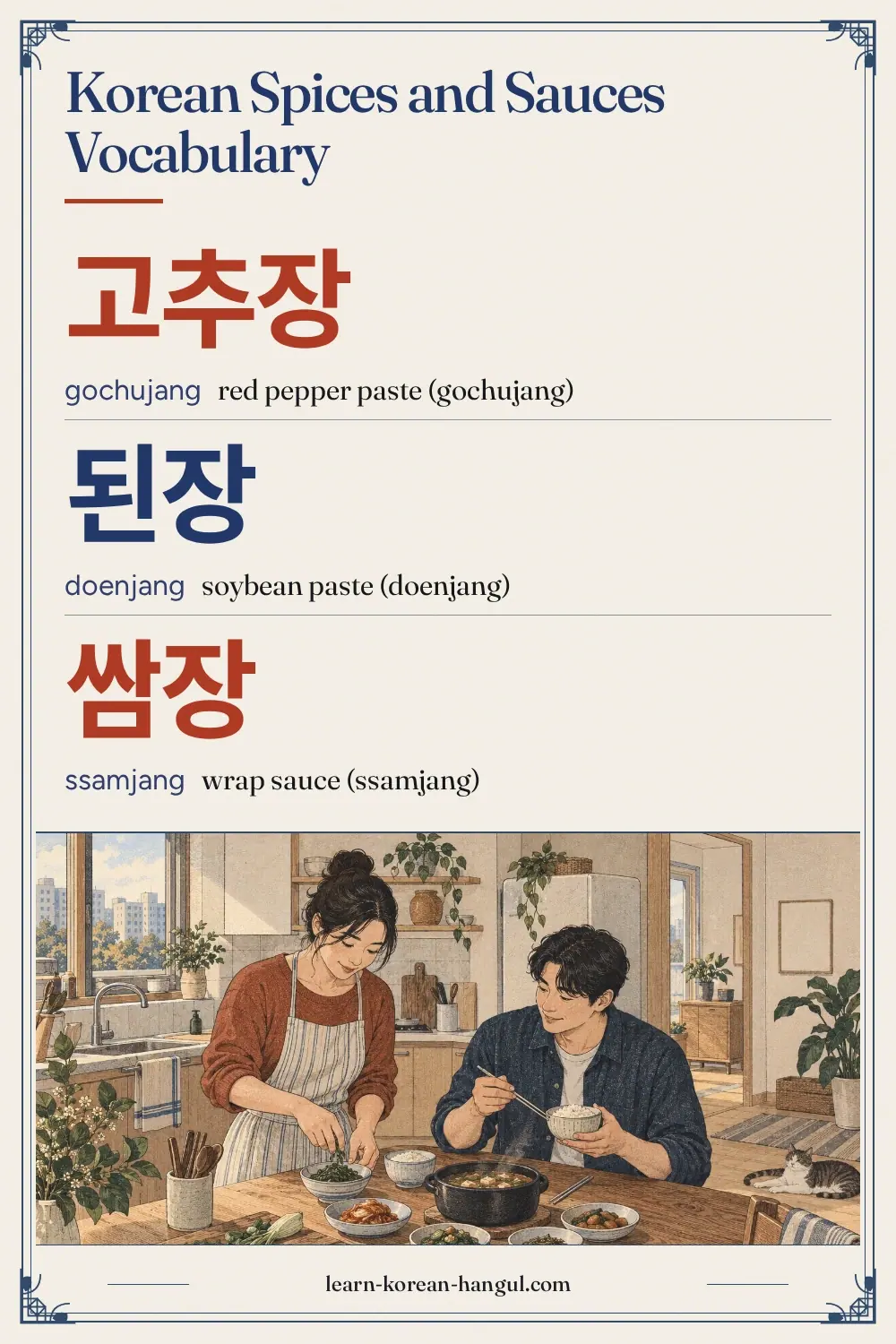
Korean Spices and Sauces Vocabulary at a Glance
This list has 30 words in five groups. It belongs to Ingredients. The first group is the three fermented pastes that define the cuisine. The rest cover dry spices, oils and vinegar, salt and sweeteners, and the dips you meet at the table. The vocabulary is practical, because jars and bottles in a supermarket carry these words on the front label.
| Group | Words | Use |
|---|---|---|
| Core pastes and sauces | 7 | The fermented pastes and soy sauce |
| Spices and powders | 7 | Pepper flakes, black pepper, sesame and spices |
| Oils and vinegar | 5 | Cooking oil, sesame oil and vinegar |
| Salt, sugar and sweeteners | 6 | Salt, sugar and syrups |
| Dipping sauces | 5 | Table sauces for dipping |
Many words repeat a smaller one. 참기름 is 참 plus 기름, 초간장 is 초 plus 간장, and 양념장 is 양념 plus 장. When you learn the parts, a new sauce name looks familiar.
Which Sauces and Seasonings Should You Learn First?
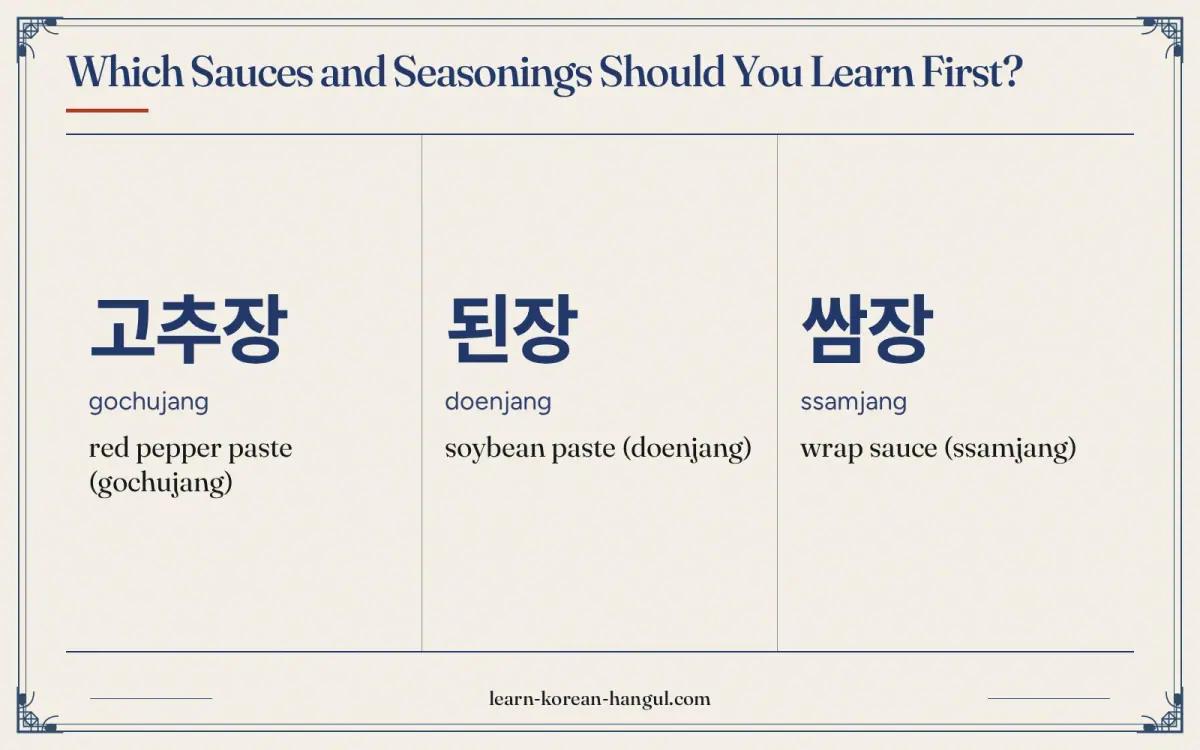
Learn 간장, 고추장, 된장, 소금 and 설탕 first. Most Korean home recipes call for at least two of them. A short sentence such as 간장을 조금 넣어요 (I add a little soy sauce) uses the first of them with a very common phrase for a small amount.
- Words to say. 간장, 고추장, 된장, 소금, 설탕. Use these when you cook or shop.
- Words to recognise. 쌈장, 참기름, 들기름, 액젓, 초장. They appear on menus and bottles.
- Words to separate. 고추장 (paste) and 고춧가루 (flakes) look alike but are different.
The cooking vocabulary list uses these seasonings in recipe steps. The scene below shows a supermarket shelf with numbered jars that match the list.
Word · 24
- 1
고추장
gochujang
red pepper paste (gochujang)
- 2
된장
doenjang
soybean paste (doenjang)
- 3
쌈장
ssamjang
wrap sauce (ssamjang)
- 4
간장
ganjang
soy sauce
- 5
양념
yangnyeom
seasoning; marinade
- 6
액젓
aekjeot
fish sauce
- 7
소스
soseu
sauce (Western style)
- 8
고춧가루
gochutgaru
red pepper flakes
- 9
후추
huchu
black pepper
- 10
깨
kkae
sesame seeds
- 11
겨자
gyeoja
mustard
- 12
계피
gyepi
cinnamon
- 13
카레
kare
curry powder; curry
- 14
향신료
hyangsinnyo
spices
- 15
기름
gireum
oil; fat
- 16
참기름
chamgireum
sesame oil
- 17
들기름
deulgireum
perilla oil
- 18
식용유
sigyongnyu
cooking oil
- 19
식초
sikcho
vinegar
- 20
소금
sogeum
salt
- 21
설탕
seoltang
sugar
- 22
꿀
kkul
honey
- 23
물엿
mullyeot
corn syrup; starch syrup
- 24
올리고당
olligodang
oligosaccharide syrup
Core Pastes and Sauces
Three fermented products carry Korean cooking: 간장 (soy sauce), 된장 (soybean paste) and 고추장 (red pepper paste). They are made from fermented soybeans, and each has its own taste. Add 쌈장, a table dip made from 된장 and 고추장, and you have the foundation of the Korean pantry. The suffix 장 appears in all four names and means a fermented sauce or paste.
| No. | Hangul | Revised Romanization | Meaning and note | Example sentence | Audio assetId |
|---|---|---|---|---|---|
| 1 | 고추장 | gochujang | red pepper paste (gochujang). Sweet, spicy and thick; used in bibimbap and stews. | 비빔밥에 고추장을 넣어요. (I add gochujang to bibimbap.) | au-pg-vocabulary-food-ingredients-sauces-seasonings-1; example: au-pg-vocabulary-food-ingredients-sauces-seasonings-31 |
| 2 | 된장 | doenjang | soybean paste (doenjang). Salty and earthy; the base of 된장찌개. | 된장은 짭짤해요. (Doenjang is salty.) | au-pg-vocabulary-food-ingredients-sauces-seasonings-2; example: au-pg-vocabulary-food-ingredients-sauces-seasonings-32 |
| 3 | 쌈장 | ssamjang | wrap sauce (ssamjang). A seasoned dip eaten with lettuce wraps. | 쌈장을 상추에 올려요. (I put ssamjang on the lettuce.) | au-pg-vocabulary-food-ingredients-sauces-seasonings-3; example: au-pg-vocabulary-food-ingredients-sauces-seasonings-33 |
| 4 | 간장 | ganjang | soy sauce. Used for seasoning, dipping and braising. | 간장을 조금 넣어요. (I add a little soy sauce.) | au-pg-vocabulary-food-ingredients-sauces-seasonings-4; example: au-pg-vocabulary-food-ingredients-sauces-seasonings-34 |
| 5 | 양념 | yangnyeom | seasoning; marinade. The general word for a seasoning mix. | 양념이 맛있어요. (The seasoning is tasty.) | au-pg-vocabulary-food-ingredients-sauces-seasonings-5; example: au-pg-vocabulary-food-ingredients-sauces-seasonings-35 |
| 6 | 액젓 | aekjeot | fish sauce. Said [액쩓]. Added to kimchi paste. | 김치에 액젓을 넣어요. (I add fish sauce to kimchi.) | au-pg-vocabulary-food-ingredients-sauces-seasonings-6; example: au-pg-vocabulary-food-ingredients-sauces-seasonings-36 |
| 7 | 소스 | soseu | sauce (Western style). A loanword for bottled sauces. | 소스를 따로 주세요. (Please give the sauce separately.) | au-pg-vocabulary-food-ingredients-sauces-seasonings-7; example: au-pg-vocabulary-food-ingredients-sauces-seasonings-37 |
The suffix 장 is a pattern worth learning. It also appears in 양념장 (seasoned sauce) and 초간장 (vinegar soy sauce) later on this page. When you see a new word ending in 장 on a menu, expect a sauce or paste. See soy sauce in Korean for one word in detail.
Example Sentences
Three frames carry most of the examples. The first is sauce + 을/를 + verb, as in 간장을 조금 넣어요 (I add a little soy sauce). The second is seasoning + 이/가 + describing word, as in 소금이 짜요 (the salt is salty). The third is food + 을/를 + sauce + 에 + 찍어요, as in 만두를 초간장에 찍어요. Say each aloud after the audio and swap in another sauce. Use 을 after a consonant (간장을) and 를 after a vowel (깨를).
How Do You Say Spices and Powders in Korean?
Spices and powders add heat and aroma. The key word is 고춧가루 (red pepper flakes), the dried chili that colours kimchi. It is not the same as 고추장, the paste. Sesame seeds (깨) go on almost every side dish, and 향신료 is the general word for spices.
| No. | Hangul | Revised Romanization | Meaning and note | Example sentence | Audio assetId |
|---|---|---|---|---|---|
| 8 | 고춧가루 | gochutgaru | red pepper flakes. Said [고추까루] or [고춛까루]. Jars often print gochugaru. | 고춧가루를 뿌려요. (I sprinkle red pepper flakes.) | au-pg-vocabulary-food-ingredients-sauces-seasonings-8; example: au-pg-vocabulary-food-ingredients-sauces-seasonings-38 |
| 9 | 후추 | huchu | black pepper. A table spice in any restaurant. | 후추를 갈아요. (I grind pepper.) | au-pg-vocabulary-food-ingredients-sauces-seasonings-9; example: au-pg-vocabulary-food-ingredients-sauces-seasonings-39 |
| 10 | 깨 | kkae | sesame seeds. Toasted and sprinkled on dishes. | 깨를 볶아요. (I toast sesame seeds.) | au-pg-vocabulary-food-ingredients-sauces-seasonings-10; example: au-pg-vocabulary-food-ingredients-sauces-seasonings-40 |
| 11 | 겨자 | gyeoja | mustard. Hot mustard served with cold noodles. | 겨자는 아주 매워요. (Mustard is very hot.) | au-pg-vocabulary-food-ingredients-sauces-seasonings-11; example: au-pg-vocabulary-food-ingredients-sauces-seasonings-41 |
| 12 | 계피 | gyepi | cinnamon. Used in the sweet drink 수정과. | 계피차를 마셔요. (I drink cinnamon tea.) | au-pg-vocabulary-food-ingredients-sauces-seasonings-12; example: au-pg-vocabulary-food-ingredients-sauces-seasonings-42 |
| 13 | 카레 | kare | curry powder; curry. A loanword; Korean packet curry is usually mild and yellow. | 카레를 만들어요. (I make curry.) | au-pg-vocabulary-food-ingredients-sauces-seasonings-13; example: au-pg-vocabulary-food-ingredients-sauces-seasonings-43 |
| 14 | 향신료 | hyangsinnyo | spices. Said [향신뇨]; the ㄹ becomes [ㄴ]. | 향신료 냄새가 강해요. (The spice smell is strong.) | au-pg-vocabulary-food-ingredients-sauces-seasonings-14; example: au-pg-vocabulary-food-ingredients-sauces-seasonings-44 |
The shopping mistake is common: 고춧가루 and 고추장 sound alike but are different products. 고춧가루 is a dry powder or flake. 고추장 is a wet paste. If a recipe calls for one, the other is not a substitute.
Oils and Vinegar
Oils and vinegar finish Korean dishes. 기름 is the general word for oil or fat. 참기름 (sesame oil) is added at the end for fragrance, and 들기름 (perilla oil) is a nuttier oil used in side dishes. 식용유 is plain cooking oil for frying.
| No. | Hangul | Revised Romanization | Meaning and note | Example sentence | Audio assetId |
|---|---|---|---|---|---|
| 15 | 기름 | gireum | oil; fat. The general word; also means fuel. | 기름이 뜨거워요. (The oil is hot.) | au-pg-vocabulary-food-ingredients-sauces-seasonings-15; example: au-pg-vocabulary-food-ingredients-sauces-seasonings-45 |
| 16 | 참기름 | chamgireum | sesame oil. 참 comes from 참깨 (sesame); 기름 means oil. | 참기름을 한 방울 넣어요. (I add a drop of sesame oil.) | au-pg-vocabulary-food-ingredients-sauces-seasonings-16; example: au-pg-vocabulary-food-ingredients-sauces-seasonings-46 |
| 17 | 들기름 | deulgireum | perilla oil. Made from perilla seeds; a nutty flavour. | 들기름은 고소해요. (Perilla oil tastes nutty.) | au-pg-vocabulary-food-ingredients-sauces-seasonings-17; example: au-pg-vocabulary-food-ingredients-sauces-seasonings-47 |
| 18 | 식용유 | sigyongnyu | cooking oil. Said [시굥뉴]. Plain oil for frying. | 식용유로 튀겨요. (I fry with cooking oil.) | au-pg-vocabulary-food-ingredients-sauces-seasonings-18; example: au-pg-vocabulary-food-ingredients-sauces-seasonings-48 |
| 19 | 식초 | sikcho | vinegar. 식 means food; 초 means vinegar. | 식초를 물에 섞어요. (I mix vinegar into the water.) | au-pg-vocabulary-food-ingredients-sauces-seasonings-19; example: au-pg-vocabulary-food-ingredients-sauces-seasonings-49 |
Compare 참기름 and 들기름. Both are pressed from seeds. 참기름 is made from sesame, 들기름 from perilla, and each suits different side dishes.
How Do You Say Salt, Sugar and Sweeteners in Korean?
Salt, sugar and sweeteners round out the pantry. 소금 and 설탕 are the two basic seasonings, and Korean recipes also use syrups, such as 물엿 and 올리고당, to give sauces a shine. 조미료 is the general word for flavour enhancers.
| No. | Hangul | Revised Romanization | Meaning and note | Example sentence | Audio assetId |
|---|---|---|---|---|---|
| 20 | 소금 | sogeum | salt. Salty is 짜다. | 소금이 짜요. (The salt is salty.) | au-pg-vocabulary-food-ingredients-sauces-seasonings-20; example: au-pg-vocabulary-food-ingredients-sauces-seasonings-50 |
| 21 | 설탕 | seoltang | sugar. White sugar. | 설탕을 넣어요. (I add sugar.) | au-pg-vocabulary-food-ingredients-sauces-seasonings-21; example: au-pg-vocabulary-food-ingredients-sauces-seasonings-51 |
| 22 | 꿀 | kkul | honey. Tense ㄲ; no puff of air. | 꿀을 차에 넣어요. (I put honey in the tea.) | au-pg-vocabulary-food-ingredients-sauces-seasonings-22; example: au-pg-vocabulary-food-ingredients-sauces-seasonings-52 |
| 23 | 물엿 | mullyeot | corn syrup; starch syrup. Said [물렫]. Adds shine to braised food. | 물엿으로 윤기를 내요. (I make it shiny with syrup.) | au-pg-vocabulary-food-ingredients-sauces-seasonings-23; example: au-pg-vocabulary-food-ingredients-sauces-seasonings-53 |
| 24 | 올리고당 | olligodang | oligosaccharide syrup. A lighter syrup used instead of sugar. | 설탕 대신 올리고당을 써요. (I use oligosaccharide syrup instead of sugar.) | au-pg-vocabulary-food-ingredients-sauces-seasonings-24; example: au-pg-vocabulary-food-ingredients-sauces-seasonings-54 |
| 25 | 조미료 | jomiryo | seasoning; flavour enhancer. The general word for seasoning powder. | 조미료를 조금만 넣어요. (I add only a little seasoning.) | au-pg-vocabulary-food-ingredients-sauces-seasonings-25; example: au-pg-vocabulary-food-ingredients-sauces-seasonings-55 |
The pattern 설탕 대신 means instead of sugar. It uses 대신, the word for instead, which works with any noun. For one-word lookups, see salt in Korean and sugar in Korean.
Dipping Sauces
Dipping sauces arrive in small dishes at the table. 초장 is a sweet-sour chili sauce that goes with raw fish, 초간장 is a vinegar soy dip for dumplings and pancakes, and 양념장 is a seasoned sauce for rice and tofu. 마요네즈 and 케첩 are the Western bottled sauces that arrive with fried food.
| No. | Hangul | Revised Romanization | Meaning and note | Example sentence | Audio assetId |
|---|---|---|---|---|---|
| 26 | 초장 | chojang | vinegar chili sauce. Short for 초고추장; served with raw fish. | 회를 초장에 찍어요. (I dip the raw fish in chili vinegar sauce.) | au-pg-vocabulary-food-ingredients-sauces-seasonings-26; example: au-pg-vocabulary-food-ingredients-sauces-seasonings-56 |
| 27 | 초간장 | choganjang | vinegar soy dip. 초 (vinegar) + 간장 (soy sauce). | 만두를 초간장에 찍어요. (I dip the dumplings in vinegar soy sauce.) | au-pg-vocabulary-food-ingredients-sauces-seasonings-27; example: au-pg-vocabulary-food-ingredients-sauces-seasonings-57 |
| 28 | 양념장 | yangnyeomjang | seasoned sauce. 양념 (seasoning) + 장 (sauce). | 양념장을 만들어요. (I make the seasoned sauce.) | au-pg-vocabulary-food-ingredients-sauces-seasonings-28; example: au-pg-vocabulary-food-ingredients-sauces-seasonings-58 |
| 29 | 마요네즈 | mayonejeu | mayonnaise. Four syllables; loanword. | 마요네즈는 느끼해요. (Mayonnaise is rich and heavy.) | au-pg-vocabulary-food-ingredients-sauces-seasonings-29; example: au-pg-vocabulary-food-ingredients-sauces-seasonings-59 |
| 30 | 케첩 | kecheop | ketchup. Standard spelling; some bottles print 케찹. | 케첩을 뿌려요. (I squirt ketchup.) | au-pg-vocabulary-food-ingredients-sauces-seasonings-30; example: au-pg-vocabulary-food-ingredients-sauces-seasonings-60 |
The verb 찍다 (to dip) goes with every dipping sauce: 간장에 찍어요, 초장에 찍어요. Put the sauce first, then the particle 에, then 찍어요.
How Do You Pronounce These Words?
Sauce words contain tense sounds, nasal insertion and linking. Standard pronunciation follows the National Institute of Korean Language (국립국어원) rules, and the romanization follows the Revised Romanization of Korean, which writes the sound you hear in some cases and the spelling in others.
| Spelling | Sounds like | What changes |
|---|---|---|
| 고춧가루 | [고추까루] | The linking ㅅ (사이시옷) makes the ㄱ tense; the standard also allows [고춛까루] (Article 30). |
| 액젓 | [액쩓] | The ㅈ after a final ㄱ becomes a tense [ㅉ]. |
| 물엿 | [물렫] | An extra ㄴ is added, then it becomes [ㄹ] after ㄹ. |
| 향신료 | [향신뇨] | The ㄹ of 료 is said [ㄴ]. This word is an exception to the usual rule that ㄴ + ㄹ is said [ㄹㄹ]. |
| 식용유 | [시굥뉴] | The final ㄱ links forward, and an extra ㄴ is added before 유. |
Two of these words have an inserted [ㄴ] sound. It appears when a word ending in a consonant meets a word starting with 이, 야, 여, 요 or 유, as in 물엿 and 식용유. The Revised Romanization writes the result: mullyeot and sigyongnyu.
Audio and Slow Playback
Each word and sentence has its own clip. The five clips below replay the hardest words slowly. Play one, repeat it aloud, then play it again and compare.
What Mistakes Do Learners Make with Sauces and Seasonings?
Five mistakes appear often.
- Buying 고추장 when the recipe wants 고춧가루. The paste is wet, sweet and thick. The flakes are dry. A recipe for kimchi wants flakes.
- Mixing 간장 and 된장. Both are made from soybeans. 간장 is a thin dark liquid, and 된장 is a thick paste.
- Reading the jar romanization as the rule. Jars print gochujang, doenjang and gochugaru. These are spellings for shoppers, and the Revised Romanization of 고춧가루 is gochutgaru.
- Confusing 참기름 and 들기름. One is sesame oil and the other is perilla oil. They have different flavours and are not interchangeable.
- Skipping the 장 pattern. 장 marks a sauce or paste. Recognise it, and 쌈장, 초장 and 양념장 become easy.
Fixing these five makes a shopping list readable. For a deeper look at one word, see soy sauce in Korean.
Practice: Flashcards and Worksheet
Study in three steps. First, run the flashcard deck in recognition mode until you recognise all 30 words. Second, switch to listening mode. Third, take the quiz. The deck holds all 30 words with audio, and your progress stays in your browser. The vocabulary flashcard decks page lists the other decks.
Practice · 65
- 01고추장
Show answer
headword 1: red pepper paste (gochujang)
- 02된장
Show answer
headword 2: soybean paste (doenjang)
- 03쌈장
Show answer
headword 3: wrap sauce (ssamjang)
- 04간장
Show answer
headword 4: soy sauce
- 05양념
Show answer
headword 5: seasoning; marinade
- 06액젓
Show answer
headword 6: fish sauce
- 07소스
Show answer
headword 7: sauce (Western style)
- 08고춧가루
Show answer
headword 8: red pepper flakes
- 09후추
Show answer
headword 9: black pepper
- 10깨
Show answer
headword 10: sesame seeds
- 11겨자
Show answer
headword 11: mustard
- 12계피
Show answer
headword 12: cinnamon
- 13카레
Show answer
headword 13: curry powder; curry
- 14향신료
Show answer
headword 14: spices
- 15기름
Show answer
headword 15: oil; fat
- 16참기름
Show answer
headword 16: sesame oil
- 17들기름
Show answer
headword 17: perilla oil
- 18식용유
Show answer
headword 18: cooking oil
- 19식초
Show answer
headword 19: vinegar
- 20소금
Show answer
headword 20: salt
- 21설탕
Show answer
headword 21: sugar
- 22꿀
Show answer
headword 22: honey
- 23물엿
Show answer
headword 23: corn syrup; starch syrup
- 24올리고당
Show answer
headword 24: oligosaccharide syrup
- 25조미료
Show answer
headword 25: seasoning; flavour enhancer
- 26초장
Show answer
headword 26: vinegar chili sauce
- 27초간장
Show answer
headword 27: vinegar soy dip
- 28양념장
Show answer
headword 28: seasoned sauce
- 29마요네즈
Show answer
headword 29: mayonnaise
- 30케첩
Show answer
headword 30: ketchup
- 31비빔밥에 고추장을 넣어요.
Show answer
example for 고추장
- 32된장은 짭짤해요.
Show answer
example for 된장
- 33쌈장을 상추에 올려요.
Show answer
example for 쌈장
- 34간장을 조금 넣어요.
Show answer
example for 간장
- 35양념이 맛있어요.
Show answer
example for 양념
- 36김치에 액젓을 넣어요.
Show answer
example for 액젓
- 37소스를 따로 주세요.
Show answer
example for 소스
- 38고춧가루를 뿌려요.
Show answer
example for 고춧가루
- 39후추를 갈아요.
Show answer
example for 후추
- 40깨를 볶아요.
Show answer
example for 깨
- 41겨자는 아주 매워요.
Show answer
example for 겨자
- 42계피차를 마셔요.
Show answer
example for 계피
- 43카레를 만들어요.
Show answer
example for 카레
- 44향신료 냄새가 강해요.
Show answer
example for 향신료
- 45기름이 뜨거워요.
Show answer
example for 기름
- 46참기름을 한 방울 넣어요.
Show answer
example for 참기름
- 47들기름은 고소해요.
Show answer
example for 들기름
- 48식용유로 튀겨요.
Show answer
example for 식용유
- 49식초를 물에 섞어요.
Show answer
example for 식초
- 50소금이 짜요.
Show answer
example for 소금
- 51설탕을 넣어요.
Show answer
example for 설탕
- 52꿀을 차에 넣어요.
Show answer
example for 꿀
- 53물엿으로 윤기를 내요.
Show answer
example for 물엿
- 54설탕 대신 올리고당을 써요.
Show answer
example for 올리고당
- 55조미료를 조금만 넣어요.
Show answer
example for 조미료
- 56회를 초장에 찍어요.
Show answer
example for 초장
- 57만두를 초간장에 찍어요.
Show answer
example for 초간장
- 58양념장을 만들어요.
Show answer
example for 양념장
- 59마요네즈는 느끼해요.
Show answer
example for 마요네즈
- 60케첩을 뿌려요.
Show answer
example for 케첩
- 61고춧가루
Show answer
slow playback: 고춧가루
- 62액젓
Show answer
slow playback: 액젓
- 63물엿
Show answer
slow playback: 물엿
- 64향신료
Show answer
slow playback: 향신료
- 65식용유
Show answer
slow playback: 식용유
Practice · 6
What does 고추장 (gochujang) mean?
Show answer
red pepper paste (gochujang)
고추장 means red pepper paste (gochujang). Example: 비빔밥에 고추장을 넣어요. (I add gochujang to bibimbap.)
What does 액젓 (aekjeot) mean?
Show answer
fish sauce
액젓 means fish sauce. Example: 김치에 액젓을 넣어요. (I add fish sauce to kimchi.)
What does 겨자 (gyeoja) mean?
Show answer
mustard
겨자 means mustard. Example: 겨자는 아주 매워요. (Mustard is very hot.)
What does 참기름 (chamgireum) mean?
Show answer
sesame oil
참기름 means sesame oil. Example: 참기름을 한 방울 넣어요. (I add a drop of sesame oil.)
What does 설탕 (seoltang) mean?
Show answer
sugar
설탕 means sugar. Example: 설탕을 넣어요. (I add sugar.)
What does 초장 (chojang) mean?
Show answer
vinegar chili sauce
초장 means vinegar chili sauce. Example: 회를 초장에 찍어요. (I dip the raw fish in chili vinegar sauce.)
Korean Spices and Sauces Vocabulary Worksheet (PDF)
A printable worksheet for these words (word list, matching, writing practice, fill-in-the-blank exercises and answer key) is available in A4 and US Letter from the download card on this page. For practice, read the labels on three jars in your kitchen and find the Korean word for each.
Where to Go Next
Korean spices and sauces vocabulary comes alive in recipes, so put it to work next. After this page, continue with cooking vocabulary, where these seasonings are used in recipe steps. Go back to Korean Seafood Vocabulary or Korean Meat Vocabulary. To move up a level, return to Ingredients.
Frequently Asked Questions
How Do You Say Sauce in Korean?
A sauce is 소스 (soseu) when it is a Western-style bottled sauce. For a Korean fermented sauce or paste, the ending 장 is used: 간장 is soy sauce and 고추장 is red pepper paste. The general word for seasoning is 양념.
What Is Gochujang in Korean?
Gochujang is 고추장. It is a thick, sweet and spicy paste made from red pepper, rice and fermented soybeans. Say go-chu-jang in three even beats. It is used in bibimbap, stews and marinades. Jars often show a heat level, from mild (순한맛) to hot (매운맛) and hotter.
What Is the Difference between 고추장 and 고춧가루?
고추장 is a paste and 고춧가루 is dry red pepper flakes or powder. They both come from red pepper, but they cook differently. Kimchi uses flakes, while bibimbap sauce uses the paste. On the shelf, 고춧가루 comes in a bag and 고추장 in a tub.
What Are the Three Basic Korean Sauces?
They are 간장 (soy sauce), 된장 (soybean paste) and 고추장 (red pepper paste). The ending 장 means a fermented sauce or paste. 쌈장 is a fourth, a dip made from 된장 and 고추장. Together they season most Korean home cooking.
What Is the Difference between 참기름 and 들기름?
참기름 is sesame oil and 들기름 is perilla oil. Both are used as finishing oils for aroma. They have different tastes, so a recipe that names one expects that one. Sesame oil is the more common; perilla oil is often used for 나물 and spoils faster once opened.
Is the Romanization on This Page Official?
It follows the Revised Romanization of Korean, which South Korea adopted on 7 July 2000 and whose rules the National Institute of Korean Language (국립국어원) publishes. It is a learning aid. Packaged goods use their own spellings, so rely on the Hangul and the audio.