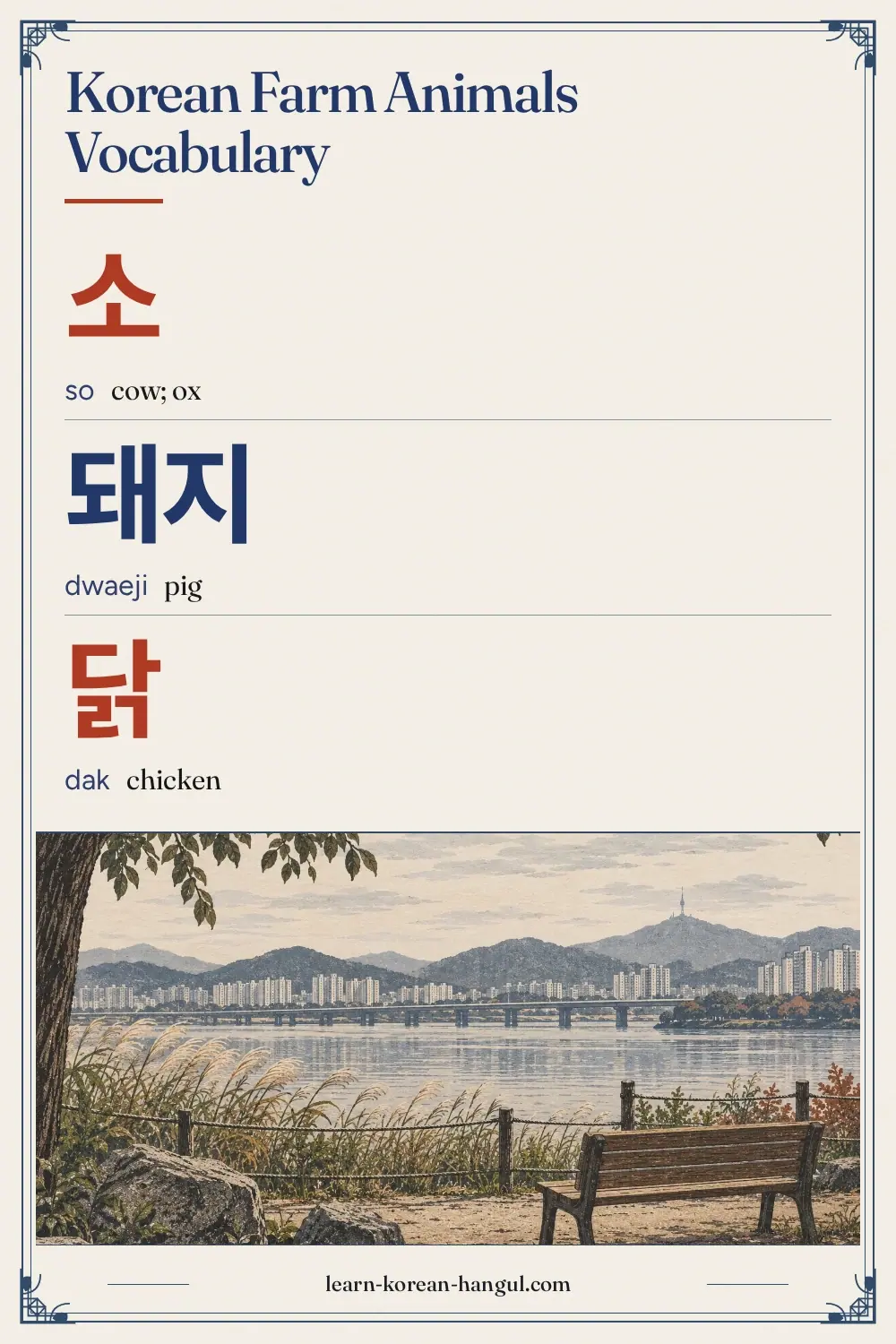
Korean Farm Animals Vocabulary at a Glance
Farm words are some of the first nouns in a child's picture book, and they stay useful for food, travel and the countryside. Most are short native words: 소, 말, 닭, 논, 밭. The places and people on the farm are mostly Sino-Korean: 농장 (farm), 축사 (animal shed), 농부 (farmer).
The list is arranged by what you see on a farm: the large animals first, then the smaller ones, then the birds, then the places, then the products.
The list holds 25 words: 16 native Korean, 8 Sino-Korean and 1 mixed. "Mixed" means a word that combines parts of different origins: 당나귀 joins Sino-Korean 당 (唐) and native 나귀 (donkey). Most animal names are native Korean, with two Sino-Korean exceptions, 양 (羊, sheep) and 한우 (韓牛, Korean cattle), while the places, the job and the products are Sino-Korean.
| Group | Words | Examples |
|---|---|---|
| Cattle and horses | 6 | 소, 한우, 젖소, 송아지 |
| Pigs and sheep | 5 | 돼지, 양, 염소, 당나귀 |
| Poultry | 6 | 닭, 수탉, 암탉, 병아리 |
| Farm places | 5 | 농장, 축사, 목장, 논 |
| Farm people and products | 3 | 농부, 우유, 계란 |
This page expands the farm animals group of Animals. The animals that live in the wild are on Korean Wild Animals Vocabulary.
Which Farm Animal Names Should You Learn First?
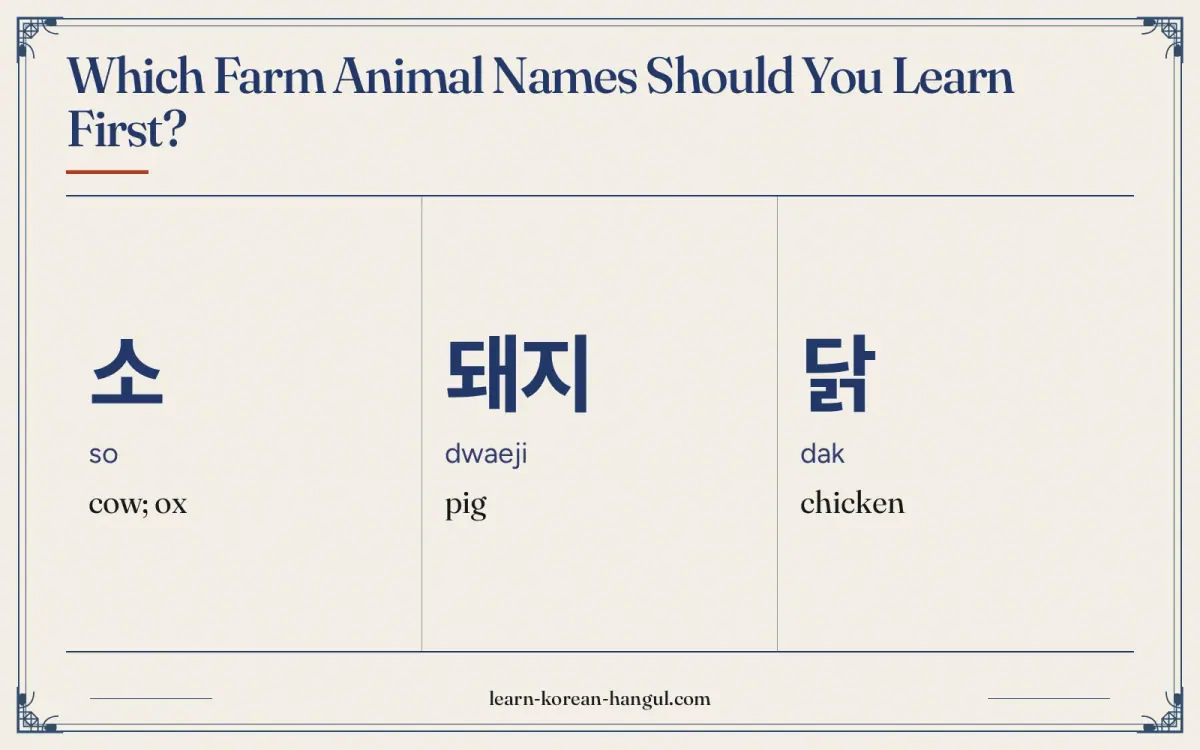
Start with five words that every farm picture shows: 소, 돼지, 닭, 말 and 농장. Use the scene to see eight words at once, then press play and the slow button on each of the five and say the word aloud.
Word · 8
- 1
소
so
cow; ox
- 2
돼지
dwaeji
pig
- 3
닭
dak
chicken
- 4
말
mal
horse
- 5
양
yang
sheep
- 6
오리
ori
duck
- 7
축사
chuksa
animal shed; barn
- 8
밭
bat
field; dry field
소 (so) means cow; ox. The same word covers cow, ox and bull. It is one syllable and is said with a round ㅗ vowel. Example: 소가 풀을 먹어요. (The cow eats grass.)
돼지 (dwaeji) means pig. The first syllable has the vowel ㅙ, said as wae. Example: 돼지가 진흙에서 놀아요. (The pig plays in the mud.)
닭 (dak) means chicken. Alone it is said [닥]. Before the subject marker 이, both final letters return: 닭이 is said [달기]. Example: 닭이 알을 낳아요. (The chicken lays an egg.)
말 (mal) means horse. It is spelled like 말 (speech), and the verb tells you which word is meant: 말을 타요 means to ride a horse. Example: 말을 타요. (I ride a horse.)
농장 (nongjang) means farm. Example: 할아버지가 농장에서 일해요. (My grandfather works at the farm.)
Cattle and Horses
Large animals come first. The group has six words, and they cover cows, calves and horses. The word 소 is very short, but it appears in many compounds.
| No. | Hangul | Revised Romanization | Meaning | Origin | Example sentence | Audio assetId |
|---|---|---|---|---|---|---|
| 1 | 소 | so | cow; ox | native | 소가 풀을 먹어요. (soga pureul meogeoyo; The cow eats grass.) | au-pg-vocabulary-nature-animals-farm-animals-1; example: au-pg-vocabulary-nature-animals-farm-animals-101 |
| 2 | 한우 | hanu | Korean beef cattle | Sino-Korean | 한우가 비싸요. (hanuga bissayo; Hanwoo beef is expensive.) | au-pg-vocabulary-nature-animals-farm-animals-2; example: au-pg-vocabulary-nature-animals-farm-animals-102 |
| 3 | 젖소 | jeotso | dairy cow | native | 젖소에서 우유가 나와요. (jeotsoeseo uyuga nawayo; Milk comes from dairy cows.) | au-pg-vocabulary-nature-animals-farm-animals-3; example: au-pg-vocabulary-nature-animals-farm-animals-103 |
| 4 | 송아지 | songaji | calf | native | 송아지가 엄마 소를 따라가요. (songajiga eomma soreul ttaragayo; The calf follows its mother cow.) | au-pg-vocabulary-nature-animals-farm-animals-4; example: au-pg-vocabulary-nature-animals-farm-animals-104 |
| 5 | 말 | mal | horse | native | 말을 타요. (mareul tayo; I ride a horse.) | au-pg-vocabulary-nature-animals-farm-animals-5; example: au-pg-vocabulary-nature-animals-farm-animals-105 |
| 6 | 망아지 | mangaji | foal | native | 망아지가 뛰어요. (mangajiga ttwieoyo; The foal runs.) | au-pg-vocabulary-nature-animals-farm-animals-6; example: au-pg-vocabulary-nature-animals-farm-animals-106 |
- 소 is the base of 젖소 (dairy cow), and 송아지 is its young. The words 송아지 and 망아지 name the young of the cow and the horse.
- 한우 is not only a breed: the word is also a food label, and you see it on meat in shops.
- 말을 타요 (I ride a horse) uses the verb 타다 (to ride). The same verb is used for bus, bicycle and train.
Example Sentences
Farm sentences use animal + 이/가 + verb. Use 이 after a consonant and 가 after a vowel: 소가 풀을 먹어요 (the cow eats grass) and 닭이 알을 낳아요 (the chicken lays an egg). For a place, add 에 or 에서: 축사에 소가 많아요 (there are many cows in the barn), and 목장에서 양을 키워요 (they raise sheep on the ranch). The verb 키우다 means to raise or keep an animal or a plant.
How Do You Say Pigs and Sheep in Korean?
Smaller animals follow the large ones. The group has five words, and the pig and the sheep are the best known. The last word, 새끼, is a general word for the young of any animal.
| No. | Hangul | Revised Romanization | Meaning | Origin | Example sentence | Audio assetId |
|---|---|---|---|---|---|---|
| 7 | 돼지 | dwaeji | pig | native | 돼지가 진흙에서 놀아요. (dwaejiga jinheulgeseo norayo; The pig plays in the mud.) | au-pg-vocabulary-nature-animals-farm-animals-7; example: au-pg-vocabulary-nature-animals-farm-animals-107 |
| 8 | 양 | yang | sheep | Sino-Korean | 양이 하얘요. (yangi hayaeyo; The sheep is white.) | au-pg-vocabulary-nature-animals-farm-animals-8; example: au-pg-vocabulary-nature-animals-farm-animals-108 |
| 9 | 염소 | yeomso | goat | native | 염소가 울타리 안에 있어요. (yeomsoga ultari ane isseoyo; The goat is inside the fence.) | au-pg-vocabulary-nature-animals-farm-animals-9; example: au-pg-vocabulary-nature-animals-farm-animals-109 |
| 10 | 당나귀 | dangnagwi | donkey | mixed | 당나귀는 귀가 길어요. (dangnagwineun gwiga gireoyo; Donkeys have long ears.) | au-pg-vocabulary-nature-animals-farm-animals-10; example: au-pg-vocabulary-nature-animals-farm-animals-110 |
| 11 | 새끼 | saekki | young animal; offspring | native | 소가 새끼를 낳았어요. (soga saekkireul naasseoyo; The cow gave birth to a calf.) | au-pg-vocabulary-nature-animals-farm-animals-11; example: au-pg-vocabulary-nature-animals-farm-animals-111 |
- 새끼 is neutral for animals but offensive when used for a person, so avoid it outside the farm context.
Poultry
Poultry words are short. The group has six words. 수탉 and 암탉 are 닭 (chicken) with 수 (male) or 암 (female) in front. These prefixes once ended in an ㅎ sound, which still turns the ㄷ of 닭 into ㅌ: 수 + 닭 = 수탉.
| No. | Hangul | Revised Romanization | Meaning | Origin | Example sentence | Audio assetId |
|---|---|---|---|---|---|---|
| 12 | 닭 | dak | chicken | native | 닭이 알을 낳아요. (dalgi areul naayo; The chicken lays an egg.) | au-pg-vocabulary-nature-animals-farm-animals-12; example: au-pg-vocabulary-nature-animals-farm-animals-112 |
| 13 | 수탉 | sutak | rooster | native | 수탉이 아침에 울어요. (sutalgi achime ureoyo; The rooster crows in the morning.) | au-pg-vocabulary-nature-animals-farm-animals-13; example: au-pg-vocabulary-nature-animals-farm-animals-113 |
| 14 | 암탉 | amtak | hen | native | 암탉이 알을 품어요. (amtalgi areul pumeoyo; The hen sits on its eggs.) | au-pg-vocabulary-nature-animals-farm-animals-14; example: au-pg-vocabulary-nature-animals-farm-animals-114 |
| 15 | 병아리 | byeongari | chick | native | 병아리가 삐약삐약 울어요. (byeongariga ppiyakppiyak ureoyo; The chick cheeps.) | au-pg-vocabulary-nature-animals-farm-animals-15; example: au-pg-vocabulary-nature-animals-farm-animals-115 |
| 16 | 오리 | ori | duck | native | 오리는 물을 좋아해요. (orineun mureul joahaeyo; Ducks like water.) | au-pg-vocabulary-nature-animals-farm-animals-16; example: au-pg-vocabulary-nature-animals-farm-animals-116 |
| 17 | 거위 | geowi | goose | native | 거위가 시끄러워요. (geowiga sikkeureowoyo; Geese are noisy.) | au-pg-vocabulary-nature-animals-farm-animals-17; example: au-pg-vocabulary-nature-animals-farm-animals-117 |
- 닭 has two final letters, ㄹ and ㄱ. Alone, only ㄱ is heard.
- 수탉 and 암탉 show a pattern: 수 means male and 암 means female, and the same two prefixes give 수컷 (a male animal) and 암컷 (a female animal).
- 병아리 is the chick, and the sentence uses the sound word 삐약삐약, which is how Korean writes the chick's cheep.
How Do You Say Farm Places in Korean?
Farm places matter when you read about the countryside. The group has five words. Two of them, 논 and 밭, are native words that name the two main kinds of farm land: 논 for rice and 밭 for other crops.
| No. | Hangul | Revised Romanization | Meaning | Origin | Example sentence | Audio assetId |
|---|---|---|---|---|---|---|
| 18 | 농장 | nongjang | farm | Sino-Korean | 할아버지가 농장에서 일해요. (harabeojiga nongjangeseo ilhaeyo; My grandfather works at the farm.) | au-pg-vocabulary-nature-animals-farm-animals-18; example: au-pg-vocabulary-nature-animals-farm-animals-118 |
| 19 | 축사 | chuksa | animal shed; barn | Sino-Korean | 축사에 소가 많아요. (chuksae soga manayo; There are many cows in the barn.) | au-pg-vocabulary-nature-animals-farm-animals-19; example: au-pg-vocabulary-nature-animals-farm-animals-119 |
| 20 | 목장 | mokjang | ranch; pasture | Sino-Korean | 목장에서 양을 키워요. (mokjangeseo yangeul kiwoyo; They raise sheep on the ranch.) | au-pg-vocabulary-nature-animals-farm-animals-20; example: au-pg-vocabulary-nature-animals-farm-animals-120 |
| 21 | 논 | non | rice paddy | native | 논에 물을 대요. (none mureul daeyo; They irrigate the rice paddy.) | au-pg-vocabulary-nature-animals-farm-animals-21; example: au-pg-vocabulary-nature-animals-farm-animals-121 |
| 22 | 밭 | bat | field; dry field | native | 밭에서 채소를 키워요. (bateseo chaesoreul kiwoyo; They grow vegetables in the field.) | au-pg-vocabulary-nature-animals-farm-animals-22; example: au-pg-vocabulary-nature-animals-farm-animals-122 |
- 논 is wet land, used for rice. 밭 is dry land, used for vegetables, beans and other crops.
- 농장 and 목장 both mean a farm, but 목장 is where animals graze, while 농장 is a general farm.
- 축사 is the building where animals stay, from 축 (livestock) and 사 (building).
Farm People and Products
The last group has three words: the person who works on a farm and the two foods most people link with farm animals. All three are Sino-Korean, and 우유 and 계란 are on every supermarket shelf.
| No. | Hangul | Revised Romanization | Meaning | Origin | Example sentence | Audio assetId |
|---|---|---|---|---|---|---|
| 23 | 농부 | nongbu | farmer | Sino-Korean | 농부가 아침 일찍 일어나요. (nongbuga achim iljjik ireonayo; The farmer gets up early in the morning.) | au-pg-vocabulary-nature-animals-farm-animals-23; example: au-pg-vocabulary-nature-animals-farm-animals-123 |
| 24 | 우유 | uyu | milk | Sino-Korean | 아침에 우유를 마셔요. (achime uyureul masyeoyo; I drink milk in the morning.) | au-pg-vocabulary-nature-animals-farm-animals-24; example: au-pg-vocabulary-nature-animals-farm-animals-124 |
| 25 | 계란 | gyeran | egg | Sino-Korean | 계란을 삶아요. (gyeraneul salmayo; I boil eggs.) | au-pg-vocabulary-nature-animals-farm-animals-25; example: au-pg-vocabulary-nature-animals-farm-animals-125 |
- 우유 joins 우 (cow) and 유 (milk). The same 우 is in 한우.
- 계란 and 달걀 both mean egg. 계란 is more common in shops and recipes, and 달걀 is the native word.
Animal Products and Meat Words
Farm animals give food, and the food words are built from the animal words. A few are on this page, and the rest are easy to guess.
| Animal | Meat word | Revised Romanization | Meaning |
|---|---|---|---|
| 소 | 소고기 | sogogi | beef |
| 돼지 | 돼지고기 | dwaejigogi | pork |
| 닭 | 닭고기 | dakgogi | chicken meat |
The pattern is simple: animal + 고기 (meat). The last row shows how 닭 changes in the middle of a word: 닭고기 is said [닥꼬기], where the ㄹ is silent and the ㄱ of 고기 becomes tense. Revised Romanization writes it dakgogi and does not mark the tense sound. Milk and eggs have their own words, 우유 and 계란, and both are in the list above. Beef has two standard words, 소고기 and 쇠고기; 소고기 is the more common one today.
The animal and the meat are different in one more way: you buy 소고기 at the shop, but you count 소 as animals with 마리. Cows on a farm: 소가 열 마리 있어요 (there are ten cows).
Counting Farm Animals with 마리
Farm animals are counted with the counter 마리. Use native numbers: 한 마리, 두 마리, 세 마리, 네 마리, 다섯 마리. The pattern is animal + 이/가 + number + 마리 + 있어요.
- 소가 세 마리 있어요. (soga se mari isseoyo; There are three cows.)
- 닭이 열 마리 있어요. (dalgi yeol mari isseoyo; There are ten chickens.)
- 말이 두 마리 있어요. (mari du mari isseoyo; There are two horses.)
The numbers one to four shorten before a counter: 한, 두, 세, 네. People take a different counter, 명: 농부 세 명 (three farmers). The full lesson on counters for animals covers all the number forms.
Farm Animal Sounds
Each farm animal has a sound word. The sound word is written in Hangul as a copy of the sound, and it is often doubled. Learning them together with the animal makes both easier to remember.
| Sound word | Revised Romanization | Animal and sound | Audio assetId |
|---|---|---|---|
| 음메 | eumme | cow mooing | au-pg-vocabulary-nature-animals-farm-animals-601 |
| 꿀꿀 | kkulkkul | pig oinking | au-pg-vocabulary-nature-animals-farm-animals-602 |
| 꼬끼오 | kkokkio | rooster crowing | au-pg-vocabulary-nature-animals-farm-animals-603 |
| 꼬꼬댁 | kkokkodaek | hen clucking | au-pg-vocabulary-nature-animals-farm-animals-604 |
| 삐약삐약 | ppiyakppiyak | chick cheeping | au-pg-vocabulary-nature-animals-farm-animals-605 |
| 꽥꽥 | kkwaekkwaek | duck quacking | au-pg-vocabulary-nature-animals-farm-animals-606 |
| 히힝 | hihing | horse neighing | au-pg-vocabulary-nature-animals-farm-animals-607 |
| 메에 | mee | sheep or goat bleating | au-pg-vocabulary-nature-animals-farm-animals-608 |
More animal voices are on the animal sounds page.
How Do You Pronounce These Words?
Farm words have a few final-consonant changes. The table lists five words, following the Standard Pronunciation rules (표준 발음법) of the 국립국어원.
| Word | Romanization | Said | Rule |
|---|---|---|---|
| 닭 | dak | [닥] | the two final letters ㄹㄱ are reduced to one sound ㄱ at the end of a word |
| 돼지 | dwaeji | [돼지] | the vowel ㅙ is said as one glide, wae |
| 밭 | bat | [받] | the final ㅌ is said as [ㄷ] when nothing follows |
| 암탉 | amtak | [암탁] | the two final letters of 탉 are reduced to ㄱ at the end of the word |
| 축사 | chuksa | [축싸] | ㅅ after final ㄱ is said tense |
Revised Romanization is the official romanization system of South Korea, announced on 7 July 2000. It follows most sound changes, such as linking and nasalization, and it spells the written double letters (ㄲ as kk), but it does not show tensing caused by a neighbouring sound: 축사 is said [축싸] but written chuksa. It is a learning aid, so always read the Hangul as well.
Audio and Slow Playback
Each headword and each example sentence has its own audio clip, and the five words in the learn-first section also have a slow clip at 0.8 times the speed. Nothing plays until you press a button. Listen once, repeat aloud, and only then check the romanization.
What Mistakes Do Learners Make with Farm Animal Names?
- Mixing up 소 (cow) with the Sino-Korean prefix 소- (small), as in 소형 (small size). The animal stands alone as a noun: 소가 풀을 먹어요.
- Confusing 말 (horse) with 말 (speech). Say 말을 타요 for riding and 말을 해요 for speaking.
- Saying both final letters of 닭 (dalk). Alone it is [닥], and with 이 it is [달기].
- Using 새끼 for a person. It is a rude word when used for people, so keep it for animals.
- Using 명 to count animals. People use 명, and animals use 마리.
- Reading the romanization instead of the sounds. Words such as 축사 contain a tense sound, but Revised Romanization shows only chuksa.
Practice: Flashcards and Worksheet
Drill these 25 words with the vocabulary flashcard decks: each card shows the Hangul on one side and the meaning on the other, so you can test recall instead of recognition. Print a labelling sheet from the vocabulary worksheets and write the Korean word for each numbered object in the scene above. A simple plan is to learn five words a day, one group at a time.
Korean Farm Animals Worksheet
Try this five-question check, then say the words aloud once more.
Practice · 5
What does 소 mean?
Show answer
cow; ox
소 (so) means cow; ox.
What does 망아지 mean?
Show answer
foal
망아지 (mangaji) means foal.
What does 새끼 mean?
Show answer
young animal; offspring
새끼 (saekki) means young animal; offspring.
What does 오리 mean?
Show answer
duck
오리 (ori) means duck.
What does 논 mean?
Show answer
rice paddy
논 (non) means rice paddy.
Self-Test: 10 Sentences
Fill each blank with a word from this page. Say the whole sentence aloud when you have it. The answers follow the test.
- ___가 비싸요. (Hanwoo beef is expensive.)
- ___에서 우유가 나와요. (Milk comes from dairy cows.)
- ___가 뛰어요. (The foal runs.)
- ___가 울타리 안에 있어요. (The goat is inside the fence.)
- 소가 ___를 낳았어요. (The cow gave birth to a calf.)
- ___이 알을 품어요. (The hen sits on its eggs.)
- ___는 물을 좋아해요. (Ducks like water.)
- 할아버지가 ___에서 일해요. (My grandfather works at the farm.)
- ___에서 양을 키워요. (They raise sheep on the ranch.)
- 아침에 ___를 마셔요. (I drink milk in the morning.)
Answers: 1. 한우; 2. 젖소; 3. 망아지; 4. 염소; 5. 새끼; 6. 암탉; 7. 오리; 8. 농장; 9. 목장; 10. 우유.
A score of 8 or more suggests the words are settling in. If you scored lower, reread the groups where you missed words.
Where to Go Next
After farm animals, many learners move on to Korean Wild Animals Vocabulary. This list sits inside Animals.
Related pages:
- cow in korean: a single-word entry with pronunciation notes, usage and more example sentences.
- pig in korean: a single-word entry with pronunciation notes, usage and more example sentences.
- chicken in korean: a single-word entry with pronunciation notes, usage and more example sentences.
Frequently Asked Questions
How Do You Say Cow in Korean?
Say 소 (so). It is one syllable, with a round ㅗ vowel. The same word covers cow, ox and bull, and a dairy cow is 젖소. For a full word entry, see cow in korean.
How Do You Pronounce 돼지 (dwaeji)?
Say dwae-ji. The first syllable starts with ㄷ and glides through the vowel ㅙ, which sounds like the English "way" with a d in front. The second syllable is a plain ji. For a full word entry, see pig in korean.
How Many Farm Animal Names Should I Learn First?
Learn the five starter words, 소, 돼지, 닭, 말 and 농장, then add one group at a time. Five new words a day with a short review of the older ones is a steady pace, and the full list takes about five days. Count the animals with 마리 as you go: 닭 세 마리 (three chickens).
Where Can I Practise Farm Animal Names with Flashcards?
Use the vocabulary flashcard decks. Start with the animals, then add the farm places. Review the older cards before you add new ones, so the earlier words do not fade.
Is the Romanization on This Page Official?
Yes, as a learning aid. It follows the Revised Romanization of Korean, the system South Korea has officially used since 7 July 2000, and the page also gives the Hangul for every word. It follows most sound changes but does not show tensing: 축사 is written chuksa but is said [축싸]. Treat the Hangul as the real spelling.
Is There a Printable Worksheet for Farm Animal Names?
The vocabulary worksheets page lists the printable sheets. The sheet for this topic is a labelling task built on the same illustrated scene as this page, so you write the Korean word next to each numbered object.