Korean Bus and Taxi Vocabulary at a Glance
The list has 35 words in five groups of seven. It follows the road: a bus and its stop, paying the fare, taking a taxi, using a ride app and travelling between cities. It belongs to Transportation. Most words are nouns, and a few are loanwords you can already half-guess, such as 버스 and 택시.
| Group | Words | Use |
|---|---|---|
| Bus types and stops | 7 | Kinds of bus, the stop and the route |
| Fares and cards | 7 | Paying with a card and getting off |
| Taxi vocabulary | 7 | Meter, fare, surcharge and the driver |
| Ride apps | 7 | Words on a taxi app screen |
| Terminal and long-distance | 7 | Intercity buses and tickets |
For a single word with a full entry, see bus in Korean, taxi in Korean, bus stop in Korean or transit card in Korean. This page is the themed list that puts them together.
Which Bus and Taxi Words Should You Learn First?
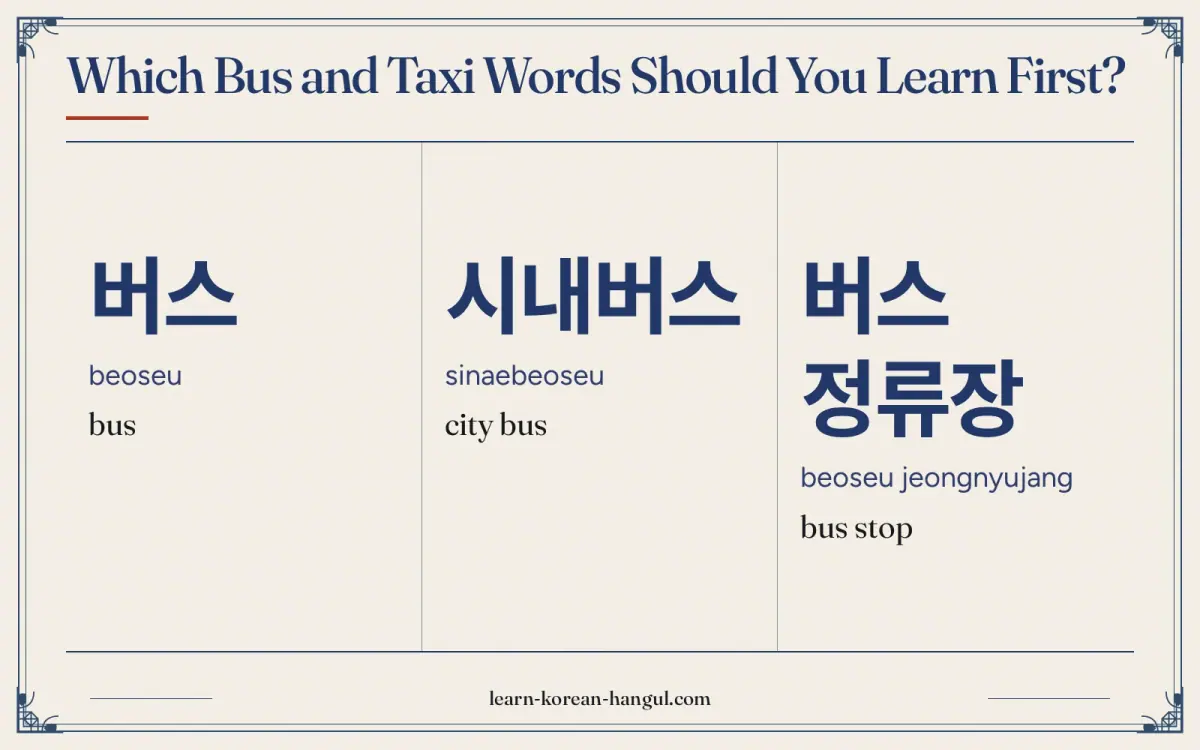
Start with 버스 (bus), 택시 (taxi), 정류장 (stop), 요금 (fare) and 기사님 (driver). They let you board, pay and talk to the driver. If you carry a card, add 교통카드 and the verb 타다 (ride), whose polite form is 타요.
- Words to say. 버스, 택시, 요금, 기사님, 영수증.
- Words to recognise. 단말기, 하차, 배차, 도착 예정. They appear on screens and readers.
- Words for long trips. 터미널, 승차권, 좌석, 휴게소.
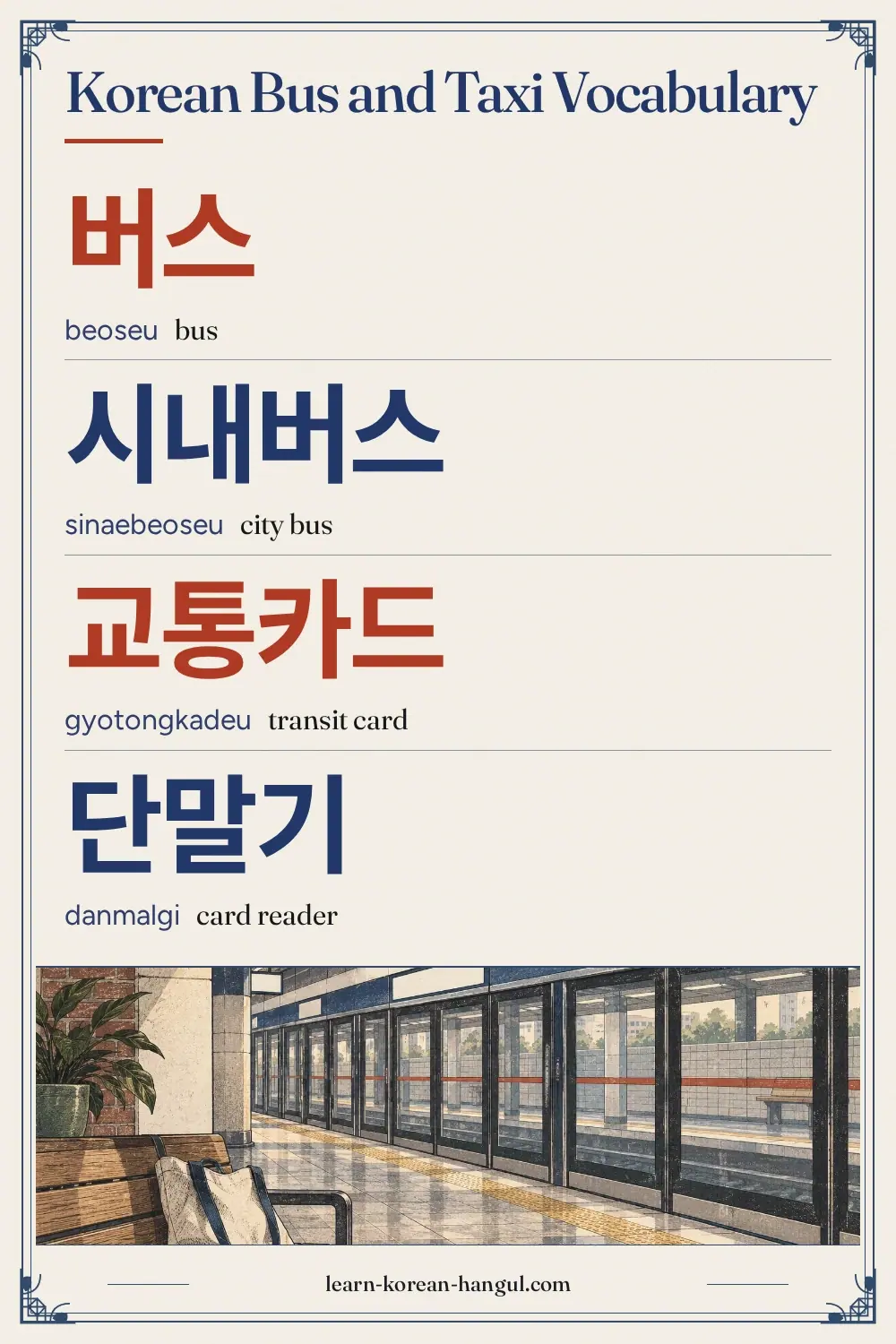
For spoken requests to a driver, such as asking to stop at a corner, see the taxi and transport phrases. The scene below numbers ten objects from the word list.
Word · 10
- 1
버스
beoseu
bus
- 2
시내버스
sinaebeoseu
city bus
- 3
버스 정류장
beoseu jeongnyujang
bus stop
- 4
교통카드
gyotongkadeu
transit card
- 5
단말기
danmalgi
card reader
- 6
미터기
miteogi
taxi meter
- 7
영수증
yeongsujeung
receipt
- 8
호출
hochul
calling (a car)
- 9
앱
aep
app
- 10
고속버스
gosokbeoseu
express bus
Bus Types and Stops
Korean has a separate name for each kind of bus, and every name tells you how far the bus goes. A 시내버스 stays inside a city, a 마을버스 runs small loops through neighbourhoods, and a 공항버스 links the airport to the city. Add the stop and the route and you can plan a journey.
| No. | Hangul | Revised Romanization | Meaning and note | Example sentence | Audio assetId |
|---|---|---|---|---|---|
| 1 | 버스 | beoseu | bus. Loanword; the general word. | 버스를 타요. (I ride the bus.) | au-pg-vocabulary-places-transportation-bus-taxi-1; example: au-pg-vocabulary-places-transportation-bus-taxi-36 |
| 2 | 시내버스 | sinaebeoseu | city bus. 시내 means downtown or inside the city. | 시내버스가 자주 와요. (City buses come often.) | au-pg-vocabulary-places-transportation-bus-taxi-2; example: au-pg-vocabulary-places-transportation-bus-taxi-37 |
| 3 | 마을버스 | maeulbeoseu | local minibus. 마을 is a village or neighbourhood. | 마을버스는 작아요. (The local minibus is small.) | au-pg-vocabulary-places-transportation-bus-taxi-3; example: au-pg-vocabulary-places-transportation-bus-taxi-38 |
| 4 | 공항버스 | gonghangbeoseu | airport bus. 공항 is airport. | 공항버스를 기다려요. (I wait for the airport bus.) | au-pg-vocabulary-places-transportation-bus-taxi-4; example: au-pg-vocabulary-places-transportation-bus-taxi-39 |
| 5 | 심야버스 | simyabeoseu | late-night bus. 심야 is the dead of night. | 심야버스는 밤에 다녀요. (The late-night bus runs at night.) | au-pg-vocabulary-places-transportation-bus-taxi-5; example: au-pg-vocabulary-places-transportation-bus-taxi-40 |
| 6 | 버스 정류장 | beoseu jeongnyujang | bus stop. Often shortened to 정류장; said [정뉴장]. | 버스 정류장이 어디예요? (Where is the bus stop?) | au-pg-vocabulary-places-transportation-bus-taxi-6; example: au-pg-vocabulary-places-transportation-bus-taxi-41 |
| 7 | 노선 | noseon | route. Printed on the bus and at the stop. | 노선을 확인해요. (I check the route.) | au-pg-vocabulary-places-transportation-bus-taxi-7; example: au-pg-vocabulary-places-transportation-bus-taxi-42 |
Bus numbers use the counter 번. To ask which bus, say 몇 번 버스예요? (Which number bus is it?), and to answer, give a number plus 번, as in 오백 번 버스. Subway lines use 호선 instead. The verb 다니다 in the late-night sentence means to run regularly along a route, and it becomes 다녀요.
How Do You Say Fares and Cards in Korean?
On a Korean bus you tap a card on the way in and tap again on the way out, and the reader works out the fare. The nouns below name the card, the money and the reader. They also cover the last action of every bus ride: getting off and pressing the stop button.
| No. | Hangul | Revised Romanization | Meaning and note | Example sentence | Audio assetId |
|---|---|---|---|---|---|
| 8 | 교통카드 | gyotongkadeu | transit card. Works on buses and subways. | 버스에서 교통카드를 써요. (I use a transit card on the bus.) | au-pg-vocabulary-places-transportation-bus-taxi-8; example: au-pg-vocabulary-places-transportation-bus-taxi-43 |
| 9 | 요금 | yogeum | fare. Shown on the reader. | 요금이 얼마예요? (How much is the fare?) | au-pg-vocabulary-places-transportation-bus-taxi-9; example: au-pg-vocabulary-places-transportation-bus-taxi-44 |
| 10 | 현금 | hyeongeum | cash. Not every bus takes it. | 현금으로 내요. (I pay with cash.) | au-pg-vocabulary-places-transportation-bus-taxi-10; example: au-pg-vocabulary-places-transportation-bus-taxi-45 |
| 11 | 잔돈 | jandon | small change. Coins and small notes. | 잔돈이 없어요. (I have no change.) | au-pg-vocabulary-places-transportation-bus-taxi-11; example: au-pg-vocabulary-places-transportation-bus-taxi-46 |
| 12 | 단말기 | danmalgi | card reader. The device you tap. | 단말기에 카드를 대요. (I touch the card to the reader.) | au-pg-vocabulary-places-transportation-bus-taxi-12; example: au-pg-vocabulary-places-transportation-bus-taxi-47 |
| 13 | 환승 할인 | hwanseung harin | transfer discount. Applies when you tap again within the time limit. | 환승 할인을 받아요. (I get a transfer discount.) | au-pg-vocabulary-places-transportation-bus-taxi-13; example: au-pg-vocabulary-places-transportation-bus-taxi-48 |
| 14 | 하차 | hacha | getting off. Printed beside the stop button. | 하차 벨을 눌러요. (I press the stop bell.) | au-pg-vocabulary-places-transportation-bus-taxi-14; example: au-pg-vocabulary-places-transportation-bus-taxi-49 |
Two verbs carry these sentences. 대다 (touch against) gives 대요, and 누르다 (press) gives 눌러요, a 르 verb whose stem gains an extra ㄹ. The opposite of 하차 is 승차, getting on. You will see 승차 and 하차 printed on readers inside a bus, so recognise both even if you say 타요 and 내려요 in speech.
Taxi Vocabulary
Taxis are a common choice for visitors in Korean cities, and the vocabulary is short. The key social point is how to address the driver. Koreans say 기사님, which adds the respectful 님 to the word for driver. Calling out 아저씨 works in speech but sounds less polite.
| No. | Hangul | Revised Romanization | Meaning and note | Example sentence | Audio assetId |
|---|---|---|---|---|---|
| 15 | 택시 | taeksi | taxi. Loanword. | 택시를 불러요. (I call a taxi.) | au-pg-vocabulary-places-transportation-bus-taxi-15; example: au-pg-vocabulary-places-transportation-bus-taxi-50 |
| 16 | 택시 승강장 | taeksi seunggangjang | taxi stand. Found outside stations. | 택시 승강장은 역 앞에 있어요. (The taxi stand is in front of the station.) | au-pg-vocabulary-places-transportation-bus-taxi-16; example: au-pg-vocabulary-places-transportation-bus-taxi-51 |
| 17 | 기본요금 | gibonnyogeum | base fare. Said [기본뇨금]. | 기본요금이 얼마예요? (How much is the base fare?) | au-pg-vocabulary-places-transportation-bus-taxi-17; example: au-pg-vocabulary-places-transportation-bus-taxi-52 |
| 18 | 미터기 | miteogi | taxi meter. 미터 is from meter. | 기사님이 미터기를 켜요. (The driver turns on the meter.) | au-pg-vocabulary-places-transportation-bus-taxi-18; example: au-pg-vocabulary-places-transportation-bus-taxi-53 |
| 19 | 영수증 | yeongsujeung | receipt. Ask for one with 주세요. | 영수증 주세요. (A receipt, please.) | au-pg-vocabulary-places-transportation-bus-taxi-19; example: au-pg-vocabulary-places-transportation-bus-taxi-54 |
| 20 | 할증 | haljeung | surcharge. Said [할쯩]. Added late at night. | 밤에는 할증이 있어요. (There is a surcharge at night.) | au-pg-vocabulary-places-transportation-bus-taxi-20; example: au-pg-vocabulary-places-transportation-bus-taxi-55 |
| 21 | 기사님 | gisanim | driver (polite). 님 is a respectful suffix. | 기사님께 물어봐요. (I ask the driver.) | au-pg-vocabulary-places-transportation-bus-taxi-21; example: au-pg-vocabulary-places-transportation-bus-taxi-56 |
The sentence 영수증 주세요 shows the simplest request pattern: noun + 주세요 means please give me this. It needs no verb conjugation. In the driver sentence, 께 is the respectful form of the particle 에게 (to a person), which suits 기사님. The verb 켜다 (switch on) gives 켜요.
How Do You Say Ride Apps in Korean?
Many people in Korean cities call a taxi from an app rather than hailing one on the street, and the app screens use a small set of fixed words. They tell you where you start, where you end, how long the car will take and how to cancel. These seven words are the ones you see on a ride app screen.
| No. | Hangul | Revised Romanization | Meaning and note | Example sentence | Audio assetId |
|---|---|---|---|---|---|
| 22 | 호출 | hochul | calling (a car). The button for requesting a ride. | 앱으로 택시를 호출해요. (I call a taxi with the app.) | au-pg-vocabulary-places-transportation-bus-taxi-22; example: au-pg-vocabulary-places-transportation-bus-taxi-57 |
| 23 | 배차 | baecha | car assignment. The step when a driver accepts. | 배차가 안 돼요. (No car is being assigned.) | au-pg-vocabulary-places-transportation-bus-taxi-23; example: au-pg-vocabulary-places-transportation-bus-taxi-58 |
| 24 | 도착 예정 | dochak yejeong | expected arrival. 예정 means planned. | 도착 예정 시간은 오 분 후예요. (The car is expected in five minutes.) | au-pg-vocabulary-places-transportation-bus-taxi-24; example: au-pg-vocabulary-places-transportation-bus-taxi-59 |
| 25 | 앱 | aep | app. Short for 애플리케이션. | 앱을 열어요. (I open the app.) | au-pg-vocabulary-places-transportation-bus-taxi-25; example: au-pg-vocabulary-places-transportation-bus-taxi-60 |
| 26 | 출발지 | chulbalji | pickup point. Said [출발찌]. | 출발지를 확인해요. (I check the pickup point.) | au-pg-vocabulary-places-transportation-bus-taxi-26; example: au-pg-vocabulary-places-transportation-bus-taxi-61 |
| 27 | 목적지 | mokjeokji | destination. Said [목쩍찌]. | 목적지를 입력해요. (I enter the destination.) | au-pg-vocabulary-places-transportation-bus-taxi-27; example: au-pg-vocabulary-places-transportation-bus-taxi-62 |
| 28 | 취소 | chwiso | cancellation. Add 하다 to cancel. | 호출을 취소해요. (I cancel the call.) | au-pg-vocabulary-places-transportation-bus-taxi-28; example: au-pg-vocabulary-places-transportation-bus-taxi-63 |
The pair 출발지 and 목적지 follows the same pattern: 지 (place) after a word for leaving or aiming. You will see it again in 도착지 (arrival place). Note the tense sound in both: after the final ㄹ of 출발 and the final ㄱ of 목적, the ㅈ of 지 is said as a tense [ㅉ].
Terminal and Long-Distance
Intercity buses run from big terminals, not from kerbside stops. You buy a ticket, find your seat and take the road through a service stop on the way. A 고속버스 is an express bus on highways, and a 시외버스 serves towns outside the city. The distinction matters when you buy a ticket, because in many cities the two leave from different terminals or sell tickets at different counters.
| No. | Hangul | Revised Romanization | Meaning and note | Example sentence | Audio assetId |
|---|---|---|---|---|---|
| 29 | 고속버스 | gosokbeoseu | express bus. 고속 is high speed. | 고속버스로 부산에 가요. (I go to Busan by express bus.) | au-pg-vocabulary-places-transportation-bus-taxi-29; example: au-pg-vocabulary-places-transportation-bus-taxi-64 |
| 30 | 시외버스 | sioebeoseu | intercity bus. 시외 is outside the city. | 시외버스는 터미널에서 타요. (I take the intercity bus at the terminal.) | au-pg-vocabulary-places-transportation-bus-taxi-30; example: au-pg-vocabulary-places-transportation-bus-taxi-65 |
| 31 | 터미널 | teomineol | bus terminal. Loanword. | 터미널에서 표를 사요. (I buy a ticket at the terminal.) | au-pg-vocabulary-places-transportation-bus-taxi-31; example: au-pg-vocabulary-places-transportation-bus-taxi-66 |
| 32 | 매표소 | maepyoso | ticket office. 표 is ticket; 소 is place. | 매표소가 저기 있어요. (The ticket office is over there.) | au-pg-vocabulary-places-transportation-bus-taxi-32; example: au-pg-vocabulary-places-transportation-bus-taxi-67 |
| 33 | 승차권 | seungchagwon | ride ticket. Said [승차꿘]. | 승차권을 확인해요. (I check the ticket.) | au-pg-vocabulary-places-transportation-bus-taxi-33; example: au-pg-vocabulary-places-transportation-bus-taxi-68 |
| 34 | 좌석 | jwaseok | seat. Intercity tickets show a seat number. | 좌석이 넓어요. (The seat is wide.) | au-pg-vocabulary-places-transportation-bus-taxi-34; example: au-pg-vocabulary-places-transportation-bus-taxi-69 |
| 35 | 휴게소 | hyugeso | highway rest stop. Long routes stop at one. | 휴게소에서 쉬어요. (I rest at the rest stop.) | au-pg-vocabulary-places-transportation-bus-taxi-35; example: au-pg-vocabulary-places-transportation-bus-taxi-70 |
The suffix 소 (place) appears in 매표소 and 휴게소, and 석 (seat) ends 좌석. On the day of travel the quickest check is the line printed on the ticket: 승차권 shows the departure time, the seat and the platform number. 넓다 (to be wide) makes 넓어요, regular, and 쉬다 (to rest) makes 쉬어요.
How Do You Pronounce Korean Bus and Taxi Words?
Bus and taxi words show tensing and nasal sounds, the two changes most likely to surprise you. A plain ㅈ or ㄱ can become tense after certain final sounds, a ㄴ is added in some compounds, and ㄹ can be said as ㄴ. Standard pronunciation follows the National Institute of Korean Language (국립국어원) rules. Revised Romanization shows some of these changes and ignores others.
| Spelling | Sounds like | What changes |
|---|---|---|
| 정류장 | [정뉴장] | ㄹ after ㅇ is said as ㄴ. |
| 기본요금 | [기본뇨금] | ㄴ is added before 요. |
| 출발지 | [출발찌] | After the final ㄹ, the ㅈ of 지 is said as tense ㅉ. |
| 목적지 | [목쩍찌] | After the final ㄱ of 목, the ㅈ of 적 is tense; after the final ㄱ of 적, the ㅈ of 지 is tense too. |
| 승차권 | [승차꿘] | The ㄱ of 권 is said as tense ㄲ. |
Audio and Slow Playback
Each word and example has its own clip, and the five below replay the hardest words slowly. Play a clip, say the word aloud, then compare the tense consonants in your version with the clip.
What Mistakes Do Learners Make with Bus and Taxi Words?
Five slips are common on Korean roads.
- Calling the driver 아저씨. It is not rude on its own, but 기사님 is the safe polite choice for a bus or taxi driver.
- Using 호선 for buses. Subway lines take 호선, and buses take 번, so 2호선 is a subway line and 이백 번 버스 is a bus.
- Leaving out 번 after a bus number. 백 버스 is incomplete. Say 백 번 버스, with the counter between the number and the word for bus.
- Saying 택시를 타요 for hailing. 타요 means ride, not call. To call a taxi use 택시를 불러요, or 호출해요 on an app.
- Confusing 터미널 and 정류장. A 정류장 is a roadside stop, and a 터미널 is a large station where intercity lines start. Intercity tickets (승차권) are sold at terminals or online, not at roadside stops.
Keep the pairs together: 승차 with 하차, 호선 with 번, and 터미널 with 정류장.
Practice: Flashcards and Worksheet
Study in three steps. First, work through the deck in recognition mode until the 35 words feel familiar. Second, switch to listening mode and play the clip before you flip each card. Third, take the five-question quiz. Your deck progress stays in your browser, and the vocabulary flashcard decks page lists the other decks.
Practice · 75
- 01버스
Show answer
headword 1: bus
- 02시내버스
Show answer
headword 2: city bus
- 03마을버스
Show answer
headword 3: local minibus
- 04공항버스
Show answer
headword 4: airport bus
- 05심야버스
Show answer
headword 5: late-night bus
- 06버스 정류장
Show answer
headword 6: bus stop
- 07노선
Show answer
headword 7: route
- 08교통카드
Show answer
headword 8: transit card
- 09요금
Show answer
headword 9: fare
- 10현금
Show answer
headword 10: cash
- 11잔돈
Show answer
headword 11: small change
- 12단말기
Show answer
headword 12: card reader
- 13환승 할인
Show answer
headword 13: transfer discount
- 14하차
Show answer
headword 14: getting off
- 15택시
Show answer
headword 15: taxi
- 16택시 승강장
Show answer
headword 16: taxi stand
- 17기본요금
Show answer
headword 17: base fare
- 18미터기
Show answer
headword 18: taxi meter
- 19영수증
Show answer
headword 19: receipt
- 20할증
Show answer
headword 20: surcharge
- 21기사님
Show answer
headword 21: driver (polite)
- 22호출
Show answer
headword 22: calling (a car)
- 23배차
Show answer
headword 23: car assignment
- 24도착 예정
Show answer
headword 24: expected arrival
- 25앱
Show answer
headword 25: app
- 26출발지
Show answer
headword 26: pickup point
- 27목적지
Show answer
headword 27: destination
- 28취소
Show answer
headword 28: cancellation
- 29고속버스
Show answer
headword 29: express bus
- 30시외버스
Show answer
headword 30: intercity bus
- 31터미널
Show answer
headword 31: bus terminal
- 32매표소
Show answer
headword 32: ticket office
- 33승차권
Show answer
headword 33: ride ticket
- 34좌석
Show answer
headword 34: seat
- 35휴게소
Show answer
headword 35: highway rest stop
- 36버스를 타요.
Show answer
example sentence for 버스
- 37시내버스가 자주 와요.
Show answer
example sentence for 시내버스
- 38마을버스는 작아요.
Show answer
example sentence for 마을버스
- 39공항버스를 기다려요.
Show answer
example sentence for 공항버스
- 40심야버스는 밤에 다녀요.
Show answer
example sentence for 심야버스
- 41버스 정류장이 어디예요?
Show answer
example sentence for 버스 정류장
- 42노선을 확인해요.
Show answer
example sentence for 노선
- 43버스에서 교통카드를 써요.
Show answer
example sentence for 교통카드
- 44요금이 얼마예요?
Show answer
example sentence for 요금
- 45현금으로 내요.
Show answer
example sentence for 현금
- 46잔돈이 없어요.
Show answer
example sentence for 잔돈
- 47단말기에 카드를 대요.
Show answer
example sentence for 단말기
- 48환승 할인을 받아요.
Show answer
example sentence for 환승 할인
- 49하차 벨을 눌러요.
Show answer
example sentence for 하차
- 50택시를 불러요.
Show answer
example sentence for 택시
- 51택시 승강장은 역 앞에 있어요.
Show answer
example sentence for 택시 승강장
- 52기본요금이 얼마예요?
Show answer
example sentence for 기본요금
- 53기사님이 미터기를 켜요.
Show answer
example sentence for 미터기
- 54영수증 주세요.
Show answer
example sentence for 영수증
- 55밤에는 할증이 있어요.
Show answer
example sentence for 할증
- 56기사님께 물어봐요.
Show answer
example sentence for 기사님
- 57앱으로 택시를 호출해요.
Show answer
example sentence for 호출
- 58배차가 안 돼요.
Show answer
example sentence for 배차
- 59도착 예정 시간은 오 분 후예요.
Show answer
example sentence for 도착 예정
- 60앱을 열어요.
Show answer
example sentence for 앱
- 61출발지를 확인해요.
Show answer
example sentence for 출발지
- 62목적지를 입력해요.
Show answer
example sentence for 목적지
- 63호출을 취소해요.
Show answer
example sentence for 취소
- 64고속버스로 부산에 가요.
Show answer
example sentence for 고속버스
- 65시외버스는 터미널에서 타요.
Show answer
example sentence for 시외버스
- 66터미널에서 표를 사요.
Show answer
example sentence for 터미널
- 67매표소가 저기 있어요.
Show answer
example sentence for 매표소
- 68승차권을 확인해요.
Show answer
example sentence for 승차권
- 69좌석이 넓어요.
Show answer
example sentence for 좌석
- 70휴게소에서 쉬어요.
Show answer
example sentence for 휴게소
- 71버스 정류장
Show answer
slow playback of 버스 정류장
- 72택시 승강장
Show answer
slow playback of 택시 승강장
- 73기본요금
Show answer
slow playback of 기본요금
- 74도착 예정
Show answer
slow playback of 도착 예정
- 75고속버스
Show answer
slow playback of 고속버스
Practice · 5
What does 버스 (beoseu) mean?
Show answer
bus
버스 means bus. Example: 버스를 타요. (I ride the bus.)
What does 버스 정류장 (beoseu jeongnyujang) mean?
Show answer
bus stop
버스 정류장 means bus stop. Example: 버스 정류장이 어디예요? (Where is the bus stop?)
What does 환승 할인 (hwanseung harin) mean?
Show answer
transfer discount
환승 할인 means transfer discount. Example: 환승 할인을 받아요. (I get a transfer discount.)
What does 호출 (hochul) mean?
Show answer
calling (a car)
호출 means calling (a car). Example: 앱으로 택시를 호출해요. (I call a taxi with the app.)
What does 도착 예정 (dochak yejeong) mean?
Show answer
expected arrival
도착 예정 means expected arrival. Example: 도착 예정 시간은 오 분 후예요. (The car is expected in five minutes.)
Korean Bus and Taxi Vocabulary Worksheet (PDF)
A printable worksheet for these words (word list, matching, writing practice, fill-in-the-blank exercises and answer key) is available in A4 and US Letter from the download card on this page. Meanwhile, write one sentence for each of the five groups, such as a fare question, a stop and a destination.
Where to Go Next
After this page, continue with Korean Subway Vocabulary for trains underground, or with Korean Train and KTX Vocabulary for intercity rail. To move up a level, return to Transportation.
Frequently Asked Questions
How Do You Say Bus in Korean?
Bus is 버스 (beoseu), a loanword from English. A bus stop is 버스 정류장, often shortened to 정류장. The bus number uses 번, so bus 100 is 백 번 버스. The single-word page on bus in Korean gives more detail.
How Do You Pronounce 버스 정류장 (beoseu jeongnyujang)?
Say beo-seu, then jeong-nyu-jang. The first syllable of 정류장 ends in the ng sound, and the ㄹ after it becomes n, so the middle sounds like nyu. The standard pronunciation is [버스 정뉴장]. Press the audio button to hear the stop.
How Many Bus and Taxi Words Should I Learn First?
Five: 버스, 택시, 정류장, 요금 and 기사님. They cover boarding, paying and talking to a driver. At five new words a day the full 35 take a week plus review. Add the ride-app group if you plan to use a taxi app.
What Is 기사님 and When Do I Use It?
기사님 is the polite way to address or mention a driver of a bus or taxi. It is the word 기사 (driver) plus the respectful suffix 님. Use it in sentences such as 기사님께 물어봐요, I ask the driver.
Where Can I Practise Bus and Taxi Words with Flashcards?
Use the vocabulary flashcard decks. The deck for this page holds all 35 words with Hangul, romanization and audio. Your progress stays in your browser. Drill the ride-app group in listening mode if you plan to use a taxi app, because those words appear on the Korean app screen.
Is There a Printable Worksheet for Bus and Taxi Words?
A printable worksheet for these words (word list, matching, writing practice, fill-in-the-blank exercises and answer key) is available in A4 and US Letter from the download card on this page. For practice, the tables on this page can be copied by hand, and the deck carries the same words.