What you'll learn
- Attach -(느)ㄴ다면서요 to verbs, adjectives, 있다/없다, past forms and nouns.
- Ask a listener to confirm hearsay without sounding rude.
- Choose between -(느)ㄴ다면서요, -다고 들었어요 and -(느)ㄴ다고요?
- Use the casual -다며 and the "you said you would, but ..." sense.
- Avoid the mistakes 가는다면서요, 바쁜다면서요 and 학생이다면서요.
Before you start: you should know the plain forms of verbs (plain present and plain past) and the spoken short forms in -대요/-냬요/-재요/-래요. Audio plays only when you press a button.
What Does -(느)ㄴ다면서요 Grammar Mean?
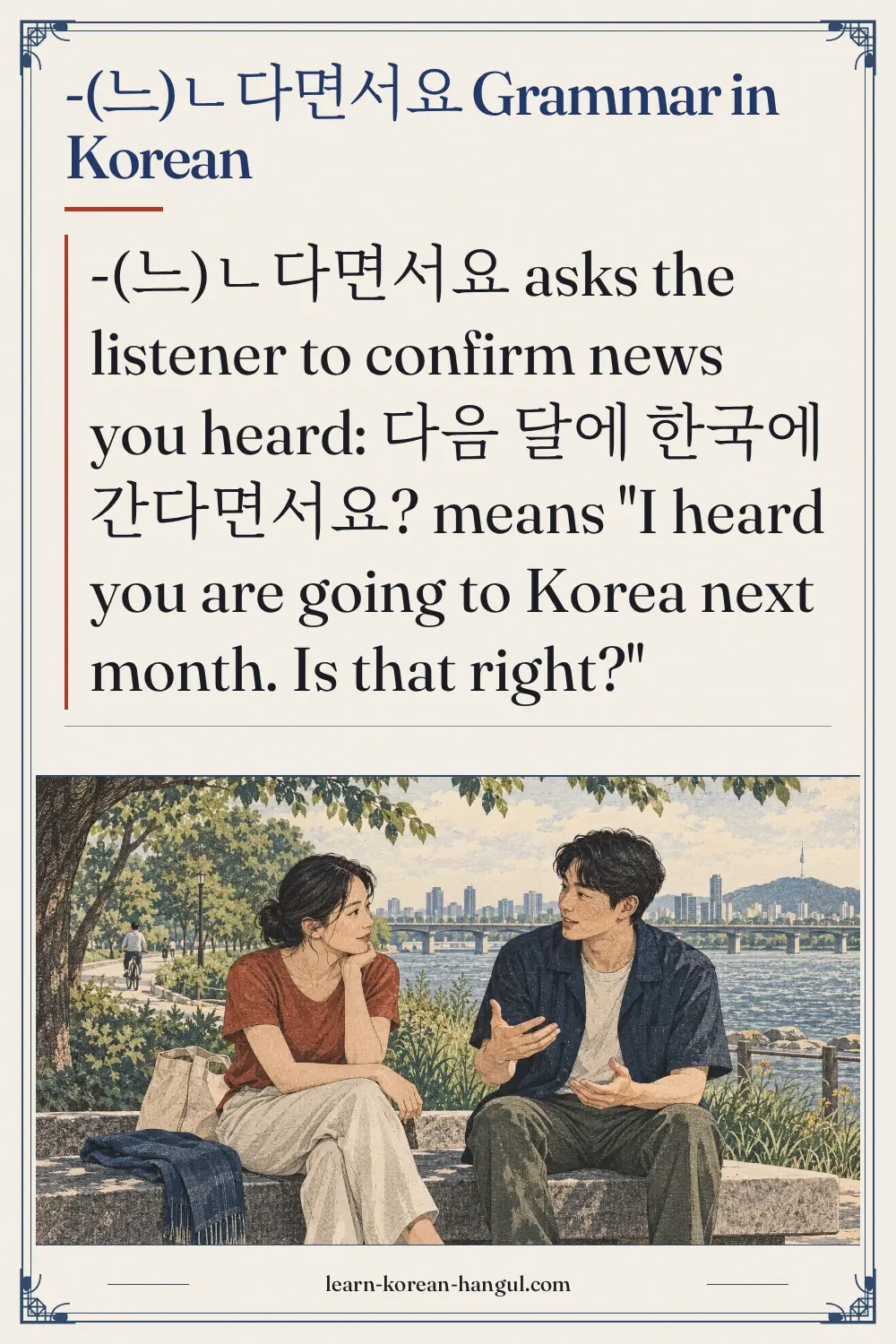
-(느)ㄴ다면서요 grammar means "I heard that ..., is that true?" or "They tell me that ..., right?" The speaker has heard a piece of news, from the listener, a third person or a message, and now asks to check it. It is built from -(느)ㄴ다고 하면서요 ("you are saying that, aren't you?") and shortened to one word.
Two examples show the idea. The first checks a plan, and the second checks a rumour. In both, the voice rises at the end, because the speaker wants a yes or a no.
다음 달에 한국에 간다면서요?
daeum dare hanguge gandamyeonseoyo?
I heard you are going to Korea next month. Is that right?
민수 씨가 결혼한다면서요?
minsu ssiga gyeolhonhandamyeonseoyo?
I heard Minsu is getting married. Is that true?
The speaker is not sure, so the sentence is a question, not a statement. The ending also carries a mild feeling of surprise or interest. The next section shows how to build the form.
How Do You Form -(느)ㄴ다면서요?
-(느)ㄴ다면서요 is formed by taking the plain-style form of the sentence and adding 면서요. It uses the same base forms as the spoken short forms in -대요/-냬요/-재요/-래요, so the work is in the base form. Verbs take -ㄴ다 or -는다, adjectives keep -다, and nouns take -(이)라.
| Type | Plain form | With 면서요 | Said as |
|---|---|---|---|
| Verb, vowel stem | 간다 | 간다면서요 | [간다면서요] |
| Verb, consonant stem | 먹는다 | 먹는다면서요 | [멍는다면서요] |
| ㄹ-stem verb | 만든다 | 만든다면서요 | [만든다면서요] |
| Adjective | 바쁘다 | 바쁘다면서요 | [바쁘다면서요] |
| 있다 / 없다 | 있다 | 있다면서요 | [읻따면서요] |
| Past | 갔다 | 갔다면서요 | [갇따면서요] |
| Future | 갈 거라 | 갈 거라면서요 | [갈꺼라면서요] |
| Noun + 이다 | 학생이라 | 학생이라면서요 | [학쌩이라면서요] |
Revised Romanization (RR) writes gandamyeonseoyo, meongneundamyeonseoyo, itdamyeonseoyo, gatdamyeonseoyo, gal georamyeonseoyo and haksaengiramyeonseoyo. The pronunciation follows the 국립국어원 standard pronunciation rules (표준 발음법): a final ㅆ is said as ㄷ and tenses the ㄷ after it, so 갔다 is said [갇따]. The next parts take the stem types one at a time.
Verbs
A verb with a final vowel takes -ㄴ다면서요: 가다 gives 간다면서요, and 오다 gives 온다면서요. A verb with a final consonant takes -는다면서요: 먹다 gives 먹는다면서요. An ㄹ-stem drops its ㄹ before ㄴ: 만들다 gives 만든다면서요, and 살다 gives 산다면서요. 하다 verbs follow the vowel rule: 결혼한다면서요.
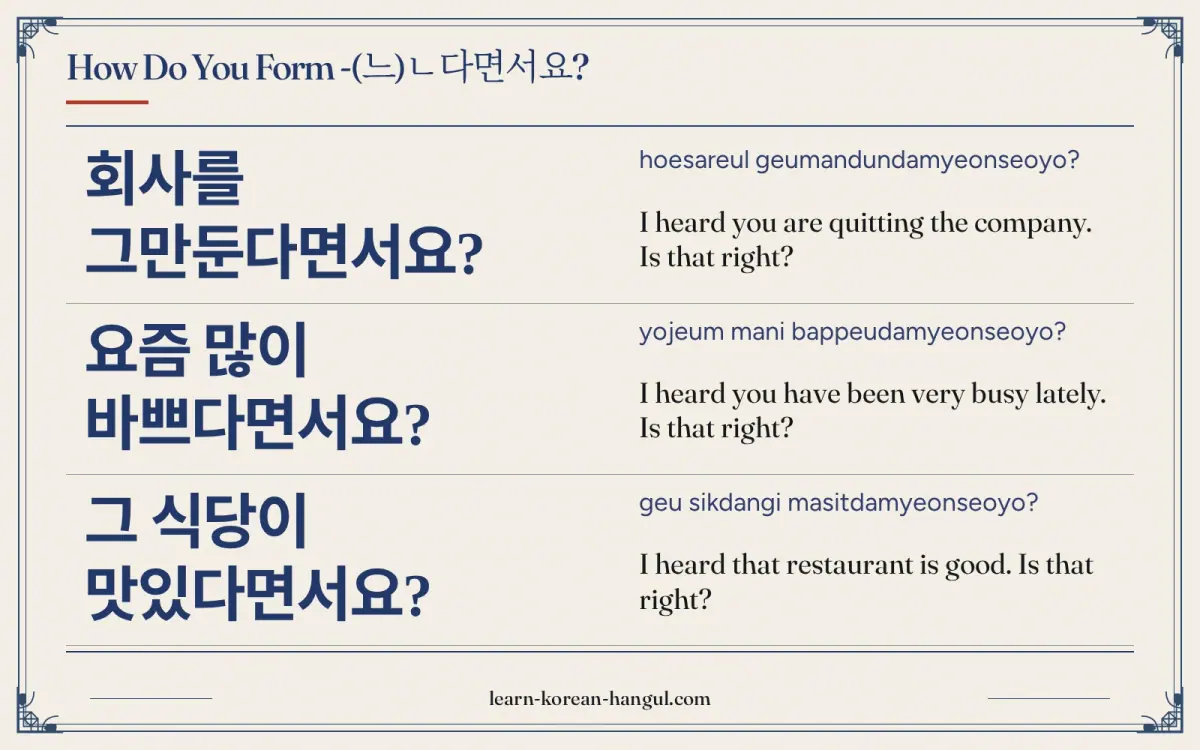
회사를 그만둔다면서요?
hoesareul geumandundamyeonseoyo?
I heard you are quitting the company. Is that right?
Adjectives and 있다/없다
An adjective keeps -다 in the plain style and takes 면서요 directly: 바쁘다 gives 바쁘다면서요, and 좋다 gives 좋다면서요, said [조타면서요]. The words 있다 and 없다 behave the same way, so 맛있다 gives 맛있다면서요.
요즘 많이 바쁘다면서요?
yojeum mani bappeudamyeonseoyo?
I heard you have been very busy lately. Is that right?
그 식당이 맛있다면서요?
geu sikdangi masitdamyeonseoyo?
I heard that restaurant is good. Is that right?
Past, Future and Nouns
For the past, add -았/었 before 다면서요: 어제 비가 왔다면서요? ("I heard it rained yesterday"). For the future, use -(으)ㄹ 거라면서요. A noun takes -(이)라면서요: 학생이라면서요 after a consonant and 의사라면서요 after a vowel.
어제 비가 왔다면서요?
eoje biga watdamyeonseoyo?
I heard it rained yesterday. Is that right?
내일 비가 올 거라면서요?
naeil biga ol georamyeonseoyo?
I heard it will rain tomorrow. Is that right?
민수 씨가 학생이라면서요?
minsu ssiga haksaengiramyeonseoyo?
I heard Minsu is a student. Is that right?
With the forms clear, you can build a full sentence.
Worked Example: Building a Sentence with -(느)ㄴ다면서요
-(느)ㄴ다면서요 grammar works the same way every time, so a five-step routine is enough. Follow it to build "I heard you are going to Korea next month, is that right?"
- Write the news. The information you heard is: 다음 달에 한국에 가요. ("You are going to Korea next month.")
- Find the plain form. 가다 is an action verb with a vowel stem, so the plain present is 간다.
- Add 면서요. 간다 + 면서요 becomes 간다면서요.
- Add the rest of the sentence. 다음 달에 한국에 간다면서요.
- Raise your voice at the end. You are asking for a yes or no, so the tone goes up.
Sentence
I heard you are going to Korea next month, is that right?
Show answer
다음 달에 한국에 간다면서요
You will know it worked if the sentence ends in -다면서요 with one rising question mark. The most common slip is writing 가는다면서요, with an extra 는. The next question is which tenses and sentence types can follow.
Which Tenses and Sentence Types Work with -(느)ㄴ다면서요?
-(느)ㄴ다면서요 works with statements in every tense, and it can also carry commands and suggestions. The tense of the news stays inside the base form, and the ending itself never changes.
| Question | Answer |
|---|---|
| Can the news be past? | Yes: 갔다면서요 ("I heard you went"). |
| Can it be future? | Yes: 갈 거라면서요, said [갈꺼라면서요]. |
| Do adjectives work? | Yes: 바쁘다면서요. |
| Do nouns work? | Yes: 학생이라면서요. |
| Can it report a command? | Yes, as -(으)라면서요: 일찍 오라면서요? ("They told you to come early, right?"). |
| Can it report a suggestion? | Yes, as -자면서요: 같이 가자면서요? ("You suggested going together, right?"). |
| How is it said? | With a rising tone, like a yes/no question. |
| Which register? | Polite. Drop 요 for casual: 간다면서? or the shorter 간다며? |
Because the speaker is checking, the sentence usually has no question word. If you add one, the question usually ends with a fall or rise-fall instead: 누가 온다면서요? ("Who did they say is coming?"). To a person you respect, put -(으)시- in the news: 선생님이 오신다면서요? ("I heard the teacher is coming, is that right?"). See -(으)시- honorific. For a very formal setting, -다고 들었는데 맞습니까? is safer.
선생님이 오신다면서요?
seonsaengnimi osindamyeonseoyo?
I heard the teacher is coming. Is that right?
The tense rule leads to the question that confuses learners most: how this pattern differs from other ways to report hearsay.
How Is -(느)ㄴ다면서요 Different from -다고 들었어요?
-(느)ㄴ다면서요 asks the listener to confirm hearsay, while -다고 들었어요 states hearsay as a fact you heard. A third look-alike, -(느)ㄴ다고요?, repeats what the listener just said. Ask yourself one question: do I want a yes or a no?
-(느)ㄴ다면서요
checks news you heard earlier
-다고 들었어요
states what you heard
-(느)ㄴ다고요?
echoes what was just said
| Comparison | -(느)ㄴ다면서요 | -다고 들었어요 | -(느)ㄴ다고요? |
|---|---|---|---|
| Purpose | ask for confirmation | give information with its source | repeat in surprise or to check |
| Expects | yes or no | nothing, or a comment | a repeat or a yes |
| Example | 간다면서요? | 간다고 들었어요. | 간다고요? |
Use -(느)ㄴ다면서요 to check news, -다고 들었어요 to state where news came from, and -(느)ㄴ다고요? to echo something you just heard.
Compare the three. 다음 달에 간다면서요? asks "Is it true you are going next month?" 다음 달에 간다고 들었어요 says "I heard you are going next month." 다음 달에 간다고요? says "You said you are going next month?" after the listener has just said it. The statement is taught in -다고 들었어요. A guess tag such as -지요 also asks for agreement, but it does not point to hearsay.
내일 온다고요?
naeil ondagoyo?
You say he is coming tomorrow?
다음 달에 한국에 간다고 들었어요.
daeum dare hanguge gandago deureosseoyo.
I heard you are going to Korea next month.
These contrasts lead to a few variations.
Variations and Edge Cases of -(느)ㄴ다면서요
-(느)ㄴ다면서요 has five common variations. Each one helps you read and say real Korean.
- The casual forms. Between friends, drop 요: 한국에 간다면서? Even shorter is -다며: 한국에 간다며? See casual speech.
- "You said you would, but ..." The shortened -다면서 can introduce a contrast: 온다면서 왜 안 왔어요? ("You said you were coming, so why didn't you come?"). The question word makes it end with a fall or rise-fall rather than a sharp rise.
- A different word. -(느)ㄴ다면서요 is not -(으)면서요 ("while ..."), which links two actions: 먹으면서요 means "while eating". See -(으)면서.
- Soft surprise. The tone of -다면서요 can show interest or mild surprise at the news, but it does not criticise.
- Experience instead of hearsay. If you saw it yourself, use -더라고요 instead.
온다면서 왜 안 왔어요?
ondamyeonseo wae an wasseoyo?
You said you were coming, so why did you not come?
한국에 간다며?
hanguge gandamyeo?
I heard you are going to Korea, right?
Think of -다면서요 as holding up a piece of news and asking, "Is this yours?" The edge cases above all keep that meaning: the speaker checks, and the listener answers.
What Mistakes Do Learners Make with -(느)ㄴ다면서요?
Learners usually use the wrong base form or use the ending to give new information. Four mistakes appear again and again.
- Adding 는 to a vowel verb. Wrong: 가는다면서요. Right: 간다면서요. A vowel verb takes -ㄴ다, not -는다.
- Using the verb rule on an adjective. Wrong: 바쁜다면서요. Right: 바쁘다면서요. An adjective keeps -다.
- Using 이다 on a noun. Wrong: 학생이다면서요. Right: 학생이라면서요. A noun takes -(이)라 before 면서요.
- Using it about yourself or for new news. If you announce your own plan, 저는 내일 간다면서요 does not make sense, because you do not need to check what you already know. Say 저는 내일 가요.
A quick check: Do I want a yes or a no? Is the base form the plain style? Is the voice rising at the end? If all three answers are yes, the sentence is sound.
The practice set below tests these points.
Practice and Answers
Try the four items before you read the answer key. Cover the answers with your hand.
- Check the news. You heard that Minsu is quitting. Ask: "I heard Minsu is quitting, is that right?" Use 그만두다.
- Choose the form. Fill in the blank with 바쁘다: 요즘 많이 ___면서요?
- Fix the error. A learner says 민수 씨가 학생이다면서요. Correct it.
- Make it casual. Change 한국에 간다면서요 into a casual short form.
Practice · 5
Which sentence means "I heard Minsu is getting married"?
Show answer
민수 씨가 결혼한다면서요?
결혼하다 is a 하다 verb with a vowel stem, so the plain present is 결혼한다: 결혼한다면서요.
Which form fits: 요즘 많이 ___ 면서요 (바쁘다)?
Show answer
바쁘다
An adjective keeps -다 in the plain style, so the form is 바쁘다면서요.
Which sentence means "I heard Minsu is a student"?
Show answer
민수 씨가 학생이라면서요?
A noun takes -(이)라 before 면서요. After the consonant of 학생, it is 이라: 학생이라면서요.
Which sentence means "I heard you went to Jeju yesterday"?
Show answer
어제 제주도에 갔다면서요?
The past adds -았/었: 가다 becomes 갔다. 갔다면서요 is the past hearsay check.
Which is the casual short form of -다면서요?
Show answer
-다며
-다며 is the spoken short form of -다면서. Between friends, 간다며? means "I heard you are going, right?"
Answer key
- 민수 씨가 그만둔다면서요? (minsu ssiga geumandundamyeonseoyo?) 그만두다 has a vowel stem, so use -ㄴ다면서요: 그만둔다면서요.
- 바쁘다. 요즘 많이 바쁘다면서요? is said [요즘 마니 바쁘다면서요].
- 민수 씨가 학생이라면서요? A noun takes -(이)라 before 면서요, not 이다.
- 한국에 간다며? (hanguge gandamyeo?) Casual speech drops 요 and shortens 면서 to 며.
If you can complete items 1 to 3 without the key, you can check most hearsay. The final section points to the next lessons.
What Should You Learn Next after -(느)ㄴ다면서요 Grammar?
After -(느)ㄴ다면서요 grammar, learn how to pass on hearsay as background, and how to state your own opinion. This lesson teaches the confirming question and does not cover every way to cite a source.
- Learn -다던데 to say "I heard ..., so ..." and give advice or a reaction.
- Review -다고 들었어요 for stating what you heard.
- Learn -다고 생각하다 to say "I think that ...".
- Review the spoken short forms in -대요/-냬요/-재요/-래요.
- Return to the Advanced Grammar list for other patterns at this level.
With these steps, the choice becomes automatic: use -(느)ㄴ다면서요 to check news, and -다고 들었어요 to state it. For exam content and levels, check the current guide on topik.go.kr; the level shown here is an editorial estimate.
Frequently Asked Questions
What does -(느)ㄴ다면서요 mean?
-(느)ㄴ다면서요 means "I heard that ..., is that true?" The speaker has heard some news and asks the listener to confirm it. 다음 달에 한국에 간다면서요? means "I heard you are going to Korea next month. Is that right?" It is a short form of -(느)ㄴ다고 하면서요.
How do I attach -(느)ㄴ다면서요 to a verb or adjective?
Use the plain-style form and add 면서요. A vowel verb takes -ㄴ다: 간다면서요. A consonant verb takes -는다: 먹는다면서요. An adjective keeps -다: 바쁘다면서요. A noun takes -(이)라: 학생이라면서요. Add -았/었 for the past: 갔다면서요.
Can -(느)ㄴ다면서요 be used in the past tense?
Yes. Put the past marker in the news: 어제 비가 왔다면서요? means "I heard it rained yesterday, is that right?" For the future, use -(으)ㄹ 거라면서요, said [갈꺼라면서요]. The ending 면서요 itself never changes.
Is -(느)ㄴ다면서요 used in speech or only in writing?
It is a spoken pattern. Friends drop 요 and say 간다면서? or 간다며? In formal speech, say -다고 들었는데 맞습니까? instead. In writing it appears in dialogue, such as the lines of a drama script or a message to a friend.
What is the most common mistake with -(느)ㄴ다면서요?
The most common mistake is using the wrong base form: 가는다면서요 for 간다면서요, 바쁜다면서요 for 바쁘다면서요, or 학생이다면서요 for 학생이라면서요. A second mistake is using it to announce your own news; it is for checking what you heard.
What is the difference between -(느)ㄴ다면서요 and -다고 들었어요?
-(느)ㄴ다면서요 asks the listener to confirm hearsay with a rising tone: 간다면서요? -다고 들었어요 states the hearsay: 간다고 들었어요, "I heard you are going." The first expects a yes or no, and the second simply tells where the information came from.