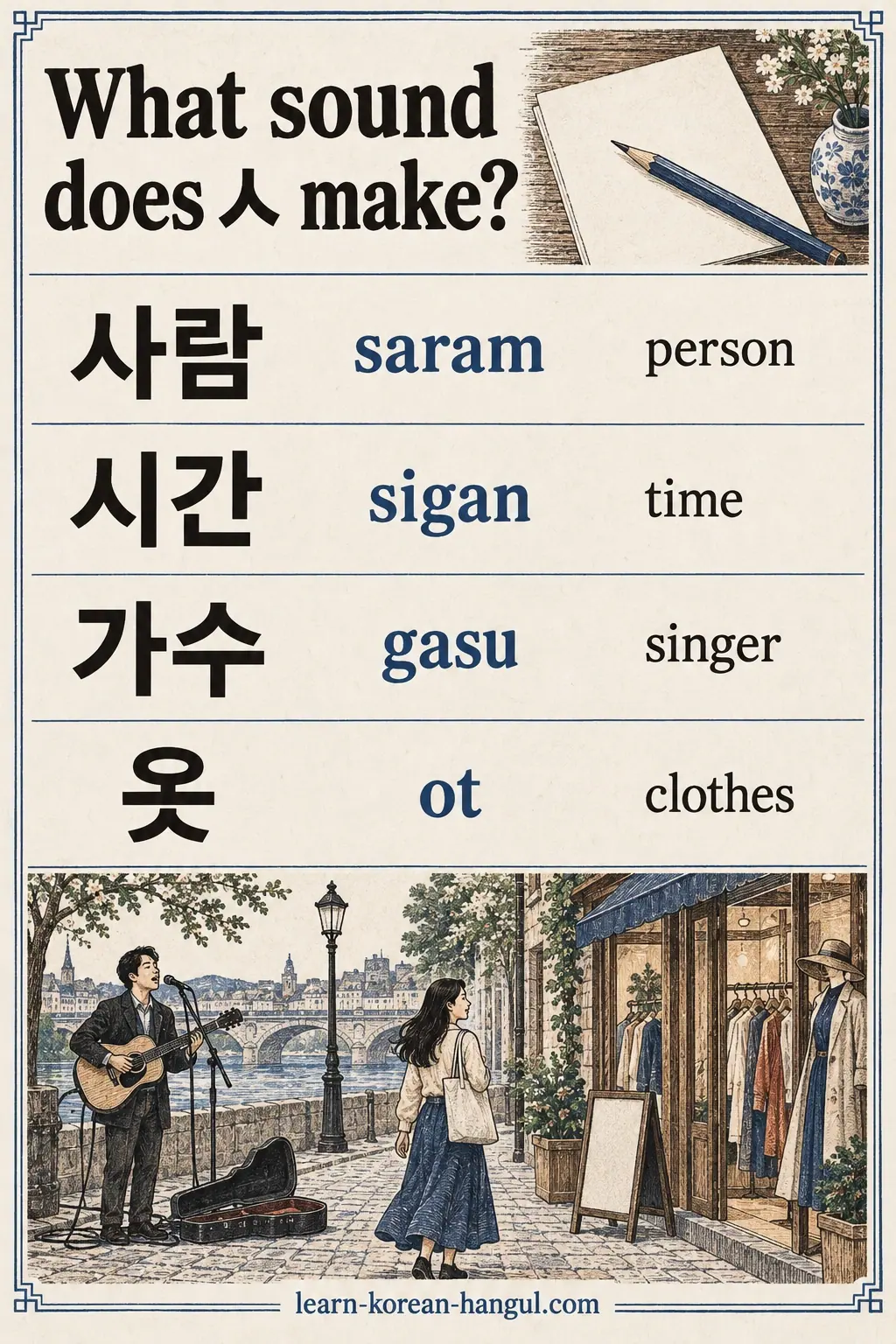
What you'll learn
- Say the letter name 시옷 and choose the right ㅅ sound before ㅏ, before ㅣ and at the end of a syllable.
- Write ㅅ in two strokes and adjust its width for 사 and 수.
- Read 사, 소, 시 and 옷 aloud, and explain why 옷이 is said [오시].
- Tell ㅅ apart from ㅆ in 사다 and 싸다.
- Prerequisites: the vowel lesson for ㅏ. Estimated time: 15 minutes.
The Korean Letter ㅅ at a Glance
The Korean letter ㅅ is the seventh of the 14 basic consonants in the standard order (ㄱ ㄴ ㄷ ㄹ ㅁ ㅂ ㅅ …) listed in the Hangul Orthography (한글 맞춤법, Article 4). On this site it follows ㅂ in the set of basic Korean consonants.
| Attribute | Value |
|---|---|
| Letter | ㅅ |
| Name | 시옷 (siot) |
| Revised Romanization | s before a vowel; t at the end of a syllable |
| Sound family | fricative: air hisses through a narrow gap behind the teeth |
| Strokes | 2 |
| Final sound (batchim) | unreleased [t] |
| Partner letter | ㅆ (tense); no aspirated partner |
| Keyboard key (Dubeolsik) | T |
The shape of ㅅ is a picture of a tooth. The 1446 commentary Hunminjeongeum Haerye (훈민정음 해례) groups ㅅ with the "tooth sounds" and says the letter shows the shape of a tooth. Adding a stroke on top makes ㅈ, and adding another makes ㅊ. ㅅ is therefore the base letter of a whole family you will meet over the next lessons.
The name 시옷 is irregular. The regular pattern would give 시읏. The name comes from Choe Sejin's 1527 textbook Hunmong Jahoe (훈몽자회), which wrote letter names with Chinese characters. It used the character for "clothes", whose Korean word is 옷, because no character was read 읏. North Korea uses 시읏. The page on the names of the Korean consonants covers this together with 기역 and 디귿. Next comes the sound.
What Sound Does ㅅ Make?
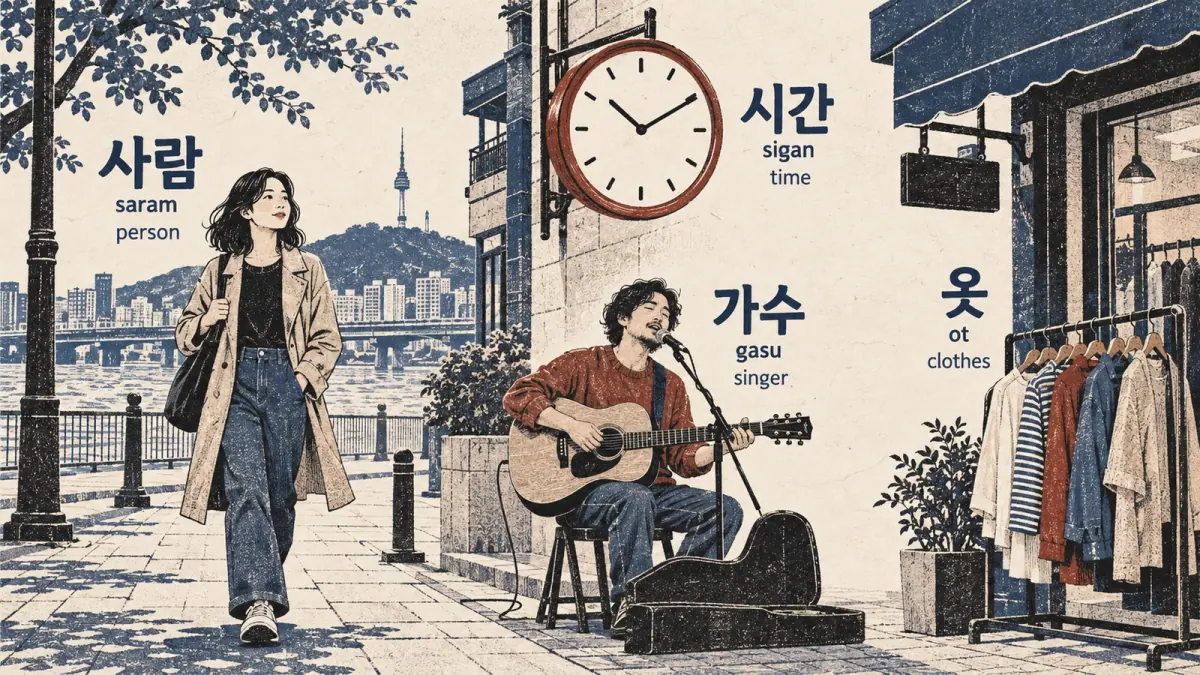
ㅅ makes a soft s before most vowels, a sound close to English sh before ㅣ and the y-vowels, and an unreleased t at the end of a syllable. Unlike ㄱ, ㄷ and ㅂ, ㅅ does not turn voiced between vowels: it stays an s and never becomes a z.
| Position | Example | Pronunciation | What you hear |
|---|---|---|---|
| Before ㅏ ㅓ ㅗ ㅜ ㅡ | 사람 (saram, person) | [사람] | soft s with a little breath |
| Before ㅣ and y-vowels | 시간 (sigan, time) | [시간] | between s and sh |
| Between vowels | 가수 (gasu, singer) | [가수] | still s, never z |
| End of a syllable | 옷 (ot, clothes) | [옫] | unreleased t |
To make the sound, place the tip of your tongue close to the ridge behind your upper teeth and let air flow out softly. The Korean ㅅ is gentler than an English s: less hiss, a little more breath. Linguists still debate how to classify this breathiness, but for a learner the practical advice is the same: relax, and do not make a sharp, hissing s.
Why Does 시 Sound Like Shi?
시 sounds like "shi" because the vowel ㅣ pulls the tongue up toward the hard palate, and ㅅ moves with it. The tongue body rises to prepare for the "ee" sound, which turns the s into a sound between s and sh. Phoneticians write this version as [ɕ]. The same thing happens before the y-vowels ㅑ, ㅕ, ㅛ and ㅠ, and before ㅟ: 샤워 (syawo, shower) begins with the sh-like sound.
Korean speakers hear this as the same letter, so Revised Romanization writes s every time: 시간 is sigan, not shigan. When you see "si" in a romanized word, expect a sound close to "shee". With both sounds in place, you can move to writing.
How Do You Write ㅅ?
ㅅ is written in two strokes: a long stroke falling from the top down to the left, then a shorter stroke that starts from the middle of the first and falls down to the right. The consonant stroke order lesson shows ㅅ next to ㅈ and ㅊ, which reuse these two strokes.
Practise on Paper
- Start at the top. Draw a stroke down and to the left.
- Start at about the middle of the first stroke. Draw down and to the right.
Stroke Order: 2 Strokes
- Start at the top. Draw a stroke down and to the left.
- Start at about the middle of the first stroke. Draw down and to the right.
The second stroke does not start at the very top; it branches from the first one, which is why ㅅ looks like a person walking rather than a symmetrical upside-down V. The shape changes with the vowel. In 사 the letter is narrow and tall, with a short second stroke so ㅏ has room. In 수 the letter sits above ㅜ, so it spreads wide and low, and both strokes look nearly equal. Writing ㅅ the same way in every block is a common reason handwriting looks stiff. With the shape learned, the next step is how ㅅ sounds in each position.
How Does ㅅ Change at the Start, Middle and End?
ㅅ is an s or sh-like sound when a vowel follows it and an unreleased [t] when it closes a syllable. Its final [t] turns back into s when the next syllable starts with a vowel.
| Position in the block | Example | Said | Romanized |
|---|---|---|---|
| Initial, word start | 소 (so, cow) | [소] | so |
| Initial, between vowels | 가수 | [가수] | gasu |
| Final (batchim) | 맛 (mat, taste) | [맏] | mat |
| Final before a vowel | 맛이 (taste + subject particle) | [마시] | masi |
The last row is the key to reading ㅅ. Spoken alone, 옷 and 맛 end in [t]. Followed by a vowel, the hidden s appears again, because the ㅅ moves into the empty consonant slot of the next syllable. This is the liaison rule (옷이 = [오시]): 옷이 is said [오시], and 맛이 is said [마시].
ㅅ as a Final Consonant (batchim)
A consonant at the bottom of a block, like ㅅ in 옷, is a batchim (받침, "support"). As a batchim, ㅅ is said [t]: the tongue tip presses against the gum ridge and stays there, so no hiss can escape.
Learners often assume ㅅ is always s; at the end of a syllable it is [t] unless a vowel-initial syllable follows. The Standard Pronunciation Rules (표준 발음법, Article 9) place final ㅅ with ㄷ, ㅆ, ㅈ, ㅊ and ㅌ under the representative sound [t], which is one of the seven final sounds. Final ㅅ is very common in everyday words:
- 옷 (ot, clothes) is said [옫].
- 맛 (mat, taste) is said [맏].
- 다섯 (daseot, five) is said [다섣].
The next section reads four blocks from start to finish.
Worked Example: Reading 사, 소, 시, 옷

Reading a block with ㅅ takes three steps: find the consonant, look at the vowel (ㅣ or a y-vowel changes the sound), then check whether ㅅ closes the block.
- 사. ㅅ sits left of ㅏ. Soft s, then "ah": [사]. Romanized sa.
- 소. ㅅ sits above ㅗ. Round your lips for ㅗ as you say the s: [소]. Romanized so. It means "cow".
- 시. ㅅ sits left of ㅣ. The tongue rises for ㅣ, so the s becomes sh-like: [시]. Romanized si.
- 옷. The silent ㅇ sits on top, ㅗ under it, and ㅅ at the bottom. Say "o", then press the tongue tip up and stop: [옫]. Romanized ot.
If your 옷 ends with a hiss, you said the final ㅅ as s; stop the air with the tongue tip instead. A sharper hiss at the start is also the clue that separates ㅅ from its tense partner.
ㅅ Compared with ㅆ

ㅅ and ㅆ are both s-sounds, but ㅅ is soft and slightly breathy while ㅆ is tense: the throat tightens and the hiss is sharper and stronger. The pair 사다 (to buy) and 싸다 (to be cheap) shows that this difference changes the word.
ㅆ: Tight Throat, Sharp Hiss; ㅅ: Relaxed, Breathy
| Korean | Romanization | Meaning | Sound |
|---|---|---|---|
| 사다 | sada | to buy | |
| 싸다 | ssada | to be cheap | |
| 살 | sal | flesh; years of age | |
| 쌀 | ssal | uncooked rice |
| Letter | Type | Hiss | Throat | Example words |
|---|---|---|---|---|
| ㅅ | plain (lenis) | soft, breathy | relaxed | 사다 (sada, to buy), 살 (sal, flesh) |
| ㅆ | tense | sharp, strong | tight | 싸다 (ssada, to be cheap), 쌀 (ssal, uncooked rice) |
Unlike ㄱ, ㄷ and ㅂ, ㅅ has only one partner. There is no aspirated "ㅅ with extra breath" letter in modern Korean, which makes ㅅ a two-way contrast rather than a three-way one. To practise, say 사다 with a relaxed throat and a little breath, then tighten your throat and say 싸다 with a crisp hiss. Compare the full lesson on the letter ㅆ (Ssangsiot), which also covers 있어요, one of the most frequent words in Korean. Mixing up these sounds leads to some of the mistakes below.
Common Mistakes with ㅅ

Four mistakes cause most ㅅ problems.
- Saying a hissing English s in 사람. A sharp s sounds closer to ㅆ. Fix: relax the tongue and let a little breath through.
- Pronouncing final ㅅ in 옷 as s. 옷 then sounds like "os". Fix: stop the air with the tongue tip so the word ends in [t].
- Saying 시 as "see" with a sharp s. This sounds foreign and can be heard as 씨. Fix: lift the tongue toward the palate so the sound moves toward sh.
- Writing ㅅ as an upside-down V with equal strokes in every block. Fix: start the second stroke from the middle of the first, and widen the letter above ㅗ and ㅜ.
Is ㅅ the Same as the English Letter?
No. ㅅ is not quite English s. Before most vowels it is softer and breathier than English s. Before ㅣ it moves toward English sh. At the end of a syllable it is not a hissing sound at all, but [t]. And between vowels it never becomes z, which is why 가수 (singer) is "ga-su", not "ga-zu".
Revised Romanization (국어의 로마자 표기법, 2000) writes ㅅ as s before vowels, including before ㅣ (시간 sigan), and as t at the end (옷 ot). These spellings are aids for names and signs, not exact pronunciation. The exercises below practise each version.
Practice: Four Quick Exercises

Try each exercise, then check the answers at the end of this section. The same items run as an interactive quiz.
Practice · 8
How is 옷 (clothes) pronounced when said alone?
Show answer
[옫]
Final ㅅ is an unreleased [t], so 옷 alone is said [옫].
How is 옷이 pronounced?
Show answer
[오시]
Before a vowel the ㅅ moves into the next syllable and the s returns, so 옷이 is said [오시].
Why does 시 sound close to "shi"?
Show answer
The vowel ㅣ pulls the tongue toward the hard palate
The tongue rises to prepare for ㅣ, turning ㅅ into a sound between s and sh.
How does ㅅ sound between vowels, as in 가수 (singer)?
Show answer
Still s
Unlike ㄱ, ㄷ and ㅂ, ㅅ does not become voiced between vowels; 가수 is ga-su, never ga-zu.
Which word means "to be cheap"?
Show answer
싸다
싸다 has tense ㅆ and means to be cheap; 사다 with plain ㅅ means to buy.
What is the South Korean name of ㅅ?
Show answer
시옷
South Korea uses the irregular name 시옷 from the 1527 Hunmong Jahoe; North Korea uses 시읏.
How is 시간 (time) written in Revised Romanization?
Show answer
sigan
Revised Romanization writes ㅅ as s before every vowel, including ㅣ, so 시간 is sigan.
Which letter is ㅅ's partner in a two-way contrast?
Show answer
ㅆ
ㅅ has only one partner, the tense ㅆ; there is no aspirated ㅅ in modern Korean.
- Listen and choose. Which word means "to be cheap": 사다 or 싸다? Which means "uncooked rice": 살 or 쌀?
- Read aloud. Read 시간, 가수, 버스 (beoseu, bus) and 맛. For each ㅅ, say whether it is a soft s, sh-like, or [t].
- Write the block. Build and write: ㅅ + ㅓ, ㅅ + ㅜ, ㅇ + ㅗ + ㅅ.
- Find the final. How is 옷 said alone, and how is 옷이 said?
Answers
- 싸다 means "to be cheap" (사다 is "to buy"). 쌀 means "uncooked rice" (살 is "flesh").
- 시간: sh-like. 가수: soft s (not z). 버스: soft s. 맛: final [t].
- ㅅ + ㅓ = 서, ㅅ + ㅜ = 수, ㅇ + ㅗ + ㅅ = 옷.
- 옷 alone is [옫]. 옷이 is [오시], because the ㅅ moves into the next syllable.
If you got all four right, you have the main ㅅ patterns.
What Should You Learn after ㅅ?
After the Korean letter ㅅ, learn The Korean Letter ㅇ (Ieung), the next basic consonant. ㅇ is the silent letter you have already seen in 옷 and 아, and its lesson explains why it sits there.
For review, use the Hangul flashcard decks for a few minutes a day, test yourself in the Hangul quizzes, and compare ㅅ before different vowels in the interactive Hangul alphabet. For handwriting, print the Korean consonants writing practice sheet, and see ㅅ among the 19 consonant letters on all Korean consonants.
What this lesson does not cover: the "sai-siot" (사이시옷), a ㅅ written between two parts of a compound such as 바닷가, and the full liaison and tensification rules. Those are taught in the pronunciation section, so this page stays focused on reading and writing the single letter ㅅ.
Frequently Asked Questions
Is ㅅ pronounced s or sh? ㅅ is pronounced s before most vowels and close to sh before ㅣ and the y-vowels. 사람 starts with a soft s, while 시간 starts with a sound between s and sh. Korean speakers treat both as one sound. Revised Romanization writes s in both cases, so 시간 is sigan, not shigan.
Why does 옷 sound like ot? 옷 sounds like [옫] because ㅅ at the end of a syllable is pronounced as an unreleased t. Korean does not let air hiss out at the end of a syllable, so ㅅ joins the group of letters that end as [t]. Add a vowel and the s returns: 옷이 is said [오시].
What is the difference between ㅅ and ㅆ? ㅅ is a soft, slightly breathy s, while ㅆ is a tense s made with a tight throat and a sharper hiss. The pair 사다 (to buy) and 싸다 (to be cheap) differs only in this way, and so does 살 (flesh) and 쌀 (uncooked rice). ㅅ has no separate aspirated partner letter.
Why is ㅅ called 시옷? The regular naming pattern would give 시읏, but the name 시옷 comes from the 1527 textbook Hunmong Jahoe, which wrote letter names in Chinese characters. It used the character for "clothes", whose Korean word is 옷, because no character was read 읏. South Korea kept 시옷, while North Korea uses 시읏.
How do you type ㅅ on a Korean keyboard? On the standard Korean 2-set keyboard (Dubeolsik), ㅅ is on the key marked T. Press Shift and T together to type the double letter ㅆ, which you need for very common words such as 있어요. With Korean input switched on, typing T then K produces 사, because the vowel ㅏ sits on the K key.