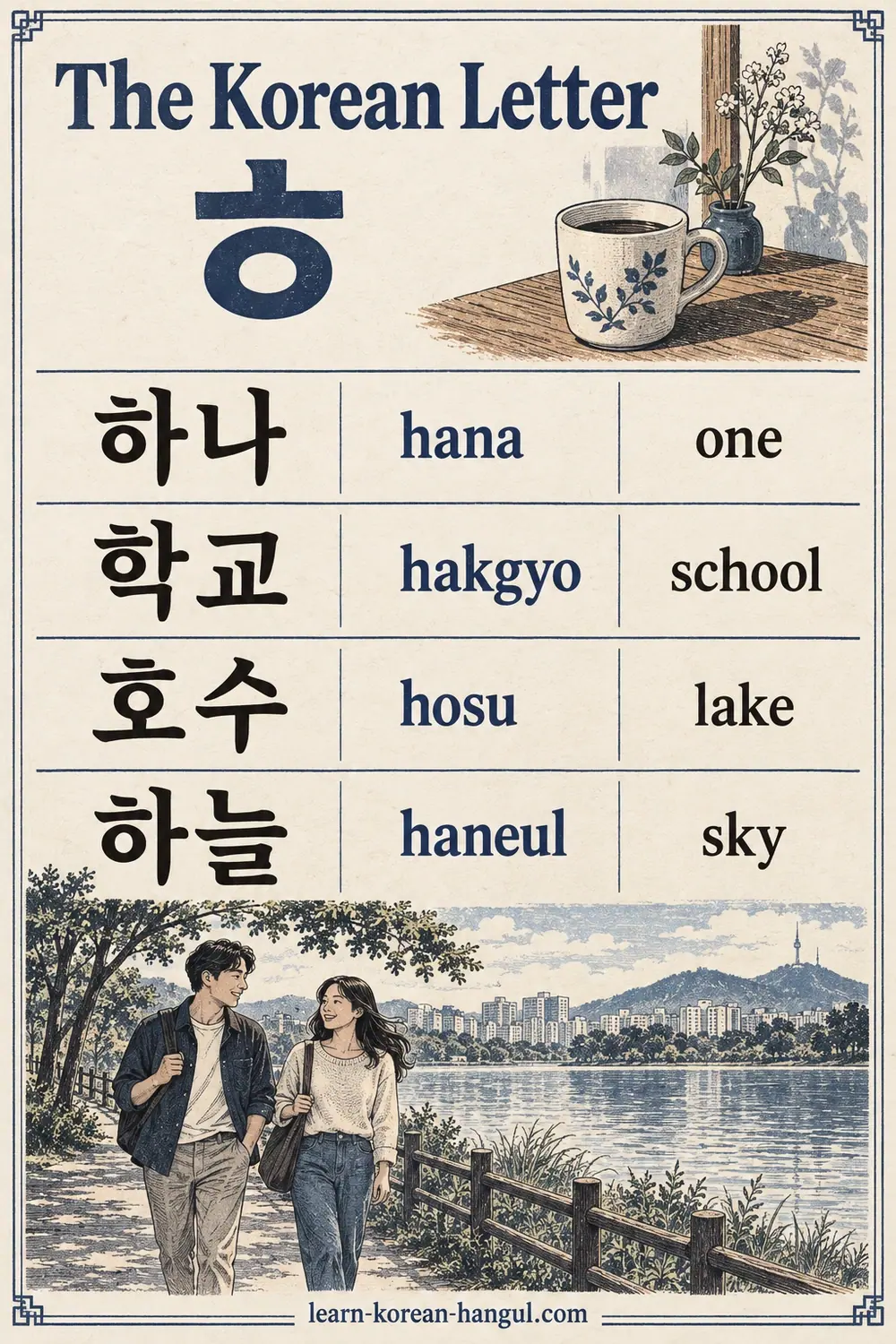
What you'll learn (about 15 minutes, level A0, you only need the vowel ㅏ first)
- Read and write ㅎ in the syllables 하, 호, 좋다 and 좋아요.
- Say the name 히읗 and pronounce ㅎ correctly at the start and end of a syllable.
- Explain why 좋아요 is said [조아요] and why 축하 is said [추카].
- Write ㅎ in 3 strokes.
What Does the Korean Letter ㅎ Sound Like?

The Korean letter ㅎ sounds like the English h in "hat" or "home" when it starts a word: a soft breath made in the throat with no lip or tongue action. The IPA symbol is [h]. Revised Romanization, the official Latin spelling system, writes it as "h". Linguists call it a glottal fricative, because the air is pushed through the narrow gap in the throat.
Start with these words:
- 하나 (hana), one
- 학교 (hakgyo), school, said [학꾜]
- 형 (hyeong), older brother of a male speaker
- 호수 (hosu), lake
- 하늘 (haneul), sky
ㅎ is the last letter of the consonant list in dictionary order. The name 히읗 follows the pattern explained on the page about the names of the Korean consonants: the letter's sound at the start, then 으 and the letter again at the end. Because a final ㅎ is read [t], the name is said [히읃].
ㅎ is one of the 14 basic Korean consonants, so this lesson is part of the core Hangul course. Its main surprise is that it does not always sound like an h.
Why Does ㅎ Disappear in 좋아요?
ㅎ disappears in 좋아요 because Korean does not pronounce ㅎ at the bottom of a block when a vowel follows. The word 좋아요 (joayo, it's good) is written with ㅎ but said [조아요]. The 국립국어원 표준 발음법 (Standard Pronunciation Rules, National Institute of Korean Language) states this rule in Article 12.
The same thing happens in 많아요 [마나요] (it's many) and 싫어요 [시러요] (I dislike it). The spelling keeps ㅎ because the stem is 좋- ("good"), and the stem keeps its shape in every form. The pronunciation rule then removes the sound. This is why a silent ㅎ is not a mistake in the spelling.
Between voiced sounds, such as vowels and ㄴ, ㅁ, ㅇ and ㄹ, ㅎ is also often weak in ordinary speech. For example, 은행 (eunhaeng, bank) is sometimes heard close to [으냉] in fast, casual talk. The slower, careful pronunciation keeps the [h].
Next, a look at the design of the letter.
Why Does ㅎ Look Like a Circle with a Hat?

ㅎ is built from the throat letter ㅇ by adding strokes. In the Hunminjeongeum Haerye (1446), the explanation of Hangul, the throat sounds are shown by a round shape, like the opening of the throat. The base throat letter is ㅇ. A stroke added on top of it gives an older letter (ㆆ), and a second stroke gives ㅎ, the strongest throat sound.
This is the stroke-addition principle (가획, gahoek), the same idea that links ㄱ to ㅋ and ㅂ to ㅍ. Today ㅎ looks like a small bar and a short stroke sitting on a circle, and the circle is the same ㅇ you meet as a silent placeholder at the start of vowel syllables.
Here is a quick comparison:
| Letter | Shape | Sound |
|---|---|---|
| ㅇ | circle | silent at the start, [ŋ] at the end |
| ㅎ | circle + bar + top stroke | [h] |
Now that you know the idea behind the shape, here is how to draw it.
How to Write ㅎ in 3 Strokes
ㅎ is written with 3 strokes in standard print.
Practise on Paper
- Draw a short stroke at the very top, in the middle.
- Draw a horizontal bar underneath it, left to right.
- Draw a circle underneath the bar, starting at the top and moving counterclockwise.
- Draw a short stroke at the very top, in the middle.
- Draw a horizontal bar underneath it, left to right.
- Draw a circle underneath the bar, starting at the top and moving counterclockwise.
Success check: your ㅎ has three parts stacked vertically and centered: a small stroke, a bar and a circle. The circle touches the bar but does not cross it.
Fonts and handwriting differ in the top stroke: some draw it as a short horizontal bar, others as a short vertical or slanted dash. Both versions are the same letter. For the full set of letters side by side, see consonant stroke order.
Inside a block, ㅎ is compact. In 하, ㅎ sits on the left and ㅏ on the right. In 호, ㅎ sits on top and ㅗ underneath. In 좋, ㅎ sits at the bottom as a final consonant.
Next, a look at how ㅎ changes depending on where it sits.
ㅎ at the Start, Middle and End of a Word
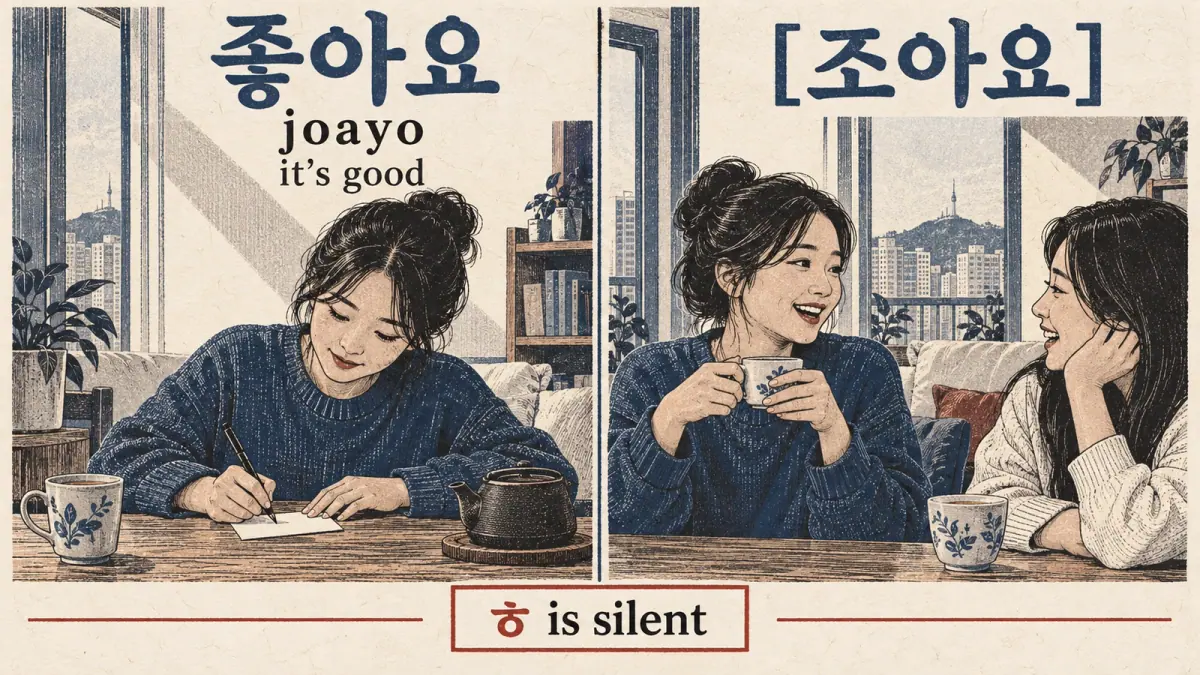
ㅎ is a clear [h] at the start of a word, weak between voiced sounds, and silent, merged or [t] at the end of a block. The table shows each case.
| Position | Example | Pronounced | What happens |
|---|---|---|---|
| Start of a word | 하나 (one) | [하나] | clear [h] |
| Between vowels | 아하 (aha) | [아하] | [h] stays but is soft |
| After ㄴ in fast speech | 은행 (bank) | careful [은행], casual [으냉] | [h] often weak |
| End of a block, vowel follows | 좋아요 (it's good) | [조아요] | ㅎ is silent |
| End of a block, ㄱ ㄷ ㅈ follows | 좋다 (to be good) | [조타] | ㅎ and ㄷ merge into ㅌ |
A letter at the bottom of a block is called a batchim (받침, final consonant). The glossary entry on batchim defines the term, and a block like 좋 has ㅎ as its batchim.
ㅎ as a Final Consonant (batchim)
ㅎ as a final consonant is pronounced [t] when it stands alone, but it usually merges with the next consonant. The final-sound rules of the Standard Pronunciation Rules reduce every final consonant to one of 7 sounds, and ㅎ falls into the [t] group. The name 히읗 itself is said [히읃]. You can see the full list in the seven final sounds.
In everyday words, ㅎ at the end of a block is almost never heard alone. A vowel after it removes the sound (좋아요 [조아요]), and a consonant after it merges with that consonant (좋다 [조타]). That is why this lesson treats "final [t]" as a rarely heard fact, not a pattern to practice.
You can read more about the silent case in the h-weakening rule (좋아요 = [조아요]). The next section covers the merging case.
ㅎ with ㄱ, ㄷ, ㅂ and ㅈ: the Aspiration Rule

When ㅎ touches ㄱ, ㄷ, ㅂ or ㅈ, the two letters merge into one aspirated sound. This is the aspiration rule (거센소리되기), and it is the main reason you hear ㅋ, ㅌ, ㅍ and ㅊ in words that do not write them.
| Spelling | Merge | Pronounced | Meaning |
|---|---|---|---|
| 좋고 | ㅎ + ㄱ → ㅋ | [조코] | good, and ... |
| 좋다 | ㅎ + ㄷ → ㅌ | [조타] | to be good |
| 좋지 | ㅎ + ㅈ → ㅊ | [조치] | it's good, isn't it |
| 축하 | ㄱ + ㅎ → ㅋ | [추카] | congratulations |
| 입학 | ㅂ + ㅎ → ㅍ | [이팍] | school entrance |
| 맏형 | ㄷ + ㅎ → ㅌ | [마텽] | eldest brother |
The merge works in both directions: ㅎ + ㄷ and ㄷ + ㅎ both give ㅌ. A good way to remember it is "ㅎ adds a puff". Each of the four plain letters ㄱ, ㄷ, ㅂ and ㅈ has an aspirated partner, and ㅎ is the puff that turns one into the other.
Other examples include 놓다 (nota, to put down), said [노타], and 많다 (manta, to be many), said [만타]. The lesson on the aspiration rule lists every case. You can compare the result sounds in the lessons on the letter ㅋ (Kieuk) and the letter ㅌ (Tieut).
Now put the pieces together in a worked example.
Worked Example: Reading 하, 호, 좋다 and 좋아요
Reading a Korean syllable means splitting the block into its parts and joining the sounds. Here are four examples, from the simplest to the one with a sound change.
Example 1: 하.
- Split the block: ㅎ + ㅏ.
- Say the breath [h] and add the vowel [a]: [ha].
Example 2: 호.
- Split the block: ㅎ + ㅗ.
- Say [h] and add [o]: [ho]. The vowel ㅗ sits under the consonant.
Example 3: 좋다 (to be good).
- Split the first block: ㅈ + ㅗ + ㅎ.
- The next letter is ㄷ, and ㅎ meets ㄷ, so the pair becomes [ㅌ].
- Join them: [조타], romanized jota.
Example 4: 좋아요 (it's good).
- Split the first block: ㅈ + ㅗ + ㅎ.
- The next block starts with the silent ㅇ and a vowel, so ㅎ is not pronounced.
- Join them: [조아요], romanized joayo.
Check yourself: if you can read all four aloud without the romanization, you have the core skill. Romanization is only a learning aid shown in parentheses.
ㅎ Compared with ㄱ and ㅅ
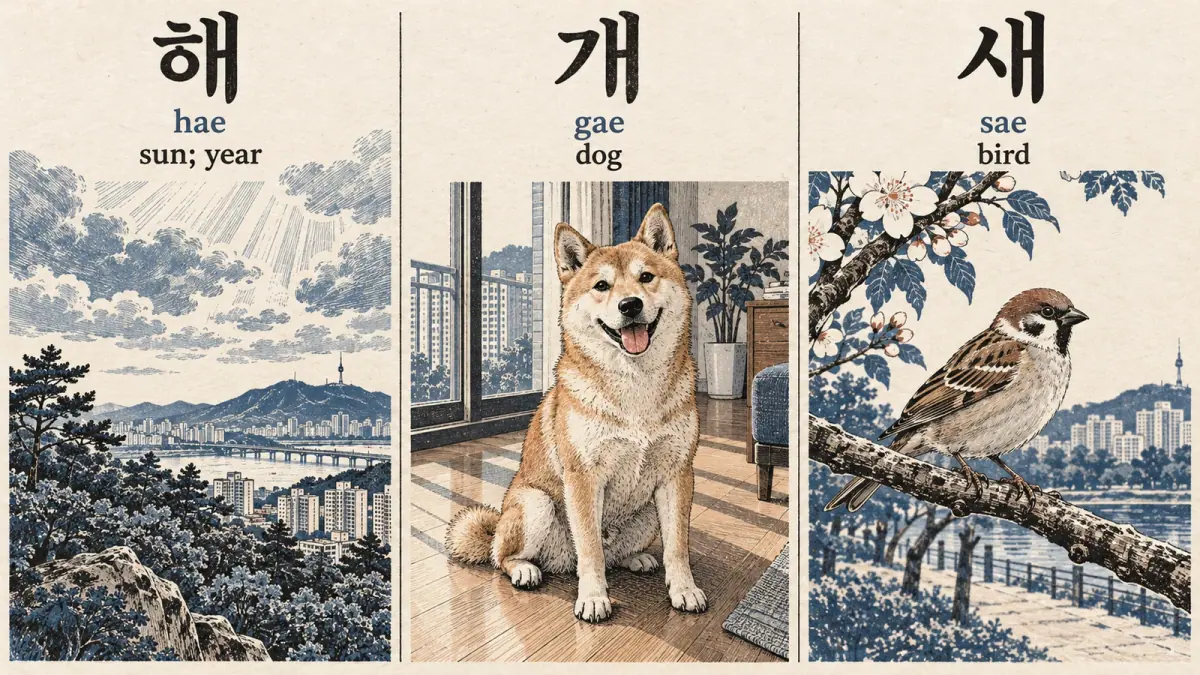
ㅎ, ㄱ and ㅅ are three different breath-and-contact patterns, and the sets 해, 개 and 새 let you hear them in one vowel. 해 (hae) means "sun" or "year", 개 (gae) means "dog", and 새 (sae) means "bird".
The vowel ㅐ (ae) in these words is read like the e in English "bed"; the vowel lessons cover it in full.
ㅎ: Breath from the Throat; ㄱ: Tongue Back Touches the Roof; ㅅ: Air Hisses between Tongue and Teeth
| Korean | Romanization | Meaning | Sound |
|---|---|---|---|
| 해 | hae | sun; year | |
| 개 | gae | dog | |
| 새 | sae | bird |
| Word | Meaning | First letter | What to listen for |
|---|---|---|---|
| 해 | sun; year | ㅎ | open breath, no contact in the mouth |
| 개 | dog | ㄱ | short contact at the back of the tongue |
| 새 | bird | ㅅ | hissing air at the front of the mouth |
ㅎ has no contact at all: no lips, no tongue touch. If your mouth touches anywhere, you are making a different letter. Compare also with the aspirated letters, because the puff of ㅋ, ㅌ, ㅍ and ㅊ is essentially ㅎ added to the plain sound. For a full contrast, see Korean aspirated consonants.
The next section lists the errors that cost learners the most.
Which Mistakes Do Learners Make with ㅎ?
Most learners make one of four errors with ㅎ, and each has a quick fix.
- Pronouncing every ㅎ fully in 좋아요. Learners say "jo-ha-yo". Fix: remember that ㅎ before a vowel at the bottom of a block is silent, and say 조아요.
- Reading 축하 as chuk-ha. The ㄱ and ㅎ merge into ㅋ, so the word is 추카. Fix: say "chu-ka" and imagine the puff of ㅋ.
- Writing the top stroke of ㅎ as a long bar. The first stroke is short and sits in the middle. Fix: make the top stroke half the length of the second bar.
- Dropping ㅎ in spelling because it is not heard. Learners write 조아요 because that is what they hear. Fix: spell the stem 좋- and let the rule do the work.
Is a Silent ㅎ a Spelling Mistake?
A silent ㅎ is not a spelling mistake. It is a deliberate feature of Hangul spelling, which keeps the stem of a word the same in every form and leaves the pronunciation rules to change the sound. The stem 좋- appears in 좋다, 좋고, 좋아요 and 좋은, and you can recognize the family at a glance.
Learners often assume that spelling shows how a word is pronounced letter by letter. Actually, Hangul spelling shows the structure of the word, and pronunciation rules produce the sounds. This is called morphophonemic spelling, and ㅎ is one of the best examples.
You are now ready to test what you have learned.
Practice: Four Quick Exercises
Complete these exercises before you check the answers. You can also test yourself with the interactive quiz.
Practice · 5
How many strokes does ㅎ take in standard print?
Show answer
3
ㅎ is three strokes: a short top stroke, a bar and a circle.
Which word means "sky"?
Show answer
하늘
하늘 means sky; 학교 means school, and 호수 means lake.
Which word has a silent final ㅎ before a vowel?
Show answer
좋아요
좋아요 is said [조아요]: the final ㅎ is not pronounced before the vowel.
What happens when ㅎ meets ㄷ in 좋다?
Show answer
They merge into ㅌ
ㅎ and ㄷ merge into the aspirated sound ㅌ, so 좋다 is said [조타].
Which word means "bird"?
Show answer
새
새 means bird; 해 means sun or year, and 개 means dog.
- Read aloud. Say each word and write its pronunciation in brackets: 하나, 호수, 좋다, 좋아요, 축하, 입학.
- Listen and choose. Play three clips. For each one, decide whether it starts with ㅎ, ㄱ or ㅅ:
- Write. Write ㅎ three times in 3 strokes, then write the blocks 하 and 호.
- Find the final. Which of these words has a ㅎ that is silent: 좋아요, 좋다, 하나?
Practise on Paper
- Draw a short stroke at the very top, in the middle.
- Draw a horizontal bar underneath it, left to right.
- Draw a circle underneath the bar, starting at the top and moving counterclockwise.
Answers to the Practice
- 하나 [하나], 호수 [호수], 좋다 [조타], 좋아요 [조아요], 축하 [추카], 입학 [이팍].
- The order of the clips is 새 (ㅅ), 해 (ㅎ), 개 (ㄱ). If you got two of three, listen again and watch whether your mouth touches anywhere.
- Your ㅎ should have a short top stroke, a bar and a circle, stacked and centered.
- 좋아요 is the word with a silent ㅎ. In 좋다, ㅎ merges with ㄷ, and in 하나, ㅎ is a clear [h].
Review the letter with the other consonants in the Hangul flashcard decks. Test yourself in the Hangul quizzes. For writing practice, print the Korean consonants writing practice sheet, and try the interactive Hangul alphabet.
What Should You Learn after ㅎ?
After ㅎ, you have seen all 14 basic consonants except the aspirated four. Next, learn how letters combine in vertical-vowel blocks (가, 너, 기). To see every consonant in one place, open all Korean consonants.
This lesson covers the sound, name, shape and the main behaviors of ㅎ. It does not cover every sound-change rule, which lives in the pronunciation section, or the vowels that combine with ㅎ. Audio on this page is machine-generated and its review status is shown beside each clip; the Korean text and audio are drafts until a Korean specialist signs them off.
Questions about the Korean Letter ㅎ
Is ㅎ always pronounced like h? No. ㅎ sounds like h at the start of a word, as in 하나. Between voiced sounds it weakens, and at the bottom of a block it is silent before a vowel (좋아요 [조아요]) or merges with the next consonant (좋다 [조타]). So ㅎ is an h mainly when it starts a syllable after a pause.
Why is 좋아요 pronounced 조아요? Korean drops the sound of ㅎ at the bottom of a block when a vowel follows. The spelling keeps ㅎ because the stem 좋- stays the same in every form of the word. The pronunciation rule then removes the sound. So 좋아요 is written with ㅎ but said [조아요], which is correct standard pronunciation.
Why does 축하해요 sound like chu-ka-hae-yo? In 축하해요, the ㄱ at the end of 축 meets the ㅎ of 하, and the two merge into ㅋ. The result is [추카해요]. This is the aspiration rule. The letters are written as ㄱ and ㅎ, but the ear hears a single ㅋ, which is why the word sounds like chu-ka-hae-yo.
How do you write the top stroke of ㅎ? Write the top stroke of ㅎ as a short stroke in the middle, above the bar. Depending on the font or the handwriting, it appears as a short horizontal bar or as a short vertical or slanted dash. Both versions are the same letter. Keep it much shorter than the bar below it.
What is the name of ㅎ in Korean? The name of ㅎ is 히읗 (hieut). It is said [히읃] because the final ㅎ in the name is reduced to [t]. The name follows the regular pattern for most consonants, in which the letter's sound opens and closes the name. Koreans use it when spelling a word aloud.