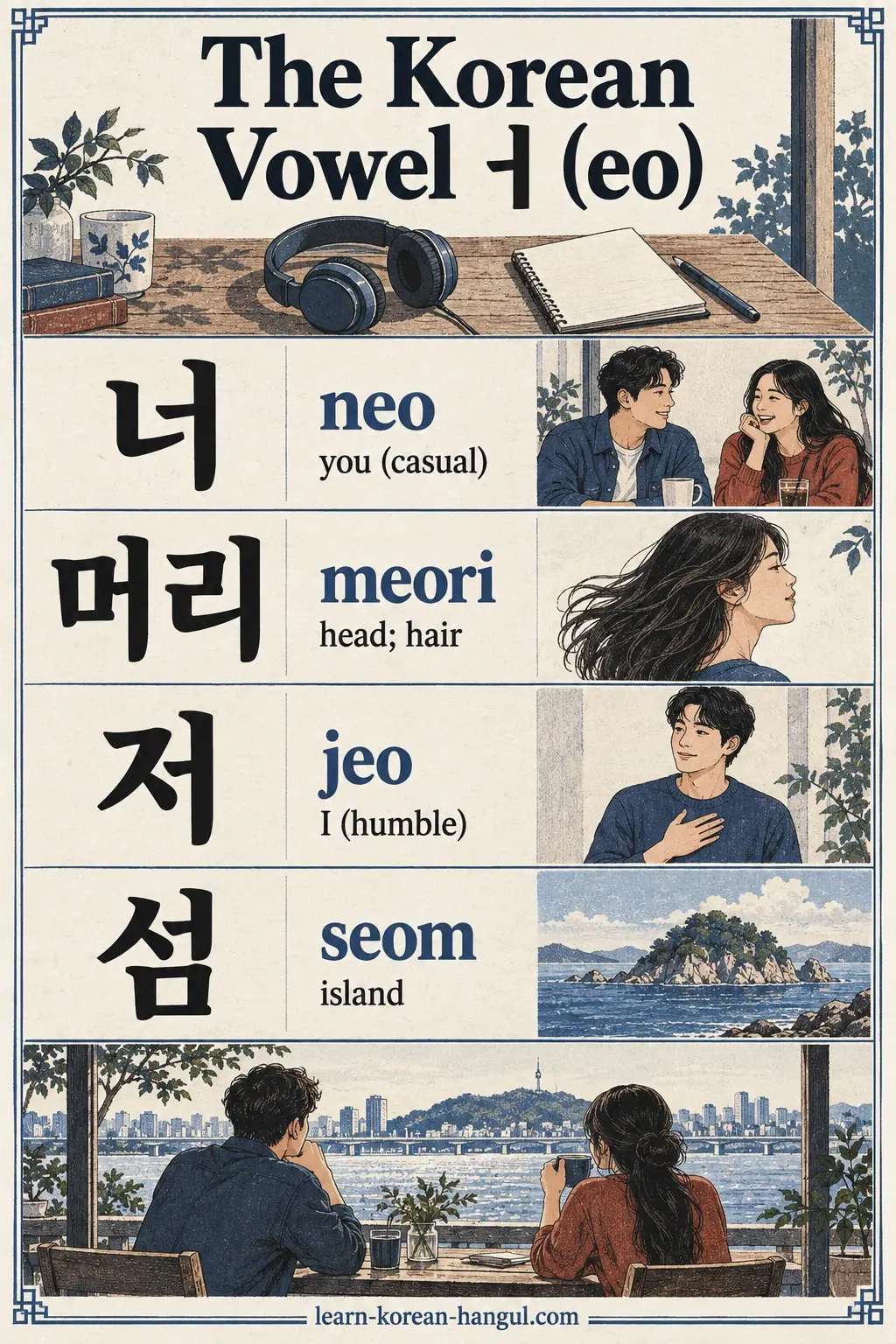
What you'll learn
- Pronounce ㅓ with flat, unrounded lips and a lowered jaw.
- Write ㅓ in the correct 2-stroke order and place it to the right of a consonant.
- Read the words 어머니, 거기 and 서울 without romanization.
- Tell 거기 "there" from 고기 "meat" by ear in at least 4 of 5 tries.
Before you start: you should know the lesson on ㅏ. Time: about 20 minutes, including practice.
Key facts about ㅓ
- Sound: close to the "u" in "cup", lips unrounded; the usual IPA symbol is [ʌ].
- Romanization: "eo" in Revised Romanization, two letters for one vowel.
- Alone: written with the silent placeholder ㅇ as 어.
- Shape: a vertical vowel, 2 strokes, short stroke on the left.
- Vowel class: dark (음성), so it selects -어요 in verbs: 먹어요.
- Main contrast: ㅓ vs ㅗ, as in 거기 "there" vs 고기 "meat".
How Do You Pronounce the Korean Vowel ㅓ?

You pronounce ㅓ by opening the jaw slightly more than for "uh", keeping the lips flat and relaxed, and holding the tongue low and toward the back of the mouth. The result is one steady vowel with no glide. Play the clip below twice before you read on, because your ear is a better guide than any English comparison.
Linguists describe ㅓ as an open-mid back unrounded vowel and usually write it [ʌ]. "Unrounded" means the lips do not form a circle. Some phonetics books write it [ɔ̜] instead, because many Seoul speakers say it a little further back than the English "cup" vowel. Both symbols point to the same target: a back vowel with no lip rounding.
Mouth and Tongue Position for ㅓ
Use these four checkpoints the first few times you say ㅓ:
- Jaw: drop it about one finger-width, a little more than for English "uh".
- Lips: keep them relaxed and flat. They must not push forward or form a circle.
- Tongue: let it lie low, with the back of the tongue slightly raised toward the soft palate.
- Length: hold the vowel steady from start to finish. Do not let it slide into "oh" or "ow".
A mirror check helps. Say 오 (the vowel ㅗ) with small, rounded lips. Now keep your tongue where it is and simply relax your lips flat while lowering the jaw a little. The sound that comes out is close to 어. This works because ㅓ and ㅗ use a similar back tongue position; the lips do most of the work of telling them apart.
How Is ㅓ Different from English Vowels?
ㅓ is different from every English vowel in at least one detail, so treat English only as a starting point. The table compares ㅓ with the English sounds learners most often borrow.
| English sound | Example | How it compares with ㅓ |
|---|---|---|
| "u" in "cup" | cup, but | Closest for most American speakers; ㅓ is a little lower and further back |
| "aw" in "saw" (American) | saw, thought | Close if your lips stay unrounded; many British speakers round this vowel, which makes it sound like ㅗ |
| "o" in "hot" (British) | hot, lot | Too rounded for most speakers; it drifts toward ㅗ |
| "uh" in "the" | the, about | Too short and central; it sounds weak and vague |
Expert insight: learners from the UK and Australia often need a different starting point from Americans. If your "saw" has rounded lips, start from "cup" instead.
With the sound in place, the shape of the letter itself gives you a useful memory hook.
Why Is ㅓ Drawn This Way?
ㅓ is drawn as a long vertical line with a short stroke on its left because of the design system King Sejong's scholars described in the Hunminjeongeum Haerye (1446). Vowels were built from three symbols: a dot for heaven (ㆍ), a flat line for earth (ㅡ) and an upright line for a person (ㅣ). ㅓ is the person line with the heaven dot placed on its left, inner side. Over time the dot became the short stroke you write today.
The side of the stroke carries meaning. In the Haerye scheme, vowels with the dot on the outer side, such as ㅏ, are yang, which Korean grammar now calls bright (양성). Vowels with the dot on the inner side, such as ㅓ, are yin, which grammar calls dark (음성). This still matters in modern Korean. A verb whose last vowel is dark takes the ending -어요, so 먹다 "to eat" becomes 먹어요 "I eat". The page on bright and dark vowels explains the full rule.
Knowing why the stroke is on the left also tells you the order in which to draw it.
How to Write ㅓ in 2 Strokes
You write ㅓ in two strokes, following the general Hangul rule of top to bottom and left to right:
- Stroke 1: draw the short horizontal stroke from left to right. It sits at mid-height and ends where the vertical line will be.
- Stroke 2: draw the long vertical line from top to bottom, touching the right end of the short stroke.
Practise on Paper
- tick, then line down.
You'll know your ㅓ is right when the short stroke is clearly on the left and meets the vertical line near its middle. The most common writing mistake is drawing the stroke on the wrong side, which turns ㅓ into ㅏ (a). Compare ㅓ with ㅏ in Korean vowel stroke order, where the two letters sit side by side.
Writing the letter alone is only half the job, because Korean never writes a vowel without a consonant slot before it.
Where ㅓ Sits in a Syllable Block
ㅓ sits to the right of the first consonant in a syllable block, because it is a vertical vowel (a vowel built on the upright line ㅣ). The consonant takes the left half and ㅓ takes the right half. If the syllable has a final consonant, that consonant goes underneath both.
| Block | Parts | Layout | Sound (RR) | Meaning |
|---|---|---|---|---|
| 거 | ㄱ + ㅓ | consonant left, ㅓ right | geo | first syllable of 거기 "there" |
| 너 | ㄴ + ㅓ | consonant left, ㅓ right | neo | you (casual) |
| 섬 | ㅅ + ㅓ + ㅁ | final ㅁ underneath | seom | island |
| 덜 | ㄷ + ㅓ + ㄹ | final ㄹ underneath | deol | less |
This is the same layout as ㅏ, ㅑ, ㅕ and ㅣ. The lesson on vertical-vowel blocks shows how the consonant shrinks to fit the left half.
Writing ㅓ Alone as 어
To write ㅓ as a syllable on its own, you put the letter ㅇ in the consonant slot: 어. At the start of a syllable ㅇ is silent; it only holds the place, so 어 sounds exactly like the bare vowel. You will see 어 at the start of many words, such as 어머니 "mother" and 어디 "where". The same ㅇ is pronounced "ng" when it sits underneath as a final consonant, as in 성 (seong).
Now you have every piece you need to read real words.
Worked Example: Reading 어머니, 거기 and 서울
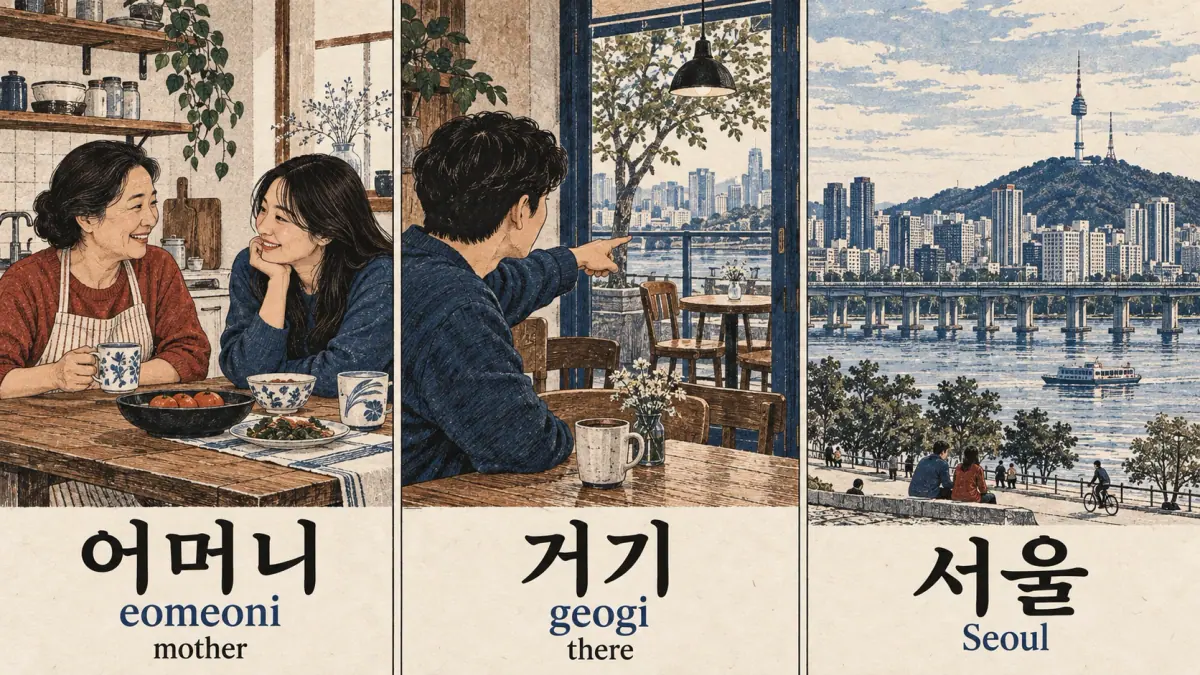
Reading a word means decoding each block, then saying the blocks in one smooth breath. Follow these three words step by step.
어머니 (eomeoni) "mother"
- 어 = silent ㅇ + ㅓ → the bare vowel "eo".
- 머 = ㅁ (m) + ㅓ → "meo".
- 니 = ㄴ (n) + ㅣ (i) → "ni".
- Together: 어머니, with the same unrounded ㅓ in the first two syllables.
거기 (geogi) "there"
- 거 = ㄱ + ㅓ → "geo". At the start of a word ㄱ is a light k-like sound, softer than English "k".
- 기 = ㄱ + ㅣ → "gi". Between vowels ㄱ is often voiced, closer to "g".
- Together: 거기. Keep the lips flat on the first syllable, or the word turns into 고기 "meat".
서울 (Seoul) "Seoul"
- 서 = ㅅ (s) + ㅓ → "seo".
- 울 = silent ㅇ + ㅜ (u) + final ㄹ (l) → "ul".
- Together: 서울, two syllables. It is not one syllable "sole".
The English spelling "Seoul" causes this mix-up. In Revised Romanization the letters "eo" are a single label for ㅓ, not "e" followed by "o". Read as English, "Seoul" looks like one syllable; read as Hangul, 서울 clearly has two blocks. Why romanization uses two letters here is covered in Korean romanization rules.
More example words with ㅓ:
| Word | RR | Meaning | Audio |
|---|---|---|---|
| 너 | neo | you (casual) | |
| 머리 | meori | head; hair | |
| 저 | jeo | I (humble) | |
| 섬 | seom | island |
Reading these words alone is easy; the real test is hearing ㅓ next to the vowel it is most often confused with.
ㅓ vs ㅗ: Hearing the Difference
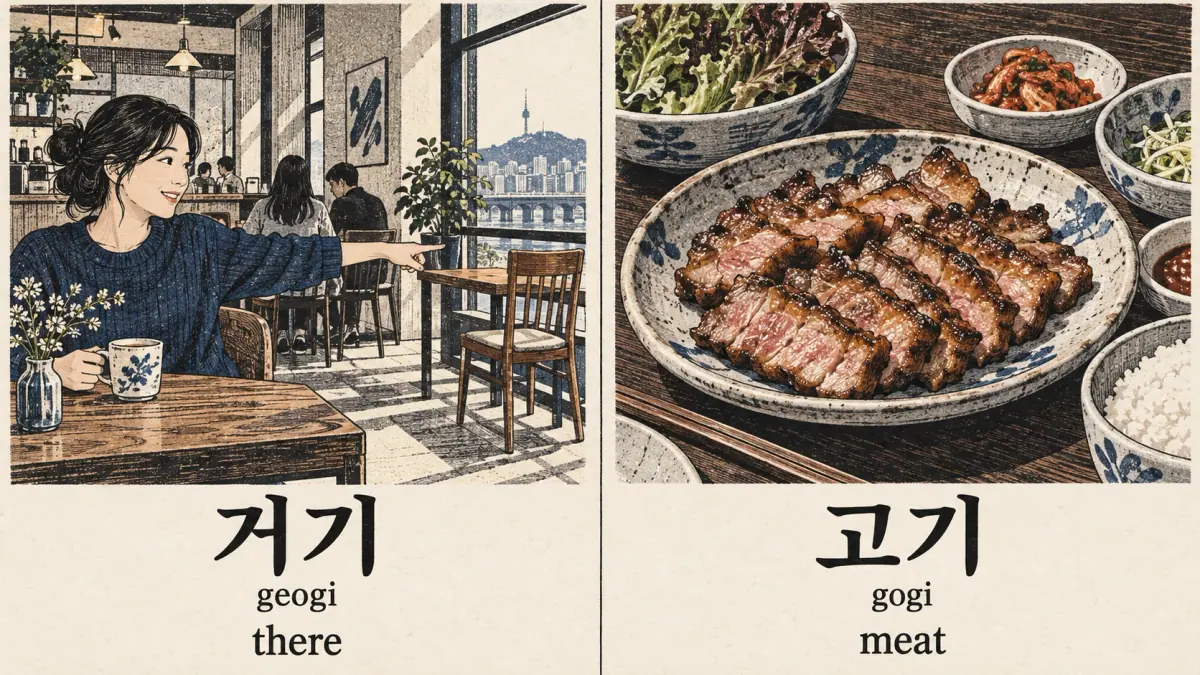
ㅓ and ㅗ are the hardest vowel pair for most beginners, because both use the back of the tongue. The difference is mainly in the lips: ㅗ is rounded and pushed forward, while ㅓ is flat and relaxed, with a slightly lower jaw. Listen to each pair below, then say both words while watching your lips.
Flat Lips vs Rounded Lips
| Korean | Romanization | Meaning | Sound |
|---|---|---|---|
| 거기 | geogi | there | |
| 고기 | gogi | meat |
Flat Lips vs Rounded Lips
| Korean | Romanization | Meaning | Sound |
|---|---|---|---|
| 섬 | seom | island | |
| 솜 | som | cotton |
Lower Jaw vs Smaller, Rounder Mouth
| Korean | Romanization | Meaning | Sound |
|---|---|---|---|
| 덜 | deol | less | |
| 돌 | dol | stone |
| Feature | ㅓ (eo) | ㅗ (o) |
|---|---|---|
| Lips | flat, relaxed | rounded, pushed forward |
| Jaw | slightly lower | slightly higher |
| Tongue | back, low-mid | back, mid-high |
| Shape of letter | vertical, stroke on the left | horizontal, stroke on top |
| Pair example | 거기 "there" | 고기 "meat" |
A useful drill: say 어-오-어-오 slowly, changing only your lips. Then say 거기-고기 five times each. If a friend or a recording can tell which one you said every time, your contrast is reliable.
ㅓ also differs from ㅏ, the vowel before it in the course. ㅏ is more open and further forward, closer to "a" in "father". Compare them here:
Then replay the 어 clip in the pronunciation section above.
For mouth diagrams of all the vowels on one chart, see Korean vowel sounds. Knowing the contrasts makes it easier to spot the mistakes learners make most often.
Which Mistakes Do Learners Make with ㅓ?

The three most common mistakes with ㅓ are rounding the lips, reading "eo" as two vowels, and drawing the stroke on the wrong side. Each one has a clear cause and a quick fix.
Rounding the lips. Learners often assume ㅓ is the "o" in "hot". Actually ㅓ has no lip rounding, because rounding is exactly what makes ㅗ. The result of this mistake is that 거기 "there" sounds like 고기 "meat". Fix: say ㅓ while lightly smiling; a smile makes rounding almost impossible.
Reading "eo" as two vowels. Learners often assume "eo" means "eh-oh". Actually it is one vowel, because Revised Romanization needed two Latin letters for a sound English spelling has no letter for. Fix: cover the romanization and read the Hangul 어 directly.
Swapping ㅓ and ㅏ in writing. Learners often place the short stroke on the right, producing ㅏ. Actually the stroke for ㅓ points left, toward the consonant. Fix: remember "ㅓ points back at the consonant". In 거, the stroke points at ㄱ.
Expert insight: the ㅓ/ㅗ confusion is often a production problem as much as a listening problem. Many learners can hear the difference in recordings but still round their lips when they speak. Recording yourself is the fastest way to catch it.
Try the exercises below to check that the fixes have stuck.
Practice: Read and Hear ㅓ

Do these four exercises in order. Answers are at the end of this section.
Practice · 8
What do your lips do when you say ㅓ?
Show answer
Stay flat and relaxed
ㅓ is unrounded: the lips stay flat and relaxed. Rounding is what makes ㅗ.
Which word means "there"?
Show answer
거기
거기 has flat-lipped ㅓ and means there; 고기 has rounded ㅗ and means meat.
What does the romanization "eo" stand for?
Show answer
One vowel, ㅓ
Revised Romanization uses two Latin letters as a single label for the one vowel ㅓ.
How many syllables does 서울 have in Korean?
Show answer
2
서울 is two blocks, 서 and 울, so it has two syllables.
Which stroke do you draw first when writing ㅓ?
Show answer
The short horizontal stroke
Following left-to-right order, ㅓ starts with the short stroke on the left, then the vertical line.
Which verb ending does ㅓ, a dark vowel, select in 먹다?
Show answer
먹어요
A verb whose last vowel is dark takes -어요, so 먹다 becomes 먹어요.
Which syllable is ㄴ + ㅓ?
Show answer
너
ㅓ is a vertical vowel, so ㄴ goes on the left: 너.
Which word means "island"?
Show answer
섬
섬 has ㅓ and means island; 솜 has ㅗ and means cotton.
Exercise 1: Read aloud. Read each word, then check with the audio: 어디 "where", 버스 "bus", 머리 "head", 너 "you".
Exercise 2: Which vowel? Play each clip and decide whether you hear ㅓ or ㅗ: (a) 고기, (b) 섬, (c) 돌, (d) 거기, (e) 솜.
Exercise 3: Build the block. Write the syllable made from each set: (a) ㄴ + ㅓ, (b) ㅁ + ㅓ + ㄱ, (c) ㅇ + ㅓ.
Exercise 4: Spot the error. One of these is not ㅓ: ㅓ, ㅏ, 어, 거. Which one, and why?
Answers to the Practice
- Exercise 1: each word contains ㅓ in its first syllable. If yours sounded like 오디, 보스, 모리 or 노, your lips were rounded.
- Exercise 2: (a) ㅗ, (b) ㅓ, (c) ㅗ, (d) ㅓ, (e) ㅗ. A score of 4 or 5 out of 5 means your ear is ready for the next lesson.
- Exercise 3: (a) 너, (b) 먹 (as in 먹다 "to eat"), (c) 어.
- Exercise 4: ㅏ is not ㅓ. Its short stroke points right, away from the consonant.
To keep practising, drill ㅓ in the Hangul flashcard decks, which play audio only when you tap, and test your ear for ㅓ and ㅗ with the Hangul quizzes. You can also build blocks such as 거, 너 and 섬 in the Hangul syllable builder or tap every vowel in the interactive Hangul alphabet.
What Should You Learn after the Korean Vowel ㅓ?
After the Korean vowel ㅓ, continue to the lesson on the vowel ㅗ, its rounded partner. Learning them back to back locks in the lip contrast while it is fresh. To see where ㅓ fits among all ten, return to the overview of basic Korean vowels.
For handwriting, print the Korean vowels writing practice sheet and keep the Korean vowels chart in view while you study.
What this lesson covers and doesn't: this page teaches the sound, shape, block position and main contrasts of ㅓ. It does not cover the y-vowel ㅕ, the compound vowels ㅔ and ㅝ that contain ㅓ, or the full rules of -어요 conjugation. Those have their own lessons. The audio on this page models one standard Seoul pronunciation; regional accents vary, and the clips are marked with their review status.
Frequently Asked Questions about ㅓ
Is ㅓ pronounced like "uh" or "aw"? ㅓ sits between the two. It is close to the "u" in American "cup", said with the jaw a little lower and the tongue a little further back, and close to the "aw" in "saw" if you keep your lips completely unrounded. Neither is exact, so copy the audio.
Why is ㅓ romanized eo? The Latin alphabet has no single letter for this sound, so Revised Romanization (2000) uses the two-letter combination "eo" for one vowel. It is a label, not an instruction to say "e" and then "o". The older McCune-Reischauer system wrote the same vowel as ŏ, which is why older books spell Seoul as Sŏul.
How do I stop confusing ㅓ and ㅗ? Watch your lips in a mirror. ㅗ needs small, rounded lips pushed forward; ㅓ needs relaxed, flat lips and a slightly lower jaw. Practise the pairs 거기/고기 and 섬/솜 slowly, then at normal speed, and record yourself. Most confusion disappears once the lip difference becomes a habit.
How many syllables are in Seoul? Seoul has two syllables in Korean: 서 and 울, said roughly "saw-ool" with unrounded lips on the first. The English habit of saying one syllable, "sole", comes from reading the romanization "Seoul" as an English word. In Hangul the two blocks 서울 make the count obvious.
Does ㅓ sound different for older speakers? Some speakers, mostly older ones, pronounce a long ㅓ in certain words a little higher and more central, closer to the vowel in English "the". Younger Seoul speakers rarely keep this length difference. Learners do not need to copy it; aim for the standard short ㅓ heard in the audio on this page.