
| Korean | Name | Romanization | Family | Sound |
|---|---|---|---|---|
| ㅏ | 아 | a | basic | a in "father" |
| ㅑ | 야 | ya | basic | ya in "yacht" |
| ㅓ | 어 | eo | basic | between u in "cup" and aw in "law" |
| ㅕ | 여 | yeo | basic | y + ㅓ |
| ㅗ | 오 | o | basic | o in "go", shorter and pure |
| ㅛ | 요 | yo | basic | yo in "yoga" |
| ㅜ | 우 | u | basic | oo in "moon" |
| ㅠ | 유 | yu | basic | "you" |
| ㅡ | 으 | eu | basic | oo in "moon" with lips spread |
| ㅣ | 이 | i | basic | ee in "see" |
| ㅐ | 애 | ae | compound | e in "bed" |
| ㅒ | 얘 | yae | compound | ye in "yes" |
| ㅔ | 에 | e | compound | e in "bed" |
| ㅖ | 예 | ye | compound | ye in "yes" |
| ㅘ | 와 | wa | compound | "wah" |
| ㅙ | 왜 | wae | compound | we in "wet" |
| ㅚ | 외 | oe | compound | we in "wet" |
| ㅝ | 워 | wo | compound | "wuh" |
| ㅞ | 웨 | we | compound | we in "wet" |
| ㅟ | 위 | wi | compound | "wee" |
| ㅢ | 의 | ui | compound | ㅡ gliding into ㅣ |
What Are Korean W Vowels?
Korean w vowels are the six vowels that begin with a short "w" glide. A glide is a very short vowel-like sound that moves straight into the next vowel. In each w-vowel, ㅗ or ㅜ turns into that glide and the second vowel carries the syllable. They are a subset of the 11 Korean compound vowels, and the other five compound vowels are ㅐ ㅒ ㅔ ㅖ ㅢ.
Think of w-vowels as the movement of the lips from round to relaxed. Within the 21 Korean vowels, they are the six that ask the lips to do two jobs in one beat.
How ㅗ and ㅜ Combine with Other Vowels
ㅗ combines with ㅏ, ㅐ and ㅣ, and ㅜ combines with ㅓ, ㅔ and ㅣ. Each pairing produces one w-vowel.
| Starts with | Second vowel | Result | Revised Romanization | Example |
|---|---|---|---|---|
| ㅗ | ㅏ | ㅘ | wa | 사과 "apple" |
| ㅗ | ㅐ | ㅙ | wae | 왜 "why" |
| ㅗ | ㅣ | ㅚ | oe | 외국 "foreign country" |
| ㅜ | ㅓ | ㅝ | wo | 뭐 "what" |
| ㅜ | ㅔ | ㅞ | we | 스웨터 "sweater" |
| ㅜ | ㅣ | ㅟ | wi | 귀 "ear" |
The rows follow a simple pattern: ㅗ takes the second vowels that are bright or neutral, and ㅜ takes the dark or neutral ones. In the traditional naming, ㅗ and ㅏ are bright vowels, while ㅜ and ㅓ are dark vowels. The idea is called vowel harmony, and bright and dark vowels explains the rule.
Why Is There No ㅗ + ㅓ?
There is no ㅗ + ㅓ because it would join a bright vowel with a dark one, which vowel harmony avoids. ㅗ is bright and ㅓ is dark, so Hangul has no such letter. The same logic keeps ㅜ away from ㅏ. If you ever wonder whether a w-vowel exists, check that the two parts match in brightness.
ㅘ and ㅝ: Wa and Wo
ㅘ and ㅝ are the clearest pair of w-vowels, and they are the ones that appear earliest in verbs. ㅘ is [wa], as in 사과 (sagwa, "apple"), and ㅝ is [wo], like the "wo" in "won", as in 뭐 (mwo, "what"). They are partners: ㅘ is bright (ㅗ + ㅏ) and ㅝ is dark (ㅜ + ㅓ). Start with the vowel ㅘ, found in 사과 (apple), then move to the vowel ㅝ, the dark partner of ㅘ.
ㅟ: the W-Vowel with ㅣ
ㅟ is [wi]: lips round for ㅜ and then spread into ㅣ, as in 귀 (gwi, "ear") and 쉬다 (swida, "to rest"). The standard allows ㅟ to be said either as a gliding vowel or as a single rounded front vowel, and most speakers use the gliding version. The vowel ㅟ combines ㅜ with ㅣ, and its lesson gives words and audio.
Why Do ㅙ, ㅚ and ㅞ Sound the Same?
ㅙ, ㅚ and ㅞ sound the same for most present-day speakers: all three are read [we], like English "weh". Their spellings differ because Korean spelling preserves older sounds. 왜 "why" uses ㅙ, 외국 "foreign country" uses ㅚ, and 웨 in 스웨터 "sweater" uses ㅞ. Learn ㅙ, ㅚ and ㅞ together because they share one sound, and memorise each word's spelling. The shared lesson is ㅙ, ㅚ and ㅞ.
This is a statement about most present-day speakers. The standard-language rules still list ㅚ as a separate vowel, and some speakers keep a difference.
Which W-Vowel Should You Learn First?
Learn ㅘ first, then ㅝ, then ㅟ, then ㅙ, ㅚ and ㅞ together. This order starts with the vowels beginners meet earliest, in common verbs, and ends with the group that shares one sound.
- You want to read verbs soon: begin with ㅘ and ㅝ, because 봐요, 와요 and 줘요 contain them.
- You want everyday nouns: add ㅟ (귀, 쉬다) and the shared [we] sound (왜, 외국).
- You are a spelling-driven learner: treat ㅙ, ㅚ and ㅞ as one sound with three spellings, and learn them word by word.
- You are short on time: learn ㅘ, ㅝ and ㅟ now, and return to the rest later.
Verb forms are a preview of the grammar section. 보다 → 봐요, 오다 → 와요, 주다 → 줘요 and 되다 → 돼요 each contain a w-vowel created by a contraction.
How Do W-Vowels Sit in a Block?
All six w-vowels are written around the consonant in a mixed layout: the consonant at the top left, the ㅗ or ㅜ part below it, and the second vowel on the right. The consonant shares the block with two vowel parts, as in 과 and 귀, so each part must stay small. Practise writing them in mixed-vowel blocks.
W-Vowels Side by Side
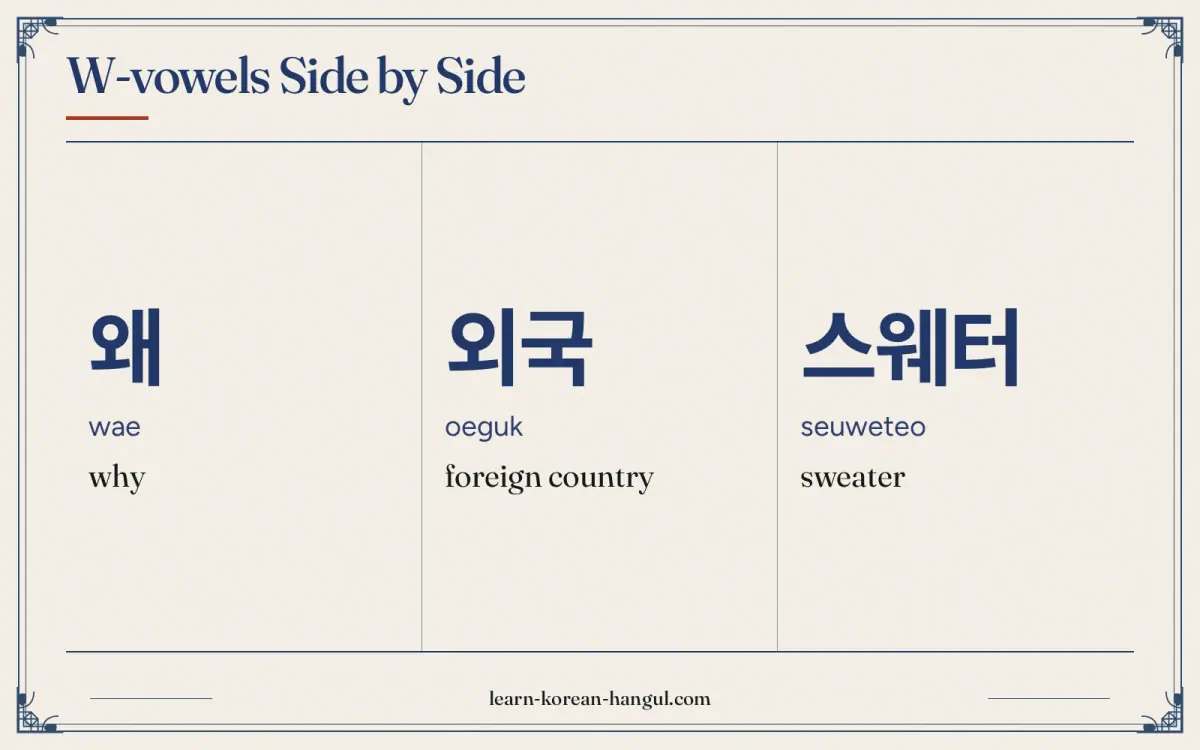
This table puts the six together. Use it to check your reading after the lessons.
| Letter | Parts | Revised Romanization | Sound for most speakers | Example |
|---|---|---|---|---|
| ㅘ | ㅗ + ㅏ | wa | "wa" | 사과 |
| ㅙ | ㅗ + ㅐ | wae | "weh" | 왜 |
| ㅚ | ㅗ + ㅣ | oe | "weh" | 외국 |
| ㅝ | ㅜ + ㅓ | wo | "wuh" | 뭐 |
| ㅞ | ㅜ + ㅔ | we | "weh" | 스웨터 |
| ㅟ | ㅜ + ㅣ | wi | "wee" | 귀 |
Three Spellings, One Sound for Most Speakers: [we].
| Korean | Romanization | Meaning | Sound |
|---|---|---|---|
| 왜 | wae | why | |
| 외국 | oeguk | foreign country | |
| 스웨터 | seuweteo | sweater |
Review the group with the Korean compound vowels page. To see where the w-vowels sit among all 21 letters, return to all Korean vowels.
Frequently Asked Questions
Why does ㅚ have no 'w' in its romanization? Revised Romanization spells ㅚ as "oe" because it follows the letter parts, ㅗ and ㅣ, rather than the common sound. The pronunciation for most speakers is [we], like the vowel in 왜. So "oe" in a romanized word is read "weh". The spelling is a learning aid, not a pronunciation guide.
Are w-vowels harder than y-vowels? Slightly, for two reasons. The mixed layout makes them harder to write, and the mergers (ㅙ, ㅚ and ㅞ) make them harder to spell. The sound idea is the same as for y-vowels: a short glide before a vowel. Most learners find the w-glide easy to produce once they round the lips first.
Can I learn ㅙ, ㅚ and ㅞ as one sound? Yes, for listening and speaking. For most present-day speakers all three are [we]. For reading and writing you still need to know which letter goes in each word, so learn the spelling with the word, such as 왜, 외국 and 스웨터. A short list of common words usually covers most of what you meet.
Which w-vowel is most common? This site does not claim a frequency ranking. For beginners, ㅘ and ㅝ appear earliest, in verbs such as 봐요, 와요 and 줘요, and ㅟ appears in words like 귀 "ear" and 쉬다 "to rest". A frequency list based on a Korean corpus would be needed to rank them, and none is cited here.
How do I type w-vowels? On a standard Korean two-set keyboard, type the starter vowel and then the second vowel, and the computer joins them. ㅗ + ㅏ gives ㅘ, ㅜ + ㅓ gives ㅝ, and ㅜ + ㅣ gives ㅟ. The keys are h, k, n, j and l, so ㅘ is "hk" and ㅟ is "nl".