
What you will learn in about 15 minutes
- Say ㅟ as [wi] and explain why a second pronunciation [y] exists.
- Write ㅟ from ㅜ and ㅣ inside a syllable block.
- Tell 위, 의 and 이 apart by ear.
- Read 귀, 위, 뒤, 쉬다, 바퀴 and 가위 aloud.
Before you start: learn the vowels ㅜ and ㅣ, because ㅟ is made from both.
What Sound Does ㅟ Make?
ㅟ makes the sound [wi], like the English word “we”. Say “week” and stop before the k. The lips start round for the “w” and spread flat for the “ee”. This is the pronunciation you will hear in everyday speech and in most learner materials.
Listen to the letter and three words that contain it, and repeat them.
Revised Romanization, the government system for writing Korean in Latin letters, spells ㅟ as “wi”. For this letter the romanization is a good guide. The Hangul orthography rules (한글 맞춤법) list ㅟ among the eleven compound vowel letters, which are made from the ten basic vowels.
How Is ㅟ Built from Simpler Vowels?
ㅟ is ㅜ plus ㅣ. The rounded ㅜ becomes a short “w” glide, and ㅣ carries the final “ee”. In the written block, ㅜ lies under the consonant and ㅣ stands to its right, so ㅟ is a mixed vowel.
| Part | Sound | Role in ㅟ | Position in the block |
|---|---|---|---|
| ㅜ | [u] | becomes the w-glide | under the consonant |
| ㅣ | [i] | the ending vowel | to the right of the consonant |
| ㅟ | [wi] | the combined sound | both positions at once |
Compare this with the other w-vowels. ㅘ is ㅗ plus ㅏ and ㅝ is ㅜ plus ㅓ. ㅟ differs because its second part is the neutral vowel ㅣ, which ends with the tongue high and forward. The Korean w-vowels overview shows the whole family.
With the sound and the design clear, the next step is to put the letter on paper.
Writing ㅟ: Stroke Order and Typing
Write ㅟ in three strokes: a horizontal line and a short downward stroke for ㅜ, then one long vertical line for ㅣ on the right. The rule is top before bottom and left before right, so the ㅜ comes first and the tall ㅣ closes the shape. Unlike ㅘ and ㅝ, ㅟ has no extra short stroke on the vertical line.
Practise on Paper
- Draw the horizontal line of ㅜ under the consonant, left to right.
- Draw the short stroke of ㅜ, hanging downward from the middle of that line.
- Draw the long vertical line of ㅣ from top to bottom along the right edge of the block.
- Draw the horizontal line of ㅜ under the consonant, left to right.
- Draw the short stroke of ㅜ, hanging downward from the middle of that line.
- Draw the long vertical line of ㅣ from top to bottom along the right edge of the block.
You will know it worked when the vertical line runs the full height of the block and the ㅜ part sits low on the left. A common mistake is a short vertical line, which makes the block look squashed. Another is crossing the ㅜ line through the ㅣ line.
Guides differ slightly on stroke order for some letters. The Hangul stroke order lesson explains the convention used on this site.
To type 위 on a computer with the standard Korean keyboard, press D for the silent ㅇ, then N for ㅜ, then L for ㅣ. The how to type in Korean guide shows the whole layout.
Knowing the shape, the next question is how to produce the sound.
How to Pronounce the Korean Vowel ㅟ Step by Step
To pronounce the Korean vowel ㅟ, round your lips for a short “w”, then spread them and raise your tongue to a high “ee” position, all in one smooth movement. The lips move from round to flat, and the tongue moves forward and up. Follow these steps with a mirror.
- Round your lips as if saying “oo” for a split second.
- Start voicing a very short “w”.
- Spread your lips and raise the front of your tongue toward the roof of your mouth.
- Finish on a clear “ee”, like the vowel in “see”.
- Stop without adding another sound.
You will know it worked when your lips are flat at the end and the sound ends on a bright “ee”. The first part is a glide, a very short vowel-like sound that leads into the main vowel.
Is ㅟ a Monophthong or a Diphthong?
ㅟ is listed in two ways in the Standard Pronunciation rules (표준 발음법). Article 4 lists it as a monophthong, a single steady vowel pronounced like German ü, written [y]. A note to that article allows speakers to pronounce it as a diphthong, [wi], which is the two-part sound described above. Many speakers use [wi], and learner materials teach [wi] as the default.
| Version | Symbol | How to make it | Where you meet it |
|---|---|---|---|
| Diphthong | [wi] | lips round, then spread | everyday speech, learner materials |
| Monophthong | [y] | lips stay round, tongue in “ee” position | standard-rule listing, some speakers |
Both versions are accepted, so you can choose [wi] and still be understood. The one you should avoid is a long “oo-ee” in two beats. Keep it quick.
If you hear [y] from a speaker, it is not a mistake. It is the other standard version.
To practise recognising [y], say “ee” and keep your tongue exactly where it is. Now round your lips without moving the tongue. The sound that comes out is [y]. You do not need to produce it, but knowing how it sounds helps you understand speakers who use it, and it explains why some textbooks describe ㅟ as a single vowel.
What Do 위 and 뒤 Mean?
위 means “above” or “on top”, and 뒤 means “behind” or “back”. Both are location words, and both contain ㅟ, so they are a useful pair to learn together. They also join with the particle 에 to say where something is.
| Word | Meaning | Opposite | Example |
|---|---|---|---|
| 위 | above, on top | 아래 (below) | 책상 위 (on the desk) |
| 뒤 | behind, back | 앞 (front) | 의자 뒤 (behind the chair) |
Location words almost always take the particle 에, which means “at” or “in”. Putting it after the word tells you where something is. The table shows the five common ones, so you can see 위 and 뒤 in their natural company.
| Word | Meaning | With 에 | Meaning |
|---|---|---|---|
| 위 | above | 위에 | on top, above |
| 아래 | below | 아래에 | underneath |
| 앞 | front | 앞에 | in front |
| 뒤 | behind | 뒤에 | behind |
| 옆 | side | 옆에 | beside |
Notice that these are short words with a single block, so they train quick recognition. You will meet the same words in directions later in the Korean city vocabulary.
Worked Example: Reading Words with ㅟ
Reading a block means asking three questions: what is the first consonant, which vowel is it, and is there a final consonant. Here is 귀 (ear), decoded step by step.
- The block has ㄱ at the top-left, ㅜ under it, and ㅣ to the right.
- ㄱ gives you [g] and ㅟ gives you [wi].
- Together: [gwi]. The word means “ear”.
Next, 바퀴 (wheel). The first block 바 is ㅂ plus ㅏ, [ba]. The second block 퀴 is ㅋ plus ㅟ, [kwi], with a puff of air on the ㅋ. Together they are [ba-kwi].
Here are more words to read aloud.
| Word | Sound | Meaning | Block parts |
|---|---|---|---|
| 위 | [위] | above | ㅇ + ㅟ |
| 귀 | [귀] | ear | ㄱ + ㅟ |
| 뒤 | [뒤] | behind | ㄷ + ㅟ |
| 쉬다 | [쉬다] | to rest | 쉬 + 다 |
| 쥐 | [쥐] | mouse, rat | ㅈ + ㅟ |
| 가위 | [가위] | scissors | 가 + 위 |
| 바퀴 | [바퀴] | wheel | 바 + 퀴 |
| 취미 | [취미] | hobby | 취 + 미 |
Because ㅟ is a mixed vowel, it occupies both the space below the consonant and the space to its right. The page on how syllable blocks are shaped shows all six layouts.
How Does ㅟ Compare with ㅘ and ㅝ?
ㅟ is one of four w-vowels built from two basic vowels (ㅘ, ㅚ, ㅝ and ㅟ). ㅚ is left out here because most speakers say it like ㅙ and ㅞ, so comparing ㅟ with ㅘ and ㅝ shows most clearly why each one sounds different. The table lists the build, the sound, the key word and the best English anchor.
| Vowel | Built from | Sound | Key word | English anchor |
|---|---|---|---|---|
| ㅘ | ㅗ + ㅏ | [wa] | 사과 (apple) | “wa” in “water” |
| ㅝ | ㅜ + ㅓ | [wʌ] | 원 (won) | “wo” in “won” |
| ㅟ | ㅜ + ㅣ | [wi] | 귀 (ear) | “wee” in “week” |
The shared feature is the rounded start, which comes from ㅗ or ㅜ. The difference is the ending vowel: open ㅏ, unrounded ㅓ or high ㅣ. Learning them as a set, rather than one by one, makes the family easier to remember. The vowel ㅝ lesson covers the middle one in depth.
ㅟ vs ㅢ vs ㅣ
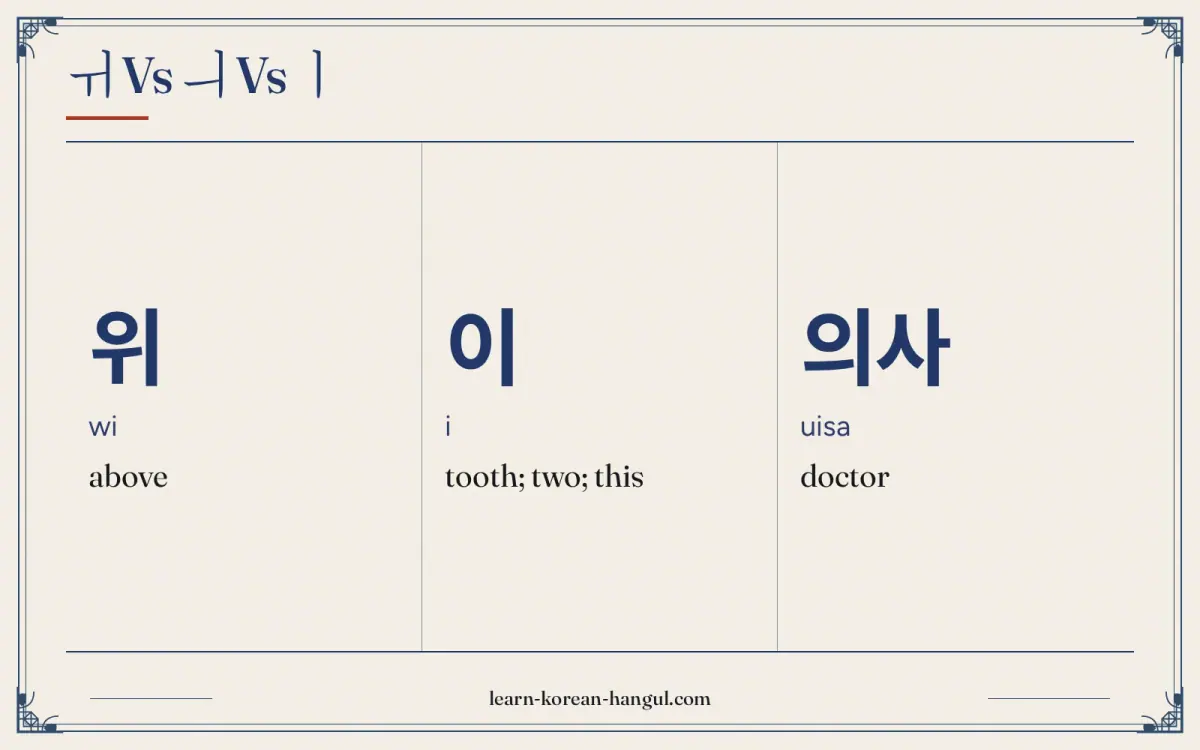
ㅟ is [wi], ㅢ is [ɰi], and ㅣ is [i]. All three end in an “ee”-like sound, so the opening of the sound is the clue. The table pairs each lookalike with a real word.
| Pair | Sound difference | Example words | Visual cue |
|---|---|---|---|
| 위 / 이 | [wi] vs [i] | 위 (above) / 이 (tooth, two, this) | extra ㅜ vs none |
| 위 / 의 | [wi] vs [ɰi] | 위 (above) / 의사 (doctor) | round vs flat lips at the start |
| 귀 / 구 | [gwi] vs [gu] | 귀 (ear) / 구 (nine) | ㅣ added vs ㅜ alone |
| 쉬다 / 시다 | [swi-da] vs [si-da] | 쉬다 (rest) / 시다 (sour) | w-glide vs none |
위: Lips Round, Then Spread. 이: Lips Flat Throughout.
| Korean | Romanization | Meaning | Sound |
|---|---|---|---|
| 위 | wi | above | |
| 이 | i | tooth; two; this |
위: Rounded Start. 의: Flat Lips from Start to End.
| Korean | Romanization | Meaning | Sound |
|---|---|---|---|
| 위 | wi | above | |
| 의사 | uisa | doctor |
귀: Ends on a Bright Ee. 구: Stays on a Rounded Oo.
| Korean | Romanization | Meaning | Sound |
|---|---|---|---|
| 귀 | gwi | ear | |
| 구 | gu | nine |
The visual cue is the ㅜ under the consonant. If a block has ㅜ plus ㅣ, it is ㅟ. If it has ㅡ plus ㅣ, it is ㅢ. The vowel ㅢ lesson explains how the lips differ.
How Can You Remember ㅟ?
The easiest way to remember ㅟ is to read it as two letters stuck together: first ㅜ, then ㅣ. Three cues work for most learners.
- Build it: ㅜ + ㅣ = ㅟ. “Oo” then “ee” becomes “wee”.
- Anchor a word: 귀 for “ear” and 위 for “above”. Point to your ear when you see the letter.
- Check the tongue: the sound ends where the tongue is highest and furthest forward, as with ㅣ.
Example Sentences with ㅟ
Short sentences help the vowel stick, because you hear it in a natural rhythm. Each line uses a word from this lesson.
- 책이 위에 있어요. (Chaegi wie isseoyo.) The book is on top.
- 의자 뒤에 있어요. (Uija dwie isseoyo.) It is behind the chair.
- 푹 쉬세요. (Puk swiseyo.) Please rest well.
- 가위가 어디 있어요? (Gawiga eodi isseoyo?) Where are the scissors?
The romanization in brackets is only a guide. Notice that every ㅟ here is said [wi], with a clear round-to-flat lip movement.
Common Mistakes Learners Make with ㅟ
Learners often assume ㅟ must be said as the German-style single vowel [y], but [wi] is the safer default. Practising [y] first can sound unnatural to ears that expect [wi].
- Mistake: stretching it into two beats. “Oo-ee” with a gap is not ㅟ. Fix: say it as one quick glide, like “we”.
- Mistake: dropping the w. Saying 이 when you mean 위 changes the word. Fix: round your lips before the sound starts.
- Mistake: confusing 위 and 의. Both end in ㅣ. Fix: check the lips, round for 위 and flat for 의.
- Mistake: squashing the block. The tall ㅣ line must run the full height. Fix: write on a square grid.
- Mistake: skipping the lip movement. If the lips stay flat the whole time, 위 turns into 이. Fix: feel the lips round first, then spread.
Honest limit: this lesson teaches the [wi] version, because it is the safer default for learners. A speaker you meet in Korea may use [y] in some words and [wi] in others, and the difference varies by person and by situation. Treat the two as variants of one letter rather than as separate sounds, and let your ear adjust over time. If a conversation partner seems to say a different vowel, check the written block first: ㅜ plus ㅣ is always ㅟ.
Practice: Read, Hear and Write
Try all three exercises, then check the answers at the end.
Practice · 8
Which two vowels combine to make ㅟ?
Show answer
ㅜ + ㅣ
ㅟ is ㅜ plus ㅣ: the rounded ㅜ becomes a short w-glide and ㅣ carries the final "ee".
How does Revised Romanization spell ㅟ?
Show answer
wi
ㅟ is spelled wi, and for this letter the romanization is a good guide. ui is ㅢ and wo is ㅝ.
What does 귀 mean?
Show answer
ear
귀 is ㄱ plus ㅟ, read [gwi], and means "ear". 위 is above, 뒤 is behind and 쥐 is mouse.
Which word means "behind"?
Show answer
뒤
뒤 means behind or back, and its opposite is 앞 (front). 위 is above, 가위 is scissors and 귀 is ear.
Which statement about how ㅟ is pronounced is true?
Show answer
Both [wi] and [y] are standard, and [wi] is the safe default for learners
The Standard Pronunciation rules list ㅟ as the monophthong [y] and allow the diphthong [wi]. Either is accepted, but never a slow two-beat "oo-ee".
What tells 위 apart from 의 at the start of the sound?
Show answer
Rounded lips for 위, flat lips for 의
Both end in an "ee"-like sound, so the opening is the clue: 위 starts with rounded lips and 의 keeps the lips flat throughout.
How many strokes does ㅟ take to write?
Show answer
3
Two strokes for ㅜ (the horizontal line, then the short downward stroke) and one long vertical line for ㅣ.
Which block contains the vowel ㅟ?
Show answer
쥐
쥐 has ㅜ under the consonant and ㅣ to its right, which is ㅟ. 의 has ㅡ plus ㅣ, 이 has only ㅣ and 구 has only ㅜ.
Exercise 1: pick by sound. Does each clip contain ㅣ or ㅟ?
Exercise 2: read aloud. 위, 귀, 뒤, 쉬다, 쥐, 가위, 바퀴, 취미.
Exercise 3: write from dictation. Listen and write each syllable or word.
Exercise 4: round to flat. Say 위 ten times in front of a mirror. Your lips should start round and finish flat. Record yourself and compare with the clip.
Answers. Exercise 1: Clips B and D contain ㅟ (위, 귀). Clips A and C contain ㅣ (이, 기). Exercise 2: above, ear, behind, to rest, mouse, scissors, wheel, hobby. Exercise 3: check that ㅜ sits low on the left and the long ㅣ line runs the full block height.
What to Learn Next
You can now say and write the Korean vowel ㅟ, and you know that [wi] and [y] are both standard. The next lesson is ㅙ, ㅚ and ㅞ, the last w-vowels. You can also return to the Korean w-vowels overview.
Review ㅟ with the Hangul flashcard decks, test your ear in the Hangul quizzes, and build blocks in the Hangul Syllable Builder. The interactive Hangul alphabet plays every letter. For mouth positions across all vowels, read the Korean vowel pronunciation guide.
This lesson does not cover particle grammar for 에, the full set of location words, or regional differences in pronunciation. Those topics have their own sections.
Frequently Asked Questions
Frequently Asked Questions
Should I say ㅟ like German ü?
You can, but you do not need to. The Standard Pronunciation rules list ㅟ as a single vowel like German ü, [y], and also allow the two-part sound [wi]. Everyday speech and most learner materials use [wi], like “wee” in “week”. Use [wi] first, and learn [y] only for recognition.
What is the difference between 위 and 의?
위 is [wi], with a rounded “w” start, and means “above”. 의 is a different vowel, ㅢ, said with unrounded lips as [ɰi] or [ɯi], and appears in words like 의사 (doctor). Both end in ㅣ, so the lips are the clue: round for 위, flat for 의.
Is 귀엽다 pronounced with [wi]?
Yes. In 귀엽다, meaning “cute”, the first block 귀 has ㅟ, pronounced [wi] (or [y]). The rest of the word has a sound change: the final ㅂ makes the next ㄷ tense, so the word is said [귀엽따]. The spelling stays 귀엽다, and the rule is covered in the pronunciation section.
How do I type ㅟ?
On the standard two-set (2-beolsik) Korean keyboard, ㅟ is typed as two keys: N for ㅜ and then L for ㅣ. To type 위, press D for the silent ㅇ, then N, then L. The input method joins all three keys into one syllable block automatically.
What does 쉬다 mean?
쉬다 means “to rest” or “to take a break”. Koreans use it for time off, sleep after work and holidays. The polite request 푹 쉬세요 means “Please rest well”. The word 휴일 (holiday) is related in meaning, but 쉬다 is the everyday verb you will hear most often.