
What you will be able to do after this lesson
- Pronounce ㅘ as one smooth [wa], not as two separate sounds.
- Write ㅘ in 4 strokes and place it in a mixed-layout block, as in 과.
- Tell 과, 가 and 고 apart, and 화, 하 and 호.
- Read five words aloud: 사과, 과일, 화장실, 와요 and 봐요.
- Recognise ㅘ inside two common verb forms before you study the grammar.
Before you start: the lessons on the vowel ㅗ and the vowel ㅏ are needed, because ㅘ is made from both. Time: about 20 minutes. Level: A0.
What Sound Does ㅘ Make?
ㅘ makes the sound [wa]: a quick rounded "w" that opens straight into an "ah". It is one syllable, like English "wa" in "wander" or "wah" in "wasabi". Listen to the vowel name 와.
Revised Romanization, the official Latin-letter system of South Korea, writes ㅘ as "wa". After a consonant it becomes "gwa", "hwa" and so on, as in 과 and 화. This is consistent, and the spelling is only a learning aid.
Linguists call the first part of ㅘ a glide. A glide is a very short vowel-like sound that moves quickly into the next vowel. In ㅘ, the glide is the rounded "w" sound taken from ㅗ. Standard Pronunciation Article 5 of the National Institute of Korean Language rules lists ㅘ among the diphthongs, meaning vowels that glide from one position to another. The word is more technical than the idea: ㅘ is simply "w" plus "ah".
How Is ㅘ Built from Simpler Vowels?
ㅘ is built by writing ㅗ and ㅏ together: ㅗ + ㅏ = ㅘ. The rounded ㅗ turns into a short "w" glide before ㅏ, so the two sounds merge into one beat.
| Part | Role | Sound contribution |
|---|---|---|
| ㅗ | first element | the rounded "w" glide |
| ㅏ | second element | the open "ah" that carries the syllable |
Think of ㅘ as the movement of the mouth from a small round "o" shape to a wide open "ah" shape. The movement takes about as long as one normal vowel, not two. Do not pronounce [o-a] as two syllables.
The vowels ㅗ and ㅏ are both bright vowels (양성 모음, yangseong moeum), which is why they can combine. In the Hangul vowel system, ㅗ pairs with bright partners (ㅏ, ㅐ) or the neutral ㅣ, and ㅜ pairs with dark partners (ㅓ, ㅔ) or the neutral ㅣ. That is why a combination "ㅗ + ㅓ" never appears. Bright and dark vowels explains the pairing in full, and the dark partner of ㅘ is taught in the lesson on the vowel ㅝ.
How to Pronounce the Korean Vowel ㅘ Step by Step
To pronounce the Korean vowel ㅘ, follow these four steps:
- Round the lips into a small "o" shape, as for ㅗ. Keep the jaw half closed.
- Start the sound with a very short rounded "w". Do not hold it.
- Open the jaw and relax the lips in one move, so the sound slides into an open "ah", as for ㅏ.
- Stop on the open sound. The whole movement takes one beat.
You will know it worked when your lips end in the relaxed shape of ㅏ, not the rounded shape of ㅗ. If you finish with rounded lips, the sound is closer to "wo".
A useful drill is to say the English word "wow" and stop after the first half. The "wa" before the second "w" is close to ㅘ. Another drill is to say 오아 slowly in two beats, then squeeze it into one beat: 와.
How to Write ㅘ in 4 Strokes
Write ㅘ with four strokes: two for ㅗ, then two for ㅏ.
- Draw the short vertical stroke of ㅗ at the top middle, from top to bottom.
- Draw the long horizontal line of ㅗ below it, from left to right.
- Draw the long vertical line of ㅏ to the right, from top to bottom.
- Draw the short stroke of ㅏ from that line to the right, at about the middle height.
Practise on Paper
- ㅗ then ㅏ
Because the consonant takes the top left of the block, ㅗ must be written small and low, and ㅏ must be written tall on the right. A common beginner distortion is to draw ㅗ as wide as the whole block, which pushes ㅏ off the edge. Keep ㅗ about as wide as the consonant, so the finished block stays square. For all vowels together, see Korean vowel stroke order.
Where Does ㅘ Sit in a Syllable Block?
ㅘ sits in a mixed-layout block: the consonant at the top left, ㅗ underneath it, and ㅏ along the right side. ㅘ contains one horizontal part (ㅗ) and one vertical part (ㅏ), so it wraps around the consonant.
| Block | Layout | Letters |
|---|---|---|
| 가 | vertical vowel | ㄱ left, ㅏ right |
| 고 | horizontal vowel | ㄱ top, ㅗ below |
| 과 | mixed vowel | ㄱ top left, ㅗ below it, ㅏ right |
Notice that the vowel ㅘ in 과 occupies the whole bottom and right edge of the block. This layout is taught in detail in how syllable blocks are shaped.
Written alone, ㅘ is spelled 와, with the silent consonant ㅇ filling the top-left slot. Every Korean syllable block needs a first consonant. When the syllable begins with a vowel sound, ㅇ makes no sound at the start of a block. So Hangul has no separate letter for "w": the "w" of 와 comes from the vowel itself.
Worked Example: Reading Words with ㅘ
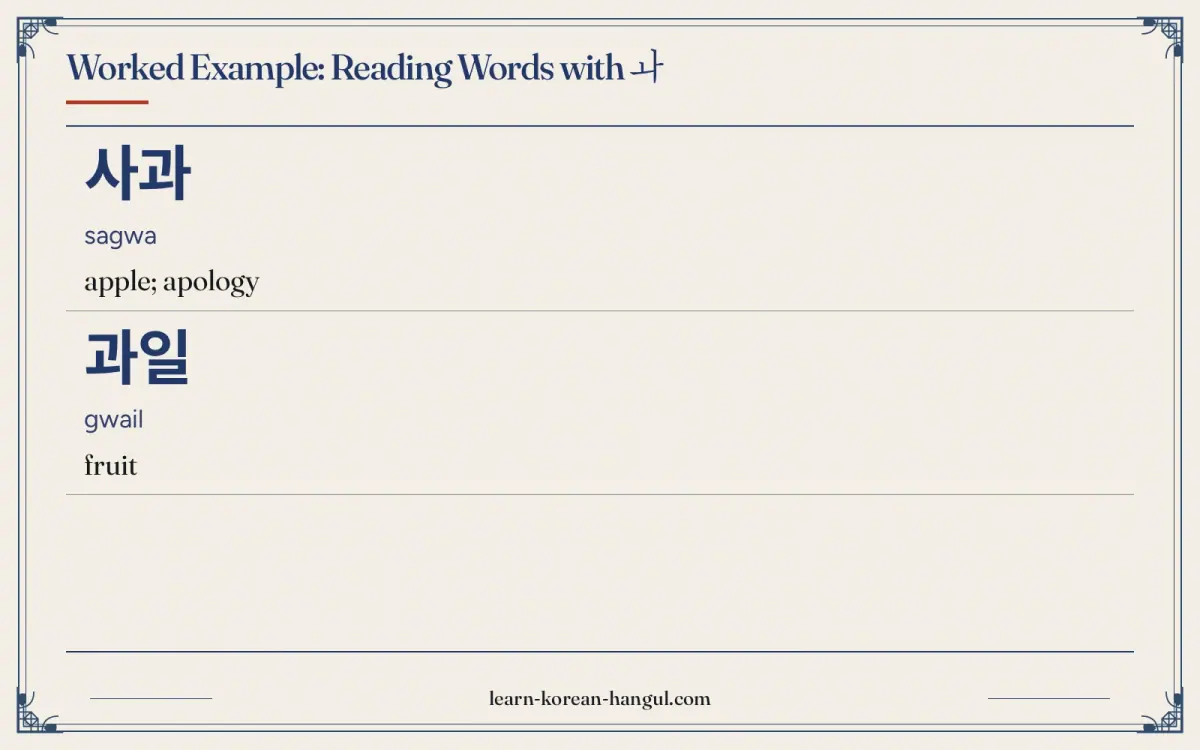
To read a Korean word, split each block into letters, say each sound, then join them. Two words give a full practice with ㅘ.
Word 1: 사과 (sagwa), "apple". The first block is ㅅ + ㅏ = 사, sounding [sa]. The second block is ㄱ + ㅗ + ㅏ = 과, which is ㄱ followed by ㅘ. Since ㄱ falls between two vowels, it is read as [g], so the block sounds like [gwa]. The word is [사과], "sah-gwah", not "sa-kwa". The same spelling also means "apology" in a separate word that sounds identical.
사과
sagwa
apple; apology
Word 2: 과일 (gwail), "fruit". The first block is ㄱ + ㅘ = 과, sounding [gwa]. The second block is ㅇ + ㅣ + ㄹ = 일, sounding [il], with ㄹ closing the syllable. The word is [과일], "gwah-eel". At the start of a word ㄱ is lighter and almost unvoiced, closer to [k], so say 과 gently, then glide into 일.
과일
gwail
fruit
Here are three more words with ㅘ.
| Word | Revised Romanization | Meaning | Note |
|---|---|---|---|
| 화장실 | hwajangsil | restroom; toilet | Three blocks; ㅎ + ㅘ = 화 |
| 와요 | wayo | (someone) comes | Polite form of 오다 "to come" |
| 봐요 | bwayo | (someone) sees; looks | Polite form of 보다 "to see" |
How Do ㅘ, ㅏ and ㅗ Differ?
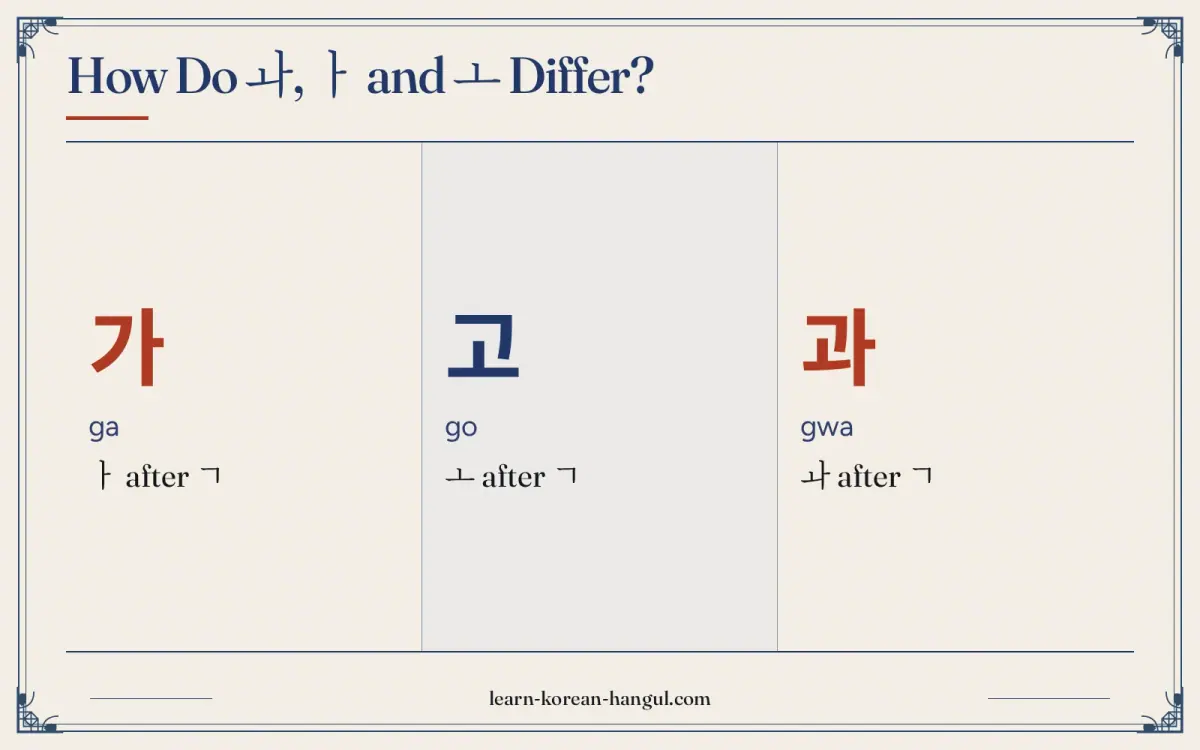
ㅘ is a gliding sound, ㅏ is a single open vowel, and ㅗ is a single rounded vowel. Two contrast drills, 가/고/과 and 하/호/화, let you hear all three.
| Contrast set | Letters | What changes |
|---|---|---|
| 가 / 고 / 과 | ㅏ / ㅗ / ㅘ | open vowel, rounded vowel, glide from rounded to open |
| 하 / 호 / 화 | ㅏ / ㅗ / ㅘ | same three vowels after ㅎ |
가: Open Jaw throughout. 고: Rounded Lips throughout. 과: Rounded at the Start, Open at the End.
| Korean | Romanization | Meaning | Sound |
|---|---|---|---|
| 가 | ga | ㅏ after ㄱ | |
| 고 | go | ㅗ after ㄱ | |
| 과 | gwa | ㅘ after ㄱ |
Same Three Vowel Movements after ㅎ.
| Korean | Romanization | Meaning | Sound |
|---|---|---|---|
| 하 | ha | ㅏ after ㅎ | |
| 호 | ho | ㅗ after ㅎ | |
| 화 | hwa | ㅘ after ㅎ |
Listen for lip movement. In 가 the lips never round. In 고 they round and stay round. In 과 they round first, then relax. English speakers usually hear the difference between 가 and 과 quickly, but 고 and 과 sound alike at first because both start with rounded lips. Focus on the ending of the sound.
Where Do You Meet ㅘ in Verbs?
You meet ㅘ most often in the polite present tense of verbs whose stem ends in ㅗ. The stem 보 (from 보다, "to see") plus the ending 아요 contracts to 봐요, and the stem 오 (from 오다, "to come") plus 아요 contracts to 와요. In both cases ㅗ and ㅏ merge into ㅘ.
| Dictionary form | Meaning | Polite present | Pieces |
|---|---|---|---|
| 보다 | to see; to look | 봐요 | 보 + 아요 |
| 오다 | to come | 와요 | 오 + 아요 |
For 보다, the long form 보아요 is also accepted, but 봐요 is what people normally write and say. For 오다, only 와요 is used. This section is a preview. The full rule belongs to present tense conjugation, which explains every ending.
Which Vowels Are Close Relatives of ㅘ?
Three vowels sit close to ㅘ, and each differs by one part. The table shows how a single change in the second part changes the whole sound.
| Vowel | Built from | Revised Romanization | Sound in short |
|---|---|---|---|
| ㅘ | ㅗ + ㅏ | wa | rounded glide into an open "ah" |
| ㅙ | ㅗ + ㅐ | wae | rounded glide into a mid "eh" |
| ㅝ | ㅜ + ㅓ | wo | tighter rounded glide into a relaxed "uh" |
Learn ㅘ first, because it appears in the verbs 봐요 and 와요 that you meet early. A learner who can say ㅘ cleanly already controls the main movement behind all of them: lips round first, then open. The family is introduced together in Korean w-vowels.
What Mistakes Do Learners Make with ㅘ?
Learners most often make four mistakes with ㅘ, and each has a simple fix.
- Reading ㅘ as two syllables, "o-a". Learners often assume that two letters mean two beats. Actually ㅘ is one syllable, so [bwa] in 봐요 takes one beat. Fix: say 봐 in a single breath.
- Ending with rounded lips. Learners often assume the "w" is the main part of the sound. Actually the main part is the open "ah" at the end. Fix: finish with a relaxed, open mouth.
- Hearing 사과 as "sakwa". Learners often assume ㄱ should be a hard "k". Actually ㄱ between vowels is [g], so 과 in 사과 sounds like [gwa]. Fix: say 사과 slowly and keep the voice on through the ㄱ.
- Writing ㅗ too wide. Learners often assume each vowel part should be full width. Actually ㅗ must stay narrow so ㅏ fits on the right. Fix: draw a small box for the block first, then fit the three letters into it.
An expert tip: Hangul has no stand-alone letter for the sound "w". Whenever you hear "w" at the start of a Korean syllable, expect a vowel that begins with ㅗ or ㅜ, such as ㅘ or ㅝ.
Practice: Read, Hear and Write
Try each task before you check the answers.
- Pick by sound. Play 가, 고 and 과. Which one glides from rounded to open?
- Read. Read these words aloud and give the meaning: 사과, 과일, 화장실.
- Write from dictation. Listen to 와요, then write it in Hangul. Which consonant fills the first slot?
Practice · 8
What is ㅘ built from?
Show answer
ㅗ + ㅏ
ㅘ is ㅗ + ㅏ: the rounded ㅗ becomes a short w-glide before the open ㅏ. ㅗ + ㅓ never combines.
How many syllables does ㅘ take in speech?
Show answer
One
ㅘ is one smooth syllable: a quick w-glide into "ah" in a single beat.
Which syllable glides from rounded lips to an open mouth?
Show answer
과
과 has ㅘ, rounded at the start and open at the end; 가 is only open and 고 is only rounded.
How is ㅘ written alone?
Show answer
와
Every block needs a first consonant, so ㅘ alone is 와 with silent ㅇ in the top-left slot.
What does 화장실 mean?
Show answer
restroom
화장실 (hwajangsil) means restroom; 과일 is fruit and 사과 is apple.
What is the polite present form of 오다 (to come)?
Show answer
와요
오 + 아요 contracts to 와요, and for 오다 only 와요 is used.
How many strokes does ㅘ take to write?
Show answer
4
ㅘ is two strokes for ㅗ, then two strokes for ㅏ: four in total.
Why is 사과 romanized sagwa and not sakwa?
Show answer
ㄱ between vowels is voiced, so it is written g
ㄱ between vowels is voiced [g], and ㅘ is written wa, giving sagwa.
Answers to the Practice
- 과 glides from rounded to open. 가 is only open, and 고 is only rounded.
- 사과 means apple (or apology), 과일 means fruit, and 화장실 means restroom.
- 와요 is written with silent ㅇ in the first slot: ㅇ + ㅘ = 와, then ㅇ + ㅛ = 요.
If you missed an answer, replay the clip and say it with the recording. For extra drills, review ㅘ with the other vowels in the Hangul flashcard decks, test whether you can pick ㅘ out by sound in the Hangul quizzes, build blocks in the hangul syllable builder, or explore every letter in the interactive hangul alphabet.
What Should You Learn after ㅘ?
Learn ㅝ next, because it is the dark-vowel partner of ㅘ. You now know the Korean vowel ㅘ: its smooth [wa] sound, its four strokes, its mixed-layout block, and its role in verbs such as 봐요 and 와요. The next lesson is the vowel ㅝ.
This lesson does not cover ㅘ before final consonants, or the other w-vowels ㅙ, ㅚ and ㅞ. To see how ㅘ fits among its relatives, return to Korean w-vowels. For mouth positions across all vowels, compare this lesson with the Korean vowel pronunciation guide.
Honest limits of this page: the description of the glide is simplified for English speakers, and the recordings are the reference. The standard Seoul pronunciation is described; regional speech varies.
Frequently Asked Questions
Is ㅘ two vowels or one? ㅘ is written with two vowel parts, ㅗ and ㅏ, but it is one vowel letter in the alphabet and one syllable in speech. The first part is a very short rounded glide and the second part is the full "ah". Hangul counts it as a single letter, so it has its own place in the dictionary order.
Why is 'apple' 사과 romanized sagwa? Revised Romanization spells the sounds it hears. The block 과 is ㄱ followed by ㅘ, and ㄱ between vowels is voiced, so it is written "g". The vowel ㅘ is written "wa". Together they give "gwa", and the word becomes "sagwa". Spelling it "sakwa" would mislead English readers.
Can ㅗ combine with ㅓ? No. Korean vowels follow harmony in these combinations: ㅗ pairs with the bright vowels ㅏ and ㅐ or the neutral ㅣ, while ㅜ pairs with the dark vowels ㅓ and ㅔ or the neutral ㅣ. So ㅗ + ㅏ gives ㅘ, and ㅜ + ㅓ gives ㅝ, but ㅗ + ㅓ does not exist as a Hangul vowel.
How do I type ㅘ? On a standard Korean two-set keyboard (2-beolsik), type the key for ㅗ and then the key for ㅏ, and the computer combines them into ㅘ. These are the "h" key and the "k" key. Type a consonant first, then h and k, to get a block such as 과.
Where will I see ㅘ in grammar? You will see ㅘ in polite present forms of verbs whose stem ends in ㅗ, such as 봐요 from 보다 and 와요 from 오다. It also appears in many Sino-Korean words, such as 사과 "apple" and 화장실 "restroom". Seeing ㅘ in a verb usually means a contraction of ㅗ and ㅏ has taken place.