
What you will learn in about 15 minutes
- Say ㅝ as [wʌ] and avoid the English “woe” sound.
- Write ㅝ from its two parts, ㅜ and ㅓ, inside a block.
- Recognise ㅝ in the polite forms 더워요, 추워요 and 고마워요.
- Read 뭐, 원, 권, 샤워 and 어려워요 aloud.
Before you start: learn the vowels ㅜ and ㅓ, because ㅝ is made from both.
What Sound Does ㅝ Make?
ㅝ makes the sound [wʌ]: a quick “w” followed by the open, unrounded vowel ㅓ. A reliable English anchor is the word “won”, the past tense of “win”, which sounds almost exactly like the Korean word 원. The sound is “wuh”, not “woe”.
Listen to the letter and two words that contain it, and repeat them.
Revised Romanization, the government system for writing Korean in Latin letters, spells ㅝ as “wo”. For this letter that spelling is a trap: English readers see “wo” and say “woe”. The Hangul orthography rules (한글 맞춤법) list ㅝ among the eleven compound vowel letters, which are made from the ten basic vowels.
How Is ㅝ Built from Simpler Vowels?
ㅝ is ㅜ plus ㅓ. The rounded ㅜ turns into a short “w” glide, and the unrounded ㅓ carries the vowel sound. In the written block, ㅜ lies under the consonant and ㅓ stands to its right, so ㅝ is a mixed vowel.
| Part | Sound | Role in ㅝ | Position in the block |
|---|---|---|---|
| ㅜ | [u] | becomes the w-glide | under the consonant |
| ㅓ | [ʌ] | the main vowel | to the right of the consonant |
| ㅝ | [wʌ] | the combined sound | both positions at once |
ㅝ is also the dark partner of ㅘ. Korean vowels fall into bright (ㅏ, ㅗ) and dark (ㅓ, ㅜ) groups, a pattern called vowel harmony. ㅘ combines the bright pair ㅗ and ㅏ, and ㅝ combines the dark pair ㅜ and ㅓ. The vowel ㅘ lesson compares them directly.
With the sound and the design clear, the next step is to put the letter on paper.
Writing ㅝ: Stroke Order and Typing
Write ㅝ in four strokes: first ㅜ (a horizontal line, then a short stroke hanging down), then ㅓ (a short stroke, then the long vertical line). The rule is top before bottom and left before right, so the ㅜ comes first and the tall ㅓ line closes the shape on the right.
Practise on Paper
- Draw the horizontal line of ㅜ under the consonant, left to right.
- Draw the short stroke of ㅜ, hanging downward from the middle of that line.
- Draw the short stroke of ㅓ to the right of the ㅜ, left to right.
- Draw the long vertical line of ㅓ from top to bottom, along the right edge of the block.
You will know it worked when the long vertical line runs the full height of the block and the ㅜ part sits low and wide on the left. A common mistake is a short vertical line, which makes the block look squashed. Another is placing ㅜ too far right, so it crowds the ㅓ.
Guides differ slightly on stroke order for some letters. The Hangul stroke order lesson explains the convention used on this site.
To type 워 on a computer with the standard Korean keyboard, press D for the silent ㅇ, then N for ㅜ, then J for ㅓ. The how to type in Korean guide shows the whole layout.
Knowing the shape, the next question is how to produce the sound.
How to Pronounce the Korean Vowel ㅝ Step by Step
To pronounce the Korean vowel ㅝ, round your lips briefly for a short “w”, then relax them completely into an open, unrounded “uh”. The lips move from round to flat, which is the opposite of the English “woe”. Follow these steps with a mirror.
- Round your lips as if saying “oo” for a split second.
- Start voicing a very short “w” with the tongue pulled back.
- Open your jaw about halfway and let the lips relax, unrounded.
- Finish on a relaxed “uh”, like the vowel in “cup”.
- Stop without adding another sound.
You will know it worked when your lips are flat at the end of the sound. In a mirror, the circle opens up as you finish. The first part is a glide, a very short vowel-like sound that leads into the main vowel.
Is ㅝ a Vowel or a Diphthong?
ㅝ is classified as a diphthong in the Standard Pronunciation rules (표준 발음법, Article 5), because it joins a glide to a vowel. A diphthong is a vowel sound that moves from one position to another within one syllable, and a monophthong keeps one steady position. In ㅝ the movement is from a rounded “w” to an unrounded “uh”. In practice you can treat ㅝ as one letter with one fast sound. Korean readers see the single letter, not two parts, and you should too.
Why Is ㅝ Romanized “Wo” When It Sounds Like “Wuh”?
Revised Romanization writes ㅓ as “eo” and ㅜ as “u”, but for the combined ㅝ it uses “wo”. The system avoids special marks, so it reuses letters that English readers already know, and the result is a spelling that suggests the wrong vowel. The Korean vowel after the glide is ㅓ, not ㅗ. If you ever see “wo” in a romanized Korean name or sign, read it as [wʌ]. A well-known example is the name of the currency itself, spelled “won”.
The guide to why Korean romanization looks wrong lists other traps of this kind. The next question is where this letter appears in grammar.
Why Does 고맙다 Become 고마워요?
ㅝ appears in the polite forms of most ㅂ-irregular verbs, which follow one pattern: the final ㅂ of the stem turns into 우, and 우 plus the ending 어 combines into 워. This is why 고맙다 (to be thankful) becomes 고마워요, and why the sound ㅝ shows up in so many high-frequency phrases.
| Dictionary form | Meaning | Polite form | Sound |
|---|---|---|---|
| 덥다 | to be hot | 더워요 | [더워요] |
| 춥다 | to be cold | 추워요 | [추워요] |
| 고맙다 | to be thankful | 고마워요 | [고마워요] |
| 쉽다 | to be easy | 쉬워요 | [쉬워요] |
| 어렵다 | to be difficult | 어려워요 | [어려워요] |
There are a few exceptions. 돕다 (to help) and 곱다 (to be pretty) use 와 instead, giving 도와요 and 고와요. You do not need to memorise the pattern now. The point is that your ear and eye will recognise ㅝ at the end of many common words. The full pattern is explained in ㅂ irregular verbs.
Where Else Does ㅝ Come From?
ㅝ also appears when a verb stem ending in ㅜ meets the ending 어. The ㅜ and the 어 melt together into one block with ㅝ. This is called contraction, and it is a second route to the same letter, besides the ㅂ-irregular pattern.
| Dictionary form | Meaning | Contracted polite form | Sound |
|---|---|---|---|
| 배우다 | to learn | 배워요 | [배워요] |
| 주다 | to give | 줘요 | [줘요] |
| 추다 | to dance | 춰요 | [춰요] |
The spelling logic is the same each time: ㅜ plus ㅓ writes ㅝ. In fast speech, learners sometimes hear 줘 as a single sound, and that is correct. It is one block with one vowel.
Honest limit: the ㅓ half of ㅝ is the hardest part for English speakers, because English has no exact match. If your ㅝ still sounds odd, go back to the vowel ㅓ lesson and perfect the plain vowel first. Once ㅓ is stable, the w-glide in front is easy.
Worked Example: Reading Words with ㅝ
Reading a block means asking three questions: what is the first consonant, which vowel is it, and is there a final consonant. Here is 뭐 (what), decoded step by step.
- The block has ㅁ at the top-left, ㅜ under it, and ㅓ to the right.
- ㅁ gives you [m], ㅝ gives you [wʌ].
- Together: [mwʌ]. The word means “what”.
Next, 원 (won). The block 원 has silent ㅇ on top, ㅝ around it, and a final ㄴ at the bottom. The final ㄴ closes the sound with the tongue tip on the ridge behind the upper teeth, as in “sun”. So 원 is [wʌn]. It means the currency “won” and also “circle”.
Here are more words to read aloud.
| Word | Sound | Meaning | Block parts |
|---|---|---|---|
| 뭐 | [뭐] | what | ㅁ + ㅝ |
| 원 | [원] | won, circle | ㅇ + ㅝ + ㄴ |
| 권 | [권] | counter for books | ㄱ + ㅝ + ㄴ |
| 샤워 | [샤워] | shower | 샤 + 워 |
| 더워요 | [더워요] | it is hot | 더 + 워 + 요 |
| 추워요 | [추워요] | it is cold | 추 + 워 + 요 |
Because ㅝ is a mixed vowel, it occupies both the space below the consonant and the space to its right. The page on how syllable blocks are shaped shows all six layouts.
ㅝ vs ㅘ vs ㅗ
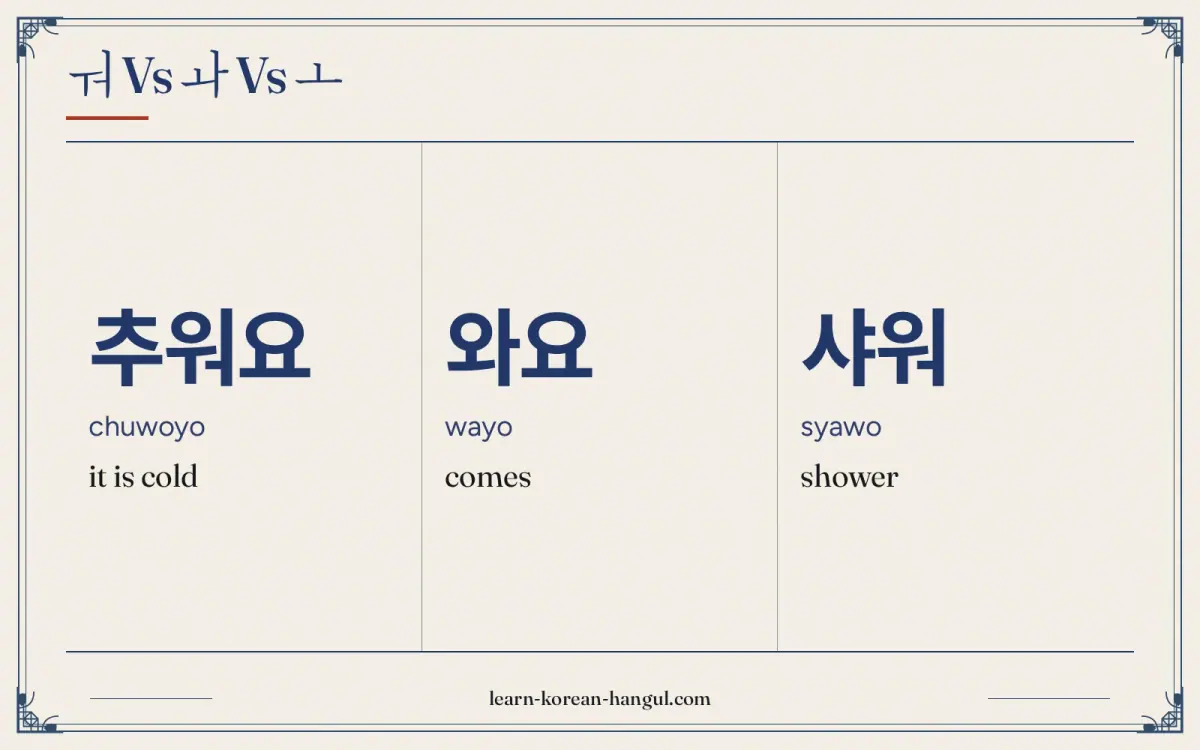
ㅝ is [wʌ], ㅘ is [wa], and ㅗ is [o]. The first two are a bright and dark pair. The table pairs each lookalike with a real word, so you can train your ear.
| Pair | Sound difference | Example words | Visual cue |
|---|---|---|---|
| 워 / 와 | [wʌ] vs [wa] | 추워요 (cold) / 와요 (come) | ㅓ on the right vs ㅏ on the right |
| 워 / 어 | [wʌ] vs [ʌ] | 샤워 (shower) / 어디 (where) | extra ㅜ vs none |
| 워 / 우 | [wʌ] vs [u] | 원 (won) / 우리 (we, our) | ㅓ added vs ㅜ alone |
| 워 / 오 | [wʌ] vs [o] | 뭐 (what) / 오리 (duck) | w-glide with open end vs round |
ㅝ Ends on a Relaxed Uh; ㅘ Ends on an Open Ah.
| Korean | Romanization | Meaning | Sound |
|---|---|---|---|
| 추워요 | chuwoyo | it is cold | |
| 와요 | wayo | comes |
ㅝ Starts with Rounded Lips; ㅓ Does Not.
| Korean | Romanization | Meaning | Sound |
|---|---|---|---|
| 샤워 | syawo | shower | |
| 어디 | eodi | where |
ㅝ Opens the Jaw at the End; ㅜ Stays Nearly Closed.
| Korean | Romanization | Meaning | Sound |
|---|---|---|---|
| 원 | won | won; circle | |
| 우리 | uri | we; our |
ㅝ Glides from Round to Relaxed; ㅗ Stays Round.
| Korean | Romanization | Meaning | Sound |
|---|---|---|---|
| 뭐 | mwo | what | |
| 오리 | ori | duck |
The visual cue is the small stroke of ㅓ on the left of its vertical line. The vowel ㅘ lesson shows the bright partner with the same layout.
How Can You Remember ㅝ?
The easiest way to remember ㅝ is to read it as two letters stuck together: first ㅜ, then ㅓ. Three cues work for most learners.
- Build it: ㅜ + ㅓ = ㅝ. “Oo” then “uh” becomes “wuh”.
- Anchor a word: 원 for money and 뭐 for “what”. Both are everywhere.
- Think “dark”: ㅝ pairs with ㅘ the way ㅓ pairs with ㅏ.
Example Sentences with ㅝ
Short sentences help the vowel stick, because you hear it in a natural rhythm. Each line uses a word from this lesson.
- 뭐 해요? (Mwo haeyo?) What are you doing?
- 추워요. (Chuwoyo.) It is cold.
- 고마워요. (Gomawoyo.) Thank you.
- 천 원이에요. (Cheon wonieyo.) It is 1,000 won.
The romanization in brackets is only a guide. Notice how the spelling “wo” hides the real vowel, which is [ʌ]. 뭐, 추워요 and 원 are among the first ㅝ words most learners meet, in daily chat and on price tags.
Common Mistakes Learners Make with ㅝ
Learners often assume ㅝ is pronounced like the English “woe”, but the ending vowel is the open, unrounded ㅓ. Practising it from the romanization teaches the wrong sound, so rely on the Hangul and the audio.
- Mistake: ending on a round “oh”. Saying “woh” turns ㅝ into ㅘ-like or ㅗ-like sounds. Fix: let the lips spread flat at the end.
- Mistake: ending on a tight “oo”. That makes ㅜ. Fix: open the jaw halfway.
- Mistake: spelling conjugations with 와. 고마워요 is correct, 고마와요 is wrong. Fix: remember that 돕다 and 곱다 are rare exceptions.
- Mistake: hearing two syllables. “Wo” is not “oo-uh” with a pause between the parts. Fix: say it as one quick glide, like a short “wuh” in “won”, and record yourself to check the rhythm.
- Mistake: squashing the block. The tall ㅓ line must run the full height. Fix: write on a square grid.
- Mistake: treating 원 as “one”. The sound is similar, but the meaning is currency or circle. Fix: learn 일 and 하나 for numbers.
Practice: Read, Hear and Write
Try all three exercises, then check the answers at the end.
Practice · 8
Which two vowels combine to make ㅝ?
Show answer
ㅜ + ㅓ
ㅝ is ㅜ plus ㅓ, the dark pair. ㅗ plus ㅏ is ㅘ and ㅜ plus ㅣ is ㅟ.
Revised Romanization spells ㅝ as "wo". How does it actually sound?
Show answer
Like "wuh" in "won", ending with flat lips
After the w-glide comes the open, unrounded ㅓ, so ㅝ is [wʌ] as in "won", not "woe".
What is the polite form of 고맙다 (to be thankful)?
Show answer
고마워요
In ㅂ-irregular verbs the final ㅂ turns into 우, and 우 plus 어 gives 워: 고마워요. 고마와요 is a spelling mistake, and 고와요 comes from 곱다.
What does 뭐 mean?
Show answer
what
뭐 is ㅁ plus ㅝ, read [mwʌ], and means "what". 샤워 is shower, 원 is won or circle and 권 is the counter for books.
Which word means "it is cold"?
Show answer
추워요
추워요 comes from 춥다 (to be cold). 더워요 is "it is hot", 쉬워요 is "it is easy" and 어려워요 is "it is difficult".
Which verb is an exception that uses 와 instead of 워 in its polite form?
Show answer
돕다
돕다 (to help) and 곱다 (to be pretty) give 도와요 and 고와요. The others follow the regular pattern: 더워요, 추워요, 쉬워요.
Which is the contracted polite form of 주다 (to give)?
Show answer
줘요
A stem ending in ㅜ meets the ending 어 and contracts: ㅜ plus ㅓ writes ㅝ, so 주다 gives 줘요. 춰요 comes from 추다 and 배워요 from 배우다.
How many strokes does ㅝ take to write?
Show answer
4
Two strokes for ㅜ, then two for ㅓ: the short stroke and the long vertical line on the right.
Exercise 1: pick by sound. Does each clip contain ㅓ or ㅝ?
Exercise 2: read aloud. 뭐, 원, 권, 샤워, 더워요, 추워요, 고마워요.
Exercise 3: write from dictation. Listen and write each syllable or word.
Exercise 4: round to flat. Say 원 ten times in front of a mirror. Your lips should start round and finish flat. Record and compare with the clip.
Answers. Exercise 1: Clips B and D contain ㅝ (워, 원). Clips A and C contain ㅓ (어, 언). Exercise 2: what, won, counter for books, shower, it is hot, it is cold, thank you. Exercise 3: check that the long vertical line of ㅓ runs the full block height and ㅜ sits low on the left.
What to Learn Next
You can now say and write the Korean vowel ㅝ, and you will recognise it in the common ㅂ-irregular phrases. The next lesson is ㅟ (wi), the w-vowel that ends in ㅣ. You can also return to the Korean w-vowels overview.
Review ㅝ with the Hangul flashcard decks, test your ear in the Hangul quizzes, and build blocks in the Hangul Syllable Builder. The interactive Hangul alphabet plays every letter. For mouth positions across all vowels, read the Korean vowel pronunciation guide.
This lesson does not cover the full ㅂ-irregular pattern, the counting system for books, or the history of the currency. Those topics have their own sections.
Frequently Asked Questions
Frequently Asked Questions
Is ㅝ pronounced like “woe”?
No. ㅝ is [wʌ], close to the English “wo” in “won” (the past tense of “win”), not the “woe” of “woke”. The romanization “wo” misleads because the Korean vowel after the glide is the unrounded ㅓ. Keep your lips relaxed and the jaw half open at the end of the sound.
What does 뭐 mean?
뭐 means “what”. It is one of the most common words in daily Korean. 뭐 해요? means “What are you doing?” and the casual 뭐야? means “What is it?” or “What?” in surprise. It is pronounced [뭐], a fast [mwʌ], and it is a good first word for practising ㅝ.
Why does 고맙다 become 고마워요?
It follows the ㅂ-irregular pattern. Before a vowel ending, the final ㅂ of the stem changes to 우, and 우 plus 어 combines into 워. So 고맙다 gives 고마워요. The same happens to 덥다 (더워요) and 춥다 (추워요). A few verbs, such as 돕다, use 와 instead.
Is 원 the same word as “one”?
No. 원 sounds similar to English “one” but means something else. It is the Korean currency, the won, and it also means “circle”. The Korean number one is 일 in the Sino-Korean system and 하나 in the native system. The similar sound is a coincidence.
How do I type ㅝ?
On the standard two-set (2-beolsik) Korean keyboard, ㅝ is typed as two keys: N for ㅜ and then J for ㅓ. To type 워, press D for the silent ㅇ, then N, then J. The input method joins them into one syllable block automatically.