
What you will learn in about 15 minutes
- Say ㅛ as a rounded [jo] with no closing “w” sound.
- Write ㅛ in three strokes and place it under its consonant.
- Recognise the polite ending -요 when you see or hear it.
- Read 요리, 학교, 우표, 효도 and 교실 aloud.
Before you start: learn the vowel ㅗ, because ㅛ uses exactly the same lip shape with a quick y-glide in front.
What Sound Does ㅛ Make?
ㅛ makes the sound [jo]: a very short “y” followed by a pure, rounded “o”. English spellers write it “yo”. Picture the “yo” of “yoga”, but stop the sound on the “o” without letting it slide into a “w”. The lips are round before you start and stay round to the end.
Listen to three words that contain ㅛ, and repeat them.
Revised Romanization, the government system for writing Korean in Latin letters, spells ㅛ as “yo”. For this letter the romanization is a good guide, but it hides one detail: English “o” slides into “w”, and Korean ㅛ does not. The Hangul orthography rules (한글 맞춤법) list ㅛ among the ten basic vowel letters.
How Is ㅛ Built from Simpler Vowels?
ㅛ is ㅗ with a second short stroke. ㅗ has a long horizontal line with one short vertical stroke standing on top. ㅛ keeps the line and gives it two short vertical strokes on top. The extra stroke marks the y-glide, just as it does in ㅑ and ㅕ.
| Plain vowel | Y-vowel | Sound change | Short strokes |
|---|---|---|---|
| ㅏ [a] | ㅑ [ja] | adds a y at the start | 1 → 2, pointing right |
| ㅓ [ʌ] | ㅕ [jʌ] | adds a y at the start | 1 → 2, pointing left |
| ㅗ [o] | ㅛ [jo] | adds a y at the start | 1 → 2, pointing up |
| ㅜ [u] | ㅠ [ju] | adds a y at the start | 1 → 2, pointing down |
The Korean y-vowels overview shows the full pattern. Once you know ㅗ, ㅛ costs only one more stroke.
With the sound and the design clear, the next step is to put the letter on paper.
Writing ㅛ: Stroke Order and Typing
Write ㅛ in three strokes: two short vertical strokes, left one first, then one long horizontal line underneath. The rule is top before bottom and left before right, so the two short strokes standing on top are drawn first. Keep them parallel and the same height.
Practise on Paper
- Draw the left short vertical stroke from top to bottom.
- Draw the right short vertical stroke the same way, parallel to the first.
- Draw the long horizontal line from left to right, touching the bottoms of both short strokes.
- Draw the left short vertical stroke from top to bottom.
- Draw the right short vertical stroke the same way, parallel to the first.
- Draw the long horizontal line from left to right, touching the bottoms of both short strokes.
You will know it worked when the two short strokes stand evenly spaced on a single flat line. A common mistake is making them different heights or leaning them, which makes the letter look uneven. Another is writing them hanging below the line, which gives ㅠ.
Guides differ slightly on stroke order for some letters. The Hangul stroke order lesson explains the convention used on this site.
To type ㅛ on a computer with the standard Korean keyboard, press the Y key without Shift. To type 요, press D for the silent ㅇ, then Y. The how to type in Korean guide shows the whole layout.
Knowing the shape, the next question is how to produce the sound.
How to Pronounce the Korean Vowel ㅛ Step by Step
To pronounce the Korean vowel ㅛ, round your lips tightly, say a very short “y”, and then hold a pure “o” without any closing movement. The lips do not change shape during the sound. Follow these steps with a mirror.
- Round your lips as if blowing out a candle gently, but with the jaw slightly open.
- Raise the front of your tongue toward the roof of your mouth for a very short “y”.
- Pull the tongue body back into the “o” position while the lips stay round.
- Hold the “o” steady for a moment. Do not let it slide toward “oo” or “w”.
- Stop without adding another sound.
You will know it worked when your recording ends on a clean “o” and matches the clip above. The first part is a glide, a very short vowel-like sound that leads into the main vowel.
How Round Should Your Lips Be?
The lips should be clearly rounded, about as round as for English “oh” in “go”, and they should not move during the vowel. In English, the “o” in “go” slides toward “oo”. In Korean, ㅛ and ㅗ are pure vowels, which means the quality stays the same from beginning to end. A good test is to say 요 in front of a mirror: the lips should look identical at the start and at the end.
The next question is why this vowel sits under its consonant.
Why Does ㅛ Sit under the Consonant?
ㅛ is a horizontal vowel, so Hangul places it below the consonant instead of to the right. Vertical vowels such as ㅑ and ㅕ sit to the right of the consonant, as in 야 and 여. Horizontal vowels such as ㅛ, ㅗ and ㅠ sit underneath, as in 교, 오 and 규. The rule keeps every syllable roughly square.
| Consonant | Block | Sound | Meaning |
|---|---|---|---|
| ㄱ | 교 | [교] | teaching, school (in compounds) |
| ㅎ | 효 | [효] | filial piety (in 효도) |
| ㅍ | 표 | [표] | ticket, mark |
| ㅅ | 쇼 | [쇼] | show |
When a block has a final consonant, it goes underneath the vowel. For example, 용 (dragon) is a silent ㅇ on top, ㅛ in the middle, and a final ㅇ at the bottom, read yong [joŋ]. The page about horizontal-vowel blocks shows this layout with more examples.
What Is the -요 at the End of Sentences?
-요 is a polite ending added to verbs and adjectives in everyday speech, and it is written with the vowel you just learned. When you hear 안녕하세요, 감사해요 or 좋아요, the last syllable is 요. This is only a preview: the full explanation belongs to the grammar section on polite speech in Korean.
Reading it now is a real win. You can already see where a polite sentence ends, even before you know the verb.
Worked Example: Reading Words with ㅛ
Reading a block means asking three questions: what is the first consonant, which vowel is it, and is there a final consonant. Here is 요리 (cooking), decoded step by step.
- The first block is 요: silent ㅇ on top, ㅛ underneath. You hear [jo].
- The second block is 리: ㄹ plus ㅣ. At the start of a syllable between vowels, ㄹ is a quick tap of the tongue, close to the Spanish single “r”. You hear [ri].
- Together: [jo-ri]. The word means “cooking” or “cuisine”.
Next, 학교 (school). The first block 학 is ㅎ, ㅏ and a final ㄱ. The second block 교 is ㄱ plus ㅛ. In speech the ㄱ in 교 becomes tense after the final ㄱ of 학, so the word is said [학꾜]. The spelling does not change. This is a pronunciation rule you will study later, and it explains why the romanization “hakgyo” does not match what you hear.
Here are more words to read aloud.
| Word | Sound | Meaning | Block parts |
|---|---|---|---|
| 요리 | [요리] | cooking | 요 + 리 |
| 학교 | [학꾜] | school | 학 + 교 |
| 우표 | [우표] | postage stamp | 우 + 표 |
| 효도 | [효도] | filial duty | 효 + 도 |
| 교실 | [교실] | classroom | 교 + 실 |
| 요일 | [요일] | day of the week | 요 + 일 |
| 요금 | [요금] | fee, fare | 요 + 금 |
Because ㅛ is a horizontal vowel, remember that it sits below the consonant in every one of these blocks. The page on how syllable blocks are shaped shows all six layouts.
ㅛ vs ㅕ vs ㅗ
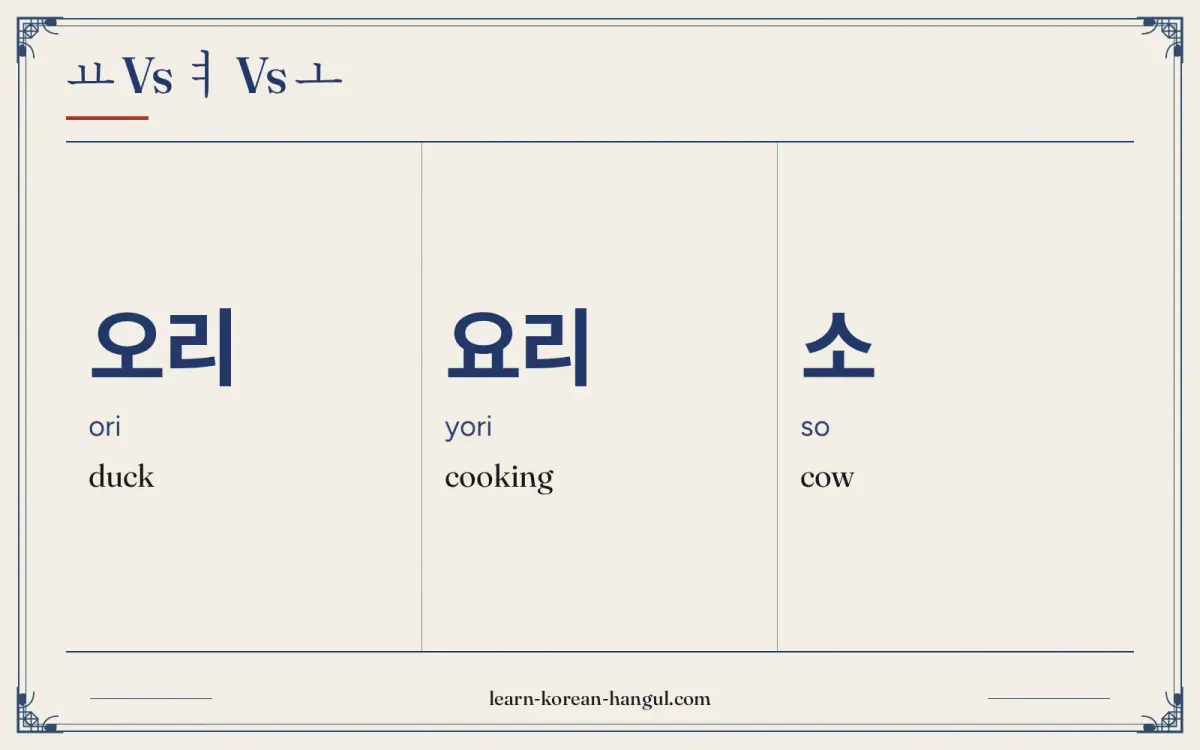
ㅛ is rounded [jo], ㅕ is unrounded [jʌ], and ㅗ is plain [o]. The two letters that cause the most confusion are ㅛ and ㅕ, because the romanizations “yo” and “yeo” look alike. The table below pairs each lookalike with a real word.
| Pair | Sound difference | Example words | Visual cue |
|---|---|---|---|
| 오 / 요 | [o] vs [jo] | 오리 (duck) / 요리 (cooking) | no glide vs glide |
| 소 / 쇼 | [so] vs [ɕo] | 소 (cow) / 쇼 (show) | one tick vs two ticks |
| 여 / 요 | [jʌ] vs [jo] | 여름 (summer) / 요리 (cooking) | flat lips vs round lips |
| 유 / 요 | [ju] vs [jo] | 유리 (glass) / 요리 (cooking) | strokes hang down vs stand up |
No Glide vs Y-Glide
| Korean | Romanization | Meaning | Sound |
|---|---|---|---|
| 오리 | ori | duck | |
| 요리 | yori | cooking |
One Tick vs Two Ticks
| Korean | Romanization | Meaning | Sound |
|---|---|---|---|
| 소 | so | cow | |
| 쇼 | syo | show |
Flat Lips vs Round Lips
| Korean | Romanization | Meaning | Sound |
|---|---|---|---|
| 여름 | yeoreum | summer | |
| 요리 | yori | cooking |
Strokes Hang down vs Stand Up
| Korean | Romanization | Meaning | Sound |
|---|---|---|---|
| 유리 | yuri | glass | |
| 요리 | yori | cooking |
The visual cue for ㅛ against ㅠ is direction: ㅛ has its strokes on top, ㅠ has them underneath. The ㅕ lesson trains the unrounded alternative.
How Can You Remember ㅛ?
The easiest way to remember ㅛ is to link its shape to its sound: two ticks on top, two parts to the sound. The ticks stand up like two small posts on a flat road. Three cues work for most learners.
- Count the marks: ㅗ has one tick and ㅛ has two, so the y-vowel has the extra mark.
- Ticks up or down: ㅛ has them up, ㅠ has them down. Say “ㅛ stands, ㅠ hangs”.
- Anchor a word: 요리 or 학교. Picture the word whenever you see the letter.
Example Sentences with ㅛ
Short sentences help the vowel stick, because you hear it in a natural rhythm. Each line uses a word from this lesson in a polite sentence.
- 요리해요. (Yorihaeyo.) I cook.
- 학교에 가요. (Hakgyoe gayo.) I go to school.
- 표 주세요. (Pyo juseyo.) A ticket, please.
The romanization in brackets is only a guide. Notice the 요 at the end of each one: that is the polite ending.
Which Polite Words End in 요?
Many of the first words you will use end in 요, so reading the ending now pays off quickly. The table lists common polite forms. Each one is a verb or adjective stem plus the polite ending, and the ending is always pronounced [요].
| Polite form | Sound | Meaning | Base word |
|---|---|---|---|
| 가요 | [가요] | I go, we go | 가다 (to go) |
| 와요 | [와요] | I come, we come | 오다 (to come) |
| 먹어요 | [머거요] | I eat, we eat | 먹다 (to eat) |
| 좋아요 | [조아요] | it is good, I like it | 좋다 (to be good) |
| 괜찮아요 | [괜차나요] | it is fine | 괜찮다 (to be fine) |
Two of these show spelling-versus-sound gaps: 먹어요 is said [머거요] because the final ㄱ moves to the next block, and 좋아요 is said [조아요] because ㅎ is silent before a vowel. Both are sound-change rules covered later. For now, just notice that the last syllable never changes.
Honest limit: reading -요 does not yet let you build the sentence. You still need verb stems and the rules for forming them, which belong to the grammar section.
Common Mistakes Learners Make with ㅛ
Learners often assume ㅛ is pronounced like the English word “yo”, with a closing “w”, but the Korean vowel is pure. Hold the final lip shape steady, whether you say it slowly or at natural speed.
- Mistake: adding a “w”. English “yo” slides toward “oo”. Fix: freeze the lips in the same round shape for the whole vowel.
- Mistake: unrounded lips. That produces ㅕ. Fix: look in a mirror for a round mouth.
- Mistake: ticks pointing the wrong way. Ticks down is ㅠ. Fix: say “ㅛ stands, ㅠ hangs”.
- Mistake: writing ㅛ to the right of the consonant. Horizontal vowels go underneath. Fix: write 교, not a ㄱ with ㅛ on its side.
- Mistake: treating 쇼 as exactly “show”. Korean has no closing glide. Fix: stop on the “o”.
A rule of thumb helps with all the round vowels: if the vowel letter is ㅗ, ㅛ, ㅜ or ㅠ, your lips stay rounded until the vowel is finished, and you only relax them for the next syllable. Most mispronunciations of these letters come from relaxing the lips too early.
Practice: Read, Hear and Write
Try all three exercises, then check the answers at the end.
Practice · 8
Where does ㅛ sit in a syllable block?
Show answer
Below the consonant
ㅛ is a horizontal vowel, so it goes under the consonant, as in 교 and 요.
What should your lips do while you say ㅛ?
Show answer
Stay round and keep the same shape
ㅛ is a pure vowel: the lips are round before you start and stay round to the end, with no closing "w".
What does 학교 mean?
Show answer
school
학교 is school, said [학꾜]. Cooking is 요리, postage stamp is 우표 and day of the week is 요일.
Which vowel has two short strokes standing on top of a horizontal line?
Show answer
ㅛ
ㅛ is ㅗ with a second tick. Ticks hanging down make ㅠ: "ㅛ stands, ㅠ hangs".
What is the 요 at the end of 감사해요 and 좋아요?
Show answer
The polite ending
-요 is the polite ending added to verbs and adjectives in everyday speech, and it is always pronounced [요].
Which word means "cooking"?
Show answer
요리
요리 is 요 plus 리. 오리 is duck, 여름 is summer and 유리 is glass.
If you say ㅛ with unrounded lips, which vowel do you produce?
Show answer
ㅕ
Flat lips turn [jo] into [jʌ], which is ㅕ. Check in a mirror for a round mouth.
Which key types ㅛ on the standard Korean keyboard?
Show answer
Y
ㅛ is the Y key without Shift, so 요 is D for the silent ㅇ, then Y. U types ㅕ and B types ㅠ.
Exercise 1: pick by sound. Does each clip contain ㅗ or ㅛ?
Exercise 2: read aloud. 요리, 학교, 우표, 효도, 교실, 요일. Then say the polite endings you learned: 안녕하세요, 감사해요, 좋아요.
Exercise 3: write from dictation. Listen and write each syllable.
Exercise 4: round, then check. Say 요리 three times while watching your lips in a mirror. Then record yourself and compare with the clip. The lips should look the same at the start and the end of 요.
Answers. Exercise 1: Clips B and D contain ㅛ (요, 쇼). Clips A and C contain ㅗ (오, 소). Exercise 2: cooking, school, postage stamp, filial duty, classroom, day of the week. Exercise 3: 요, 교, 표, 요리; check that each ㅛ has two parallel ticks standing on top of the line, and that the consonant sits above it.
What to Learn Next
You can now say and write the Korean vowel ㅛ and recognise the polite ending -요. The next lesson is ㅠ (yu), the twin whose strokes point down. You can also return to the Korean y-vowels overview.
Review ㅛ with the Hangul flashcard decks, test your ear in the Hangul quizzes, and build blocks in the Hangul Syllable Builder. The interactive Hangul alphabet plays every letter. For mouth positions across all vowels, read the Korean vowel pronunciation guide.
This lesson does not cover verb conjugation, the full set of polite endings, or sound-change rules such as the tensification in 학교. Those topics have their own sections.
Frequently Asked Questions
Frequently Asked Questions
Is ㅛ the same as English “yo”?
Close, but not identical. English “yo” usually ends with a small “w” glide, as in “yoga” said as “yo-w-ga”. Korean ㅛ stays on a pure, tightly rounded “o” from start to finish. Keep your lips in the same round shape and avoid any closing movement.
Why do so many Korean sentences end in 요?
The ending -요 marks polite everyday speech. Verbs such as 가요 (go), 먹어요 (eat) and 좋아요 (be good) all end in it. Formal speech uses other endings, like -ㅂ니다, so not every sentence ends in 요. Still, it is the most common ending a beginner hears and says.
Which way do the two short strokes point?
In ㅛ, the two short strokes point up, standing on top of the long horizontal line. In its twin ㅠ they point down, hanging underneath. A simple check: ㅛ looks like a small fence standing on a floor, while ㅠ looks like a table with two legs.
How do I type ㅛ?
On the standard two-set (2-beolsik) Korean keyboard, ㅛ is the Y key with no Shift. To type 요, press D for the silent ㅇ and then Y. The input method joins the two letters into one syllable block automatically. Use H for the plain vowel ㅗ.
Is 쇼 pronounced like “show”?
Roughly. 쇼 is the Korean spelling of the English word “show”, and the sound is [ɕo], with a “sh” onset and a pure “o”. Unlike English “show”, there is no closing “w” glide. The same pattern appears in 쇼핑 (shopping).