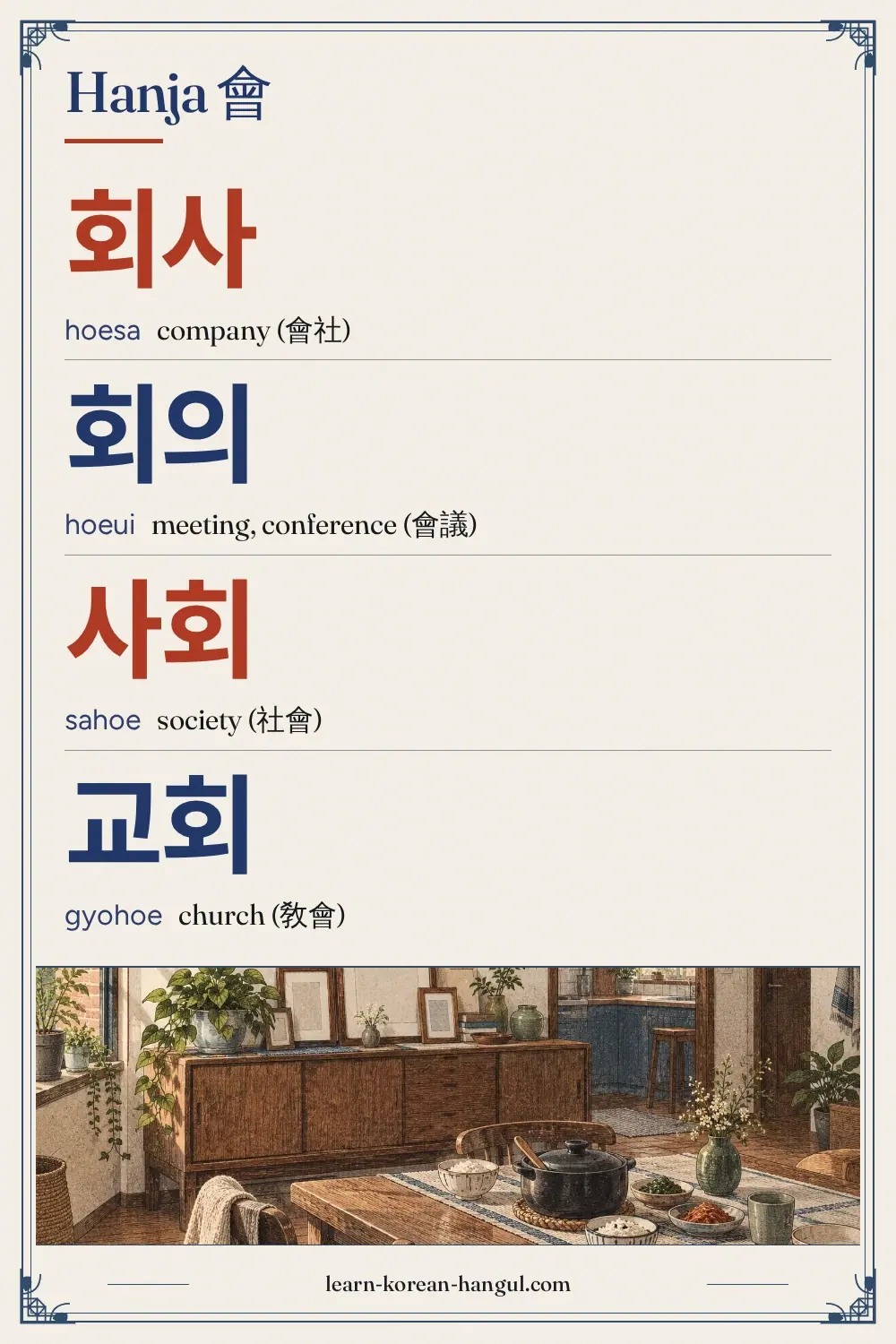
Hanja 會: the Essentials
Hanja 會 is one of the most useful characters for the world of work and groups. Its 음훈 (the pair of the native meaning word and the Korean reading, as dictionaries list it) is 모일 회. The meaning word 모일 comes from the verb 모이다 (to gather), and the 회 is the reading you hear inside Sino-Korean words. Together they say: the character that means "gather", read hoe.
The character is complex, with 13 strokes. Dictionaries file it under 曰, the radical for "to say", although the meaning of the radical has little to do with the idea of a meeting. For a learner the shape is a block: a roof-like top, a middle that looks like a window and 曰 at the bottom. In Japanese and in simplified Chinese the same character is written in a short form, 会, which you may see on a Japanese sign. Korean keeps the long form 會.
In practice 會 appears in two main roles. At the front of a word it is about the group: 회사 (company), 회의 (meeting), 회원 (member). At the end it names an event or an association: 사회 (society), 국회 (national assembly), 대회 (competition). The card below sums up the character.
| Item | Detail |
|---|---|
| Character | 會 |
| 음훈 | 모일 회 |
| Reading | 회 (hoe) |
| Core meanings | meet; gathering; group; society |
| Radical | 曰 (to say) |
| Strokes | 13 |
| Words on this page | 12 |
The same character is read 회 whether it comes first or last, so it is a good first example of a hanja that moves around inside words. Notice that two of the words, 회사 and 사회, use the same two characters in opposite order. The next sections show how.
Which Words Does 會 Build?
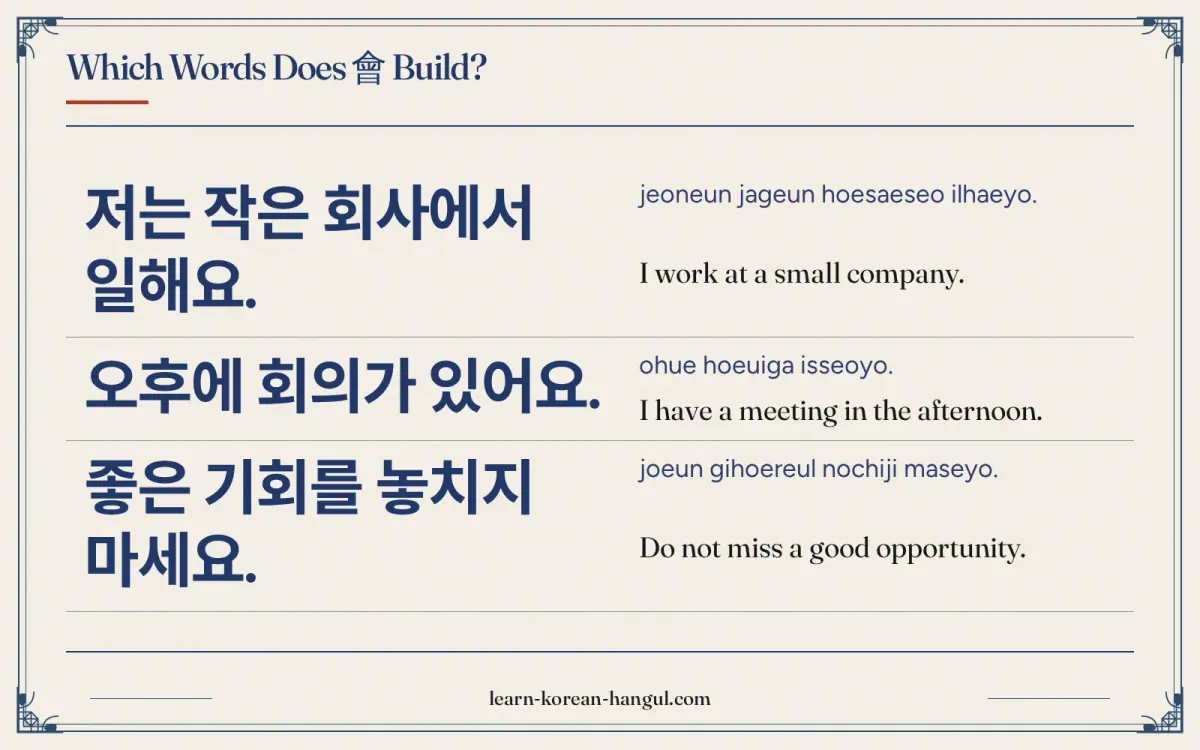
These 12 words are the best ones to learn first. They cover companies, meetings, groups, public life and events. Revised Romanization (RR) appears only as a learning aid, and square brackets show the spoken form where it differs from the spelling.
| Word | Characters | RR | Meaning | How the characters add up |
|---|---|---|---|---|
| 회사 | 會社 | hoesa | company | 會 meet + 社 group |
| 회의 | 會議 | hoeui | meeting, conference | 會 meet + 議 discuss |
| 사회 | 社會 | sahoe | society | 社 group + 會 gathering |
| 교회 | 敎會 | gyohoe | church | 敎 teach, religion + 會 gathering |
| 기회 | 機會 | gihoe | opportunity, chance | 機 chance + 會 meeting |
| 회원 | 會員 | hoewon | member | 會 association + 員 member |
| 국회 [구쾨] | 國會 | gukhoe | national assembly, parliament | 國 country + 會 assembly |
| 회화 | 會話 | hoehwa | conversation | 會 meet + 話 talk |
| 회식 | 會食 | hoesik | company dinner, group meal | 會 gathering + 食 eat |
| 대회 | 大會 | daehoe | competition, large gathering | 大 large + 會 gathering |
| 회장 | 會長 | hoejang | chairperson, president (of an association) | 會 association + 長 head |
| 전시회 | 展示會 | jeonsihoe | exhibition | 展 display + 示 show + 會 gathering |
Two patterns are worth knowing. At the front of a word, 會 is about the group and its business: 회사, 회의, 회원, 회화, 회식, 회장. At the end, it names a gathering or an organisation: 사회, 교회, 기회, 국회, 대회, 전시회. As a suffix, -회 is productive: 음악회 (音樂會, concert), 송년회 (送年會, year-end party), 환영회 (歡迎會, welcome party), 동창회 (同窓會, alumni meeting) and 학부모회 (parents' association) are all built from it. When a new word ends in -회, think "event" or "association".
The 12 Words One by One
회사 (會社, hoesa): company. The usual word for a company or a business: 회사에 다녀요 (I work at a company), 회사원 (office worker). 社 (사) means a group or a shrine and appears in 신문사 (newspaper company) and 출판사 (publisher). Note that 회사 is a company, while 직장 is a workplace.
회의 (會議, hoeui): meeting, conference. A working meeting where people discuss and decide: 회의가 있어요 (I have a meeting), 회의실 (meeting room). 議 (의) means to discuss and also appears in 의논 (discussion) and 의회 (parliament). In relaxed speech the last syllable can be said [이], giving [회이]; many people still say [회의] in careful speech.
사회 (社會, sahoe): society. Society, the human world around you. 사회 문제 (social problem), 사회생활 (life in society or working life) and 사회인 (a working adult) are common. The word is the reverse of 회사: the same two characters, a different order and a different meaning.
교회 (敎會, gyohoe): church. A Christian church, literally a "gathering of the teaching". 교회에 가요 means "I go to church". 敎 (교) is the character in 교실 (classroom) and 교육 (education). A Catholic church is usually called 성당, not 교회.
기회 (機會, gihoe): opportunity, chance. An opportunity: 기회를 잡다 (to seize a chance), 좋은 기회 (a good opportunity), 기회가 없다 (there is no chance). 機 (기) means a mechanism or a key moment and appears in 비행기 (aeroplane) and 위기 (crisis). The pair has the picture of a good moment coming together.
회원 (會員, hoewon): member. A member of a club, gym, shop or website: 회원 가입 (joining as a member), 회원 카드 (membership card), 회원 번호 (member number). 員 (원) means a person in a group and also appears in 직원 (staff member) and 공무원 (civil servant).
국회 [구쾨] (國會, gukhoe): national assembly, parliament. The national legislature, called the National Assembly in English. The ㄱ at the end of 국 and the ㅎ at the start of 회 join into ㅋ, so it is said [구쾨]. RR writes gukhoe: for a noun, the h is kept and not merged. 국회의원 means a member of the National Assembly.
회화 (會話, hoehwa): conversation. Conversation, mainly as a skill: 영어 회화 (English conversation), 회화 수업 (a conversation class). 話 (화) means speech and also appears in 전화 (telephone) and 대화 (dialogue). 회화 is about practising to speak; for a single conversation with a person, 대화 is more common.
회식 (會食, hoesik): company dinner, group meal. A group meal organised by a workplace or a team, often with drinks: 오늘 저녁에 회식이 있어요. It is a cultural word. Traditionally it was a regular part of work life, and many workplaces now take a more flexible approach. It is not used for a family dinner; that is just 저녁 식사.
대회 (大會, daehoe): competition, large gathering. A large organised event: 체육 대회 (sports day), 노래 대회 (singing contest), 세계 대회 (world championship). The same 大會 can also be a big convention. 大 (대) is the same character as in 대학 (university).
회장 (會長, hoejang): chairperson, president (of an association). The head of an association, a club or a large company group: 학생회장 (student council president), 동창회장 (alumni chair). In big business 회장님 is the title of the owner or top leader, above the 사장님 (company president). 長 (장) means long or head.
전시회 (展示會, jeonsihoe): exhibition. A show where things are displayed: 미술 전시회 (art exhibition), 사진 전시회 (photo exhibition). 展 (전) means to spread out and 示 (시) means to show. The ending -회 turns any activity into an event: 음악회 (concert), 송년회 (year-end party), 동창회 (alumni meeting).
Sentences to Hear the Words in Use
Six of the words appear in short sentences. Listen to each one first, then read it aloud with the audio. The brackets in the word table show how the words are said in connected speech.
저는 작은 회사에서 일해요.
jeoneun jageun hoesaeseo ilhaeyo.
I work at a small company.
오후에 회의가 있어요.
ohue hoeuiga isseoyo.
I have a meeting in the afternoon.
한국 사회는 빠르게 변하고 있어요.
hanguk sahoeneun ppareuge byeonhago isseoyo.
Korean society is changing quickly.
좋은 기회를 놓치지 마세요.
joeun gihoereul nochiji maseyo.
Do not miss a good opportunity.
국회는 서울에 있어요.
gukhoeneun seoure isseoyo.
The National Assembly is in Seoul.
오늘 저녁에 회식이 있어요.
oneul jeonyeoge hoesigi isseoyo.
There is a team dinner this evening.
How Is 會 Read in Different Words?
The reading of 會 never changes. It is 회 in every word, whether it comes first or last. It also does not fall under the initial-sound rule (두음법칙), which changes some words that begin with ㄹ or ㄴ, because 회 begins with ㅎ. So you can read every word in the family with one syllable.
Rule box: ㄱ + ㅎ in 국회. Only one word in the list is said differently from its spelling.
- 국회 → [구쾨]: the final ㄱ of 국 and the ㅎ of 회 merge into an aspirated ㅋ. RR keeps the h in a noun and writes gukhoe. In a verb or adjective RR writes the merged sound, as in 좋다, which becomes jota, but nouns keep their letters.
In the other eleven words nothing happens. In 교회 and 대회 the first syllable ends in a vowel, so 회 is said with a clear ㅎ: [교회], [대회]. In 사회, 기회 and 전시회 the 회 follows a vowel too. In 회사, 회의, 회원, 회화, 회식 and 회장 the 회 begins the word, so nothing before it can change it. The vowel ㅚ is written with ㅗ and ㅣ, and in the standard it is [ø], a rounded front vowel. The standard also allows the diphthong [웨], close to "weh", and most speakers use it. So 회사 sounds like "hweh-sa".
In 회의, the second 의 is not the first syllable of the word, so it can be said [이]: [회의] or [회이] are both accepted, so either form is fine.
What Is Easy to Confuse with 會?
회사 and 사회. The same two characters in reverse order. 會社 (회사) is a company; 社會 (사회) is society. Memory trick: in 회사 you meet (會) in a group (社) to work, and in 사회 the group (社) is the gathering (會) of everyone. You work for a 회사 but you live in a 사회.
회 as a counter and as raw fish. The syllable 회 has other meanings that are not 會. As a counter, 회 (回) means "time, round", as in 제1회 대회 (the first competition) and 일 회 (once). 회 (膾) is also a Korean dish of raw fish, as in 생선회. If a 회 follows a number, it is the counter; if it follows the name of a food, it is raw fish.
회의 (meeting) and 회의 (doubt). 會議 (회의) is a meeting. 懷疑 (회의) is doubt, mainly in 회의적 (sceptical) and 회의감 (a feeling of doubt). The context makes it clear: 회의에 참석해요 (I attend a meeting) and 회의적이에요 (I am sceptical).
회화 and 대화. 회화 (會話) is conversation as a school subject or skill. 대화 (對話) is a particular conversation between people. Say 영어 회화 for an English-conversation class and 친구와 대화했어요 for "I talked with a friend".
회원 and 직원. Both end in 員 (a person in a group). 회원 is a member who belongs to a club or a service. 직원 (職員) is a worker who is employed by a firm. A gym has 회원 and 직원.
Practice This Family
The 12 Words as Flashcards
The deck below has one card for each of the 12 words, with audio. The table shows the same cards, so you can study from either one.
| # | Korean | RR | Meaning | Character and note |
|---|---|---|---|---|
| 1 | 회사 | hoesa | company (會社) | 會 (모일 회) + 社 (모일 사). A company. 회사원 = office worker. |
| 2 | 회의 | hoeui | meeting, conference (會議) | 會 + 議 (의논할 의). A working meeting. 회의실 = meeting room. |
| 3 | 사회 | sahoe | society (社會) | 社 + 會. Society. Reverse of 회사. 사회 문제 = social problem. |
| 4 | 교회 | gyohoe | church (敎會) | 敎 (가르칠 교) + 會. A church. A Catholic church = 성당. |
| 5 | 기회 | gihoe | opportunity, chance (機會) | 機 (틀 기) + 會. A chance. 기회를 잡다 = seize a chance. |
| 6 | 회원 | hoewon | member (會員) | 會 + 員 (인원 원). A member. 회원 가입 = sign-up. |
| 7 | 국회 [구쾨] | gukhoe | national assembly, parliament (國會) | 國 (나라 국) + 會. Said [구쾨]. 국회의원 = member of the Assembly. |
| 8 | 회화 | hoehwa | conversation (會話) | 會 + 話 (말씀 화). Conversation skill. 영어 회화 = English conversation. |
| 9 | 회식 | hoesik | company dinner, group meal (會食) | 會 + 食 (먹을 식). Team dinner. 회식 문화 = dinner culture. |
| 10 | 대회 | daehoe | competition, large gathering (大會) | 大 (큰 대) + 會. A big event. 체육 대회 = sports day. |
| 11 | 회장 | hoejang | chairperson, president (of an association) (會長) | 會 + 長 (긴 장). The head of a group. 학생회장 = student president. |
| 12 | 전시회 | jeonsihoe | exhibition (展示會) | 展 (펼 전) + 示 (보일 시) + 會. An exhibition. -회 = an event. |
Practice · 12
- 01회사
Show answer
hoesa
company (會社)
- 02회의
Show answer
hoeui
meeting, conference (會議)
- 03사회
Show answer
sahoe
society (社會)
- 04교회
Show answer
gyohoe
church (敎會)
- 05기회
Show answer
gihoe
opportunity, chance (機會)
- 06회원
Show answer
hoewon
member (會員)
- 07국회 [구쾨]
Show answer
gukhoe
national assembly, parliament (國會)
- 08회화
Show answer
hoehwa
conversation (會話)
- 09회식
Show answer
hoesik
company dinner, group meal (會食)
- 10대회
Show answer
daehoe
competition, large gathering (大會)
- 11회장
Show answer
hoejang
chairperson, president (of an association) (會長)
- 12전시회
Show answer
jeonsihoe
exhibition (展示會)
Decode Three Unseen Words
會費 회비 (hoebi). 會 "association" + 費 "cost". It means membership dues, the fee you pay to a club or association: 회비를 내다 (to pay the dues). The sound is [회비] with no change.
總會 총회 (chonghoe). 總 "all, general" + 會 "meeting". It means a general meeting of an organisation or a company's shareholders. The sound is [총회] and the ㅇ before 회 is clear.
音樂會 음악회 (eumakhoe). 音 "sound" + 樂 "music" + 會 "gathering". It is a concert, a gathering for music. The ㄱ at the end of 악 and the ㅎ of 회 merge into ㅋ, so it is said [으마쾨]. RR writes eumakhoe.
Check Yourself
Each question asks you to decode a word or answer a question about 會. The answers are checked as you go.
Practice · 6
회사 is 會 + 社. What does it mean?
Show answer
company
會社 is a company. The same characters in reverse order, 社會, make 사회, which means society.
How is 국회 (national assembly) said in normal speech?
Show answer
[구쾨]
The final ㄱ and the ㅎ merge into an aspirated ㅋ, so 국회 is [구쾨]. RR keeps the letters in a noun: gukhoe.
Which word is a meeting where people discuss and decide?
Show answer
회의
회의 (會議) is a meeting. 회식 is a team dinner, 회화 is conversation practice and 회원 is a member.
The ending -회, as in 음악회 and 송년회, tells you that the word is…
Show answer
an event or association
The suffix -회 comes from 會 and marks a gathering or an association: 음악회 (concert) and 송년회 (year-end party).
Which pair uses the same two characters in opposite order?
Show answer
회사 and 사회
會社 (회사, company) and 社會 (사회, society) use the same two characters in reverse order.
총회 is 總 "all" + 會 "meeting". What is a 총회?
Show answer
a general meeting
A 總會 is a general meeting of all members, such as a company's shareholders meeting.
What to Learn Next
You now have 12 words and the two main roles of 會. A good next step is the page about the family for 時 (시), because meetings and events always have a 일시 (date and time). If you work in an office, the page of office vocabulary shows these words in context. The rule behind 국회 [구쾨] is set out in the aspiration rules. The method behind these pages is set out in how to learn hanja, and a longer list of common hanja characters is on the page of the 100 most useful hanja. To choose another character, return to the hanja word families page. For the big picture, see Does Korean use hanja? and the hanja hub.
Frequently Asked Questions
What is 회식?
회식 (會食) is a meal that a workplace or team eats together after work, often with drinks. The characters mean "gathering" and "eat". It is a feature of Korean work culture, and the habit and the expectations around it vary between companies and are changing. 회식 is not used for a family or friends' dinner.
Why do both 會社 and 社會 exist?
They are two different words built from the same two characters in opposite order. 會社 (회사) is a company, where people meet (會) in a group (社) to work. 社會 (사회) is society, the whole group (社) of people who gather (會) in a community. Korean has many such reversible pairs, so always check which comes first.
Is 會話 spoken or written?
회화 (會話) is spoken. It names the skill of conversation and is the usual word on language-course names such as 영어 회화 (English conversation) and 회화 수업 (conversation class). The word for a written exchange is not 회화; a written letter or message would be called 편지 or 메시지. For a particular conversation between two people, 대화 is more natural than 회화.
What does 會 mean as a suffix?
As a suffix, -회 (會) names an event or an association. Examples are 대회 (competition), 전시회 (exhibition), 음악회 (concert), 송년회 (year-end party), 환영회 (welcome party), 동창회 (alumni association) and 학생회 (student council). If you hear a new word that ends in -회, it is a good guess that it is a gathering or a group.