Hanja 時: the Essentials
Hanja 時 is one of the first characters worth learning, because it is behind both the clock and the calendar. Its 음훈 (the pair of the native meaning word and the Korean reading, as dictionaries list it) is 때 시. The meaning word 때 is the native Korean noun for "time, occasion", as in 어릴 때 (when I was young). The 시 is the reading you hear inside Sino-Korean words.
The character has two parts. On the left is 日 (sun, day), the radical that dictionaries use to file it, and it fits the idea of time because the sun marks the day. On the right is 寺, which mainly gives the sound: the same part is in 詩 (시, poem), 持 (지, hold), 特 (특, special) and 待 (대, wait). You do not need to study the parts to read the family. They only show why this shape and this sound belong together.
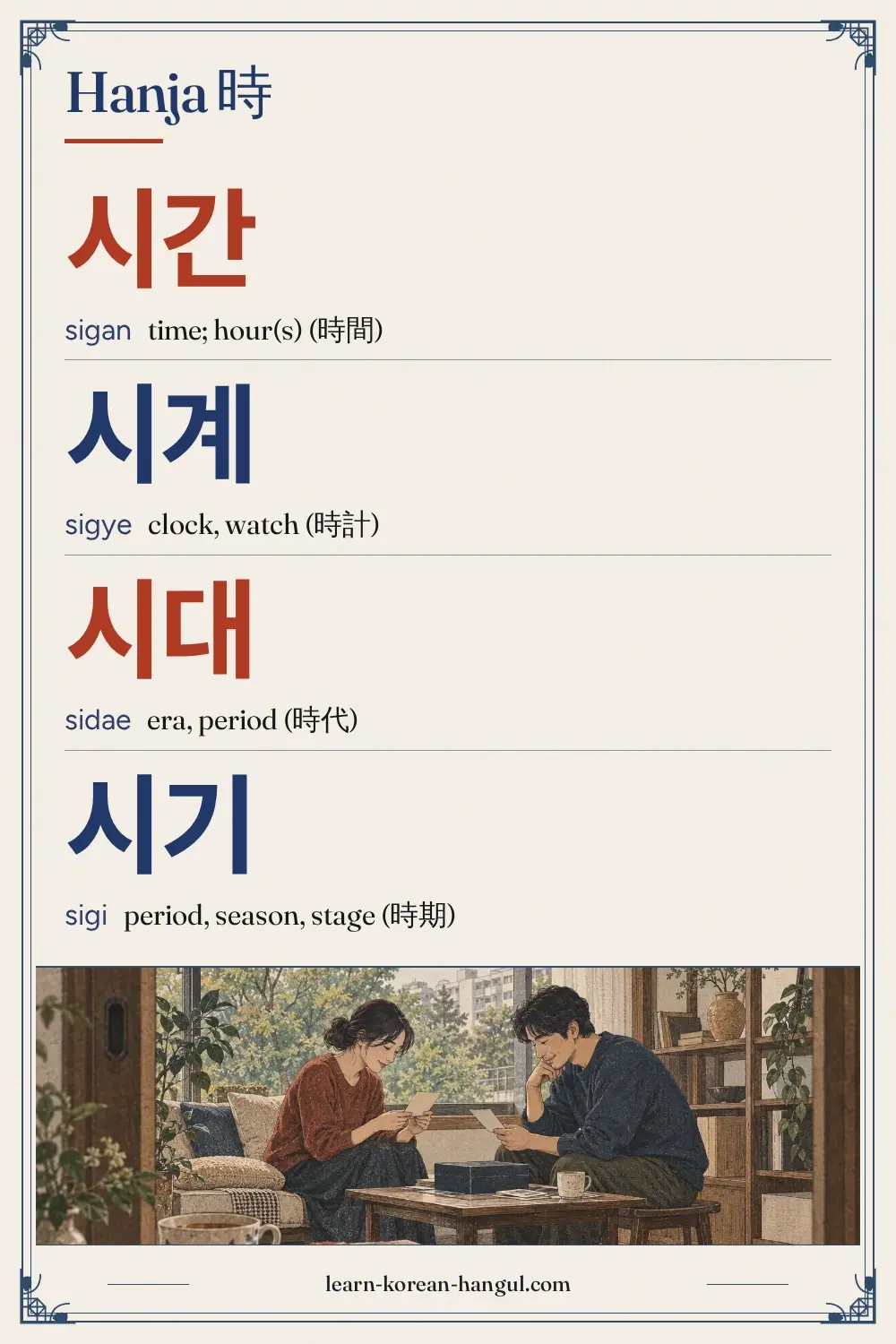
In practice 時 appears in three kinds of word: general time words (시간, 시대, 시기), words that point to a moment (당시, 동시, 일시, 시각) and words that say how long a state lasts (임시, 상시, 시급). The card below sums up the character.
| Item | Detail |
|---|---|
| Character | 時 |
| 음훈 | 때 시 |
| Reading | 시 (si) |
| Core meanings | time; hour; occasion |
| Radical | 日 (sun, day) |
| Strokes | 10 |
| Words on this page | 12 |
The same 시 is the unit for telling the hour. In 한 시, 두 시, 세 시 (one, two, three o'clock) a native Korean number sits before 時. The next sections show how this differs from 시간, the word for an amount of time.
Which Words Does 時 Build?
These 12 words are the best ones to learn first. They cover time in general, clocks, history, schedules, work and travel. Revised Romanization (RR) appears only as a learning aid, and square brackets show the spoken form where it differs from the spelling.
| Word | Characters | RR | Meaning | How the characters add up |
|---|---|---|---|---|
| 시간 | 時間 | sigan | time; hour(s) | 時 time + 間 interval |
| 시계 | 時計 | sigye | clock, watch | 時 time + 計 measure |
| 시대 | 時代 | sidae | era, period | 時 time + 代 generation |
| 시기 | 時期 | sigi | period, season, stage | 時 time + 期 period |
| 동시 | 同時 | dongsi | same time, simultaneous | 同 same + 時 time |
| 당시 | 當時 | dangsi | at that time | 當 that very + 時 time |
| 임시 | 臨時 | imsi | temporary | 臨 arrive at + 時 time |
| 시급 | 時急 | sigeup | urgent | 時 time + 急 urgent |
| 시각 | 時刻 | sigak | point in time, moment | 時 time + 刻 notch |
| 시차 | 時差 | sicha | time difference | 時 time + 差 difference |
| 일시 [일씨] | 日時 | ilsi | date and time | 日 day + 時 time |
| 상시 | 常時 | sangsi | at all times, regular | 常 always + 時 time |
Two patterns are worth knowing. At the front of a word, 時 means "time" in a general sense: 시간, 시계, 시대, 시기, 시각, 시차. At the end, it marks a moment or occasion: 동시 (the same time), 당시 (that time), 임시 (the time that arrives), 상시 (always) and 일시 (day and time). A third group is not in the list but is very common: 시 as the hour counter, as in the table below.
| Clock time | Korean | Duration | Korean |
|---|---|---|---|
| 1:00 | 한 시 | 1 hour | 한 시간 |
| 3:00 | 세 시 | 3 hours | 세 시간 |
| 12:00 | 열두 시 | 12 hours | 열두 시간 |
In the first column, 시 is 時 as a unit on the clock. In the second column, 시간 is 時間, the amount of time. The number before it is always a native Korean number (한, 두, 세, 네), while minutes use Sino-Korean numbers (오 분, 십 분).
The 12 Words One by One
시간 (時間, sigan): time; hour(s). An amount of time, or time in general. 시간이 없어요 means "I have no time", and 한 시간 means "one hour" as a length of time. 間 (간) is the same character as in 공간 (space) and 인간 (human being). Do not use 시간 for the clock hour; that is 시.
시계 (時計, sigye): clock, watch. A "time measurer". It covers clocks of every kind, and compounds such as 손목시계 (wristwatch) and 벽시계 (wall clock) are written as one word. The standard says the ㅖ can be said [ㅔ] here, so [시계] and [시게] are both acceptable. 시계 방향 means "clockwise".
시대 (時代, sidae): era, period. A long stretch of history marked by one kind of life or rule: 조선 시대 (the Joseon period), 디지털 시대 (the digital age). 代 (대) means a generation or a replacement, and it also appears in 현대 (modern times) and 시대극 (period drama).
시기 (時期, sigi): period, season, stage. A stretch of time with a particular character, shorter and more specific than 시대: 이 시기 (this period), 바쁜 시기 (a busy season), 사춘기 시기. 期 (기) also appears in 학기 (school term) and 기간 (period of time).
동시 (同時, dongsi): same time, simultaneous. "Same time". It usually appears as 동시에 (at the same time): 두 사람이 동시에 말했어요 (the two people spoke at the same time). In 동시 통역 it means simultaneous interpretation. The ㅅ stays plain after the nasal ㅇ.
당시 (當時, dangsi): at that time. Used when you tell a story set in the past and want to say "at that time": 당시에는 (at that time), 당시 상황 (the situation then). 當 (당) here means "that very" and not the meaning "to face" or "to be right" that it has in other words. It is more formal than 그때.
임시 (臨時, imsi): temporary. "Arriving at the time", so something that is for the moment only: 임시 직원 (temporary staff), 임시 휴업 (temporary closure), 임시 번호 (temporary number). It is a noun that sits before another noun and does not take a verb ending itself.
시급 (時急, sigeup): urgent. A matter that cannot wait: 시급한 문제 (an urgent problem) and 시급하다 (to be urgent). There is a second 시급 in daily life, written 時給, that means an hourly wage: 시급이 얼마예요? (What is the hourly pay?). Same spelling and sound, but a different second character.
시각 (時刻, sigak): point in time, moment. A single moment on the clock, as in 도착 시각 (arrival time) and 출발 시각 (departure time). 刻 (각) means to carve or notch, and it was also used as an old unit of time. Compare 시간, which is an amount of time. A timetable lists 시각; a trip takes 시간.
시차 (時差, sicha): time difference. The difference in clock time between two places: 한국과 미국의 시차 (the time difference between Korea and the US). 시차 적응 means getting used to a new time zone, and 시차 때문에 피곤해요 means "I am tired because of the time difference".
일시 [일씨] (日時, ilsi): date and time. The "day and hour" of an event. It is the usual label on invitations and notices: 일시: 10월 9일 오후 2시. After the final ㄹ, a Sino-Korean ㅅ is tense, so it is said [일씨]; RR writes ilsi. Another word 일시 (一時) means "for a moment", as in 일시적 (temporary).
상시 (常時, sangsi): at all times, regular. Always, or on a regular basis. It sits before another noun: 상시 운영 (always in operation), 상시 모집 (rolling recruitment), 상시 대기 (always on standby). The 常 here also appears in 일상 (daily life) and 정상 (normal).
Sentences to Hear the Words in Use
Six of the words appear in short sentences. Listen to each one first, then read it aloud with the audio. The brackets in the word table show how the words are said in connected speech.
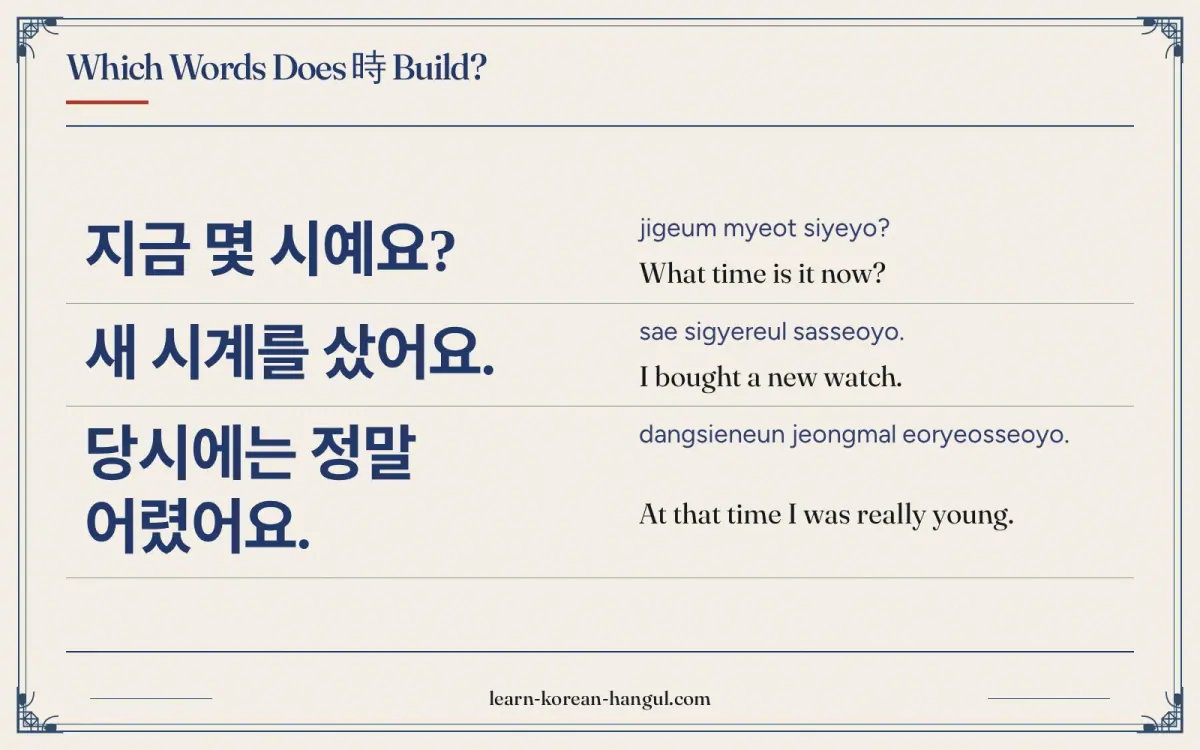
지금 몇 시예요?
jigeum myeot siyeyo?
What time is it now?
한 시간 동안 한국어를 공부했어요.
han sigan dongan hangugeoreul gongbuhaesseoyo.
I studied Korean for one hour.
새 시계를 샀어요.
sae sigyereul sasseoyo.
I bought a new watch.
그 시대에는 전화가 없었어요.
geu sidaeeneun jeonhwaga eopseosseoyo.
There were no telephones in that era.
당시에는 정말 어렸어요.
dangsieneun jeongmal eoryeosseoyo.
At that time I was really young.
시차 때문에 너무 졸려요.
sicha ttaemune neomu jollyeoyo.
I am very sleepy because of the time difference.
How Is 時 Read in Different Words?
The reading of 時 never changes. It is 시 in every word, whether it comes first or last. It also does not fall under the initial-sound rule (두음법칙), which changes some words that begin with ㄹ or ㄴ, because 시 begins with ㅅ. So you can read every word in the family with one syllable.
Rule box: one tense ㅆ. Only one word in the list is said differently from its spelling.
- 일시 → [일씨]: in Sino-Korean words, a final ㄹ makes a following ㄷ, ㅅ or ㅈ tense. RR does not mark tensing caused by a sound change, so it gives ilsi.
In the other eleven words nothing happens. In 동시, 당시, 상시 and 임시 the 시 follows a nasal (ㅇ or ㅁ), and a nasal does not tense the next sound, so say them with a plain, light ㅅ: [동시], [당시], [상시], [임시]. In 시간, 시계, 시대, 시기, 시급, 시각 and 시차, 시 begins the word, so nothing before it can change it. The general rule is explained on the page about Sino-Korean tensification.
The spoken question 몇 시예요? is commonly said [멷씨예요]. The final ㅊ of 몇 is said as [ㄷ] and then the ㅅ of 시 becomes tense. RR keeps the two words apart: myeot siyeyo.
Two details help English speakers. First, 시 is a short syllable: the vowel ㅣ is the "ee" of "see" but shorter and not drawn out. Second, ㅅ before ㅣ is said like the "sh" of "she", so 시 sounds close to "shee". That is normal and is not a mistake. Compare it with 사, which keeps a plain "s".
What Is Easy to Confuse with 時?
시간 and 시각. Both come from 時, but 시간 (時間) is an amount of time and 시각 (時刻) is a point in time. A train's 출발 시각 is the time on the board, 오후 3시 (3 p.m.). The trip's 시간 is how long it takes, 두 시간 (two hours). If the question is "when?" use 시각. If the question is "how long?" use 시간.
시 (時), 詩 and 市. The syllable 시 is also the reading of 詩 (poem), 市 (city) and 始 (begin). They sound the same, so the word around them matters. 시를 써요 is "I write a poem", and 서울시 uses 市. The o'clock 시 is always 時.
시급: urgent or hourly pay. 時急 (시급) means urgent, and 時給 (시급) means an hourly wage. In an ad for a part-time job, 시급 is the pay per hour. In a news story, 시급한 과제 is an urgent task. The sentence decides.
동시: at the same time or a children's poem. 同時 (동시) means "the same time". The word 동시 is also written 童詩 for a poem written for children. In the first meaning it usually comes as 동시에.
일시: day and time or for a moment. 日時 (일시) is the date and time on a notice. 一時 (일시) means "one moment" and mainly appears in 일시적 (temporary, for a short time) and 일시불 (a one-time payment). Both are said [일씨].
時 and 寺. The right-hand part 寺 is read 사, but in 時 it only hints at the sound 시. Do not guess the reading of a character from its right side alone: 詩 is 시, 持 is 지 and 特 is 특.
Practice This Family
The 12 Words as Flashcards
The deck below has one card for each of the 12 words, with audio. The table shows the same cards, so you can study from either one.
| # | Korean | RR | Meaning | Character and note |
|---|---|---|---|---|
| 1 | 시간 | sigan | time; hour(s) (時間) | 時 (때 시) + 間 (사이 간). An amount of time. 한 시간 = one hour. |
| 2 | 시계 | sigye | clock, watch (時計) | 時 + 計 (셀 계). A time measurer. 손목시계 = wristwatch. |
| 3 | 시대 | sidae | era, period (時代) | 時 + 代 (대신할 대). An era. 조선 시대 = Joseon period. |
| 4 | 시기 | sigi | period, season, stage (時期) | 時 + 期 (기약할 기). A period or stage. Also 학기 (term). |
| 5 | 동시 | dongsi | same time, simultaneous (同時) | 同 (한가지 동) + 時. 동시에 = at the same time. |
| 6 | 당시 | dangsi | at that time (當時) | 當 (마땅 당) + 時. Looks back to a past moment. Plainer: 그때. |
| 7 | 임시 | imsi | temporary (臨時) | 臨 (임할 림, read 임 here) + 時. For now only. 임시 휴업 = temporary closure. |
| 8 | 시급 | sigeup | urgent (時急) | 時 + 急 (급할 급). Urgent. Another 시급 (時給) = hourly wage. |
| 9 | 시각 | sigak | point in time, moment (時刻) | 時 + 刻 (새길 각). A moment on the clock. 도착 시각 = arrival time. |
| 10 | 시차 | sicha | time difference (時差) | 時 + 差 (다를 차). Time zone gap. 시차 적응 = getting over jet lag. |
| 11 | 일시 [일씨] | ilsi | date and time (日時) | 日 (날 일) + 時. Said [일씨]. Label on notices: 일시 / 장소. |
| 12 | 상시 | sangsi | at all times, regular (常時) | 常 (항상 상) + 時. Always. 상시 모집 = rolling recruitment. |
Practice · 12
- 01시간
Show answer
sigan
time; hour(s) (時間)
- 02시계
Show answer
sigye
clock, watch (時計)
- 03시대
Show answer
sidae
era, period (時代)
- 04시기
Show answer
sigi
period, season, stage (時期)
- 05동시
Show answer
dongsi
same time, simultaneous (同時)
- 06당시
Show answer
dangsi
at that time (當時)
- 07임시
Show answer
imsi
temporary (臨時)
- 08시급
Show answer
sigeup
urgent (時急)
- 09시각
Show answer
sigak
point in time, moment (時刻)
- 10시차
Show answer
sicha
time difference (時差)
- 11일시 [일씨]
Show answer
ilsi
date and time (日時)
- 12상시
Show answer
sangsi
at all times, regular (常時)
Decode Three Unseen Words
時間表 시간표 (siganpyo). 時間 "time" + 表 "table". It is a timetable or schedule, such as a school timetable or a bus schedule. The sound is [시간표] with no change.
時速 시속 (sisok). 時 "hour" + 速 "speed". It means speed per hour, as in 시속 100킬로미터 (100 kilometres per hour). You see it on road signs and in weather reports.
時事 시사 (sisa). 時 "time" + 事 "matter". It means current affairs, the issues of the moment, as in 시사 프로그램 (a current-affairs programme). Both syllables are plain: [시사].
Check Yourself
Each question asks you to decode a word or answer a question about 時. The answers are checked as you go.
Practice · 6
시계 is 時 "time" + 計 "measure". What does it mean?
Show answer
a clock or watch
A "time measurer" is a clock or a watch. A timetable is 시간표.
Which character is the 시 in 한 시 (one o'clock)?
Show answer
時 (time)
The hour counter 시 is 時. The others are also read 시, but they mean poem, city and begin.
Which word means a point in time, such as the time a train leaves?
Show answer
시각
시각 (時刻) is a moment on the clock. 시간 is an amount of time, 시대 is an era and 시기 is a period.
How is 일시 (date and time) said in normal speech?
Show answer
[일씨]
After the final ㄹ, the ㅅ of a Sino-Korean word is tense, so 일시 is [일씨]. RR still writes ilsi.
임시 is 臨 + 時. Which meaning fits?
Show answer
temporary
임시 means for the moment only, so temporary, as in 임시 휴업 (temporary closure). Urgent is 시급 and "at that time" is 당시.
Which word means the time difference between two places?
Show answer
시차
시차 (時差) is a "time gap", the difference between two time zones. 상시 is always, 동시 is simultaneous and 시급 is urgent.
What to Learn Next
You now have 12 words and the main jobs of 時. A good next step is to practise the clock itself, with native numbers before 시 and Sino-Korean numbers before 분, on the page about telling time in Korean. The family for 會 (회) covers another set of words you meet at work and in the news. The days of the week are built from other characters in nature and days of the week. The method behind these pages is set out in how to learn hanja, and a longer list of common hanja characters is on the page of the 100 most useful hanja. To choose another character, return to the hanja word families page. For the big picture, see Does Korean use hanja? and the hanja hub.
Frequently Asked Questions
What is the difference between 시간 and 시각?
시간 (時間) is an amount of time or time in general: 한 시간 is one hour, and 시간이 없어요 is "I have no time". 시각 (時刻) is a point in time, such as the time a train leaves or arrives. A timetable lists 시각; the trip itself takes 시간. In everyday speech people often use 시간 for both, but in writing and on boards the two are kept apart.
Is the counter 시 this character?
Yes. The 시 in 한 시, 두 시, 세 시 (one, two, three o'clock) is the character 時. It follows a native Korean number (한, 두, 세, 네, 다섯). The word for a length of time, 시간, is 時間, so 세 시 is 3:00 and 세 시간 is three hours. Minutes use Sino-Korean numbers and the unit 분, as in 삼십 분.
What is 時計?
時計 (시계) is a clock or a watch. The first character, 時, means time, and the second, 計, means to measure or count, so the word is a "time measurer". Compounds such as 손목시계 (wristwatch) and 벽시계 (wall clock) are written as single words. The standard allows the ㅖ to be said as ㅔ, so 시계 is heard as [시계] or [시게].
How does 時 appear in 臨時?
In 臨時 (임시), 時 is the second part and gives the idea of a moment in time. 臨 means to arrive at or to face, so the word means "arriving at the time", that is, something that is for now only. It is used for temporary arrangements: 임시 직원 (temporary staff), 임시 휴업 (temporary closure) and 임시 번호 (temporary number).