What you'll learn
- Count one to ten books with 권, using the correct native number forms.
- Ask 몇 권 in a library or bookshop and answer it.
- Tell "two books" (두 권) from "volume 2" (이 권).
- Choose between 권, 장 and 쪽 for books, sheets and pages.
Prerequisites: native Korean numbers 1-10. Estimated time: 30 minutes.
Korean Counter Gwon: the Essentials
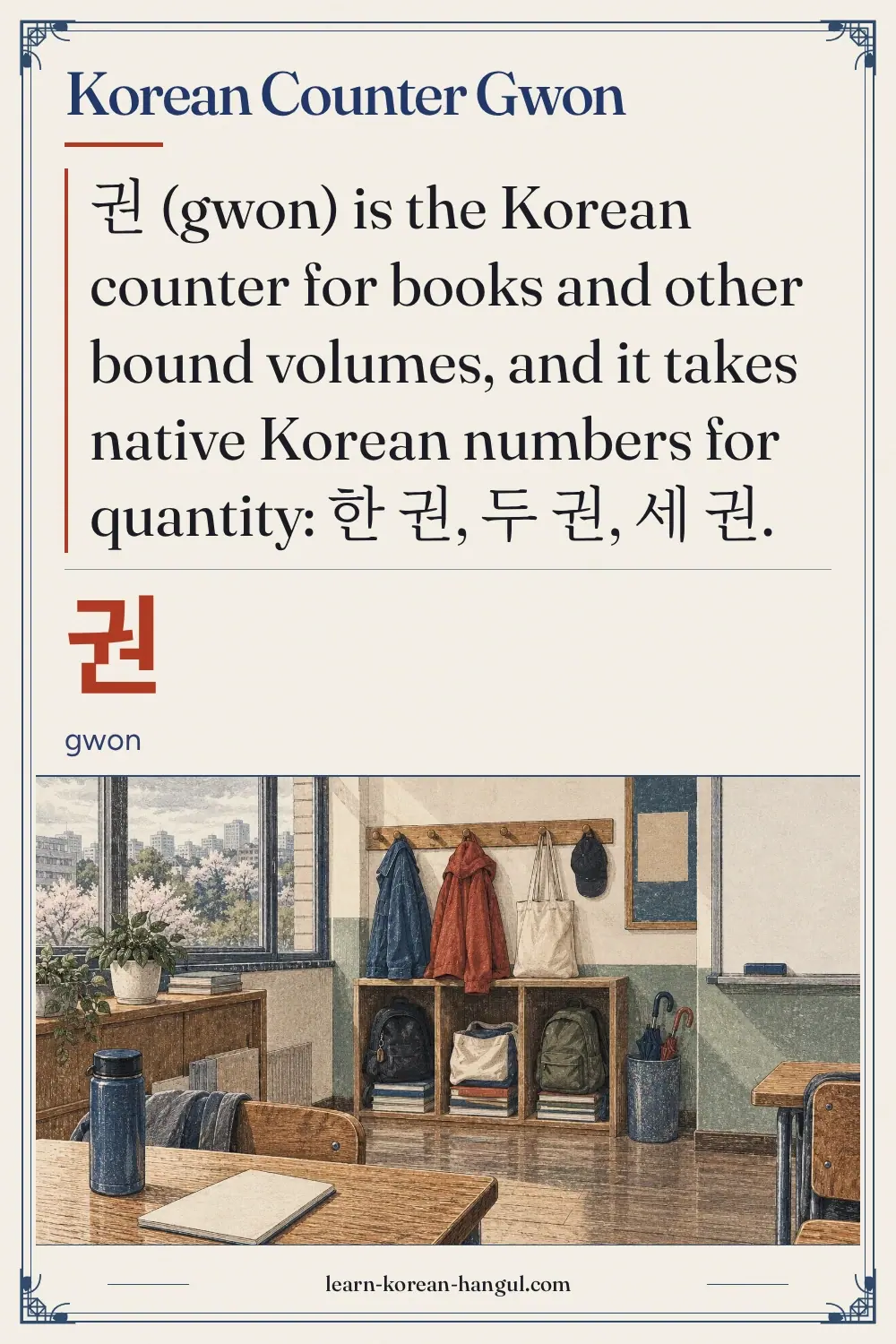
The Korean counter gwon (권) is a short word that follows a number and means "volumes of". A counter is a word that tells you what kind of unit a number refers to. English has a few such words, such as "two volumes of poems" or "three copies of the book". Korean needs a counter almost every time, and 권 is the one for anything bound like a book.
The pattern is: book word + native number + 권.
| Book word | Number + 권 | Meaning |
|---|---|---|
| 책 (chaek) | 책 두 권 | two books |
| 공책 (gongchaek) | 공책 한 권 | one notebook |
| 잡지 (japji) | 잡지 세 권 | three magazines |
| 만화책 (manhwachaek) | 만화책 다섯 권 | five comic books |
The word 권 comes from the Chinese character 卷, which first meant a scroll or a roll of writing. That history explains why 권 counts bound volumes and why it also numbers the volumes of a set. Today you do not need the character. You only need the rule: if the item is a bound book-like thing, use 권.
For quantity, 권 takes native Korean numbers (하나, 둘, 셋), not Sino-Korean ones (일, 이, 삼). So 두 권 is correct for two books. Sino numbers appear only when you number volumes, as a later section shows. The wider system is explained in how Korean counters work. The next section puts the counter into sentences.
How Do You Use 권 in a Sentence?
To use 권 in a sentence, put the book word first, then the native number, then 권: 책을 세 권 샀어요 (I bought three books). English puts the number before the noun, but Korean puts the counter phrase after the noun, and the counter is an extra word that English does not need.
Three patterns cover almost every real sentence.
| Job | Pattern | Example |
|---|---|---|
| Buying or borrowing | Book word + particle + number + 권 + verb | 책을 두 권 빌렸어요. |
| Saying what you read | Book word + particle + number + 권 + verb | 이번 달에 소설을 네 권 읽었어요. |
| Saying how many exist | Place + book word + 이/가 + number + 권 + 있어요 | 책상 위에 공책이 한 권 있어요. |
More sentences to hear and repeat:
- 가방에 책이 세 권 들어 있어요. (There are three books in the bag.)
- 서점에서 만화책을 다섯 권 샀어요. (I bought five comic books at the bookshop.)
- 일 년에 책을 스무 권쯤 읽어요. (I read about twenty books a year.)
The particle 을/를 or 이/가 can sit on the book word (책을 두 권) or be dropped in speech (책 두 권 빌렸어요). You never put a particle between the number and 권. Writing 두를 권 is always wrong. The suffix 쯤 in 스무 권쯤 means "about" and attaches to the counter phrase.
Now you can build a full sentence. Next comes the number rule that makes the counter work.
Which Number System Does 권 Take?
The counter 권 takes native Korean numbers from 1 to 99 when you count how many books there are. Five native numbers shorten before any counter, and learning those five forms once covers every counter that takes native numbers, including 개, 장 and 대.
| Number | Before 권 | Spoken | Revised Romanization | Meaning |
|---|---|---|---|---|
| 1 | 한 권 | [한권] | han gwon | one book |
| 2 | 두 권 | [두권] | du gwon | two books |
| 3 | 세 권 | [세권] | se gwon | three books |
| 4 | 네 권 | [네권] | ne gwon | four books |
| 5 | 다섯 권 | [다섣꿘] | daseot gwon | five books |
| 6 | 여섯 권 | [여섣꿘] | yeoseot gwon | six books |
| 7 | 일곱 권 | [일곱꿘] | ilgop gwon | seven books |
| 8 | 여덟 권 | [여덜권] | yeodeol gwon | eight books |
| 9 | 아홉 권 | [아홉꿘] | ahop gwon | nine books |
| 10 | 열 권 | [열권] | yeol gwon | ten books |
Look at the "Spoken" column for 5, 6, 7 and 9. A final ㅅ or ㅂ is said as a plain stop ([ㄷ] or [ㅂ]), and that stop usually makes the ㄱ of 권 tense, so you hear [ㄲ]. This is tensification, covered by the National Institute of Korean Language (국립국어원) standard pronunciation rules (표준 발음법). After ㄹ, as in 여덟 권 and 열 권, the standard form stays plain. The same effect gives 몇 권 the sound [멷꿘].
Which Forms Shorten before 권?
Five numbers shorten before 권: 하나 becomes 한, 둘 becomes 두, 셋 becomes 세, 넷 becomes 네 and 스물 becomes 스무. These short forms are numeral determiners (수 관형사). They stand in front of the counter the way an adjective stands in front of a noun.
| Full number | Counting form | Example with 권 |
|---|---|---|
| 하나 (1) | 한 | 한 권 |
| 둘 (2) | 두 | 두 권 |
| 셋 (3) | 세 | 세 권 |
| 넷 (4) | 네 | 네 권 |
| 스물 (20) | 스무 | 스무 권 |
The shortening applies at the end of larger numbers too: 열한 권 (11), 열두 권 (12), 스물한 권 (21). Round tens keep their full form: 서른 권 (30), 마흔 권 (40).
Expert tip: learners often say 둘 권 because 둘 is the first form of two they learned. Say 두 권. A quick check: if a counter follows, the number is 한, 두, 세, 네 or 스무, never 하나, 둘, 셋, 넷 or 스물.
What Happens at 100 and Above?
Native numbers stop at 아흔아홉 (99) in everyday counting. A library with 오천 권 (5,000 volumes) uses Sino-Korean numbers, and so does a warehouse of 백 권. Everyday reading stays between 한 권 and 스무 권.
When you write the number in Hangul, keep a space: 세 권, not 세권. When you write with digits, Article 43 of the 한글 맞춤법 (Hangul spelling rules) allows the counter to be attached, and that is the usual style: 3권, 12권.
You can now count any pile of books. Next is the point that sets 권 apart from other counters.
What Is the Difference between 두 권 and 이 권?
두 권 means two books, and 이 권 means volume 2. The first counts a quantity with a native number. The second numbers one volume inside a set with a Sino-Korean number. This is the most useful rare feature of 권, because most counters have no volume use at all.
| Korean | Number type | Meaning | Example |
|---|---|---|---|
| 책 두 권 | native | two books | 책 두 권을 샀어요. |
| 이 권 | Sino | volume 2 | 이 권을 읽고 있어요. |
| 책 세 권 | native | three books | 책 세 권이 있어요. |
| 삼 권 | Sino | volume 3 | 삼 권은 어디 있어요? |
A series of ten volumes is 모두 열 권이에요 (ten volumes in all), which counts the volumes with a native number. The third volume is 삼 권, which names one volume with a Sino number. In printed catalogues you see the digits 3권, and the reader decides from context whether to say 세 권 or 삼 권. If the sentence asks "how many", read it as 세 권. If it asks "which one", read it as 삼 권.
Two other words appear on box sets and old editions. 상권 (the upper volume) and 하권 (the lower volume) name a two-volume set, and 중권 names a middle volume.
What Counts as a 권?
권 counts bound volumes of print: books, magazines, notebooks, comics, dictionaries and e-books. If you could name the item as a book, 권 fits. The table lists the common cases.
| Item | Phrase | Meaning |
|---|---|---|
| 소설 (novel) | 소설 한 권 | one novel |
| 사전 (dictionary) | 사전 두 권 | two dictionaries |
| 교과서 (textbook) | 교과서 세 권 | three textbooks |
| 시집 (poetry book) | 시집 네 권 | four poetry books |
| 공책 (notebook) | 공책 다섯 권 | five notebooks |
| 전자책 (e-book) | 전자책 여섯 권 | six e-books |
E-books count as 권 because they stand in for a book. A newspaper does not: it is counted by 부 (copies), such as 신문 한 부, a counter outside this lesson. Single sheets and loose pages also fall outside 권, as the next section shows.
How Do You Ask How Many with 몇 권?
To ask how many books there are, say 몇 권이에요? The word 몇 means "how many", so 몇 권 means "how many books". It is pronounced [멷꿘] because the final ㅊ of 몇 is said as [ㄷ], which tenses the ㄱ.
| Situation | Question | Answer |
|---|---|---|
| Asking a friend | 책을 몇 권 읽었어요? | 세 권 읽었어요. |
| At the library | 몇 권 빌릴 수 있어요? | 다섯 권 빌릴 수 있어요. |
| At the bookshop | 몇 권 필요하세요? | 두 권 필요해요. |
| Checking a series | 모두 몇 권이에요? | 모두 열 권이에요. |
The answer repeats the same pattern: number + 권 + 이에요 or a verb. After 권 the copula takes the 이에요 form because 권 ends in a consonant, so you say 열 권이에요.
Library and Bookshop Dialogues
The first dialogue happens at a library desk. The second one happens at a bookshop till.
학생: 책을 몇 권 빌릴 수 있어요? (How many books can I borrow?)
사서: 한 번에 다섯 권까지 빌릴 수 있어요. (You can borrow up to five at a time.)
학생: 그럼 소설 세 권이랑 잡지 한 권 빌릴게요. (Then I will borrow three novels and one magazine.)
사서: 반납은 2주 뒤까지예요. (Return them within two weeks.)
손님: 이 책 두 권 주세요. (Two copies of this book, please.)
직원: 선물 포장해 드릴까요? (Shall I gift-wrap them?)
손님: 네, 한 권만 해 주세요. (Yes, just one, please.)
The limit of five books is an example, since libraries set their own rules. Notice 2주 (read 이 주, two weeks) uses a Sino number with the week counter, not 권. Writing the digit avoids a clash with 이 주, which also means "this week". The particle 까지 means "up to", and 만 in 한 권만 means "only". Both attach to the counter phrase.
Should You Use 권, 장 or 쪽?
Use 권 for books, 장 for single sheets and 쪽 for printed pages. The counters sort by what you hold in your hand, so one study session can use all three.
| Counter | Counts | Example | Meaning |
|---|---|---|---|
| 권 | bound volumes | 책 두 권 | two books |
| 장 | sheets, tickets, photos | 종이 세 장 | three sheets of paper |
| 쪽 | pages | 오십 쪽 | fifty pages |
| 개 | other objects | 가방 한 개 | one bag |
Notice that 쪽 always takes Sino numbers, whether it counts pages (오십 쪽, fifty pages) or names one (오십 쪽, page fifty). The loanword 페이지 (page) does the same job: 십 페이지. The 장 counter is covered in its own lesson. For other objects, the fallback is the 개 counter. Both sit in the group of counters for things.
Daily-Life Phrases with 권
Most real uses of 권 fall into a few daily scenes: shopping, studying, borrowing and gifts. Learn these phrases as whole chunks, because the number and counter then come out together without thinking.
| Scene | Phrase | Meaning |
|---|---|---|
| Bookshop | 이 책 두 권 주세요. | Two copies of this book, please. |
| Library | 책 세 권 반납할게요. | I will return three books. |
| Study | 교과서 네 권이 필요해요. | I need four textbooks. |
| Gift | 친구에게 시집 한 권을 선물했어요. | I gave a friend a book of poems. |
| Goals | 올해 책 쉰 권을 읽고 싶어요. | I want to read fifty books this year. |
| Series | 이 시리즈는 모두 열두 권이에요. | This series has twelve volumes. |
The word 쉰 (50) is a native round ten, so it keeps its full form before 권. The phrase 시리즈는 uses the topic particle 는, and 모두 (all together) sits before the counter phrase. Next, clear up the beliefs that trip up learners.
Misconceptions about 권
Learners often assume that 권 is only for thick books, or that one rule covers both quantity and volume. Both ideas are wrong.
Misconception 1: 권 is only for books. 권 counts any bound volume: notebooks, magazines, comics and dictionaries all take it.
Misconception 2: thin booklets do not count as 권. A thin booklet or a school notebook still takes 권. The binding matters, not the thickness.
Misconception 3: 두 권 and 이 권 are interchangeable. They differ. 두 권 counts two books, and 이 권 names volume 2. Mixing them changes the meaning of the sentence.
Misconception 4: 개 is always safe for books. It is understood, but it sounds like you do not know the counter for books. Use 권.
Common Mistakes and Fixes
The most frequent errors with 권 are about number forms and counter choice. Each one has a simple fix.
| Mistake | Why it is wrong | Fix |
|---|---|---|
| 책 이 권 (for two books) | Sino number for a quantity | 책 두 권 |
| 책 셋 권 | Full number before a counter | 책 세 권 |
| 두 권 책을 샀어요. | Counter phrase before the noun sounds unnatural | 책을 두 권 샀어요. |
| 스물 권 | Full form of 20 before a counter | 스무 권 |
| 책 두 개 | Understood but sounds off | 책 두 권 |
| 종이 한 권 | Loose paper uses 장 | 종이 한 장 |
Remember the rule of thumb: if you can open it and turn the pages, use 권. If you can slide a single sheet out of it, use 장 for that sheet.
Practice Set
Try these five questions before you check the answers below.
- Fill in the blank: 책 ___ 권 주세요. (two)
- Say "five comic books" in Korean.
- What is the difference between 책 세 권 and 삼 권?
- Which counter fits ten sheets of paper?
- Correct this sentence: 책 이 권 샀어요. (the speaker bought two books)
Practice · 8
Fill in the blank for two books: 책 ___ 권 주세요.
Show answer
두
For a quantity, 권 takes native numbers, and 둘 shortens to 두 before a counter.
What does 이 권 mean?
Show answer
volume 2
With a Sino-Korean number, 권 names one volume in a set; two books is 두 권.
How do you say "five comic books"?
Show answer
만화책 다섯 권
Put the book word first, then the native number, then 권.
Which counter fits ten sheets of paper?
Show answer
장
Loose sheets take 장 (종이 열 장); 권 is for bound volumes and 쪽 is for pages.
How do you say "twenty books"?
Show answer
스무 권
Exactly 20 shortens to 스무 before a counter, and the quantity takes native numbers.
How is 몇 권 pronounced?
Show answer
[멷꿘]
The final ㅊ of 몇 is said as [ㄷ], which tenses the ㄱ of 권, so you hear [멷꿘].
How is a newspaper counted?
Show answer
신문 한 부
A newspaper is not a bound volume, so it takes 부 (copies), not 권.
How do you say "fifty pages"?
Show answer
오십 쪽
쪽 always takes Sino-Korean numbers, whether it counts pages or names one.
Answers
- 두. The sentence is 책 두 권 주세요.
- 만화책 다섯 권.
- 책 세 권 means three books. 삼 권 means volume 3.
- 장, as in 종이 열 장.
- 책 두 권 샀어요. For a quantity, 권 takes the native number 두.
What This Lesson Does Not Cover
This lesson covers 권 for books and volumes. It does not cover sheets of paper (see the 장 counter), copies of a newspaper (the counter 부) or the general fallback for objects (see the 개 counter). It also leaves out publishing terms such as edition and print run, which belong in a vocabulary lesson.
What to Learn Next
The next lesson is the 장 counter, which counts sheets, tickets and photos. To see every counter for objects side by side, go back to Counting Things. Once the korean counter gwon feels natural, practise it with Korean shopping phrases and the numbers in native Korean numbers 1-100.
Frequently Asked Questions
Can I use 개 for books?
A Korean listener will understand 책 두 개, but it sounds off, like counting books as plain lumps. Use 권 whenever you talk about books, magazines or notebooks: 책 두 권. The counter 개 is the safe fallback for objects that have no counter of their own, and books do have one.
How do I say "volume 1" in Korean?
Use a Sino-Korean number with 권, or write it with digits: 일 권 or 1권. For a titled series, add 제 in formal writing, as in 제1권. Do not use the native form here. 한 권 means one book, while 일 권 names the first volume of a set, so the numbers play different roles.
What about e-books?
E-books follow the same rule. You count them with 권 because they stand for a book: 전자책 두 권 (two e-books). A subscription or an app is not a book, so those use 개. The counter depends on the object you can name as a book.
Is 권 used for a ream of paper?
No. Loose paper is counted by the sheet with 장, as in 종이 오백 장. A ream, which is 500 sheets of full-size paper, has its own word, 연. Use 권 for bound volumes only, such as books and notebooks. A pad of sheets stitched together is a notebook, so 공책 한 권.
Does 권 take Sino-Korean numbers?
Only when the number names a volume, not a quantity. For quantity, 권 takes native numbers: 한 권, 두 권, 스무 권. For a volume in a series, it takes Sino numbers: 일 권, 이 권, 삼 권. The meaning decides, so check whether you are counting books or numbering them.