생일 축하합니다
생일 축하합니다
What you'll learn
- Read and say the four lines of the Korean birthday song.
- Put a name into line three with 사랑하는.
- Pronounce 생일 축하합니다 as [생일 추카함니다].
- Choose between singing the formal song and saying a polite greeting such as 생일 축하해요.
Before you start: the greeting page happy birthday in Korean covers the spoken forms. Time: about 11 minutes. Audio plays only when you press a button.
How Do You Say Happy Birthday Song in Korean?
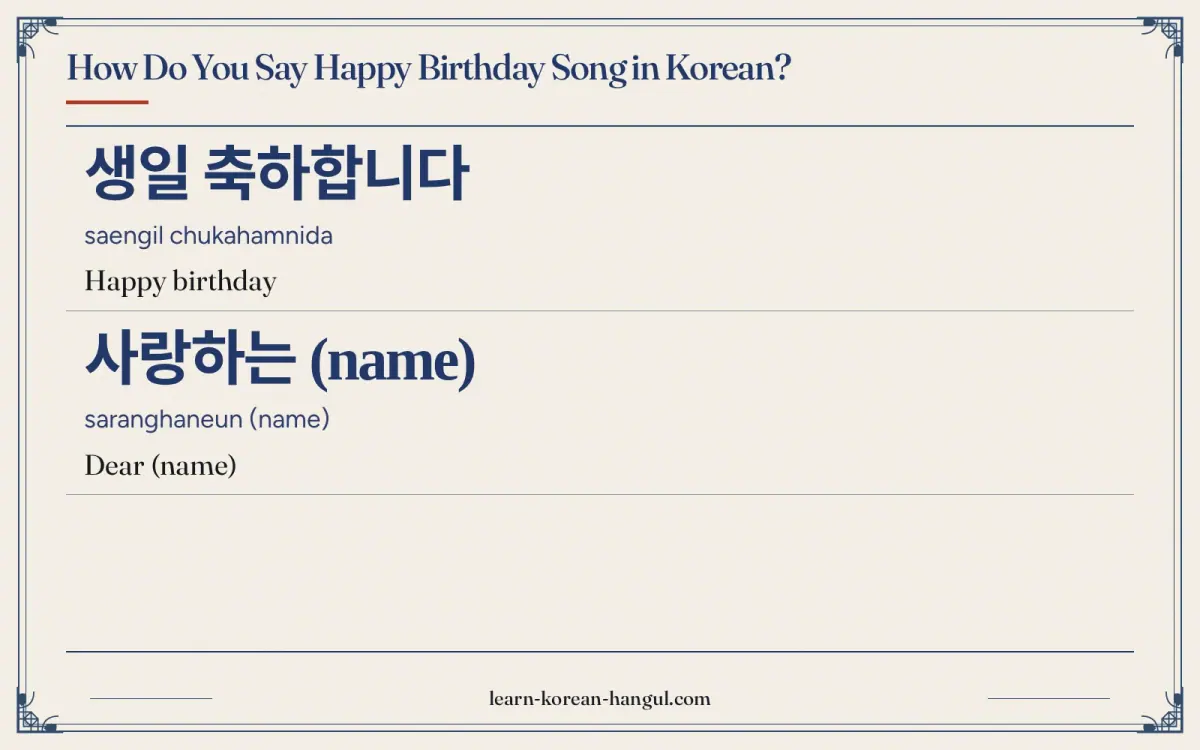
The Korean happy birthday song is 생일 축하합니다 (saengil chukahamnida), which means "I congratulate you on your birthday". It has four short lines, and the same words open the first, second and fourth lines. The table below gives each line with its romanization and meaning.
| Line | Korean | Romanization | Meaning |
|---|---|---|---|
| 1 | 생일 축하합니다 | saengil chukahamnida | Happy birthday |
| 2 | 생일 축하합니다 | saengil chukahamnida | Happy birthday |
| 3 | 사랑하는 (name) | saranghaneun (name) | Dear (name) |
| 4 | 생일 축하합니다 | saengil chukahamnida | Happy birthday |
Some singers join lines three and four into 사랑하는 (name)의 생일 축하합니다, with the possessive particle 의 (of). Both versions are sung. The sections below take the phrases one at a time.
What Are the Formal Ways to Say the Happy Birthday Song?
The birthday song uses one register: the formal style (합쇼체, hapsyoche), the most respectful of the Korean speech levels. The guide to Korean speech levels explains why the ending -ㅂ니다 sounds ceremonial. A group singing together, with ages mixed, suits this style exactly.
Formal: 생일 축하합니다 (saengil chukahamnida)
Formal · 합쇼체생일 축하합니다 is both the repeating line of the song and a formal spoken greeting. At an office party, a host can say it before the song starts. At home, families sing it and then switch to a warmer 생일 축하해 or 생일 축하해요 for individual wishes.
다 같이 불러요. 생일 축하합니다.
da gachi bulleoyo. saengil chukahamnida
Let's all sing together. Happy birthday.
Formal: 사랑하는 ...의 생일 축하합니다 (saranghaneun ...ui saengil chukahamnida)
Formal · 합쇼체사랑하는 (saranghaneun) means "beloved" or "dear", from the verb 사랑하다 (to love). Put the person's name after it. 지민의 means "Jimin's", because 의 is the possessive particle. For a respected adult, sing a title ending in 님 (nim) instead of the bare name, as in 사랑하는 팀장님 (beloved team leader).
이름을 넣어서 불러요. 사랑하는 민수의 생일 축하합니다.
ireumeul neoeoseo bulleoyo. saranghaneun minsuui saengil chukahamnida
Put in the name and sing: happy birthday, dear Minsu.
Noun Phrase: 생일 축하 노래 (saengil chukha norae)
Polite · 해요체생일 축하 노래 is the name of the song, built from 생일 (birthday), 축하 (congratulation) and 노래 (song). Use it when you ask for the song or announce it. The verb for singing a song is 부르다 (bureuda), so 노래를 불러요 means "I sing a song".
생일 축하 노래를 불러요.
saengil chukha noraereul bulleoyo
Let's sing the birthday song.
The song is one phrase repeated, with a name in the middle. How it sounds comes next.
How Do You Pronounce 생일 축하합니다?
생일 축하합니다 is pronounced saeng-il chu-ka-ham-ni-da, in seven syllables, and the written ㅎ and ㅂ both change.
- 생 (saeng): s plus the "e" of "bed", ending in "ng".
- 일 (il): "eel", with a short l.
- 축하 (chu-ka): the ㄱ and ㅎ merge, so this sounds like "chuka".
- 합 (ham): the ㅂ becomes an m.
- 니 (ni): "nee".
- 다 (da): a soft d and "ah".
Sound Changes to Listen For
These changes follow the National Institute of Korean Language (국립국어원) Standard Pronunciation rules (표준 발음법):
- ㄱ + ㅎ becomes ㅋ. 축하 is said [추카]. Singing "chuk-ha" breaks the rhythm.
- ㅂ + ㄴ becomes ㅁ + ㄴ. 합니다 is said [함니다]. The rule is explained in ㅂ-to-ㅁ nasalization.
- 의 as [에]. In 지민의, the possessive 의 may be said [에], so 지민의 can sound like "ji-mi-ne". Both are accepted.
Together the full line is [생일 추카함니다]. After the sound, the question is when to sing the song and when to speak a greeting.
When Should You Use the Song, and When Should You Not?
Sing the song at a party with a cake, and say a polite greeting such as 생일 축하해요 when you meet the person alone. The song is a group performance, not a message.
Situations Where It Fits
- A family dinner. Everyone sings while the cake arrives with candles.
- An office party. Colleagues sing in front of the cake, then clap.
- A restaurant. Some restaurants bring a cake and the staff sing 생일 축하합니다.
- A school class. Children sing together and the teacher joins.
Situations to Avoid
- A text message. Write 생일 축하해요 instead of the lyrics.
- An elder's party with 생일. Many families sing 생신 축하합니다 with the honorific noun.
- A sad or quiet event. If the person is unwell or grieving, skip the song.
- A serious meeting. The song belongs to celebrations, not to formal announcements.
The short conversations below show how a party starts.
What Does the Birthday Song Sound Like in a Real Conversation?
Before the song, someone leads, and after it, the birthday person makes a wish. Notice the polite endings around the song.
Starting the Song
Host
자, 같이 불러요. 하나, 둘, 셋.
ja, gachi bulleoyo. hana, dul, set
Okay, let's sing together. One, two, three.
Guests
좋아요.
joayo
Sure.
What to notice: the host counts in with native Korean numbers, 하나, 둘, 셋, just before the first note.
Candles on the Cake
Friend
소원 빌고 촛불 꺼.
sowon bilgo chotbul kkeo
Make a wish and blow out the candles.
Birthday Person
응, 잠깐만. 소원 빌게.
eung, jamkkanman. sowon bilge
Okay, wait a moment. I'll make a wish.
What to notice: friends use casual speech, and 꺼 (kkeo) is the casual command form of 끄다 (to put out). The customs around the song are worth knowing before your first party.
What Should You Know about the Culture behind the Birthday Song?
The Korean birthday song is a shared moment: people sing together, the person blows out the candles and everyone claps. These points shape how it sounds at a party.
- The tune. The melody is the same as the English "Happy Birthday to You", so you can start singing without learning a new tune.
- English and Korean. Many groups sing the Korean words, and some sing the English or mix them. Joining the Korean words is welcomed.
- Seaweed soup. Birthday meals often include 미역국 (miyeokguk), a seaweed soup, and the song comes with the cake.
- A wish before the candles. The person makes a silent wish before blowing out the candles.
- Respect for age. For a grandparent, families commonly use 생신 instead of 생일.
An expert insight: learners often worry about the tune, but the word rhythm is the harder part. The Korean line is seven syllables with a clear break after 생일, so practise saying it in steady beats before you sing. The mistakes below come from the same details.
What Mistakes Do Learners Make with the Birthday Song in Korean?
Most mistakes come from translating the English lyrics word for word, or from mispronouncing 축하.
| Mistake | Why it is a problem | Fix |
|---|---|---|
| Singing 해피 버스데이 투 유 for the Korean song | Fine for fun, but not the Korean wording | Sing 생일 축하합니다 |
| Singing "chuk-ha" with a clear h | The ㄱ and ㅎ merge into a k sound | Sing [추카] |
| Saying 합니다 with a b | ㅂ becomes m before ㄴ | Sing [함니다] |
| Skipping 사랑하는 in line three | The line then has no name slot | Add 사랑하는 and the name |
| Using 생일 for a grandparent | The honorific noun is 생신 | Sing 생신 축하합니다 |
Learners often assume that the Korean song translates "Happy birthday to you" directly. Actually, the Korean lyrics are a separate formal congratulation, so there is no word for "happy" or "to you" in the song at all. The next section answers the other ways people search for it.
Is It the Same as Birthday Song?
Yes. The searches below all point to the same song and lyrics.
- Birthday song in Korean: 생일 축하 노래, sung with the lyrics on this page.
- Happy birthday lyrics in Korean: 생일 축하합니다 (x2), 사랑하는 (name), 생일 축하합니다.
- Happy birthday song Korean: the same four lines.
- Birthday song lyrics in Korean: the table in the first section gives each line with romanization.
For the spoken greeting, see happy birthday in Korean. Now practise.
Practice: Say It Aloud
Play the slow clip of 생일 축하합니다 and repeat it three times at a steady pace, then read the full lyric once. Next answer these. Answers follow.
- Which word do you sing in line three before the name?
- How is 축하 pronounced?
- Your grandmother's birthday song uses which noun instead of 생일?
- What is the formal ending in 축하합니다?
Answers
- 사랑하는.
- [추카].
- 생신 (the honorific noun), as in 생신 축하합니다.
- -ㅂ니다 (here 합니다).
The phrase flashcards drill the birthday phrases with audio.
Related Phrases to Learn Next
The birthday song pairs with other celebration phrases.
- Happy birthday in Korean: the spoken greetings for friends, coworkers and elders.
- Cheers in Korean: 건배 for toasts after the cake.
- Congratulations in Korean: 축하해요 for other occasions.
This guide belongs to the Korean celebration phrases collection. What this page does not cover: sheet music, regional variants and other Korean songs. Sing 생일 축하합니다 twice, name the person with 사랑하는, and close with the same line, and you know the happy birthday song in Korean.
Frequently Asked Questions
Do Koreans sing happy birthday in English or Korean?
Both are heard. Many Koreans sing the Korean words, 생일 축하합니다, at family and workplace parties, while friends often sing the English version or mix the two for fun. If you join a Korean party, joining the Korean words shows respect, and the repeating line is easy to learn after a single listen.
What does 생일 축하합니다 mean in the song?
생일 축하합니다 means "I congratulate you on your birthday", from 생일 (birthday) and 축하합니다 (I congratulate). The Korean song does not repeat "happy birthday to you" word for word. It repeats the formal congratulation instead, which is why the same line also works as a spoken greeting at formal events.
How do you put a name into the Korean birthday song?
On line three, sing 사랑하는 (saranghaneun, beloved) and the name, for example 사랑하는 지민. Some singers add the possessive particle and sing 사랑하는 지민의 생일 축하합니다 as one line. Use the name the person normally goes by, or a title ending in 님 (nim), such as 팀장님, for a respected adult.
Is the Korean birthday song only for children?
No. Adults sing it at offices, restaurants and family dinners too. The formal ending -ㅂ니다 makes it suitable for groups of any age. For a grandparent or other elder, families usually swap 생일 for 생신 so the song matches the respectful greeting used in conversation.
How do you say sing happy birthday in Korean?
Say 생일 축하 노래 불러요 (saengil chukha norae bulleoyo, let's sing the birthday song) or 같이 노래해요 (gachi noraehaeyo, let's sing together). To invite the table to start, say 다 같이 불러요 (da gachi bulleoyo). A leader often counts 하나, 둘, 셋 (one, two, three) before the first line.