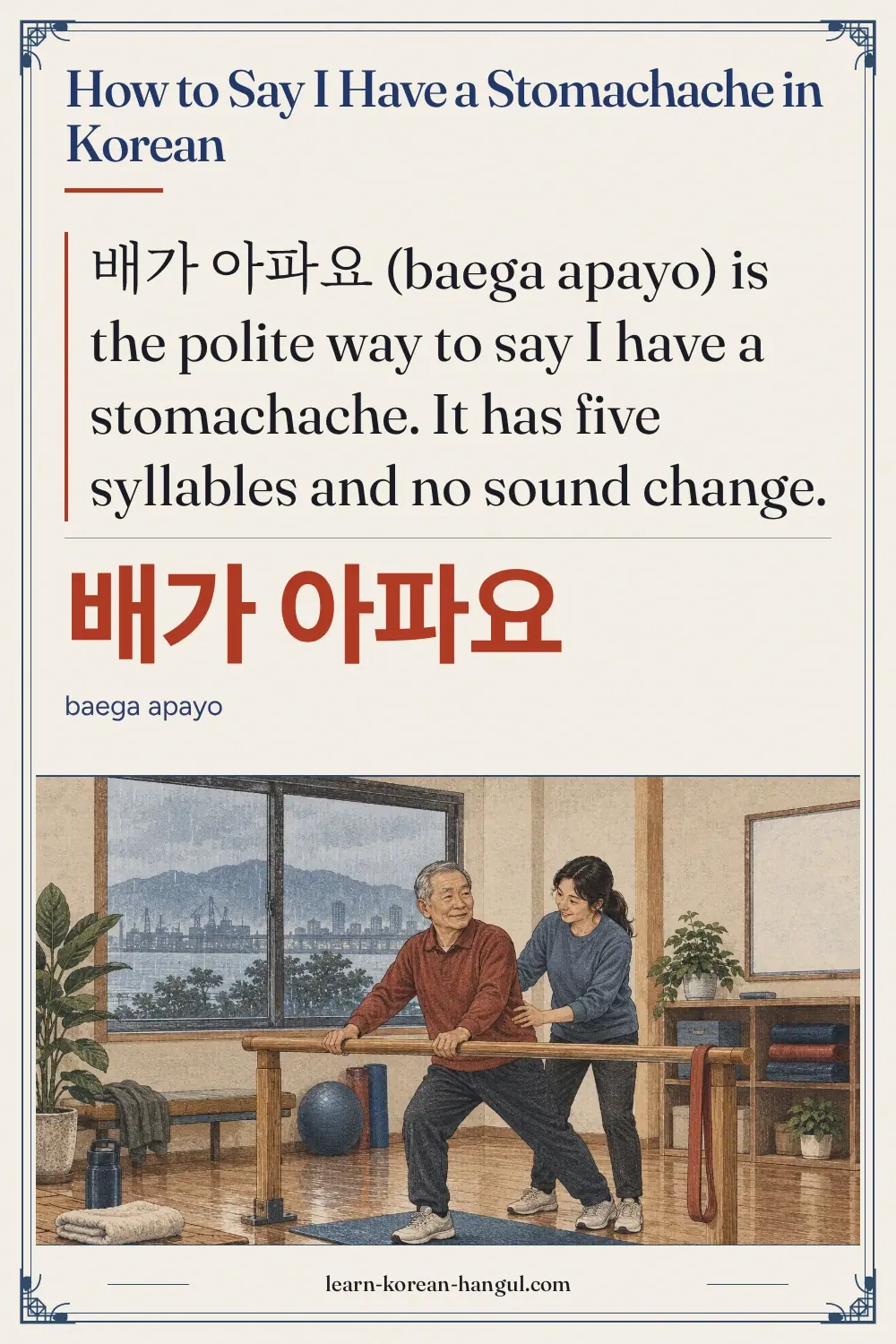
배가 아파요
배가 아파요
What you'll learn
- Say a stomachache with 배가 아파요, 배가 아픕니다 or 배가 아파.
- Tell a stomachache apart from an upset stomach, indigestion and hunger.
- Understand why 배 can also mean pear or boat.
- Hear the difference between 아파요 (hurts) and 고파요 (hungry).
Before you start: you only need to read Hangul. This page teaches language, not medical advice. If the pain is sudden or severe, call 119, Korea's emergency number for ambulance and fire. Time: about 10 minutes. Audio plays only when you press a button.
Key facts
- 배가 아파요 (baega apayo) is the polite way to say I have a stomachache. It has five syllables.
- 배 means belly or stomach in daily speech. It is also the word for pear and for boat.
- 배탈이 났어요 (baetari nasseoyo) means an upset stomach, and 체했어요 (chehaesseoyo) means food sits badly.
- 배가 아파요 and 배가 고파요 (I am hungry) differ in one syllable.
How Do You Say I Have a Stomachache in Korean?
The standard way to say I have a stomachache in Korean is 배가 아파요. It has three parts: 배 (bae, belly), the subject marker 가 (ga) and 아파요 (apayo, it hurts). The sentence is the same pattern as the headache sentence, with a different body part.
| Situation | Best form | Romanization | Why |
|---|---|---|---|
| Telling a pharmacist, a host or a colleague | 배가 아파요 | baega apayo | Polite, the default |
| Telling a close friend or sibling | 배가 아파 | baega apa | Casual |
| A formal message to a superior | 배가 아픕니다 | baega apeumnida | Formal |
| After eating something bad | 배탈이 났어요 | baetari nasseoyo | Upset stomach |
| After a heavy meal | 체했어요 | chehaesseoyo | Food sits badly |
| A vague feeling of nausea or unease | 속이 안 좋아요 | sogi an joayo | Insides feel bad |
English "stomach" covers a wide area. Korean splits it: 배 is the belly you can point to, and 속 (sok) is the "inside". The next section sorts the forms by level.
What Are the Formal, Polite and Casual Ways to Say I Have a Stomachache?
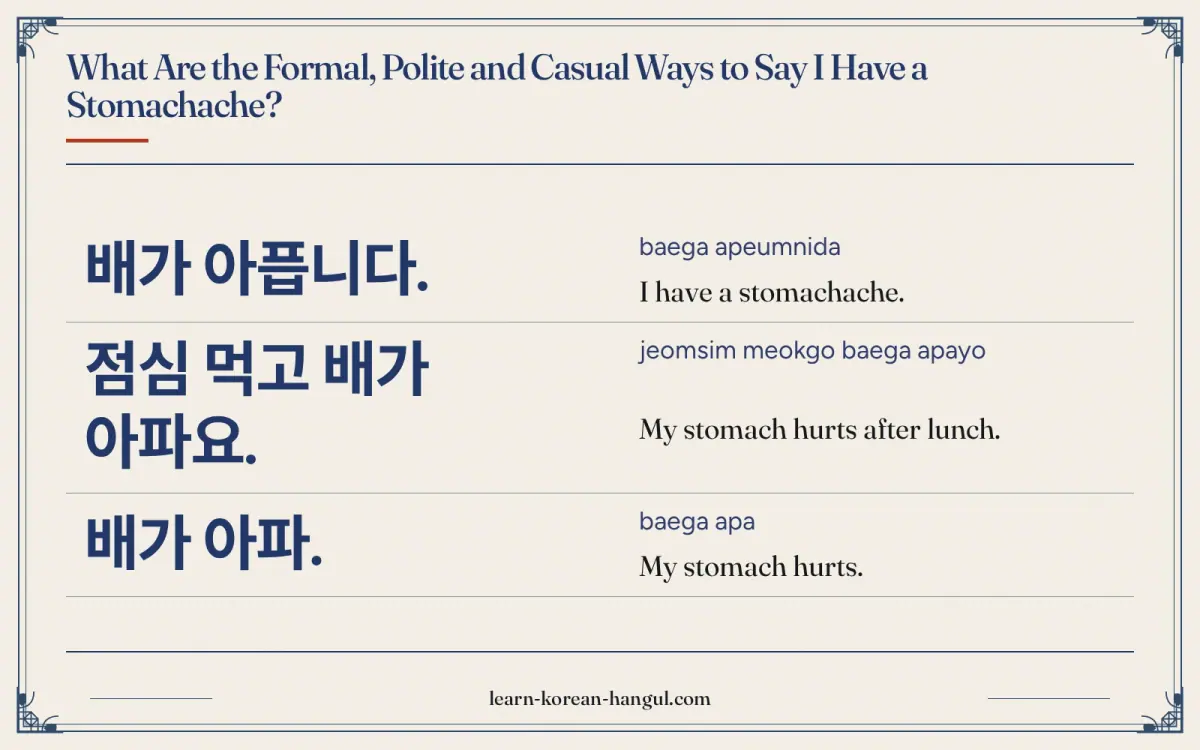
The forms follow the Korean speech levels, explained in the guide to Korean speech levels. Here we move from formal to casual.
Formal: 배가 아픕니다 (baega apeumnida)
Formal · 합쇼체배가 아픕니다 uses the formal -ㅂ니다 ending. It fits a message to a boss, a form at a clinic or a spoken report. It is pronounced [배가 아픔니다], because ㅂ before ㄴ turns into ㅁ.
배가 아픕니다.
baega apeumnida
I have a stomachache.
Polite: 배가 아파요 (baega apayo)
Polite · 해요체배가 아파요 is the everyday default. Add the cause or the time to help the listener: 점심 먹고 배가 아파요, "My stomach hurts after lunch".
점심 먹고 배가 아파요.
jeomsim meokgo baega apayo
My stomach hurts after lunch.
Casual: 배가 아파 (baega apa)
Casual · 반말배가 아파 drops the polite 요. Use it with a friend, a sibling or a child. Close friends often add 진짜 (jinjja, really): 진짜 배가 아파.
배가 아파.
baega apa
My stomach hurts.
Past: 배가 아팠어요 (baega apasseoyo)
Polite · 해요체배가 아팠어요 is pronounced [배가 아파써요]. Use it when the pain has passed: 어제 배가 아팠어요, "My stomach hurt yesterday".
배가 아팠어요.
baega apasseoyo
My stomach hurt.
Upset Stomach: 배탈이 났어요 (baetari nasseoyo)
Polite · 해요체배탈 (baetal) is a stomach illness, such as an upset stomach from bad food, and 나다 (nada) here means "to come out, to occur". So 배탈이 났어요 means "I have an upset stomach". In speech it is [배타리 나써요]: the ㄹ of 탈 moves to the next syllable, and ㅆ moves too.
배탈이 났어요.
baetari nasseoyo
I have an upset stomach.
A Vague Feeling: 속이 안 좋아요 (sogi an joayo)
Polite · 해요체속 means "the inside", and 속이 안 좋아요 says that your insides do not feel good. Use it for mild nausea or a queasy feeling, before it becomes real pain. It is pronounced [소기 안 조아요]. The final ㄱ of 속 links to the next syllable, and the ㅎ of 좋아요 is silent before a vowel.
속이 안 좋아요.
sogi an joayo
My stomach feels bad.
Indigestion: 체했어요 (chehaesseoyo)
체했어요 comes from 체하다 (chehada), "to get indigestion". It is pronounced [체해써요]. Use it when you ate too fast or too much and the food will not settle. It is a very common everyday word.
How Do You Pronounce 배가 아파요?
배가 아파요 is pronounced [배가 아파요], bae-ga a-pa-yo, in five syllables, and nothing changes. Every syllable ends in a vowel, so no final consonant moves.
- 배 (bae): the vowel ㅐ is like the "e" in "bed". The standard pronunciation rules (Article 4) still list ㅐ and ㅔ as two vowels, but most Seoul speakers today pronounce them the same.
- 가 (ga): a soft "g".
- 아 (a): the silent ㅇ gives a clean "a".
- 파 (pa): the ㅍ is aspirated, with a puff of breath.
- 요 (yo): "yo".
Sounds to Listen For
These notes follow the National Institute of Korean Language standard pronunciation rules (표준 발음법):
- One syllable apart. 배가 아파요 and 배가 고파요 share the first and last syllables. Only 아 versus 고 changes the meaning, so say it clearly. 고프다 and 아프다 follow the same ㅡ-drop, which is why both end in 파요.
- Past tense. 아팠어요 is [아파써요]. The final ㅆ moves onto the next syllable (Article 13).
- Formal ending. 아픕니다 is [아픔니다]: ㅂ becomes ㅁ before ㄴ (Article 18).
Practise the three syllables 아-파-요 slowly, then link them. Because 배가 ends in a vowel, you can say 배가 and 아파요 almost as one smooth line.
When Should You Use 배가 아파요, and When Should You Not?
Use 배가 아파요 when you want to say that your abdomen hurts. If you only feel queasy or tired from eating, a softer sentence is more accurate.
Situations Where It Fits
- After a meal. 점심 먹고 배가 아파요.
- At a hotel or on a trip. 배가 많이 아파요, "My stomach hurts a lot".
- To explain a day off. 어제 배가 아팠어요, "My stomach hurt yesterday".
Situations to Avoid
- Hunger. If you only want food, say 배가 고파요, not 배가 아파요.
- Heartburn or a burning feeling. 속이 쓰려요 (sogi sseuryeoyo), which means "my insides sting", describes it better.
- A medical emergency. If the pain is sudden and severe, call 119 rather than practising a sentence.
Two short conversations show how the phrase sounds.
What Does I Have a Stomachache Sound Like in a Real Conversation?
In real life, the phrase comes with a reason or a request. Listen for the way the question is asked.
After Lunch with a Friend
Jimin
왜 그래요?
wae geuraeyo?
What's wrong?
Sujin
배가 아파요. 점심을 너무 많이 먹었어요.
baega apayo. jeomsimeul neomu mani meogeosseoyo
My stomach hurts. I ate too much lunch.
Jimin
따뜻한 물 마셔요.
ttatteutan mul masyeoyo
Drink some warm water.
What to notice: 왜 그래요? is a wh-question, so it does not end with a sharp rise. Jimin suggests warm water with the polite 마셔요, which works here as a gentle suggestion.
At the Hotel Desk
Guest
죄송한데, 배가 많이 아파요.
joesonghande, baega mani apayo
Sorry, but my stomach hurts a lot.
Staff
많이 아프세요? 약국이 근처에 있어요.
mani apeuseyo? yakgugi geuncheoe isseoyo
Does it hurt a lot? There is a pharmacy nearby.
Guest
감사합니다.
gamsahamnida
Thank you.
What to notice: the guest opens with 죄송한데 (sorry, but) to ask for help politely, and the staff member uses the honorific -세요 for the guest.
What Should You Know about the Culture behind I Have a Stomachache?
In Korea, food and the stomach are closely linked in daily talk. People ask 밥 먹었어요? (did you eat?) as a greeting, and a stomach problem is often traced to what or how fast someone ate. A friend may say 체했나 봐요 (chehaenna bwayo), "you may have indigestion".
- Warm drinks and simple food. People commonly suggest warm water, plum tea (매실차, maesilcha) or plain rice porridge (죽, juk) for an upset stomach. These are home habits, not medical instructions.
- One sound, three meanings. 배 means belly, pear and boat. Context settles it at once: 배가 아파요 is pain, 배가 맛있어요 is a tasty pear, and 배를 타요 is "I take a boat".
- Politeness at work. A short 배가 좀 아파서요 (my stomach hurts a bit, so...) is usually enough to excuse yourself, and people rarely ask for details.
An expert tip: the ending -서요 gives a reason without finishing the sentence. 배가 아파서요 works as a full, polite answer to 왜요? (why?).
What Mistakes Do Learners Make with I Have a Stomachache in Korean?
Most mistakes come from English habits and from the sound of 배.
| Mistake | Why it is a problem | Fix |
|---|---|---|
| 배를 아파요 | 를 marks an object, and 아프다 has none | Use 배가 |
| 배가 아프요 | Forgets the ㅡ-drop | Say 아파요 |
| 배가 아파요 when hungry | Means pain, not hunger | Say 배가 고파요 |
| 위가 아파요 for every pain | Names the organ, so it sounds clinical for general belly pain | Use 배가 for belly pain |
| 배가 아픕니다 to a friend | Stiff and distant | Say 배가 아파 |
Learners often assume that Korean has one word for "stomach". Actually, 배, 속 and 위 (wi, the organ) cover different ideas, and 배 is the one that fits daily pain.
Is It the Same as Stomach Pain, Stomachache or Upset Stomach?
Mostly. The short answers below cover the other searches folded into this page.
- Stomach pain in Korean: 배가 아파요, or 복통이 있어요 at a clinic.
- Stomachache in Korean (the word): 복통 (boktong) or 배앓이 (baeari); in speech people use the sentence.
- Upset stomach in Korean: 배탈이 났어요 or 속이 안 좋아요.
- I have a bad stomachache: 배가 너무 아파요 (baega neomu apayo).
- For the word "stomach": see stomach in Korean.
Now say them aloud.
Practice: Say It Aloud
Play the slow clip of 배가 아파요 three times, then say it with a puff of air on 파. Choose a phrase. Answers follow.
- You tell a friend your stomach hurts.
- You tell a pharmacist your stomach hurts.
- You say that you have an upset stomach.
- You say that you are hungry.
Answers
- 배가 아파.
- 배가 아파요.
- 배탈이 났어요.
- 배가 고파요.
The phrase flashcards drill these lines with audio.
Related Phrases to Learn Next
A stomachache often leads to a pharmacy or a doctor.
- I have a headache in Korean: 머리가 아파요 for another common pain.
- I need a doctor in Korean: for when the pain needs more than medicine.
- Where is the pharmacy in Korean: 약국이 어디예요? for finding help.
- I'm sick in Korean: 아파요 on its own, for general illness.
This guide belongs to the Korean medical phrases collection. What this page does not cover: describing the kind of pain in detail, food allergies and a doctor's instructions. Remember that Korean says "my belly hurts", pick a level, and you can say i have a stomachache in Korean clearly and politely.
Frequently Asked Questions
How do you say I have a stomachache in Korean?
Say 배가 아파요 (baega apayo) in a polite setting and 배가 아파 (baega apa) to a friend. In a formal setting, say 배가 아픕니다. The phrase literally means "my belly hurts". For an upset stomach after eating, 배탈이 났어요 or 속이 안 좋아요 are also natural.
How do you say stomach pain in Korean?
The everyday sentence is 배가 아파요. If you want to name the pain as a noun, 복통 (boktong) is the Sino-Korean word for stomach pain, used at a clinic: 복통이 있어요. Friends and family prefer the plain 배가 아파. Add 너무 or 많이 to say that the pain is strong.
How do you say upset stomach in Korean?
Say 배탈이 났어요 (baetari nasseoyo), which means "a stomach illness has come out". It is pronounced [배타리 나써요]. For a lighter feeling, 속이 안 좋아요 (sogi an joayo) means "my insides feel bad". After a heavy meal, 체했어요 (chehaesseoyo) says that food is sitting badly.
What is the difference between 배가 아파요 and 배가 고파요?
배가 아파요 means "my stomach hurts", and 배가 고파요 means "I am hungry". Only one syllable changes, 아 versus 고, so in fast speech the two can sound close. If you want to be sure, say the whole sentence slowly and add the situation, such as 점심 먹고 배가 아파요, "my stomach hurts after lunch".
Does 배 mean stomach, pear or boat?
All three. 배 is a very common sound with several meanings, and the sentence decides which one you hear. 배가 아파요 means a stomach pain because 아파요 follows. 배가 맛있어요 means the pear is tasty. 배를 타요 means "I take a boat". The words are written the same and said the same.
What is the most common mistake with I have a stomachache in Korean?
Learners say 위가 아파요 for every stomach pain, or they say 배를 아파요 with the wrong particle. Use 배가 아파요 in daily speech, because 배 covers the belly area. A second slip is 아프요, which forgets the ㅡ-drop. Say 아파요, and keep the breath on the ㅍ.