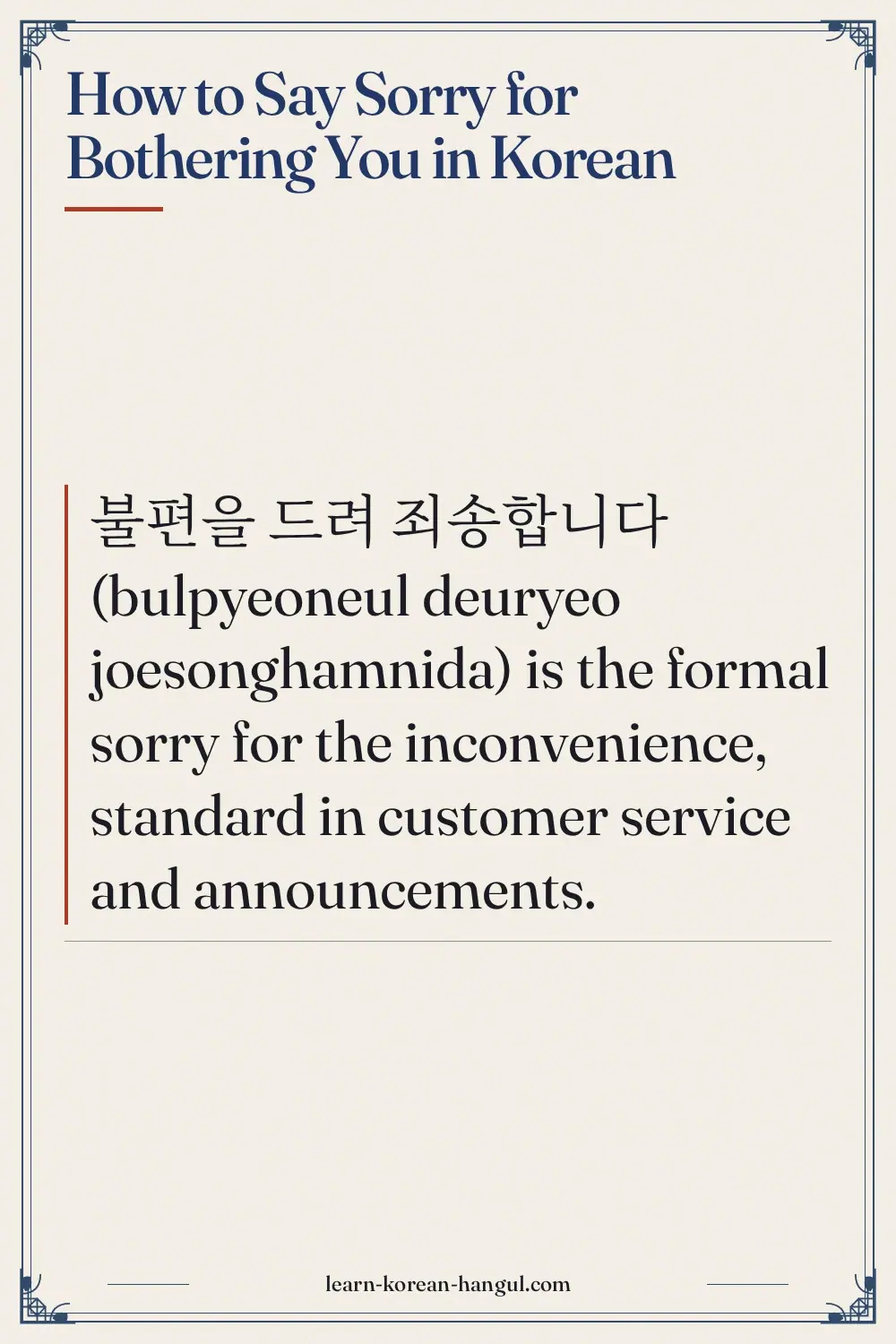
불편을 드려 죄송합니다
불편을 드려 죄송합니다
What you'll learn
- Separate three kinds of trouble: inconvenience, interruption and a small favour.
- Choose a formal, polite or casual way to apologise for each.
- Pronounce 불편을 as [불펴늘] and 귀찮게 as [귀찬케].
- Open a request politely with 바쁘신데 죄송합니다.
Before you start: knowing sorry in Korean helps, because every phrase here builds on 죄송합니다. Time: about 12 minutes. Audio plays only when you press a button.
Key facts
- 방해해서 죄송합니다 means sorry for interrupting, and 귀찮게 해서 죄송해요 means sorry to bother you.
How Do You Say Sorry for Bothering You in Korean?
The standard way to say sorry for bothering you in Korean is 불편을 드려 죄송합니다, which literally means "I am sorry for giving you discomfort". It is formal, respectful and safe with strangers, customers and seniors.
| Kind of trouble | Korean | Romanization | Typical situation |
|---|---|---|---|
| Inconvenience | 불편을 드려 죄송합니다 | bulpyeoneul deuryeo joesonghamnida | Delays, errors, service problems |
| Interruption | 방해해서 죄송합니다 | banghaehaeseo joesonghamnida | Entering a meeting, cutting in |
| Small favour | 귀찮게 해서 죄송해요 | gwichanke haeseo joesonghaeyo | Asking a neighbour for help |
| Extra effort | 번거롭게 해서 죄송해요 | beongeoropge haeseo joesonghaeyo | Asking someone to make a trip |
| Burden | 폐를 끼쳐서 죄송합니다 | pyereul kkichyeoseo joesonghamnida | After staying at a host's home |
Each phrase has two parts. The first part names the trouble: 불편 (discomfort), 방해 (obstruction), 귀찮게 (making it a nuisance), 번거롭게 (making it complicated) or 폐 (burden). The second part is 죄송합니다 or 죄송해요, "I am sorry". The sections below show each in a sentence.
What Are the Formal, Polite and Casual Ways to Apologise?
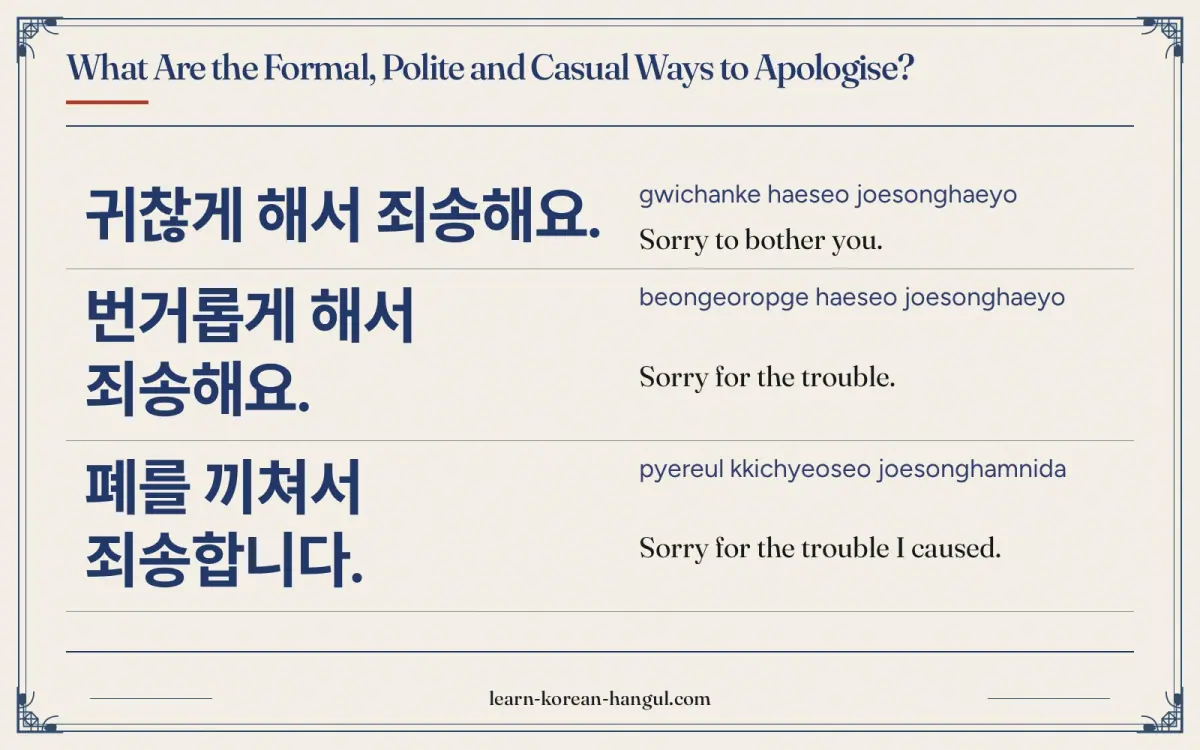
Korean changes the sentence ending to match the listener, a system called speech levels. The guide to Korean speech levels explains them in depth, and this page uses three: formal (합쇼체), polite (해요체) and casual (해체).
Formal: 불편을 드려 죄송합니다 (bulpyeoneul deuryeo joesonghamnida)
Formal · 합쇼체불편을 드려 죄송합니다 is the formal apology for causing inconvenience. 드리다 is the humble form of 주다 (to give), so the speaker lowers themselves. Shops, banks, airlines and public transport use it in announcements, often as 이용에 불편을 드려 죄송합니다 (sorry for the inconvenience in using the service).
이용에 불편을 드려 죄송합니다.
iyonge bulpyeoneul deuryeo joesonghamnida
Sorry for the inconvenience in using the service.
Formal: 방해해서 죄송합니다 (banghaehaeseo joesonghamnida)
Formal · 합쇼체방해해서 죄송합니다 means "I am sorry for interrupting". 방해하다 is "to disturb". It fits a meeting, a class, a private talk or someone's work time.
회의 중에 방해해서 죄송합니다.
hoeui junge banghaehaeseo joesonghamnida
Sorry for interrupting during the meeting.
Polite: 귀찮게 해서 죄송해요 (gwichanke haeseo joesonghaeyo)
Polite · 해요체귀찮게 해서 죄송해요 means "I'm sorry I made it a nuisance for you". It suits a neighbour, a classmate or a coworker of similar rank after a small request. 귀찮다 alone means "to feel too lazy" or "to be a nuisance", so avoid this wording with a boss and use 불편을 드려 instead.
귀찮게 해서 죄송해요.
gwichanke haeseo joesonghaeyo
Sorry to bother you.
Polite: 번거롭게 해서 죄송해요 (beongeoropge haeseo joesonghaeyo)
Polite · 해요체번거롭게 해서 죄송해요 means "sorry for making this troublesome". 번거롭다 describes extra steps or effort. Use it when you ask someone to carry, send, fill in or travel for you.
번거롭게 해서 죄송해요.
beongeoropge haeseo joesonghaeyo
Sorry for the trouble.
Formal: 폐를 끼쳐서 죄송합니다 (pyereul kkichyeoseo joesonghamnida)
Formal · 합쇼체폐를 끼쳐서 죄송합니다 means "I am sorry for being a burden". 폐 is a Sino-Korean word for harm or burden, and 끼치다 means "to cause". It is common after staying with someone or after asking for a lot of help.
폐를 끼쳐서 죄송합니다.
pyereul kkichyeoseo joesonghamnida
Sorry for the trouble I caused.
Casual: 귀찮게 해서 미안해 (gwichanke haeseo mianhae)
Casual · 반말With friends, switch 죄송해요 to 미안해: 귀찮게 해서 미안해 means "sorry to bother you". Never use it with a teacher, a boss or an older stranger.
귀찮게 해서 미안해.
gwichanke haeseo mianhae
Sorry to bother you.
The formal 불편을 드려 죄송합니다 and the polite 번거롭게 해서 죄송해요 will cover most situations. Now the sounds.
How Do You Pronounce 불편을 드려 죄송합니다?
불편을 드려 죄송합니다 is pronounced [불펴늘 드려 죄송함니다], in ten syllables, with a linked ending in 불편을 and a nasal sound in 죄송합니다. Say it in four chunks.
- 불펴늘 (bul-pyeo-neul): the written 불편을 is read as bul-pyeo-neul.
- 드려 (deu-ryeo): "deu" with spread, unrounded lips (ㅡ), then "ryeo".
- 죄송 (joe-song): most speakers say 죄 like "jweh" (the standard also allows a single rounded vowel), then "song".
- 함니다 (ham-ni-da): the written 합니다 is read ham-ni-da.
Sound Changes to Listen For
Three rules explain the differences between spelling and sound.
- Liaison (연음). The ㄴ of 편 moves onto the empty ㅇ of 을, so 불편을 is [불펴늘]. See Korean liaison.
- Aspiration (격음화). In 귀찮게, the ㅎ combines with the ㄱ of 게 into a k sound, so it is said [귀찬케]. This is a rule of the National Institute of Korean Language Standard Pronunciation (표준 발음법).
- Nasalization (비음화). The ㅂ of 합 turns into ㅁ before ㄴ, so 죄송합니다 is said [죄송함니다]. See ㅂ-to-ㅁ nasalization.
With the sounds clear, the next skill is choosing when to apologise.
When Should You Use 불편을 드려 죄송합니다, and When Should You Not?
Use 불편을 드려 죄송합니다 when you or your organisation caused a problem for other people. Use 방해해서 죄송합니다 for interruptions and 귀찮게 해서 죄송해요 for small, friendly favours. Match the phrase to the trouble, not to the English sentence.
Situations Where It Fits
- A delay or error in service. 불편을 드려 죄송합니다.
- Cutting into a meeting. 방해해서 죄송합니다.
- Asking a neighbour to move a car. 귀찮게 해서 죄송해요.
- Opening a request to a senior. 바쁘신데 죄송합니다 (sorry to trouble you while you are busy).
Situations to Avoid
- A real mistake that hurt someone. Use 정말 죄송합니다, as in I'm very sorry in Korean.
- Squeezing past someone in a corridor. Use 잠시만요 or 실례합니다, as in excuse me in Korean.
- A boss with 귀찮게 해서. Use 불편을 드려 or 바쁘신데 죄송합니다.
Real exchanges show how the three kinds of trouble sound.
What Does Sorry for Bothering You Sound Like in a Real Conversation?
This apology usually opens or closes a request, so it comes with a short explanation or a polite reply.
A Late Phone Call
Caller
늦은 시간에 전화드려서 죄송합니다.
neujeun sigane jeonhwadeuryeoseo joesonghamnida
I'm sorry to call at such a late hour.
Receiver
아니에요, 괜찮습니다.
anieyo, gwaenchanseumnida
Not at all, it's fine.
What to notice: 전화드리다 is the humble way to say "to call" a senior, and the apology comes before the reason. The reply 괜찮습니다 is the formal it's fine, as in no problem in Korean.
A Faulty Product in a Shop
Shop Assistant
불편을 드려 죄송합니다. 바로 교환해 드리겠습니다.
bulpyeoneul deuryeo joesonghamnida. baro gyohwanhae deurigetseumnida
Sorry for the inconvenience. I will exchange it right away.
Customer
감사합니다.
gamsahamnida
Thank you.
What to notice: the staff member uses the formal apology and a humble verb, 드리겠습니다, and the customer replies with thanks, which links to thank you for your help in Korean.
Asking a Friend for Help
Minsu
귀찮게 해서 미안해.
gwichanke haeseo mianhae
Sorry to bother you.
Jia
아니야, 괜찮아. 뭐야?
aniya, gwaenchana. mwoya?
No, it's fine. What is it?
What to notice: friends use 미안해 and answer 아니야 (no, not at all). The question 뭐야? invites the request. These choices follow a Korean habit of apologising before asking.
What Should You Know about the Culture behind Sorry for Bothering You?
Koreans often apologise before they ask for something, especially to seniors or strangers. The apology is a sign of respect for the listener's time, not a sign that you did something wrong.
- Service apologies are routine. Staff and announcements use 불편을 드려 죄송합니다 for any delay or change, even small ones.
- Pre-request apologies. 바쁘신데 죄송합니다 (sorry to trouble you while you are busy) and 실례합니다 (excuse me) are standard openings.
- Hosts and guests. After a stay or a meal, guests often say 폐를 끼쳐서 죄송합니다 and hosts reply 아니에요 (not at all).
- Rank matters. The more senior the listener, the more formal the apology.
An expert insight: learners sometimes think these apologies mean someone is blaming themselves. They are social openings. A shop assistant saying 불편을 드려 죄송합니다 may simply be informing you of a policy. The mistakes below show how to avoid the wrong tone.
What Mistakes Do Learners Make with Sorry for Bothering You in Korean?
Most mistakes come from using 귀찮다 with the wrong listener or from using one phrase for every kind of trouble.
| Mistake | Why it is a problem | Fix |
|---|---|---|
| 귀찮게 해서 죄송합니다 to a boss | 귀찮다 can sound like "you are a nuisance" | Say 불편을 드려 죄송합니다 or 바쁘신데 죄송합니다 |
| 미안해 to a stranger | Casual speech is rude | Say 죄송합니다 |
| 방해해서 for a service delay | The verb means interrupting | Say 불편을 드려 |
| Reading 귀찮게 as "gwi-chan-ge" | The aspirated sound is missing | Say [귀찬케] |
| Starting a request with no apology | Sounds abrupt | Add 바쁘신데 죄송합니다 first |
Learners often assume 죄송합니다 always means a serious apology. Actually, in these phrases it works as a polite opener, so using it does not mean you did something wrong.
Is It the Same as Sorry to Bother You or Sorry for the Inconvenience?
Mostly yes. Each English variant maps to one form on this page. The short answers below cover the other searches folded into this page.
- Sorry for disturbing (you) in Korean: 방해해서 죄송합니다.
- Sorry to bother you in Korean: 귀찮게 해서 죄송해요, or 바쁘신데 죄송합니다 for a senior.
- Sorry for the inconvenience in Korean: 불편을 드려 죄송합니다.
- Sorry for the trouble in Korean: 번거롭게 해서 죄송해요 or 폐를 끼쳐서 죄송합니다.
The pattern holds across all of them: name the trouble, then add 죄송합니다 or 죄송해요. Now practise.
Practice: Say It Aloud
Play the slow clip of 불편을 드려 죄송합니다 three times, then say 귀찮게 해서 죄송해요. Choose a phrase for each situation. Answers follow.
- A train is delayed and you make the announcement.
- You walk into a manager's meeting by mistake.
- You ask your neighbour to take in a parcel.
- You stayed three nights at a host's home.
Answers
- 이용에 불편을 드려 죄송합니다.
- 방해해서 죄송합니다.
- 귀찮게 해서 죄송해요.
- 폐를 끼쳐서 죄송합니다.
The phrase flashcards drill these with audio.
Related Phrases to Learn Next
Apologising for trouble leads straight to attention-getting phrases and requests, so these are the natural next phrases.
- Excuse me in Korean: 실례합니다, 저기요 and 잠시만요.
- I'm very sorry in Korean: 정말 죄송합니다 for real mistakes.
- Thank you for your help in Korean: 도와주셔서 감사합니다.
This guide belongs to the polite Korean phrases collection. What this page does not cover: formal business apology emails and the full honorific system, which have their own lessons. Pick 불편을 드려 for an inconvenience, 방해해서 for an interruption and 귀찮게 해서 for a small request, and you can say sorry for bothering you in Korean to anyone.
Frequently Asked Questions
What does 귀찮다 mean on its own?
귀찮다 means to be bothersome or, for the speaker, to feel too lazy to do something. 귀찮아요 means I can't be bothered. In 귀찮게 해서 죄송해요, it means I made you feel bothered. It is polite with the right ending, but with a boss, 불편을 드려 or 바쁘신데 sounds more careful.
How do I apologise for a late phone call in Korean?
Say 늦은 시간에 전화드려서 죄송합니다 (sorry to call at such a late hour). 전화드리다 is the humble way to say to call a senior. For a text message, say 늦은 시간에 연락드려서 죄송합니다. Both openings show respect before you explain why you are contacting the person.
What is the difference between 폐를 끼쳐서 and 불편을 드려?
폐를 끼치다 means to put a burden on someone, usually a person who helped or hosted you. 불편을 드리다 means to cause inconvenience, usually through service or a shared problem. Use 폐를 끼쳐서 죄송합니다 after staying at a friend's home, and 불편을 드려 죄송합니다 after a delay or an error.
Can I say 미안해요 instead of 죄송해요 when I bother someone?
미안해요 is a softer sorry between people on equal terms, while 죄송해요 or 죄송합니다 is more respectful and fits a stranger or a senior. If you interrupt a coworker you know well, 미안해요 may work. If you interrupt a boss or a client, use 죄송합니다.
How do I apologise before asking a favour?
Start with 바쁘신데 죄송합니다 (sorry to trouble you while you are busy) or 번거롭게 해서 죄송해요 (sorry to make this trouble), then ask your question. You can also begin with 실례합니다, the polite excuse me. These openings prepare the listener and show that you value their time.