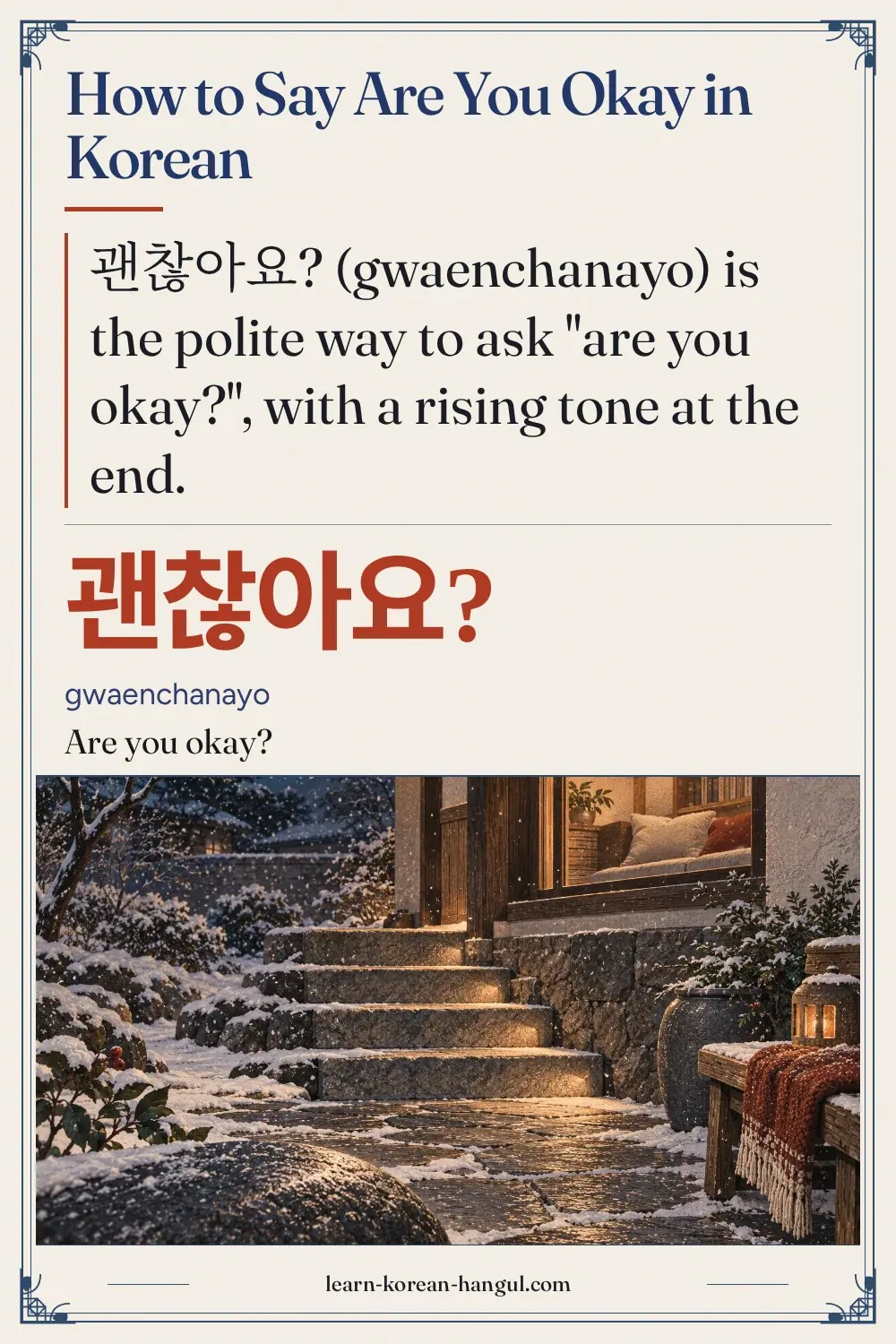
괜찮아요?
괜찮아요?
What you'll learn
- Ask are you okay with 괜찮아요?, 괜찮으세요? and 괜찮아?
- Ask whether someone is hurt with 다친 데 없어요?
- Use a rising tone so the phrase is a question and not a statement.
- Pronounce 괜찮아요 as [괜차나요] with a silent ㅎ.
Before you start: the lesson on Korean speech levels explains the three endings below. The same word is also the answer, as covered in it's okay in Korean. Time: about 14 minutes. Audio plays only when you press a button.
How Do You Say Are You Okay in Korean?
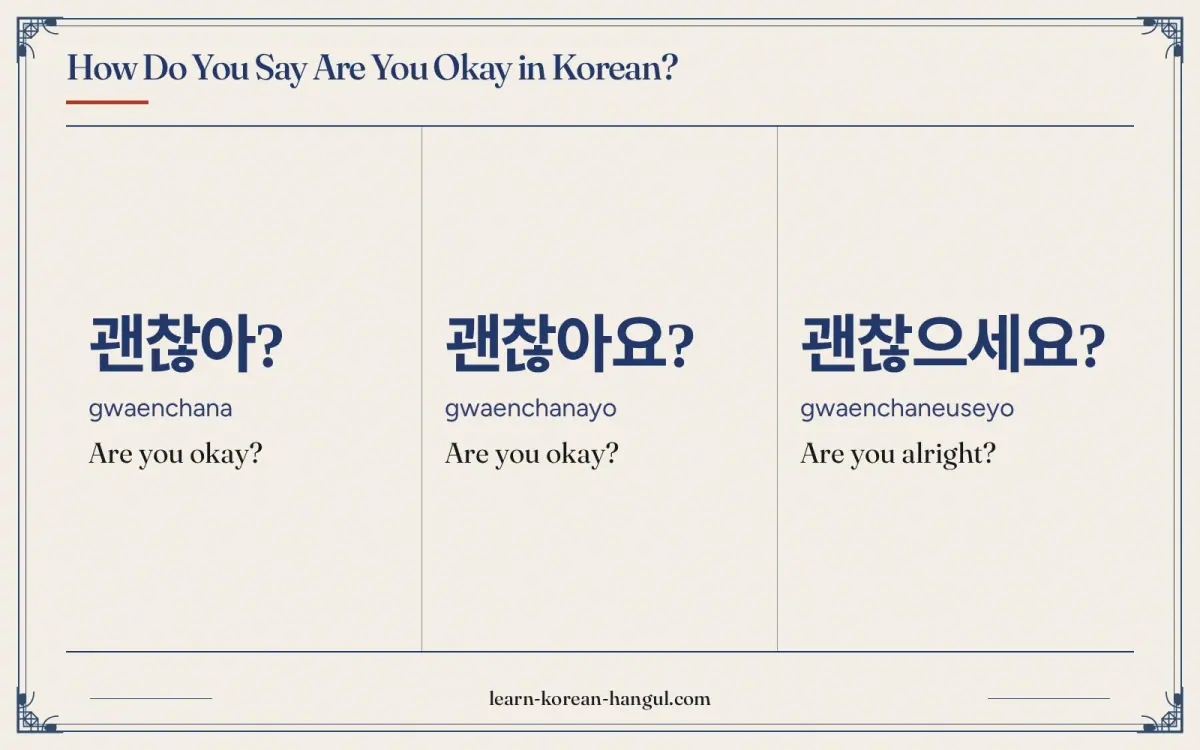
The standard way to say are you okay in Korean is 괜찮아요?, from the adjective 괜찮다 (to be all right, to be fine). The question uses the same word as the answer "I'm fine", so the rising tone is the only difference.
| Listener | Korean | Romanization | Meaning |
|---|---|---|---|
| Friend, sibling, younger person | 괜찮아? | gwaenchana | Are you okay? |
| Coworker, stranger your age | 괜찮아요? | gwaenchanayo | Are you okay? |
| Elder, customer, teacher | 괜찮으세요? | gwaenchaneuseyo | Are you alright? |
| After an accident | 다친 데 없어요? | dachin de eopseoyo | Are you hurt anywhere? |
Revised Romanization (the South Korean government standard of 2000) is only a reading aid here. Learn the Hangul first. The next section explains each form.
What Are the Polite and Casual Ways to Say Are You Okay?
Are you okay has four common forms, and the listener decides which one to use. The stem 괜찮- stays the same, while the ending and the honorific change.
Polite: 괜찮아요? (gwaenchanayo)
Polite · 해요체괜찮아요? is the default question. It is safe with coworkers, neighbours and strangers around your age. A caring tone and a concerned look make it sound sincere.
괜찮아요? 얼굴이 안 좋아 보여요.
gwaenchanayo? eolguri an joa boyeoyo
Are you okay? You look unwell.
Respectful: 괜찮으세요? (gwaenchaneuseyo)
Polite · 해요체괜찮으세요? adds the honorific -으시-, so the question respects the listener. Use it with elders, teachers, customers and anyone who looks clearly older. It is also the safest choice when you do not know the age of a stranger.
괜찮으세요? 많이 다치셨어요?
gwaenchaneuseyo? mani dachisyeosseoyo
Are you alright? Are you badly hurt?
Casual: 괜찮아? (gwaenchana)
Casual · 반말괜찮아? drops the polite -요. It is for friends, siblings, partners and children. The follow-up 무슨 일 있어? ("What's wrong?") invites the person to share more.
괜찮아? 무슨 일 있어?
gwaenchana? museun il isseo
Are you okay? What's wrong?
Polite: 다친 데 없어요? (dachin de eopseoyo)
Polite · 해요체다친 데 없어요? means "Is there anywhere you are hurt?" It fits after a fall, a collision or a spill. 다친 is the past modifier of 다치다 (to get hurt), and 데 means "place".
다친 데 없어요?
dachin de eopseoyo
Are you hurt anywhere?
Four forms cover most check-ins. The tone is the part learners miss, so the next section explains it.
How Do You Pronounce 괜찮아요?
괜찮아요? is pronounced [괜차나요], gwaen-cha-na-yo, in four syllables. The question mark in writing matches a rising pitch in speech.
- 괜 (gwaen): a soft "gw" gliding into "weh" and ending in n.
- 차 (cha): written 찮, but said "cha", because the ㄴ moves on and the ㅎ drops.
- 나 (na): the moved ㄴ joins 아 to form "na".
- 요 (yo): a short "yo", with the pitch rising for a question.
Sound Changes to Listen For
Three features shape this phrase:
- Silent ㅎ before a vowel. In the double final ㄶ, the ㅎ is silent before a vowel, and the ㄴ moves forward, so 괜찮아요 is [괜차나요] and 괜찮으세요 is [괜차느세요]. The rule is covered in the lesson on ㅎ weakening.
- Question intonation. In Korean, a polite -요 sentence becomes a question through a rising pitch on the last syllable. Written, it is the question mark.
- Casual form. 괜찮아? is [괜차나], with the rise on 나.
A flat 괜찮아요 sounds like the answer "I'm fine", so the rise is what turns it into a question. The right form also depends on who is listening.
How Do You Check on Someone Step by Step?
Checking on someone in Korean takes four steps, and following them keeps the question gentle. The steps work for strangers and friends.
- Ask the short question. Say 괜찮으세요? to an elder or 괜찮아요? to an adult peer. You will know it worked when the person looks at you and answers.
- Ask about injury if there was an accident. Say 다친 데 없어요? so the person can say where it hurts.
- Offer help. Add 도와드릴까요? ("Shall I help you?") or 병원에 가야 돼요? ("Do you need to go to the hospital?").
- Listen to the answer and respond. Accept a reply of 괜찮아요, but look at the person's face before you step away.
A common mistake at step 1 is asking in a flat tone, which sounds like a statement. Replies fall into a few patterns, listed below.
| Reply | Korean | Meaning |
|---|---|---|
| Fine | 네, 괜찮아요 | Yes, I'm fine |
| Slightly hurt | 좀 아파요 | It hurts a little |
| Needs help | 도와주세요 | Please help me |
| Tired | 좀 피곤해요 | I'm a bit tired |
| Not fine | 안 괜찮아요 | I'm not okay |
The replies show why one more question is sometimes needed. Next, think about when to ask and when not to.
When Should You Use 괜찮아요?, and When Should You Not?
Use 괜찮아요? when someone seems hurt, upset or unwell. Avoid it as a routine greeting, because Koreans do not ask it to mean "how are you?".
Situations Where It Fits
- Someone trips in front of you. 괜찮으세요?
- A friend looks tired or sad. 괜찮아? 무슨 일 있어?
- A coworker rubs their head after a bump. 괜찮아요? 다친 데 없어요?
- Someone coughs or looks pale. 괜찮으세요? 물 드릴까요?
Situations to Avoid
- As a greeting. The question for a plain hello is 잘 지내요? (how are you doing?), not 괜찮아요?
- Elders with 괜찮아요? Use the honorific 괜찮으세요?
- Strangers who are clearly fine. An unprompted 괜찮아요? can feel intrusive.
- A grieving person. 괜찮아요? can sound as if the loss were small. A quiet word of sympathy, or simply staying with the person, fits better.
Three short dialogues show how these questions sound.
What Does Are You Okay Sound Like in a Real Conversation?
괜찮아요? usually opens a short exchange of two or three lines. Listen for the rising tone on the question and the falling tone on the answer.
A Stranger Trips
Passer-By
어머, 괜찮으세요?
eomeo, gwaenchaneuseyo
Oh my, are you alright?
Man
네, 괜찮아요. 감사합니다.
ne, gwaenchanayo. gamsahamnida
Yes, I'm fine. Thank you.
What to notice: the rising 괜찮으세요? asks, and the falling 괜찮아요 answers.
A Friend Looks Tired
Ji-An
너 괜찮아? 얼굴이 안 좋아 보여.
neo gwaenchana? eolguri an joa boyeo
Are you okay? You look unwell.
Hyeon-U
좀 피곤해서 그래. 괜찮아.
jom pigonhaeseo geurae. gwaenchana
I'm just a bit tired. I'm fine.
What to notice: Ji-an names what she sees, and Hyeon-u gives a reason before saying he is fine.
After a Fall
Colleague
다친 데 없어요?
dachin de eopseoyo
Are you hurt anywhere?
Hana
무릎이 좀 아파요.
mureupi jom apayo
My knee hurts a little.
Colleague
병원 가야 돼요?
byeongwon gaya dwaeyo
Do you need to go to the hospital?
What to notice: the colleague asks a second, specific question, which moves the talk from feeling to action. That habit is part of the culture around the phrase.
What Should You Know about the Culture behind Are You Okay?
Koreans check on others quickly, and the question is a sign of care, not of nosiness.
- Strangers ask too. After a fall or a collision, passers-by often ask 괜찮으세요? and offer help, even if they do not know the person.
- Follow-up questions are normal. People may add 병원 가야 돼요? to see whether the person needs real help.
- The honorific is the default. When the age of a stranger is unknown, 괜찮으세요? is the safe choice.
- Not always a true answer. People may reply 괜찮아요 to avoid trouble, as explained on the page about it's okay in Korean. A second gentle question shows real concern.
An expert insight: the same words ask and answer. 괜찮아요? asks and 괜찮아요 replies, so listen for the pitch, not the vocabulary, when you are unsure which one you heard. The mistakes below come from this overlap.
What Mistakes Do Learners Make with Are You Okay in Korean?
Most are-you-okay mistakes come from tone and from the honorific.
| Mistake | Why it is a problem | Fix |
|---|---|---|
| Flat tone on 괜찮아요 | Sounds like "I'm fine" | Raise the last syllable |
| 괜찮아요? to an elder | Not respectful enough | Ask 괜찮으세요? |
| 괜찮아? to a stranger | Casual and abrupt | Ask 괜찮아요? or 괜찮으세요? |
| Saying [괜찮아요] with a sounded ㅎ | Misses the silent ㅎ | Say [괜차나요] |
| Using it as "how are you?" | Wrong meaning | Ask 잘 지내요? |
Learners often assume are you okay and I'm fine are two different phrases. Actually, they are the same words with different pitch, so the rise matters more than the vocabulary.
Is It the Same as Are You Ok, Are U Ok and Are You Alright?
Yes. "Are you ok", "are u ok", "you okay" and "are you alright" all lead to the same Korean question. The short answers below cover each search.
- Are you ok in Korean: 괜찮아요?, the same phrase with a shorter English spelling.
- Are u ok in Korean: the chat spelling of the same question; the Korean is unchanged.
- You okay in Korean: 괜찮아? in casual speech.
- Are you alright in Korean: 괜찮으세요? when you want to show respect.
- Are you sick in Korean: a different question, 아파요? (does it hurt?). See I'm sick in Korean.
Now practise the tone with your own voice.
Practice: Say It Aloud
Play the slow clip and repeat 괜찮아요? three times, raising the last syllable. Then choose the right question for each listener. Answers follow.
- A grandmother drops her bag on the street.
- Your friend looks sad at lunch.
- A coworker bumps into a door.
- How do you make 괜찮아요 a question?
Answers
- 괜찮으세요?
- 괜찮아? 무슨 일 있어?
- 괜찮아요? 다친 데 없어요?
- Raise the pitch on the last syllable.
The phrase flashcards drill these questions with audio.
Related Phrases to Learn Next
Are you okay connects to the phrases for answering and explaining.
- It's okay in Korean: the same word used to reassure and decline.
- I'm fine in Korean: how to answer a check-in.
- What happened in Korean: the follow-up after bad news.
This guide belongs to the Korean small talk collection. What this page does not cover: medical vocabulary and emergency phrases. Raise your tone, add the honorific for elders, and you can say are you okay in Korean with care.
Frequently Asked Questions
How do you say are you okay in Korean?
Say 괜찮아요? (gwaenchanayo) with a rising tone. To an elder or a stranger, say 괜찮으세요?, and to a friend, say 괜찮아? The same words become a statement ("I'm fine") when your voice falls, so the rising tone is what turns the phrase into a question.
How is 괜찮아요 pronounced?
Say gwaen-cha-na-yo, written [괜차나요]. The ㅎ in the double final ㄶ is silent before a vowel, and the ㄴ moves forward to start the third syllable. Raise your pitch on the last syllable to make it a question. For the honorific, 괜찮으세요 sounds like [괜차느세요].
What is the difference between 괜찮아요 and 괜찮으세요?
괜찮아요? is polite and neutral, while 괜찮으세요? adds the honorific -으시-, which shows respect to the person you ask. Use 괜찮으세요? with elders, teachers, customers and strangers who look older than you. With a peer or a younger person, 괜찮아요? is enough.
Is 괜찮아요? formal or casual?
괜찮아요? is polite but not formal. It suits coworkers, acquaintances and strangers around your age. The casual form is 괜찮아?, and the respectful form is 괜찮으세요?. In formal writing or an announcement, 괜찮으십니까? is the most formal version, though you will rarely need it.
What is the most common mistake with are you okay in Korean?
Saying 괜찮아요 with a flat or falling tone. Without the rise it sounds like "I'm fine", not "are you okay?". A second mistake is using 괜찮아요? with an elder, when the honorific 괜찮으세요? is expected. A third is pronouncing the silent ㅎ.