또 만나요
또 만나요
What you'll learn
- Say 또 만나요, 다시 만나요 and 곧 다시 만나요 and know how they differ.
- Pick the right form for a fan, a friend and a senior.
- Pronounce the tense ㄸ in 또 without a puff of air.
- Avoid the two common mistakes: promising too much to a stranger, and using casual 또 보자 upward.
Before you start: the forms below change with the listener, so a quick look at Korean speech levels helps. Time: about 10 minutes. Audio plays only when you press a button.
How Do You Say Let's Meet Again in Korean?
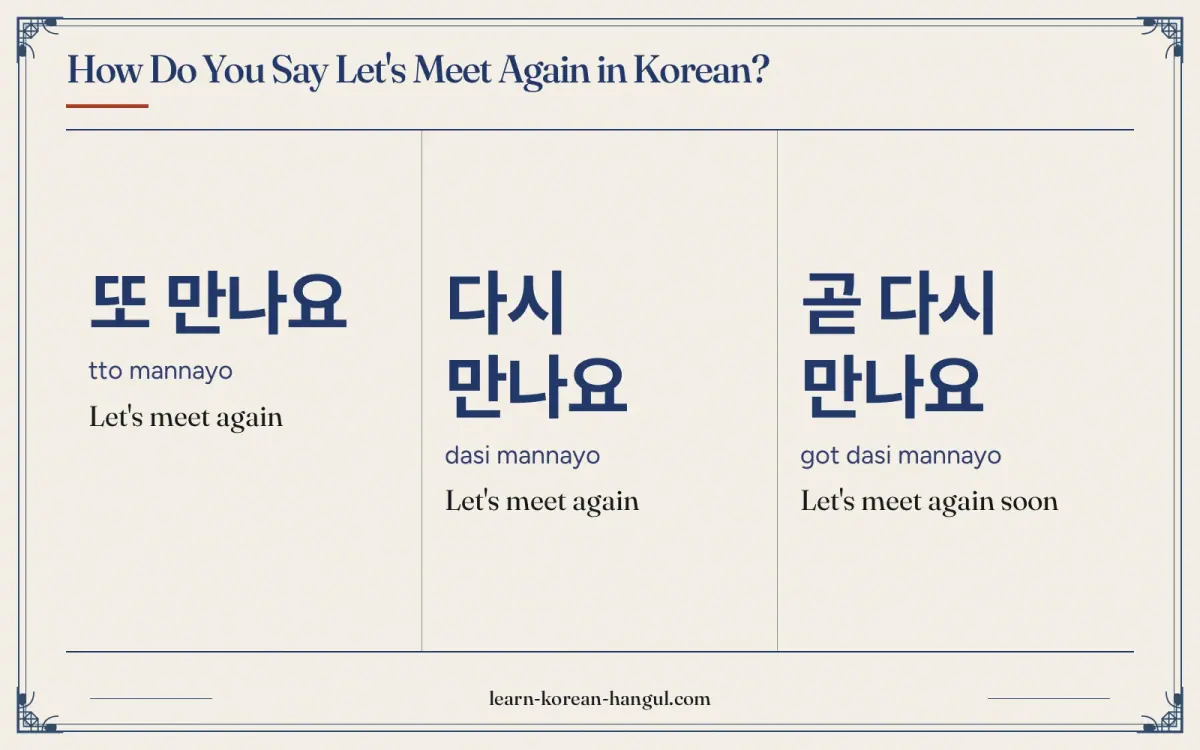
The most common answer is 또 만나요. It is made of three parts: 또 (tto, "again"), the verb 만나다 (mannada, "to meet") and the polite ending -요. In the polite style, the present form 만나요 works both as a statement ("we meet") and as a suggestion ("let's meet"). Context and a friendly tone tell the listener which one you mean, and the word 또 makes the suggestion clear.
| Korean | Romanization | Meaning | Style |
|---|---|---|---|
| 또 만나요 | tto mannayo | Let's meet again | Polite |
| 다시 만나요 | dasi mannayo | Let's meet again | Polite |
| 곧 다시 만나요 | got dasi mannayo | Let's meet again soon | Polite |
| 또 보자 | tto boja | See you again | Casual |
| 또 뵙겠습니다 | tto boepgetseumnida | I will see you again | Formal, respectful |
Revised Romanization (the South Korean government standard of 2000) is only a reading aid. Learn the Hangul first. The next section sorts these forms by listener.
What Are the Polite Ways to Say Let's Meet Again?
Korean has three polite options, and all of them use the -요 ending. They differ in tone, not in grammar. The casual and formal versions come after them.
Polite: 또 만나요 (tto mannayo)
Polite · 해요체Use 또 만나요 when you have enjoyed meeting someone and hope it happens again. 또 means "again" in the sense of "one more time, as before". It sounds friendly and light, and it asks for nothing fixed.
오늘 정말 즐거웠어요. 또 만나요.
oneul jeongmal jeulgeowosseoyo. tto mannayo
I really enjoyed today. Let's meet again.
Polite: 다시 만나요 (dasi mannayo)
Polite · 해요체다시 also means "again", but it often suggests starting over or meeting after a gap. Because of that, 다시 만나요 can sound a little wistful, like a goodbye before a long break. It fits a farewell message better than a casual chat.
다음 주에 다시 만나요.
daeum jue dasi mannayo
Let's meet again next week.
Polite: 곧 다시 만나요 (got dasi mannayo)
Polite · 해요체곧 means "soon". Adding it turns a hope into a near-term wish: "let's meet again soon". It is a warm choice when the next meeting really is close.
곧 다시 만나요. 기다릴게요.
got dasi mannayo. gidarilgeyo
Let's meet again soon. I'll be waiting.
Casual and Respectful Alternatives
With a friend your own age, drop -요 and use the casual suggestion ending -자: 또 보자 (tto boja, "see you again") or 또 만나자 (tto mannaja). To a teacher, a boss or an older relative, use the formal 또 뵙겠습니다 (tto boepgetseumnida), where 뵙다 is the humble verb for "to see". Do not turn 또 보자 into 또 보자요 to make it polite. Say 또 봐요 or 또 만나요 instead.
Casual · 반말 Formal · 합쇼체The three polite forms share a rhythm, so the main skill is the tense sound at the start. That is the next topic.
How Do You Pronounce 또 만나요?
또 만나요 has four syllables: 또 (tto), 만 (man), 나 (na) and 요 (yo). It is read as written: [또 만나요]. Nothing in the spelling changes in sound, so the challenge is the first consonant.
- 또: a tense ㄸ plus "oh". Press your tongue against the ridge behind your upper teeth, tighten your throat and release without a breath.
- 만: "man", with a clear ㄴ at the end.
- 나: "na", a light ㄴ plus "ah".
- 요: "yo", short and bright.
When 만 meets 나, the two ㄴ sounds sit side by side, so hold the ㄴ slightly longer: "man-na-yo". The vowel ㅏ is open, like "a" in "father".
Sound Changes to Listen For
There is no spelling change, but three sounds repay attention.
- Tense ㄸ, not plain ㄷ or aspirated ㅌ. Korean has three "t" sounds. The tense one is tight and silent in the breath. Korean tensification explains tense sounds in more depth.
- Long ㄴ. The double ㄴ in 만나요 is held a moment longer than a single ㄴ.
- 곧 다시. In 곧 다시 만나요, the final ㄷ sound of 곧 is a closed stop, and in everyday speech the 다 after it often sounds tense, close to [곧따시]. The standard spelling stays 곧 다시.
| Korean | Type | Sound |
|---|---|---|
| 도 | plain | soft, a little breath |
| 또 | tense | tight, no breath |
| 토 | aspirated | strong puff of air |
Hold a tissue in front of your mouth. It should move for 토, barely for 도, and not at all for 또. Once the sound is steady, you can choose the right form for the right person.
When Should You Use 또 만나요, and When Should You Not?
Use 또 만나요 when the meeting was pleasant and you honestly hope to repeat it. Do not use it as an empty farewell to people you do not intend to see.
Situations Where It Fits
- Closing a fan event or live stream. Idols and creators end with 또 만나요. Fans reply with the same line in the comments.
- Leaving a new friend or an online acquaintance. It is warm and does not ask for a fixed date.
- Ending a lesson or a language exchange. A teacher or partner can say 다음 주에 또 만나요 ("let's meet again next week").
Situations to Avoid
- A stranger you just met. 또 만나요 can sound like a promise or an invitation. A neutral 안녕히 가세요 or 수고하세요 is safer.
- A senior or an older stranger, in casual form. 또 보자 is too familiar. Use 또 뵙겠습니다 or 또 뵐게요.
- Business situations. Prefer 다음에 또 뵙겠습니다 ("I hope to see you again next time").
- When you do not mean it. In Korean, repeating 또 suggests a real hope, so use goodbye in Korean for a plain farewell.
Two short dialogues show the phrase in context.
What Does Let's Meet Again Sound Like in a Real Conversation?
The first scene is the end of a fan meeting, and the second is two friends leaving a restaurant.
After a Fan Meeting
Idol
오늘 팬 미팅 정말 좋았어요.
oneul paen miting jeongmal joasseoyo
Today's fan meeting was really great.
Fan
저도요! 또 만나요!
jeodoyo! tto mannayo
For me too! Let's meet again!
What to notice: the fan answers 저도요 ("me too") and then repeats the same 또 만나요. Echoing the phrase is a friendly habit in Korean farewells.
Two Friends after Dinner
Ji-Ho
오늘 재미있었다. 또 보자!
oneul jaemiisseotda. tto boja
That was fun today. See you again!
Da-In
응, 다음 주에 또 만나자.
eung, daeum jue tto mannaja
Yes, let's meet again next week.
What to notice: both friends use the casual -자 ending, with no -요. The same words with -요 would suit a new acquaintance. Now consider where this phrase comes from.
What Should You Know about the Culture behind Let's Meet Again?
Korean farewells often point to the future instead of ending the conversation. That is why 또 is so common at the end of an event.
- Idol closing lines. Idols and streamers end meetings and broadcasts with 또 만나요, and fans often post the same words at the end of a concert. The repeated 또 carries the hope of a future meeting, not a fixed plan.
- Hope, not a calendar entry. Unlike a phrase with a date, 또 만나요 does not need an answer or a time. If you want to arrange a meeting, add one: 다음 주에 또 만나요.
- Softer than a plain goodbye. Koreans often use 또 or 다음에 ("next time") to leave the door open, even after a first meeting.
- Online communities. In comment sections you will see 또 만나요 under farewell posts, with the exact feeling of "see you in the next video".
An expert insight: the same two syllables 만나 appear in 만나서 반갑습니다 ("nice to meet you"). Learners who know that greeting already know the verb they need here. The mistakes below come from stretching 또 만나요 too far.
What Mistakes Do Learners Make with Let's Meet Again in Korean?
Most errors concern the listener and the level, not the grammar.
| Mistake | Why it is a problem | Fix |
|---|---|---|
| Using 또 만나요 to a stranger you just met | It can sound like a promise | Say 안녕히 가세요, or add a clear plan |
| Using 또 보자 to a senior | The casual ending is too familiar | Say 또 뵙겠습니다 |
| Saying 도 만나요 or 토 만나요 | The wrong "t" sound changes the word | Keep a tense ㄸ with no breath |
| Writing 또 만나자요 to be polite | Mixing casual -자 with -요 is not standard | Use 또 만나요 or 또 만나자 |
| Treating 다시 and 또 as always identical | 다시 can sound like a fresh start | Use 또 for a repeat, 다시 for a farewell |
Many learners also try to use 만나요 for "meet" in every sense. It means to meet someone by plan or chance, but not to be introduced. For a first meeting, use nice to meet you in Korean. The English phrase has more than one Korean version, as the next section shows.
Is It the Same as Meet Again?
Yes. "Let's meet again" and "meet again in Korean" lead to the same phrases, and the right answer depends on tone.
- Meet again, polite: 또 만나요 or 다시 만나요.
- Meet again soon: 곧 다시 만나요.
- Meet again, with friends: 또 보자 or 또 만나자.
- Meet again, respectfully: 또 뵙겠습니다.
- See you soon, a lighter version: see you soon in Korean.
If you only remember one, remember 또 만나요. It is safe with almost every listener except a stranger or a superior in the casual form.
Practice: Say It Aloud
Play the slow clip and repeat 또 만나요 three times, keeping the first sound tight. Then choose a form for each situation. Answers follow.
- You are signing off a live stream for fans.
- You are saying goodbye to a classmate your age.
- You are leaving your manager after a meeting.
- You hope to see a friend again in a few days.
Answers
- 또 만나요.
- 또 보자.
- 또 뵙겠습니다.
- 곧 다시 만나요.
The phrase flashcards drill these goodbyes with audio.
Related Phrases to Learn Next
Let's meet again sits beside the other farewell and fan phrases.
- Saranghae in Korean: the most famous fan phrase and its polite forms.
- See you soon in Korean: a lighter way to say goodbye for the near future.
- Goodbye in Korean: the two goodbyes, for the person leaving and for the person staying.
This guide belongs to the kpop Korean phrases collection. What this page does not cover: how to arrange a meeting with a date and place, or the full set of farewell phrases for work. Say 또 만나요 when you mean it, and you can say let's meet again in Korean with the right warmth.
Frequently Asked Questions
How do you say let's meet again in Korean?
Say 또 만나요 (tto mannayo). It joins 또 (again) and 만나요 (let's meet, in the polite style). For a gentler farewell use 다시 만나요, and for a near-term plan use 곧 다시 만나요. With a close friend your age, drop the -요 and say 또 보자.
How do you pronounce 또 만나요?
Say it as written: tto-man-na-yo, four syllables, [또 만나요]. The first sound is a tense ㄸ, so tighten your throat and release it without a puff of air. Hold the ㄴ of 만나 for a moment, and keep the vowel ㅏ open. Play the slow clip and repeat after it.
What is the difference between 또 만나요 and 다시 만나요?
Both mean "let's meet again" and both are polite. 또 suggests one more time, as before, so it sounds light and friendly. 다시 can suggest starting again or meeting after a gap, so it often feels a little more wistful. In daily use they are close enough to swap.
Can I use 또 만나요 with friends, elders and strangers?
It works well with friends in the polite style and with fans and online acquaintances. With friends your own age, 또 보자 is more natural. To an older person or a superior, use 또 뵙겠습니다. With a stranger it can sound like a promise, so a plain 안녕히 가세요 is safer.
What is the most common mistake with let's meet again in Korean?
The most common mistake is the wrong level: casual 또 보자 to a senior, or 또 만나요 to a stranger. The second is the sound, because 또 is read as 도 or 토. Keep the first consonant tense and unaspirated, and choose the form by the listener.