
천만에요
천만에요
What you'll learn
- Reply to thanks with 아니에요, 천만에요, 별말씀을요 or 아니야 according to the listener.
- Explain why 아니에요 is more common than 천만에요.
- Pronounce 천만에요 as [천마네요].
- Tell the reply "you're welcome" apart from the greeting "welcome".
Before you start: learn thank you in Korean first, because every form on this page answers 감사합니다 or 고마워요. Time: about 12 minutes. Audio plays only when you press a button.
How Do You Say You're Welcome in Korean?
The dictionary way to say you're welcome in Korean is 천만에요, but the natural everyday reply is 아니에요. Both are polite. The difference is tone: 천만에요 sounds like a textbook, while 아니에요 sounds like a person.
| Who thanks you | Natural reply | Romanization | Literal meaning |
|---|---|---|---|
| A stranger or acquaintance | 아니에요 | anieyo | It's not (anything) |
| Someone, in a slightly formal tone | 천만에요 | cheonmaneyo | Not at all |
| A senior or elder | 별말씀을요 | byeolmalsseumeuryo | (You say) such special words |
| A close friend | 아니야 | aniya | Nah, it's nothing |
| Anyone, after a small favour | 별거 아니에요 | byeolgeo anieyo | It's nothing big |
천만에요 is built on 천만 (千萬), literally "ten million"; 천만에 means "by no means", and the full formal phrase is 천만의 말씀입니다, roughly "thanks is not needed at all". 아니에요 is simply the polite form of 아니다 (to not be). The next section shows each form at work.
What Are the Formal, Polite and Casual Ways to Say You're Welcome?
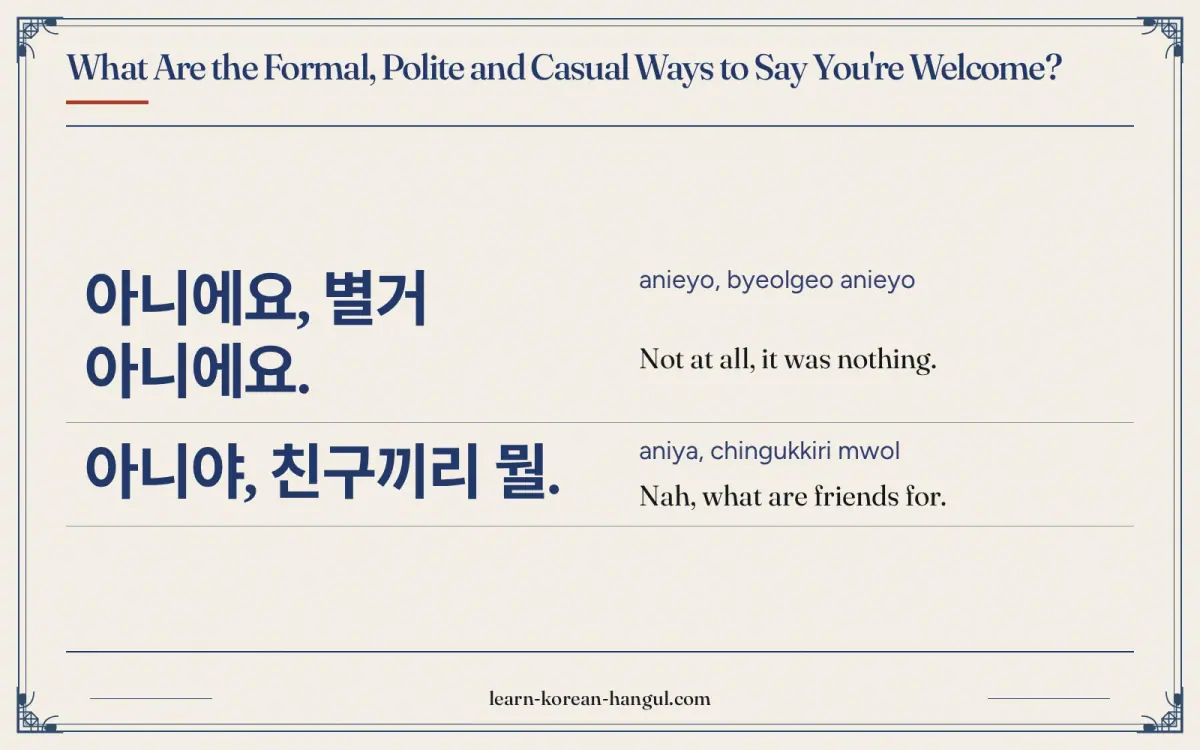
You're welcome follows the Korean speech levels, the endings that change with the listener, explained in the guide to Korean speech levels. The reply should match the level of the thanks you received.
Polite: 천만에요 (cheonmaneyo)
Polite · 해요체천만에요 is correct, polite and widely taught. It fits when someone thanks you warmly and you want a clear, slightly formal reply, for example after giving directions to a tourist. Used for every small thanks, it can sound scripted.
천만에요. 즐거운 여행 되세요.
cheonmaneyo. jeulgeoun yeohaeng doeseyo
You're welcome. Have a nice trip.
The fully formal version is 천만의 말씀입니다 (cheonmanui malsseumimnida), heard in speeches and formal service.
Polite: 아니에요 (anieyo)
Polite · 해요체아니에요 means "it's not (anything)" and is the reply you will hear most. It often comes with 괜찮아요 or a small wave of the hand: 아니에요, 괜찮아요. The meaning of 괜찮아요 is explained in it's okay in Korean.
아니에요, 별거 아니에요.
anieyo, byeolgeo anieyo
Not at all, it was nothing.
Formal: 별말씀을요 (byeolmalsseumeuryo)
Formal · 합쇼체별말씀을요 literally means "(what) a special word", implying "you need not say such a thing". 말씀 is the honorific word for speech, so the phrase honours the person who thanked you. The ending -요 is the polite style; the formal, humble tone comes from 말씀. Use it when a teacher, a boss or an elder thanks you.
별말씀을요. 언제든지 말씀하세요.
byeolmalsseumeuryo. eonjedeunji malsseumhaseyo
Don't mention it. Ask me any time.
Casual: 아니야 (aniya)
Casual · 반말아니야 is the casual form of 아니에요, for close friends, siblings and people younger than you. 별거 아니야 (it was nothing big) is a common longer version.
아니야, 친구끼리 뭘.
aniya, chingukkiri mwol
Nah, what are friends for.
Four replies cover nearly every thank-you. The textbook one has a small sound change worth hearing.
How Do You Pronounce 천만에요?
천만에요 is pronounced [천마네요], cheon-ma-ne-yo, in four even syllables. The written ㄴ at the end of 만 moves forward to start the next syllable.
- 천 (cheon): an aspirated ch with a puff of air, then "uhn".
- 마 (ma): written 만; the ㄴ leaves this block.
- 네 (ne): the moved ㄴ joins 에 to make "neh".
- 요 (yo): short and level.
Sound Changes to Listen For
Three points shape these replies, following the National Institute of Korean Language Standard Pronunciation rules (표준 발음법):
- Liaison in 천만에요. A final consonant moves to an empty initial slot in the next syllable, so 만에 becomes [마네]. The rule is explained in Korean liaison.
- 에 and 예 sound alike. In 아니에요, the ending -에요 often sounds close to [예요] in fast speech. That is why many people misspell it 아니예요, even though the standard spelling is 아니에요.
- The particle 의 as [에]. In 천만의 말씀입니다, the standard pronunciation rules allow the particle 의 to be said [에] as well as [의], and [에] is what you usually hear: [천마네 말쓰밈니다].
Pronunciation is simple here. A bare reply can still feel short, so Koreans often add a second line.
What Can You Add after You're Welcome?
A one-word reply such as 아니에요 is complete, but a short follow-up makes it warmer. Koreans usually choose one of four follow-ups, depending on what the favour was.
- Offer more help: 언제든지 말씀하세요. "Ask me any time." Friends say 언제든지 말해. This fits a colleague or neighbour you may help again.
- Say you are glad: 도움이 돼서 다행이에요. "I'm glad it helped." This fits help with a problem, such as fixing a phone setting.
- Return the thanks: 제가 더 감사하죠. "I should be thanking you." This fits a host who thanks you for coming, or a client who thanks you for your work.
- Shrink the favour: 별거 아니에요. "It was nothing big." This fits small favours like holding a door or lending a pen.
아니에요. 도움이 돼서 다행이에요.
anieyo. doumi dwaeseo dahaengieyo
Not at all. I'm glad it helped.
Each follow-up keeps the focus away from your own effort, which is the point of a Korean reply to thanks. Choosing the main reply is still where learners slip most.
When Should You Use 천만에요, and When Should You Not?
Use 천만에요 when someone thanks you sincerely for a clear favour and you want a polite, slightly formal reply. Avoid it with close friends, with service thanks from staff, and for tiny favours, where 아니에요 sounds more natural.
Situations Where It Fits
- A tourist thanks you for directions. 천만에요 is clear and kind.
- A neighbour thanks you for carrying a parcel. 천만에요 or 아니에요.
- Formal events. After a host thanks a speaker, 천만에요 or 천만의 말씀입니다 fits.
Situations to Avoid
- A close friend says 고마워. Reply 아니야.
- A cashier says 감사합니다. Answer 감사합니다 back or nod.
- A boss or elder thanks you. 별말씀을요 or 아니에요 is humbler than 천만에요.
- Every small thanks. Repeating 천만에요 sounds like a phrasebook; mix in 아니에요.
The conversations below show the replies in natural exchanges.
What Does You're Welcome Sound Like in a Real Conversation?
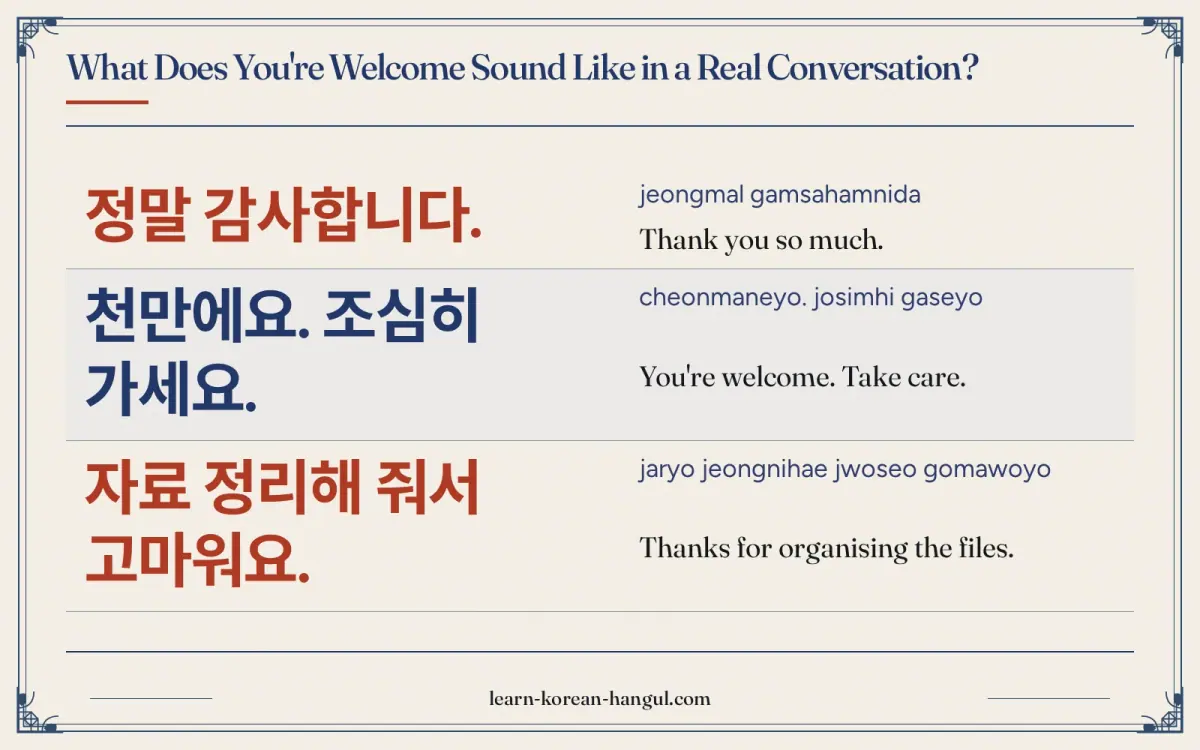
A thanks-and-reply exchange in Korean usually ends with the helper playing down the favour. Listen for how each reply makes the help sound small.
Giving Directions
Tourist
정말 감사합니다.
jeongmal gamsahamnida
Thank you so much.
Local
천만에요. 조심히 가세요.
cheonmaneyo. josimhi gaseyo
You're welcome. Take care.
What to notice: the reply adds a send-off, 조심히 가세요 (take care).
A Manager Thanks You
Manager
자료 정리해 줘서 고마워요.
jaryo jeongnihae jwoseo gomawoyo
Thanks for organising the files.
Employee
아니에요, 별말씀을요.
anieyo, byeolmalsseumeuryo
Not at all, don't mention it.
What to notice: the junior combines 아니에요 and 별말씀을요 to be extra humble.
A Friend Says Thanks
Jisoo
태워 줘서 고마워.
taewo jwoseo gomawo
Thanks for the ride.
Mark
아니야. 다음에 커피 사.
aniya. daeume keopi sa
No problem. Buy me a coffee next time.
What to notice: a joking request is a friendly way to wave thanks away. That habit of deflection is the key cultural point.
What Should You Know about the Culture behind You're Welcome?
Korean replies to thanks usually deflect rather than accept, because accepting thanks directly can sound like claiming credit.
- Playing it down. Replies like 아니에요 (it's nothing) and 별거 아니에요 (it was nothing big) shrink the favour.
- Returning the thanks. 제가 더 감사하죠 (I should be thanking you) turns the thanks back to the speaker.
- Service is different. Staff and customers exchange 감사합니다 both ways; no one says you're welcome.
- Gesture. A small wave of the hand or a nod often replaces words entirely.
An expert insight: learners trained on textbooks often say 천만에요 dozens of times a day. Switching to 아니에요 for small thanks is one of the quickest ways to sound less like a phrasebook and more like a resident.
What Mistakes Do Learners Make with You're Welcome in Korean?
Most you're welcome mistakes come from using the textbook phrase everywhere or confusing reply and greeting.
| Mistake | Why it is a problem | Fix |
|---|---|---|
| Saying 천만에요 to every thanks | Sounds scripted | Use 아니에요 for small favours |
| Saying 천만에요 to a cashier | Service thanks needs no reply | Say 감사합니다 or nod |
| Saying 아니야 to a boss | Casual ending | Say 아니에요 or 별말씀을요 |
| Using 어서 오세요 as "you're welcome" | That is the welcome greeting | Use 아니에요 |
| Writing 아니예요 | Nonstandard spelling | Write 아니에요 |
Learners often assume 아니에요 sounds rude because it literally means "no". Actually, in reply to thanks, 아니에요 is the warmest and most natural answer, because it says the favour was nothing.
Are Youre Welcome and Your Welcome the Same Phrase?
Yes. "You're welcome", "youre welcome", "your welcome" and "you are welcome" are all the same reply, and in Korean all are 천만에요 or 아니에요. The short answers below cover the other searches folded into this page.
- Welcome reply in Korean: 아니에요 (everyday) or 천만에요 (textbook).
- You're welcome formal in Korean: 천만의 말씀입니다 or 별말씀을요.
- No problem reply in Korean: 아니에요, 괜찮아요, or casual 아니야; more options are on no problem in Korean.
Now practise choosing the reply aloud.
Practice: Say It Aloud
Play the slow clip of 천만에요 three times, then 아니에요 and 아니야. Then choose a reply. Answers follow.
- A tourist thanks you for taking their photo.
- Your professor thanks you for handing out papers.
- Your roommate says 고마워 for washing the dishes.
- Is 아니에요 rude as a reply to thanks?
Answers
- 천만에요, or 아니에요.
- 아니에요, or 별말씀을요.
- 아니야.
- No. It means "it's nothing" and is the most common reply.
The phrase flashcards pair each thank-you with its natural reply, with audio.
Related Phrases to Learn Next
You're welcome closes the exchange that thank you opens, so the next phrases are its neighbours.
- Thank you in Korean: the five thank-you forms these replies answer.
- No problem in Korean: 문제없어요 and other relaxed replies.
- Please in Korean: 주세요, the request that starts many of these exchanges.
This guide belongs to the polite Korean phrases collection. What this page does not cover: replying to compliments, which has its own deflection patterns, and formal speech-making. Deflect rather than accept, reach for 아니에요 first, and you can say you're welcome in Korean the way Koreans actually do.
Frequently Asked Questions
How do you say my pleasure in Korean?
Korean has no exact equivalent, but 제가 더 감사하죠 (I should be thanking you) or 도움이 됐다니 다행이에요 (I'm glad it helped) carry the same warmth. Service staff simply say 감사합니다 back. Between friends, 별거 아니야 (it was nothing) or a smile does the job.
How do you say welcome as in welcome to my shop in Korean?
That welcome is a different phrase. Shops and restaurants greet you with 어서 오세요 (come in, welcome), and events or signs use 환영합니다 (we welcome you). Neither replies to thanks. Use 아니에요 or 천만에요 only when someone has just said 감사합니다 or 고마워요 to you.
Is it 아니에요 or 아니예요?
The standard spelling is 아니에요. 아니 ends in a vowel, and the polite ending after the adjective 아니다 is -에요, so 아니예요 is a common but nonstandard spelling according to the National Institute of Korean Language. In speech, the two can sound almost the same, so the difference matters only when you write.
Do Koreans say you're welcome to service staff?
Usually not. When a waiter or clerk thanks a customer, the customer typically answers 감사합니다 back or just nods. Replying 천만에요 to a cashier would sound odd, because the thanks is a service formula rather than gratitude for a favour. Keep you're-welcome replies for real favours.
How do you reply to 고마워 from a friend?
Say 아니야 (no problem), 뭘 이런 걸로 (it's nothing, for something like this) or 별거 아니야 (it was nothing big). Close friends often reply with a joke or with 다음에 밥 사 (buy me a meal next time). The casual reply should match the casual thanks.