방 청소해 주세요
방 청소해 주세요
What you'll learn
- Say 방 청소해 주세요 aloud and ask hotel staff to clean your room.
- Ask for more towels with 수건 더 주세요 and report a problem with 에어컨이 안 돼요.
- Tell 청소 (cleaning) apart from 치우다 (to clear away) and 정리 (tidying).
- Know when to call the front desk and when to leave a card on the door.
Before you start: knowing check in in Korean helps, because you usually arrange cleaning when you arrive. Time: about 10 minutes. Audio plays only when you press a button.
How Do You Say Please Clean My Room in Korean?
The standard way to say please clean my room in Korean is 방 청소해 주세요. The noun 청소 (cheongso) means cleaning, and 청소하다 (cheongsohada) is the verb "to clean". Put 방 (room) in front so the staff know which space you mean. In a hotel, staff also hear the term 하우스키핑 (hauseukiping, housekeeping), a loanword, but 청소 is the plain word for the job.
| Form | Romanization | Register | Say it to |
|---|---|---|---|
| 방 청소해 주세요 | bang cheongsohae juseyo | Polite (해요체) | Front desk, housekeeping and hosts |
| 객실 청소 부탁드립니다 | gaeksil cheongso butakdeurimnida | Formal (합쇼체) | Written notes and requests to the desk |
| 수건 더 주세요 | sugeon deo juseyo | Polite (해요체) | Front desk and housekeeping |
| 에어컨이 안 돼요 | eeokeoni an dwaeyo | Polite (해요체) | Front desk, to report a fault |
| 청소해 줘 | cheongsohae jwo | Casual (해체) | Close friends and family at home |
Every form that you use with hotel staff is polite or formal. The next section takes the three most useful requests one by one.
What Are the Polite Ways to Say Please Clean My Room?
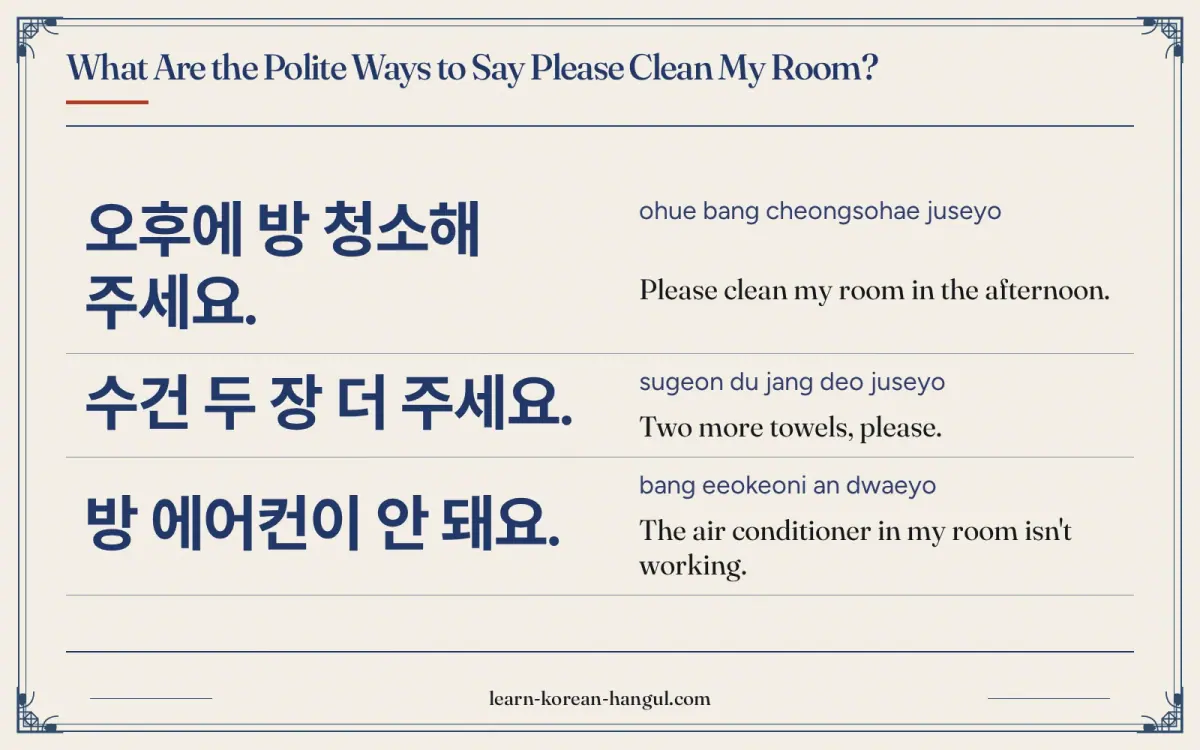
At a hotel the politeness level stays the same, so the choice depends on the job you want done. The speech levels are explained in the guide to Korean speech levels. Three requests cover most stays: cleaning, towels and a broken air conditioner.
Polite: 방 청소해 주세요 (bang cheongsohae juseyo)
Polite · 해요체방 청소해 주세요 asks someone to clean your room. It is made from 청소하다 (to clean) in its -어 form 청소해, plus 주세요 (please do it for me). Add a time before it if you want a particular hour, such as 오후에 (ohue, in the afternoon).
오후에 방 청소해 주세요.
ohue bang cheongsohae juseyo
Please clean my room in the afternoon.
Polite: 수건 더 주세요 (sugeon deo juseyo)
Polite · 해요체수건 (sugeon) means towel, 더 (deo) means more, and 주세요 means please give me. Use a counter to say how many. The counter for flat things such as towels and sheets is 장 (jang), and it takes native numbers: 한 장 (one), 두 장 (two).
수건 두 장 더 주세요.
sugeon du jang deo juseyo
Two more towels, please.
Polite: 에어컨이 안 돼요 (eeokeoni an dwaeyo)
Polite · 해요체안 돼요 literally means "it does not work out" and is the usual way to say that a machine is not working. The particle 이 marks 에어컨 (air conditioner) as the subject. Swap in another item to report other faults, such as 와이파이가 안 돼요 (the Wi-Fi isn't working).
방 에어컨이 안 돼요.
bang eeokeoni an dwaeyo
The air conditioner in my room isn't working.
Cleaning and complaints need clear sounds, so the pronunciation comes next.
How Do You Pronounce 방 청소해 주세요?
방 청소해 주세요 has seven syllables and is pronounced [방 청소해 주세요], bang cheongsohae juseyo. Say 방 as a short first word, then 청소해 and 주세요 as two smooth beats.
- 방 (bang): "bahng" with the ng sound at the end.
- 청 (cheong): a puffed "ch" and an open "uh" vowel, like "chuhng".
- 소 (so): "soh".
- 해 (hae): "heh" with a very light h.
- 주 (ju): a soft j and "oo".
- 세 (se): "seh".
- 요 (yo): "yoh".
Sound Changes to Listen For
Four details from the National Institute of Korean Language Standard Pronunciation Rules (표준 발음법) matter in these phrases.
- No change in 청소해. Nothing joins or tenses in 방 청소해, so each syllable keeps its spelling. The ㅎ in 해 is light between vowels, and you may hear it almost disappear in fast speech.
- Linking in 에어컨이. The final ㄴ of 컨 moves to the vowel 이, so 에어컨이 is pronounced [에어커니]. That is why the romanization is eeokeoni.
- Tense ㅆ in 객실. In the hotel term 객실 (room), the ㅅ becomes tense after the final ㄱ, so it is pronounced [객씰]. Revised Romanization writes gaeksil, with no tensing shown.
- ㅓ is open. In 청 and 더, the vowel ㅓ is an unrounded "uh", not the rounded "oh" of ㅗ. Saying "cheong" with a rounded mouth changes the word.
With the sounds clear, the next question is when to call and when to leave a note.
When Should You Use 방 청소해 주세요, and When Should You Not?
Use 방 청소해 주세요 when you want the room cleaned at a time you choose. Use 수건 더 주세요 for supplies and 에어컨이 안 돼요 for a fault. All three work by phone or in person.
Situations Where It Fits
- At the front desk. 방 청소해 주세요. (Please clean my room.)
- By room phone. 수건 더 주세요. (More towels, please.)
- A broken item. 에어컨이 안 돼요. (The air conditioner isn't working.)
- A rental host or guesthouse owner. 방 청소 시간 알려 주세요. (Please tell me the cleaning time.)
Situations to Avoid
- With 치워. 치워 is a casual order meaning "clear it away"; staff may find it rude.
- While you want privacy. If you do not want anyone to enter, say 방 청소 안 해도 돼요 (bang cheongso an haedo dwaeyo, no cleaning needed).
- For a lost item. Use help in Korean and say what is missing.
- For Wi-Fi trouble. Ask for the password with wifi password in Korean first.
Short scenes show how the requests sound at a real desk.
What Does Please Clean My Room Sound Like in a Real Conversation?
A hotel request has a greeting, a request and a short confirmation. Each scene below keeps the polite ending 요 or the formal 습니다.
Asking the Front Desk to Clean the Room
Guest
안녕하세요, 방 청소해 주세요.
annyeonghaseyo, bang cheongsohae juseyo
Hello, please clean my room.
Staff
네, 언제가 좋으세요?
ne, eonjega joeuseyo
Yes, when would suit you?
Guest
오후 두 시에 해 주세요.
ohu du sie hae juseyo
Please do it at two in the afternoon.
What to notice: the staff question uses 언제 (when), a wh-word, so it does not end with a sharp rise.
Asking for Extra Towels
Guest
수건 두 장 더 주세요.
sugeon du jang deo juseyo
Two more towels, please.
Staff
네, 바로 가져다 드릴게요.
ne, baro gajyeoda deurilgeyo
Yes, I'll bring them right away.
Guest
감사합니다.
gamsahamnida
Thank you.
What to notice: 드릴게요 is the humble form of giving, so the staff promise to bring the towels.
Reporting a Broken Air Conditioner
Guest
방 에어컨이 안 돼요.
bang eeokeoni an dwaeyo
The air conditioner in my room isn't working.
Staff
죄송합니다. 지금 확인해 보겠습니다.
joesonghamnida. jigeum hwaginhae bogetseumnida
I'm sorry. I'll check it now.
What to notice: the staff use the formal 확인해 보겠습니다 (I will check), which you can study in please check in Korean.
What Should You Know about the Culture behind Please Clean My Room?
Hotel service in Korea is polite and fast, and requests by phone are the norm.
- Front desk first. Housekeeping is usually arranged at the front desk or by the room phone, and 객실 청소 is the formal term hotels use.
- Policies vary. Some hotels clean every day, and others only on request or when you hang a card on the door, so ask at check-in.
- Small guesthouses. At a guesthouse or rental, the host often handles cleaning and may ask you to tell them a time.
- Tipping is not the custom. Staff do not expect a tip for cleaning, and a simple 감사합니다 is enough.
Learners often say the English word "clean" and hope staff understand. Some staff will, but 청소 is the word Korean hotels use for the service. If you learn only one noun for this job, learn 청소. The mistakes below show where the nearby words go wrong.
What Mistakes Do Learners Make with Please Clean My Room in Korean?
Most mistakes with please clean my room come from the verb choice and from counting towels.
| Mistake | Why it is a problem | Fix |
|---|---|---|
| Saying 치워 or 치워 줘 | It is a casual command meaning clear away | Say 청소해 주세요 |
| Saying 방 청소해요 only | It is a statement, "I clean the room" | Add 주세요 to make a request |
| Saying 수건 하나 더 only | It works, but it sounds blunt without 주세요 | Say 수건 하나 더 주세요 |
| Saying 에어컨 없어요 | It means there is no air conditioner | Say 에어컨이 안 돼요 |
| Saying 정리해 주세요 for cleaning | 정리 means tidy up, not clean | Use 청소해 주세요 |
Learners often assume that 안 돼요 means "not allowed" in every sentence. Actually, 안 돼요 can mean both "not allowed" and "does not work", and the object tells you which one it is. With a machine, it means the machine is not working.
Is It the Same as Towels?
The short answers below cover the other ways people search for this phrase.
- Towels in Korean: 수건 (sugeon), as in 수건 더 주세요.
- Clean room in Korean: 깨끗한 방 (kkaekkeutan bang) describes a clean room, while 방 청소 is the act of cleaning it.
- Housekeeping in Korean: 객실 청소 or the loanword 하우스키핑.
- Check in in Korean: see check in in Korean.
The related pages below continue the hotel vocabulary.
Related Phrases to Learn Next
Please clean my room sits beside the other lines you use during a stay.
- Check in in Korean: the first conversation at the desk.
- Wifi password in Korean: a request every guest makes.
- Help in Korean: for urgent problems.
This guide belongs to the Korean hotel phrases collection. What this page does not cover: booking a room, late checkout and complaints about noise. Say 방 청소해 주세요, name the thing you need, and you can say please clean my room in Korean at any hotel.
Practice: Say It Aloud
Play the slow clip of 방 청소해 주세요 and repeat it three times, then try 수건 더 주세요 and 에어컨이 안 돼요. Then choose the phrase for each case. Answers follow.
- You come back from the beach and the room is still dirty.
- You need three more towels for your family.
- The air conditioner shows no light.
- You want the room cleaned while you are out at lunch.
Answers
- 방 청소해 주세요.
- 수건 세 장 더 주세요.
- 에어컨이 안 돼요.
- 점심 먹는 동안 방 청소해 주세요.
The phrase flashcards drill the hotel requests with audio.
Frequently Asked Questions
How do you say please clean my room in Korean?
Say 방 청소해 주세요 (bang cheongsohae juseyo). The phrase is polite and works with front-desk staff, housekeepers and hosts. Add a time, such as 오후에, if you want a specific hour. Staff may also use the formal word 객실 청소 for the same service.
How do you pronounce 방 청소해 주세요?
Pronounce it [방 청소해 주세요]. It has seven syllables, and nothing is tensed or linked. The ㅎ in 해 is light, and ㅓ in 청 is an open "uh". The Revised Romanization is bang cheongsohae juseyo.
What is the difference between 방 청소해 주세요 and 수건 더 주세요?
방 청소해 주세요 asks for a service: someone cleans the room. 수건 더 주세요 asks for an object: extra towels. Both are polite requests that end in 주세요. Add a number and the counter 장 for towels, as in 수건 두 장 더 주세요.
Can I use 방 청소해 주세요 with friends, elders and strangers?
Yes with strangers, staff and elders, because it is polite. With a close friend or family member at home, the casual 청소해 줘 is fine. Avoid the bare command 치워 with staff, since it sounds rude.
What is the most common mistake with please clean my room in Korean?
The most common mistake is using 치워, a casual command that means "clear it away", instead of the polite request 청소해 주세요. A second mistake is dropping 주세요, because 방 청소해요 is a statement, "I clean the room", not a request.