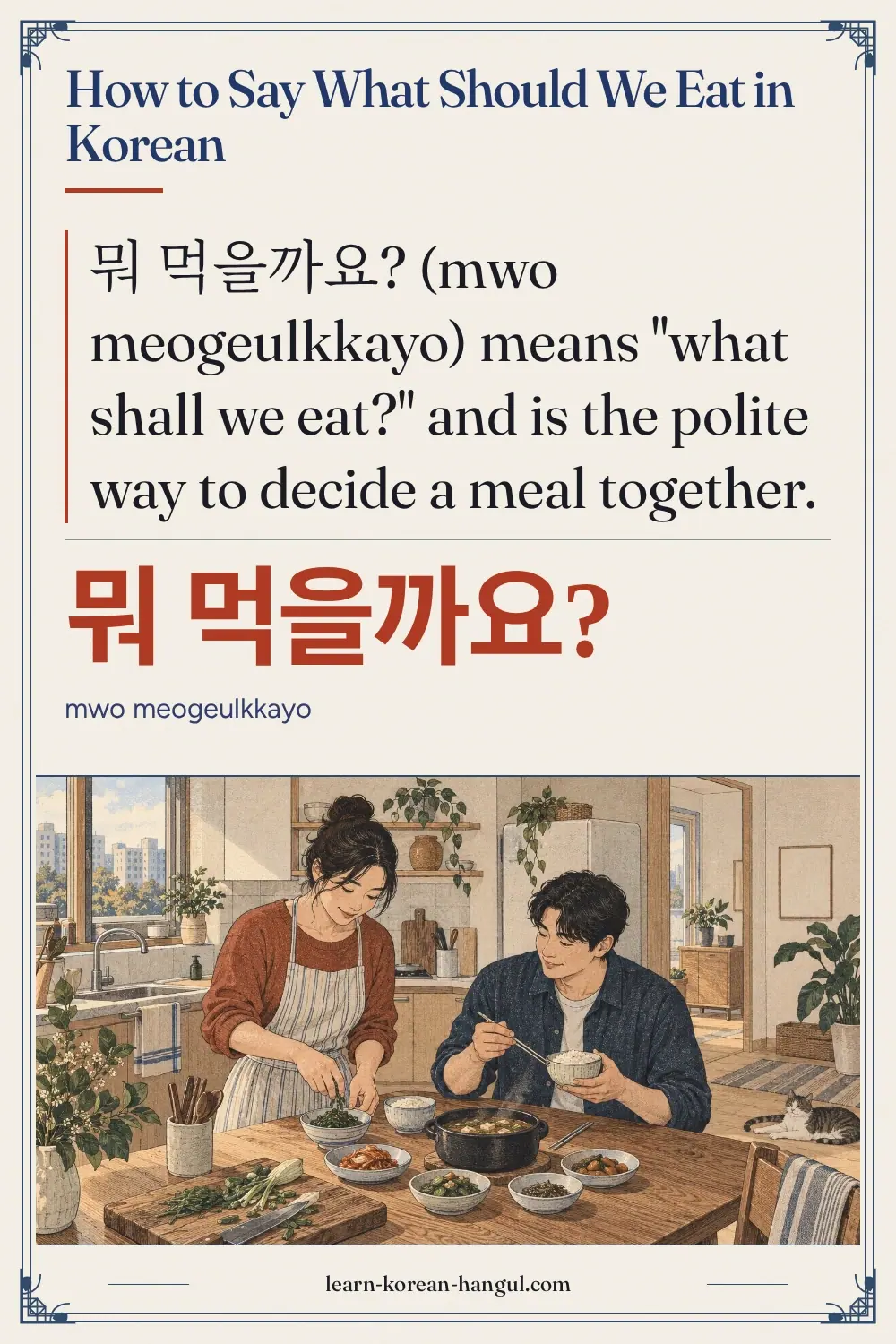
뭐 먹을까요?
뭐 먹을까요?
What you'll learn
- Say 뭐 먹을까요? aloud as [뭐 머글까요], with the linking ㄱ and a tense ㄲ.
- Choose between 뭐 먹을까요?, 뭐 먹고 싶어요? and 뭐 먹을래? for a colleague, an elder and a friend.
- Reply with 아무거나 괜찮아요 (anything is fine) or a suggestion.
- Avoid 뭐 먹어요?, which asks what you eat.
Before you start: you need to read Hangul; romanization is shown as an aid and can be hidden. Time: about 9 minutes. Audio plays only when you press a button.
How Do You Say What Should We Eat in Korean?
The most natural way to decide a meal together is 뭐 먹을까요?. It joins 뭐 (what), 먹다 (to eat) and -(으)ㄹ까요 (shall we?). Four forms cover the question and the common reply.
| Form | Romanization | Register | Say it to |
|---|---|---|---|
| 뭐 먹을까요? | mwo meogeulkkayo | Polite (해요체) | Colleagues, classmates, people you eat with |
| 뭐 먹고 싶어요? | mwo meokgo sipeoyo | Polite (해요체) | Guests, friends, dates, anyone whose wish matters |
| 뭐 먹을래? | mwo meogeullae | Casual (반말) | Close friends and people younger than you |
| 아무거나 괜찮아요 | amugeona gwaenchanayo | Polite reply (해요체) | Your reply when someone asks what to eat |
The table lists the choices. The next section shows when each one fits.
What Are the Polite and Casual Ways to Say What Should We Eat?
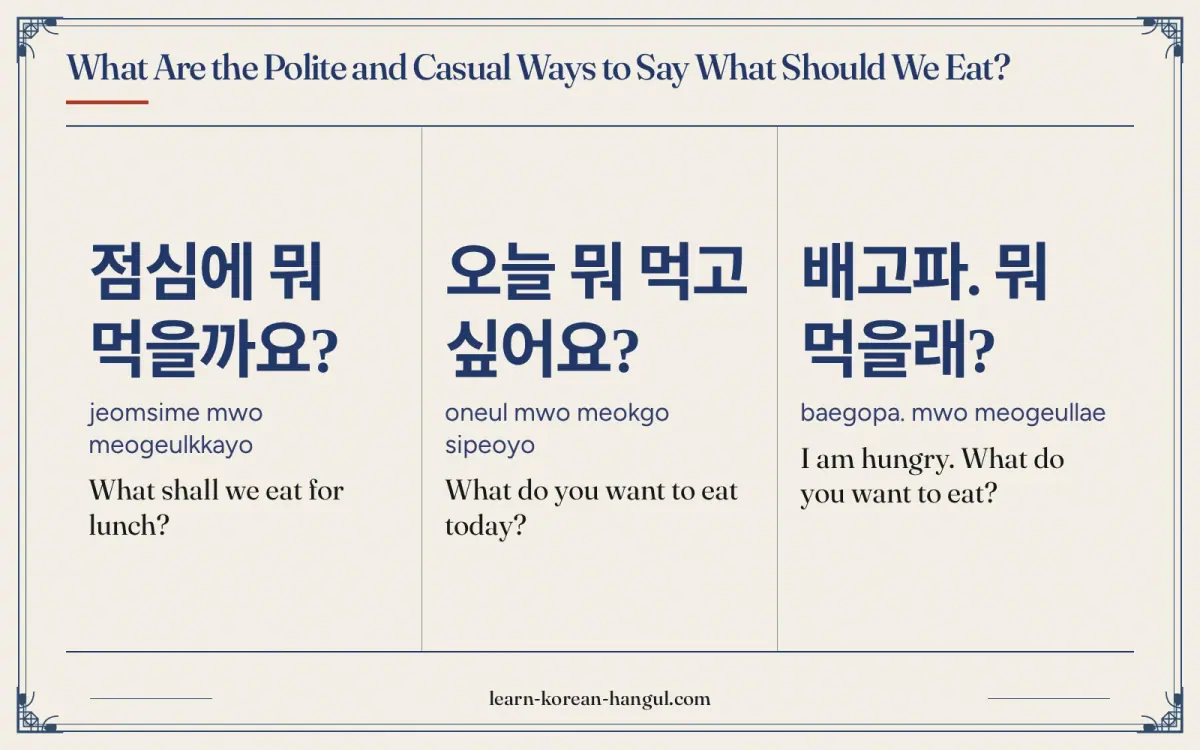
Korean changes the sentence ending to match the listener's age, status and closeness. These endings are called speech levels, and the guide to Korean speech levels explains them in full. With an older person, use the honorific verb 드시다 (to eat, honorific): 뭐 드실래요? (mwo deusillaeyo). With a close friend, drop -요. The four lines below are the core set.
Polite: 뭐 먹을까요? (mwo meogeulkkayo)
Polite · 해요체뭐 먹을까요? is the standard question when two or more people decide together. The stem 먹- takes -을까요, which turns a statement into a suggestion: "shall we eat what?". It is the natural form for "what shall we do" questions.
점심에 뭐 먹을까요?
jeomsime mwo meogeulkkayo
What shall we eat for lunch?
Polite: 뭐 먹고 싶어요? (mwo meokgo sipeoyo)
Polite · 해요체뭐 먹고 싶어요? asks what the other person wants. 먹고 싶다 means "to want to eat", so the question is about their wish, not a joint plan. It is a kind choice when you are the host or the one treating.
오늘 뭐 먹고 싶어요?
oneul mwo meokgo sipeoyo
What do you want to eat today?
Casual: 뭐 먹을래? (mwo meogeullae)
Casual · 반말뭐 먹을래? is the casual form of 먹을래요? (will you eat?). It drops the polite ending and asks what the friend feels like eating. Use it only with close friends, siblings and younger people.
배고파. 뭐 먹을래?
baegopa. mwo meogeullae
I am hungry. What do you want to eat?
Polite: 아무거나 괜찮아요 (amugeona gwaenchanayo)
Polite · 해요체아무거나 means "anything" and 괜찮아요 means "it is fine". Together they leave the decision to the other person. It is a polite reply, but say it only sometimes: if you always say it, the other person has to choose every time.
저는 아무거나 괜찮아요.
jeoneun amugeona gwaenchanayo
Anything is fine for me.
Four lines cover the question and the reply. Saying the main question cleanly comes next.
How Do You Pronounce 뭐 먹을까요?
뭐 먹을까요? is written with five syllables and spoken as [뭐 머글까요], mwo meogeulkkayo. The spelling and the sound differ, so say it slowly once.
- 뭐 (mwo): a short "mwuh"; the ㅓ part is open and not rounded
- 먹 (meo-): the final ㄱ moves forward onto the next syllable
- 을 (-geul): the moved ㄱ lands here, so you say "geul" with an unrounded ㅡ
- 까 (kka): a tense "kka", said with a tight throat and no puff of air
- 요 (yo): "yoh"; the question word 뭐 marks the question, so the end falls or rises and then falls
Sound Changes to Listen For
Three points matter here, from the National Institute of Korean Language Standard Pronunciation (표준 발음법) and everyday speech.
- Liaison in 먹을. The ㄱ of 먹 moves onto the vowel of 을, so you hear [머글]. See liaison (resyllabification).
- Tense kk. The 까 in -(으)ㄹ까요 is written with a tense consonant, so Revised Romanization shows kk: meogeulkkayo. By contrast, -(으)ㄹ래 has a plain ㄹ래, so 먹을래 is [머글래], meogeullae, with no tense sound.
- Tensing in 먹고 싶어요. The ㄱ of 먹 and the ㄱ of 고 meet, and the second one turns tense: [먹꼬 시퍼요]. Revised Romanization does not show this tensing, so it writes meokgo sipeoyo. See Korean tensification. The ㅍ in 싶어요 is spelled, not changed: [시퍼요].
With the sounds set, the next question is who to ask.
When Should You Use 뭐 먹을까요?, and When Should You Not?
Ask 뭐 먹을까요? whenever you eat with someone and nobody has decided. Ask 뭐 먹고 싶어요? when you want to put their wish first.
Situations Where It Fits
- Lunch with colleagues. 점심 뭐 먹을까요? is the classic office question.
- A meal with a friend. 뭐 먹을래? is quick and natural.
- Hosting a guest. 뭐 먹고 싶어요? puts the guest first.
- Replying to a suggestion. Say 아무거나 괜찮아요 when you truly do not mind.
Situations to Avoid
- Using 뭐 먹어요? It asks what you eat, not what you should eat.
- Using 뭐 먹을래? with an elder. Switch to 뭐 드실래요?.
- Answering 아무거나 every time. Offer one idea, such as 비빔밥 어때요? (how about bibimbap?).
These choices are easier to feel in real exchanges, so here are three.
What Does What Should We Eat Sound Like in a Real Conversation?
A meal-planning exchange is short. One person asks, the other suggests or leaves the choice.
Office Lunch
Jisu
점심 뭐 먹을까요?
jeomsim mwo meogeulkkayo
What shall we eat for lunch?
Hyun
김치찌개 어때요?
kimchijjigae eottaeyo
How about kimchi stew?
What to notice: Hyun answers with a suggestion and 어때요? (how about it?), which keeps the talk moving.
Lunch with a Senior
Junior
부장님, 뭐 드실래요?
bujangnim, mwo deusillaeyo
Sir, what would you like to eat?
Boss
나는 아무거나 괜찮아요. 골라 보세요.
naneun amugeona gwaenchanayo. golla boseyo
Anything is fine for me. Try choosing.
What to notice: the junior uses the honorific 드실래요, and the boss hands the choice back.
Friends
Soyeon
배고파. 뭐 먹을래?
baegopa. mwo meogeullae
I am hungry. What do you want to eat?
Dami
치킨 먹을까?
chikin meogeulkka
Shall we have fried chicken?
What to notice: Dami answers with a casual -을까? suggestion, a typical move among friends.
Behind these lines sits some food culture worth knowing.
What Should You Know about the Culture behind What Should We Eat?
In Korea, meals are often shared, so deciding what to eat is part of the social moment.
- Group decisions. Colleagues often choose a lunch place together, so 뭐 먹을까요? is heard every day around noon.
- Shared dishes. Many Korean dishes are made for sharing, so the question often means "what should we all order?".
- Leaving it to others. 아무거나 is polite, but a concrete idea helps the group more than a shrug.
- Hosts and guests. The person treating often asks 뭐 먹고 싶어요? so the guest chooses.
An expert tip: -(으)ㄹ까요 does two jobs. With 우리 (we) it suggests, as in 뭐 먹을까요? (what shall we eat?). With 저 (I) it offers, as in 제가 도와줄까요? (shall I help?). The context, not the ending, tells you which one. This page covers deciding a meal. Ordering at the restaurant is on separate pages.
What Mistakes Do Learners Make with What Should We Eat in Korean?
Most mistakes come from the verb ending and the sound changes.
| Mistake | Why it is a problem | Fix |
|---|---|---|
| Saying 뭐 먹어요? | It asks what you eat in general | Say 뭐 먹을까요? |
| Saying 뭐 먹을래? to an elder | The casual ending is too familiar | Say 뭐 드실래요? |
| Stopping after 먹, as [먹 을까요] | The ㄱ should move onto 을 | Say [머글까요] |
| Saying 까 with a plain k | The ㄲ is tense | Tighten the throat for [까] |
| Replying only 아무거나 | It leaves all the work to the other person | Add an idea: 비빔밥 어때요? |
Learners often think 먹을까요 and 먹을래요 are the same. -(으)ㄹ까요 suggests "shall we?", while -(으)ㄹ래요 asks what you want. Pick the first for a joint plan and the second for a personal wish.
Is It the Same as What to Eat, What Do You Want to Eat or Lunch Plans?
Partly. The short answers below cover the other ways people search for this phrase.
- What to eat in Korean: to ask yourself, say 뭐 먹지? (mwo meokji), pronounced [뭐 먹찌].
- What do you want to eat in Korean: 뭐 먹고 싶어요? (polite) or 뭐 먹고 싶어? (casual).
- Lunch plans in Korean: to ask if someone is free, say 점심 약속 있어요? (jeomsim yaksok isseoyo, do you have lunch plans?). To plan, say 점심 뭐 먹을까요?.
Reading the forms is one thing; producing them on cue is another, so practise now.
Practice: Say It Aloud
Play the slow clip of 뭐 먹을까요?, repeat it three times, then choose a form for each situation. Answers follow.
- You are deciding lunch with a colleague.
- You are asking a close friend.
- You are asking your boss.
- Why does 먹을까요 sound like [머글까요]?
Answers
- 뭐 먹을까요?
- 뭐 먹을래?
- 뭐 드실래요?
- The ㄱ of 먹 moves onto the vowel of 을 (liaison).
The phrase flashcards drill all four lines with audio.
Related Phrases to Learn Next
Deciding a meal sits with the other eating phrases.
- Let's eat together in Korean: the invitation that comes before this question.
- Did you eat in Korean: a common greeting about meals.
- Delicious in Korean: the word to say once the food arrives.
This guide belongs to the korean small talk collection. What this page does not cover: ordering and restaurant manners. When in doubt, ask 뭐 먹을까요?, and you can ask what should we eat in Korean to almost anyone.
Frequently Asked Questions
How do you say what should we eat in Korean?
Say 뭐 먹을까요? (mwo meogeulkkayo) for "what shall we eat?". Ask 뭐 먹고 싶어요? to ask what the other person wants. With a close friend, say 뭐 먹을래?. For an older person, use 뭐 드실래요?.
How do you pronounce 뭐 먹을까요?
It is [뭐 머글까요]. The ㄱ of 먹 moves onto 을, and 까 is a tense consonant. Revised Romanization writes mwo meogeulkkayo. The end falls or rises and then falls, because 뭐 is a question word.
What is the difference between 뭐 먹을까요? and 뭐 먹고 싶어요?
뭐 먹을까요? suggests a joint decision: "what shall we eat?". 뭐 먹고 싶어요? asks about the other person's wish. Use the first with colleagues and the second when you are the host.
Is 뭐 먹을까요? formal or casual?
It is polite, in the 해요체 style. It fits colleagues and acquaintances. For friends use 뭐 먹을까?, and for elders use 뭐 드실까요? or 뭐 드실래요?.
Can I use 뭐 먹을까요? with friends, elders and strangers?
Yes with colleagues, strangers and most elders, because -요 is polite. With close friends, drop it. With an older person, the honorific 뭐 드실래요? shows extra respect.
What is the most common mistake with what should we eat in Korean?
The most common mistake is using 뭐 먹어요?, which asks what you eat. The second is replying 아무거나 every time. Offer an idea such as 비빔밥 어때요? so the group can decide.